


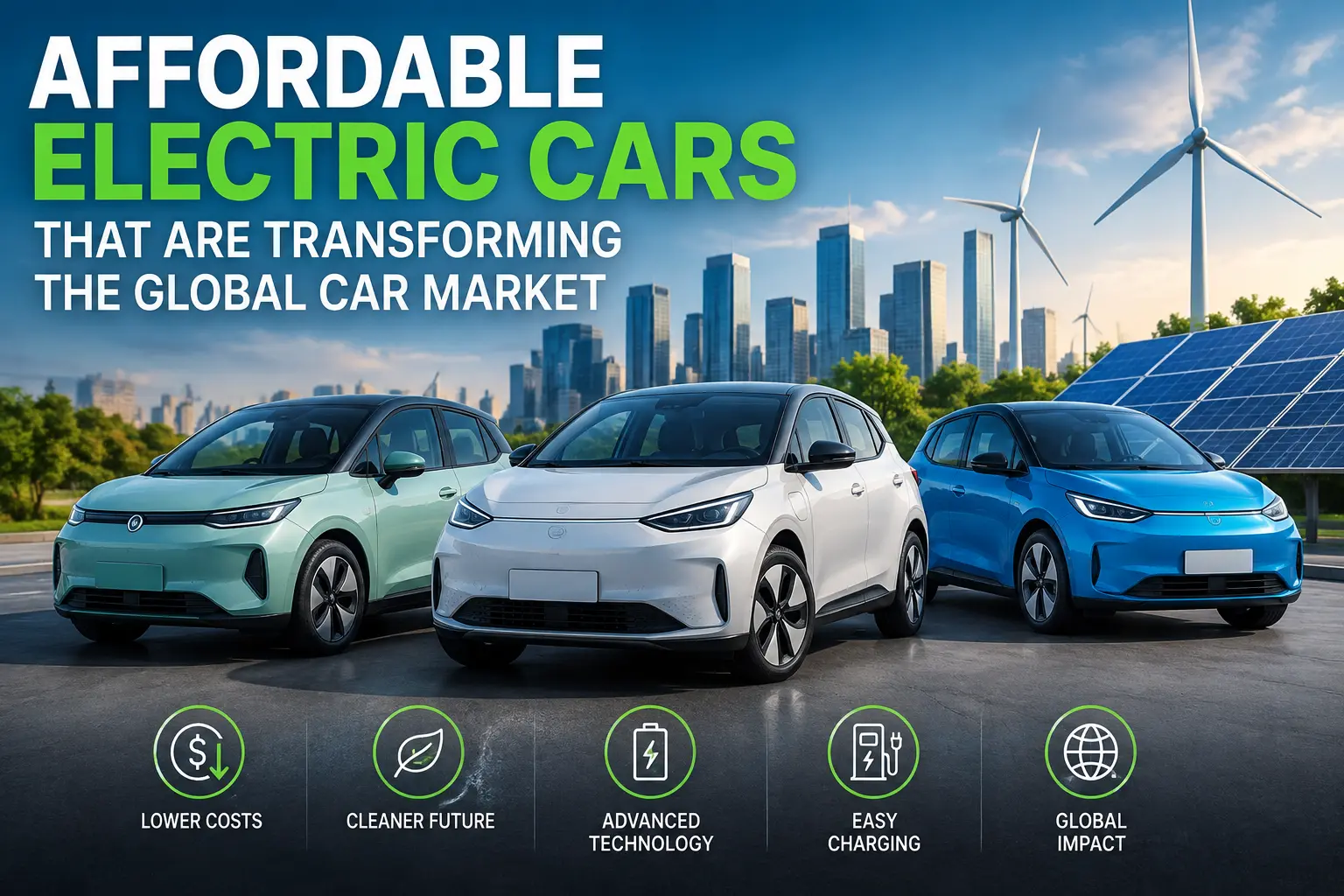
Affordable electric cars are becoming increasingly important to the future of the global automotive industry. What was once largely associated with expensive technology and premium vehicles is gradually becoming accessible to a much wider range of buyers as battery costs fall, manufacturers increase production and competition intensifies.
The global shift toward electric mobility is also no longer limited to a handful of early-adopting markets. Electric cars accounted for around one-quarter of new-car sales globally in 2025, with approximately 21 million electric cars sold during the year.
This growth is helping transform the role of affordable electric cars in the automotive market. Manufacturers are increasingly focusing on lower-cost platforms, efficient batteries and mass-market models that can appeal to buyers looking for practical transportation rather than expensive technology showcases.
But affordability is about more than the sticker price. Battery costs, charging expenses, maintenance, range, government policies and manufacturing scale all influence whether an electric vehicle is genuinely affordable for everyday drivers.
In this article, we look at why affordable EVs are becoming increasingly important, what is driving their lower costs and how they could reshape the global car market.
Why Affordable Electric Cars Are Transforming the Auto Industry
For many years, one of the biggest obstacles to EV adoption was the purchase price. Electric vehicles generally required more expensive batteries than conventional petrol or diesel cars, making it difficult for manufacturers to compete in the mass-market segment.
That situation is gradually changing.
The expansion of EV production has increased competition between manufacturers while improvements in battery technology and manufacturing efficiency have reduced costs. The International Energy Agency reports that average battery prices fell by 8% in 2025, while battery prices have declined substantially over the longer term as production has scaled up.
China has been particularly important in this transformation. In 2024, two-thirds of battery-electric cars sold in China were cheaper than comparable internal-combustion-engine vehicles, according to the IEA. Strong domestic competition and attractive pricing have continued to support rapid EV adoption in the country.
This is changing consumer expectations. As more manufacturers compete in the lower-priced segments, budget electric cars are becoming increasingly relevant to buyers who previously considered EVs too expensive.
Read More: Electric Cars vs Gas Cars
What Is Making Electric Cars More Affordable?
Several factors are contributing to the growing availability of affordable electric vehicles.
Falling Battery Costs
The battery is one of the most important components of an electric vehicle, making battery pricing a major factor in the final cost of an EV.
Battery manufacturing has become more efficient, while manufacturers have increasingly adopted chemistries that can reduce material costs.
In 2025, average battery prices declined by 8%, according to the IEA. Lithium iron phosphate (LFP) batteries also became increasingly important, accounting for more than 55% of global EV battery deployment during the year.
Lower battery costs can give manufacturers greater flexibility to build smaller and more affordable EVs without sacrificing the basic functionality required by everyday drivers.
Greater Manufacturing Scale
As electric cars move from niche products toward mass-market vehicles, manufacturers can produce larger numbers of vehicles using shared platforms, components and battery systems.
Higher production volumes can reduce manufacturing costs and allow companies to spread development expenses across more vehicles.
This is particularly important for mass-market electric cars, where even a relatively small reduction in production cost can have a significant effect on the final retail price.
Increasing Competition
The global EV market has become increasingly competitive.
Manufacturers are competing not only on performance and range but also on price, charging capability, technology, efficiency and ownership costs.
China has emerged as a particularly competitive EV market, with electric cars accounting for more than half of annual car sales in 2025. The IEA attributes much of this growth to intense domestic competition, attractive prices and a growing variety of models.
This competition is also putting pressure on manufacturers in other regions to improve their products and pricing.
China and the Rise of Low-Cost Electric Cars
China has played a major role in making low-cost electric cars more accessible.
The country’s large EV manufacturing ecosystem, extensive battery supply chain and intense competition have helped manufacturers develop vehicles across a broad range of prices and sizes.
The IEA reported that battery pack prices in China were about 30% lower than in North America and 35% lower than in Europe in 2025.
This cost advantage has important consequences beyond China because competitively priced Chinese electric vehicles and batteries are increasingly influencing other markets.
The growth of affordable models also demonstrates that EV adoption does not depend exclusively on expensive long-range vehicles. Smaller batteries, efficient platforms and practical vehicle sizes can make electric mobility more accessible to buyers with different budgets.
Affordable Electric Cars in Europe
Europe’s electric-car market has also expanded, although affordability remains more challenging in some countries than in China.
The price gap between electric and conventional vehicles has narrowed for some models, but EVs can still carry a higher upfront price in several European markets.
This makes the development of affordable EVs in Europe particularly important for wider adoption.
Manufacturers are increasingly introducing smaller electric cars and more cost-conscious platforms designed around urban and everyday driving. These vehicles do not necessarily need extremely large batteries because many buyers use them primarily for commuting, school runs, shopping and shorter journeys.
For this segment, an efficient vehicle with a moderate battery and convenient charging can be more useful than a much larger and more expensive EV.
Affordable Electric Cars in India
India represents another important market for affordable electric mobility.
The country’s price-sensitive automotive market means that affordability is particularly important for EV adoption. Buyers often consider purchase price, running costs, charging availability, range and long-term ownership expenses together rather than looking at technology alone.
This creates an opportunity for affordable electric cars in India that can offer practical range, manageable charging requirements and lower running costs without moving into premium pricing.
India’s EV market is also developing across multiple vehicle categories, with electric two-wheelers already playing an important role in the country’s transition toward electric mobility.
As battery technology improves and domestic manufacturing expands, the availability of more affordable electric vehicles could become increasingly important to India’s broader automotive market.
Electric Car Prices vs Ownership Costs
Looking only at electric car prices does not always provide a complete picture of affordability.
An EV may have a higher purchase price than a comparable petrol car while offering lower energy and maintenance costs over time.
Electric motors have fewer moving parts than conventional internal-combustion engines, and EVs generally do not require many of the routine engine-related services associated with petrol or diesel vehicles.
Charging costs can also be lower than the cost of purchasing petrol or diesel, particularly when the vehicle is charged at home.
The IEA estimates that home charging continues to provide running-cost savings compared with conventional vehicles in major EV markets, although the exact savings depend on local electricity and fuel prices.
This means buyers should consider electric car running costs alongside the initial purchase price when evaluating an EV.

Battery Technology Is Changing the EV Market
Battery technology is one of the biggest reasons the electric-car industry continues to evolve.
Modern EV batteries offer significantly greater energy density, improved charging capability and better manufacturing economics than earlier generations.
One of the most important developments has been the wider adoption of LFP battery technology.
LFP batteries can offer cost advantages compared with nickel-manganese-cobalt chemistries and have become particularly important in markets where manufacturers are focused on affordability. The IEA says LFP batteries represented more than half of EV battery deployment globally in 2025.
At the same time, research into sodium-ion batteries and other technologies could provide manufacturers with additional options for lower-cost vehicles in the future.
The result could be a broader range of battery technologies designed for different vehicle types and price points.
Range and Charging Still Matter
Price is only one part of the equation when choosing an EV.
Electric car range and charging availability remain important considerations, particularly for drivers who regularly travel long distances.
However, affordable electric cars do not necessarily need the largest batteries available.
A smaller, lighter vehicle designed primarily for urban use can operate effectively with a smaller battery because it does not need to carry the additional weight and cost of a very large pack.
This creates an opportunity for manufacturers to develop more efficient EVs that focus on practical everyday range rather than maximum range.
Charging infrastructure is equally important. A reasonably priced EV becomes much more useful when owners have convenient access to home, workplace or public charging.
The Role of Government Policies and Incentives
Government policies have played an important role in the growth of the electric vehicle market.
Purchase incentives, tax benefits, emissions regulations, charging infrastructure investment and manufacturing policies can all influence EV adoption.
However, the market is increasingly being influenced by economics as well.
The IEA notes that falling prices are becoming an increasingly important driver of EV adoption, alongside government policies.
This is an important development for the long-term future of electric mobility. If EVs become competitive based on price, operating costs and practicality rather than incentives alone, their adoption could become more resilient as individual government programmes change.
Why Affordable EVs Matter for Mass Adoption
The transition to electric mobility cannot depend entirely on luxury vehicles and high-performance EVs.
For electric cars to become genuinely mainstream, manufacturers need to offer products for ordinary households and everyday transportation needs.
That is why affordable EVs are so important.
A lower-cost electric car can introduce buyers to electric mobility who may not be interested in premium technology or extremely long driving ranges.
These vehicles can also be particularly useful in cities, where daily driving distances are often predictable and access to charging can be easier to manage.
The growth of affordable models therefore has the potential to move EVs from an emerging technology into a more normal part of the automotive market.
Challenges Facing Affordable Electric Cars
Despite the progress, several challenges remain.
Upfront Purchase Price
Even when battery prices fall, EVs can still be more expensive to purchase than comparable conventional vehicles in some markets.
Charging Infrastructure
Public charging availability varies considerably between countries and regions. Drivers without home charging can face greater inconvenience.
Battery Supply Chains
Battery production depends on complex global supply chains for minerals, components and manufacturing equipment.
Range Expectations
Consumers often expect an affordable EV to provide the same range as a much more expensive vehicle, which can increase battery size and therefore cost.
Market Differences
An EV that is affordable in one country may not be affordable in another because of taxes, import duties, exchange rates, manufacturing costs and local incentives.
These challenges mean that the path toward truly affordable electric cars will not be identical across every market.
Read More: The Future of Electric Vehicles
The Future of Affordable Electric Cars
The long-term direction of the market points toward greater choice.
Battery prices have continued to fall, manufacturing capacity has expanded and competition between EV manufacturers has intensified. The IEA reports that battery prices fell again in 2025 and that global electric-car sales reached around 21 million vehicles, demonstrating how quickly the technology has moved into the mainstream.
The next stage of the EV transition is likely to focus increasingly on cost efficiency.
Instead of simply making electric vehicles faster, larger or more technologically complex, manufacturers will need to make them easier to manufacture, cheaper to purchase and more efficient to operate.
That could lead to more compact EVs, smaller battery packs, lower-cost battery chemistries and simplified vehicle platforms.
If these trends continue, affordable electric cars could become one of the most important factors shaping the next phase of the global automotive industry.
Frequently Asked Questions About Affordable Electric Cars
Are affordable electric cars becoming more common?
Yes. Increasing competition, falling battery costs and growing manufacturing scale are helping manufacturers introduce more electric vehicles aimed at mass-market buyers.
Why are electric cars becoming cheaper?
Several factors contribute to lower costs, including battery manufacturing improvements, cheaper battery chemistries, larger production volumes, stronger competition and more efficient vehicle platforms.
Are affordable EVs cheaper to run than petrol cars?
They can be. Electricity and fuel prices vary by market, but EVs can benefit from lower energy and maintenance costs, particularly when they are charged at home.
Which factor has the biggest effect on electric car prices?
The battery is one of the most important cost components of an EV. Changes in battery chemistry, manufacturing efficiency and raw-material prices can therefore have a significant effect on vehicle costs.
Why is China important to affordable EVs?
China has a large EV manufacturing and battery ecosystem and intense competition between manufacturers. This has helped create a wide range of competitively priced electric vehicles and has influenced EV markets beyond China.
Are affordable electric cars suitable for long-distance travel?
That depends on the individual vehicle’s range, charging speed and the availability of charging infrastructure along the route. For drivers who mainly travel within cities or commute predictable distances, a smaller and more affordable EV can be particularly practical.
Ride And Tech Verdict
Affordable electric cars are becoming increasingly important to the future of the global automotive industry.
The EV market is moving beyond its early premium-focused phase as manufacturers compete to reduce costs, improve battery technology and develop vehicles designed for everyday buyers.
China’s rapid EV growth, falling battery prices and expanding competition demonstrate how quickly the market is changing. At the same time, Europe, India and other emerging markets are developing their own pathways toward more accessible electric mobility.
The biggest opportunity may not be the most powerful or technologically advanced electric car. It may be the vehicle that combines reasonable purchase pricing, practical range, convenient charging and low running costs into a package that ordinary drivers can realistically afford.
As those factors continue to improve, affordable EVs could move from being an alternative to conventional cars to becoming one of the main pillars of the global automotive market.
Ride And Tech — Where Ride Meets Tech.
Drive Smarter. Ride Smarter.
Copyright (c) Ride And Tech. All rights reserved.

3 thoughts on “Affordable Electric Cars That Are Transforming the Global Car Market”