


The modern automobile is becoming far more than a machine built around an engine, battery and mechanical components. Software now influences everything from infotainment and navigation to driver assistance, battery management and vehicle personalization. This shift has led to the rise of software-defined vehicles (SDVs), where software determines an increasingly large share of what a vehicle can do and how it can evolve during ownership.
Unlike conventional vehicles, where many functions are tied closely to dedicated electronic control units and fixed hardware, software-defined vehicles are designed around more centralized computing, connected systems and software that can be updated after the vehicle has been delivered. This means a car can potentially receive new features, performance improvements, bug fixes and security updates without requiring every change to be handled through a physical workshop visit.
The transition is still developing, but it is already changing how automakers design vehicles, develop software and think about the ownership experience.
What Is a Software-Defined Vehicle?
A software-defined vehicle is a vehicle in which software plays a central role in controlling, coordinating and improving a growing number of vehicle functions. Instead of treating software as a collection of separate programs supporting individual hardware components, the SDV approach increasingly treats the vehicle as a connected computing platform.
Traditional vehicles commonly use numerous electronic control units (ECUs), with individual controllers responsible for functions such as lighting, climate control or other systems. The SDV approach moves toward domain and zonal architecture, where fewer, more powerful computers can manage multiple vehicle functions.
This architectural change is important because it allows software to become more independent from individual hardware components. As a result, automakers can develop and update vehicle functionality more like software products, with improvements delivered throughout the vehicle’s lifecycle.
Read More: Global Auto News: How Electric and Smart Vehicles Are Shaping the Future of Mobility
How Is an SDV Different From a Traditional Vehicle?
The easiest way to understand software-defined vehicles is to compare them with conventional vehicles.
| Traditional Vehicle | Software-Defined Vehicle |
|---|---|
| Primarily hardware-centric | Software plays a central role |
| Many dedicated ECUs | Greater use of centralized or zonal computing |
| Features largely fixed at delivery | Features can evolve through software |
| Updates often require service intervention | Many updates can be delivered OTA |
| Functions are more tightly tied to hardware | Software can control multiple systems |
| Limited digital personalization | Greater scope for personalization |
| Vehicle functionality changes slowly | Functionality can evolve during ownership |
This does not mean that hardware is becoming unimportant. An SDV still depends on sensors, processors, batteries, motors, braking systems and other physical components. Instead, the difference is that software increasingly determines how those components work together.
The IEA describes conventional distributed architectures and newer centralized or zonal architectures as two ends of a transition, with many current vehicles occupying an intermediate position rather than being completely software-defined.
How Do Software-Defined Vehicles Work?
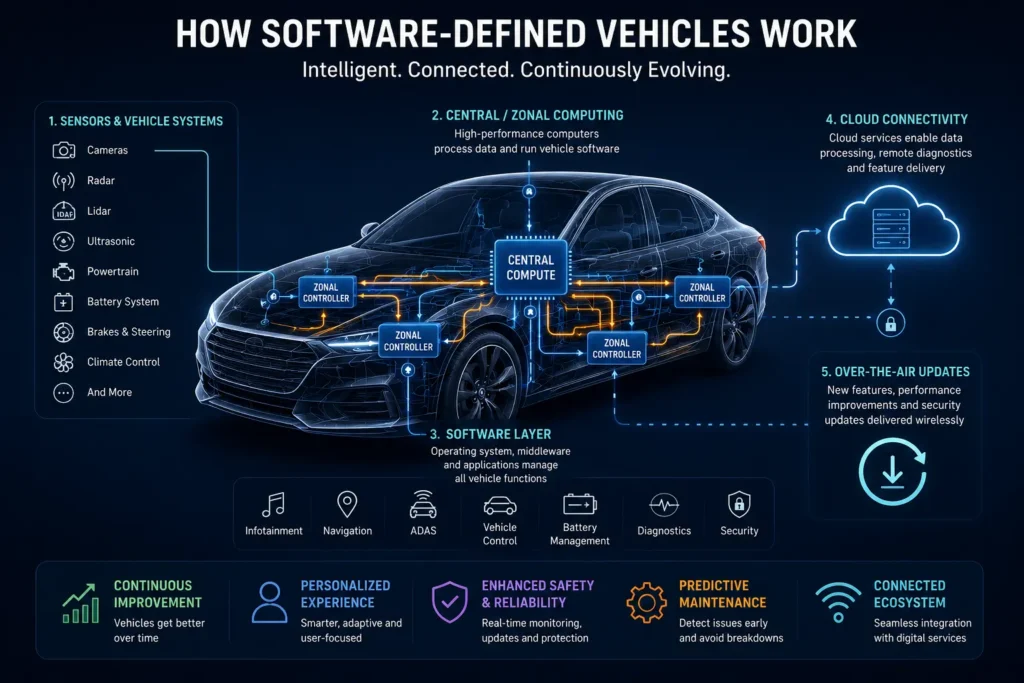
The technology behind an SDV can be understood as a combination of vehicle hardware, computing platforms, software, connectivity and cloud services.
Sensors and Vehicle Systems
Cameras, radar, battery systems, steering, braking, powertrain components and other systems generate information that can be processed by the vehicle’s computing architecture.
High-Performance Computing
Instead of relying entirely on numerous small controllers, newer architectures can use more powerful centralized computers or zonal controllers to process information and coordinate different functions.
Vehicle Software
Software acts as the layer connecting the computing hardware with vehicle functions. It can manage everything from infotainment and navigation to advanced driver-assistance functions and battery systems.
Cloud Connectivity
Connected vehicles can communicate with cloud services for software deployment, data processing, digital services and other functions.
Over-the-Air Updates
The final piece is the ability to update software remotely. OTA technology allows manufacturers to fix software problems, introduce features, improve performance and deliver cybersecurity patches without requiring every update to be installed at a dealership.
What Are the Key Technologies Behind SDVs?
The growth of SDV technology depends on several developments happening together rather than on one particular component.
Centralized and Zonal Architecture
Zonal architecture reduces dependence on large numbers of dedicated controllers and allows a smaller number of powerful computers to manage broader vehicle functions. It can also reduce wiring complexity and create a more flexible foundation for software development.
Over-the-Air Updates
OTA updates are one of the most visible advantages of a software-defined vehicle. Automakers can use them to correct software defects, improve vehicle performance, introduce new functions and deploy security updates after the initial sale.
Artificial Intelligence
AI is increasingly being integrated into vehicle systems for functions such as driver assistance, personalization, energy management and intelligent interfaces. The IEA says advances in AI and computing power are particularly benefiting EVs and integrated vehicle control, while also supporting applications across other vehicle types.
Cloud and Connected Services
Connected vehicles can use cloud infrastructure to support digital services, data processing and software deployment. This also opens the door to new business models based on subscriptions and digital features.
Automotive Cybersecurity
Greater connectivity also creates greater cybersecurity responsibility. As more vehicle functions depend on software and external connectivity, manufacturers must protect vehicle systems, user data and software-update processes from cyber threats.
What Can a Software-Defined Vehicle Actually Do?
The concept becomes easier to understand when we look at the features it can enable.
A software-defined vehicle can potentially:
- Receive OTA software updates
- Improve infotainment and navigation
- Personalize vehicle settings for different drivers
- Monitor vehicle health
- Support predictive maintenance
- Improve energy and battery management
- Enhance certain ADAS functions
- Add new digital features after purchase
- Deliver cybersecurity patches
- Support subscription-based vehicle functions
However, software cannot magically overcome physical hardware limitations. A vehicle can only receive software-based improvements when its underlying sensors, processors, actuators and other hardware are capable of supporting them.
That distinction is important because software-defined does not mean hardware-independent.
How SDVs Can Improve Safety and Efficiency
One of the most important advantages of software-defined vehicles is the ability to improve certain systems throughout the vehicle’s lifecycle.
Advanced Driver-Assistance Systems can depend heavily on software for functions such as automated emergency braking, lane assistance and other forms of driver support. Similarly, software can help manage battery performance and energy consumption in electric vehicles.
The IEA specifically identifies ADAS and battery-management systems as examples of vehicle functions that can benefit from OTA improvements.
Predictive maintenance is another potential benefit. By continuously monitoring vehicle data, software can identify unusual patterns and alert owners before some problems become more serious. However, these systems should be viewed as assistance rather than a guarantee that every mechanical failure can be predicted.
Software-Defined Vehicles and Electric Cars
Electric vehicles have played an important role in accelerating the development of software-defined vehicles.
The IEA notes that battery-electric vehicles currently represent the most advanced examples of centralized software architectures and extensive OTA capabilities.
EVs benefit from software-controlled battery management, energy optimization, thermal management and integrated vehicle systems. Their electrical architecture also makes them well suited to increasingly centralized computing.
However, an SDV is not the same thing as an EV. Software-defined technology can eventually be applied across different powertrains. The distinction is between the vehicle’s propulsion system and the way its electronic and software systems are designed.
How AI Is Changing Software-Defined Vehicles
AI is becoming an increasingly important part of the software-defined vehicle ecosystem.
Instead of software simply following fixed instructions, AI-based systems can process large amounts of information and adapt their responses to changing situations. This can support driver assistance, voice interfaces, personalization, energy management and other intelligent vehicle functions.
AI can also help manufacturers analyse vehicle data and improve software development. The IEA identifies AI and increased computing power as important drivers of progress in automated driving and integrated vehicle control.
For drivers, this could eventually mean a vehicle that learns preferences, adjusts settings automatically and provides a more personalized digital experience.
Software-Defined Vehicles in India
India is becoming an important market for software-defined vehicles, particularly as consumers become more comfortable with connected technology, AI and digital services.
Deloitte’s 2026 Global Automotive Consumer Study found that 95% of surveyed Indian consumers were willing to pay for SDV capabilities, including safety, security and continuous vehicle-health reporting. The study also found strong interest in AI-enabled vehicle customization.
The research suggests that Indian consumers are not interested only in entertainment features. Safety, security and vehicle monitoring are among the areas that can drive interest in connected vehicle technologies.
At the same time, data privacy is an important consideration. Deloitte reported significant concern among Indian consumers about sharing connected-vehicle data, including personal-device information and vehicle-location data.
This means India’s SDV future will depend not only on better software but also on trust, cybersecurity and responsible data management.
What Are the Benefits of Software-Defined Vehicles?
For consumers, automakers and the wider automotive industry, SDVs can create several advantages.
For Vehicle Owners
- More frequent software improvements
- Greater personalization
- Potentially longer digital relevance
- Remote software fixes
- New features during ownership
For Automakers
- Faster feature deployment
- More direct relationships with customers
- New digital revenue opportunities
- Better software-driven differentiation
- Greater ability to improve vehicles after launch
For the Automotive Industry
The transition can change how vehicles are developed and supported. Instead of treating the vehicle as a finished product at the moment it leaves the factory, manufacturers can increasingly treat it as a platform that continues to evolve.
The IEA also highlights the emergence of subscription and feature-as-a-service models, although these can increase lifetime ownership costs depending on how manufacturers structure them.
What Are the Challenges of SDVs?
The transition to software-defined vehicles is not without problems.
Cybersecurity
A connected vehicle has more digital entry points, making cybersecurity an essential part of vehicle development and software management.
Data Privacy
Connected vehicles can collect information about locations, driving behaviour, connected devices and vehicle usage. Manufacturers therefore need strong privacy controls and transparent data policies.
Software Reliability
A software error can affect important vehicle functions. Automakers need extensive testing and validation, particularly for safety-critical systems.
Software Support
An SDV depends on continued software development. Owners may therefore become increasingly dependent on manufacturers for updates, compatibility and long-term support.
Subscription Costs
Digital features can create new revenue streams for automakers, but consumers may face additional costs when functions are offered through subscriptions or pay-per-use models.
Read More: Smart Cars, Smarter World
What Is the Future of Software-Defined Vehicles?
The automotive industry is moving toward vehicles that behave more like continuously evolving digital platforms. More centralized computing, zonal architectures, AI, OTA updates and connected services are likely to become increasingly important as manufacturers redesign vehicle platforms.
The IEA expects the transition to continue beyond today’s EV-focused SDVs, with the first hybrid and internal-combustion models using zonal architectures and near-full OTA capability expected by 2027.
For automakers, this means software development will become increasingly important alongside traditional mechanical and electrical engineering. For consumers, the biggest change may be that buying a car no longer represents the end of its technological development.
Frequently Asked Questions
What is a software-defined vehicle?
A software-defined vehicle is a vehicle in which software controls and manages an increasing share of vehicle functionality, allowing features and certain systems to be improved or updated throughout the vehicle’s lifecycle.
How is an SDV different from a traditional car?
Traditional vehicles generally rely on many dedicated electronic control units and hardware-specific systems. SDVs increasingly use centralized or zonal computing architectures that allow software to manage multiple vehicle functions and receive remote updates.
Are all electric cars software-defined vehicles?
No. EVs have accelerated the development of SDVs, but an electric vehicle is defined by its powertrain while an SDV is defined by its software and electronic architecture. The two concepts overlap but are not identical.
What are OTA updates in a car?
Over-the-air updates allow manufacturers to remotely update vehicle software using wireless connectivity. They can be used for software fixes, performance improvements, new features and cybersecurity updates.
Can software-defined vehicles improve after purchase?
Yes, within the capabilities of their hardware and software architecture. Manufacturers can use OTA updates to improve supported functions, add features and address software problems during ownership.
Are software-defined vehicles safe?
SDVs can support advanced safety technologies, but increased connectivity also creates cybersecurity and software-reliability challenges. Strong security controls, testing and update management are therefore essential.
Are software-defined vehicles available in India?
SDV technology is already becoming part of India’s connected and technology-focused automotive market. Deloitte’s 2026 research found particularly strong Indian consumer interest in SDV capabilities and AI-enabled vehicle customization.
Ride And Tech Verdict
Software-defined vehicles are changing the automobile from a largely fixed product into a technology platform that can continue evolving after purchase. OTA updates, centralized computing, AI, connected services and increasingly sophisticated vehicle software are changing how cars are developed, upgraded and experienced.
The transition will not happen overnight, and not every vehicle will become fully software-defined. Hardware will remain fundamental, while cybersecurity, privacy, software reliability and long-term support will determine how successfully the industry makes the shift.
For India, the opportunity is particularly significant. Strong consumer interest in SDV capabilities suggests that buyers are increasingly prepared to value software, safety and connected services alongside traditional measures such as performance, design and price.
Ride And Tech — Where Ride Meets Tech.
Drive Smarter. Ride Smarter.
Copyright (c) Ride And Tech. All rights reserved.

2 thoughts on “Software-Defined Vehicles: How Software Is Changing the Future of Cars”