



The automotive industry is entering a new era of intelligent mobility, with artificial intelligence (AI) becoming an increasingly important part of how modern vehicles operate, understand their surroundings and assist drivers. From advanced safety systems and intelligent navigation to predictive maintenance and automated parking, smart driving is already changing the way people interact with their cars.
AI in cars enables vehicles to process information from cameras, radar, sensors and other systems, helping them recognize road conditions, identify potential hazards and support drivers in real time. These technologies are making AI-powered cars more capable, connected and responsive while also improving safety and convenience.
However, smart driving is broader than fully autonomous or self-driving cars. Today’s vehicles range from basic driver-assistance features to increasingly sophisticated ADAS technology, while higher levels of driving automation continue to develop. Understanding where AI is already being used—and where autonomous driving is heading—is essential to understanding the future of mobility.
What Is Smart Driving?
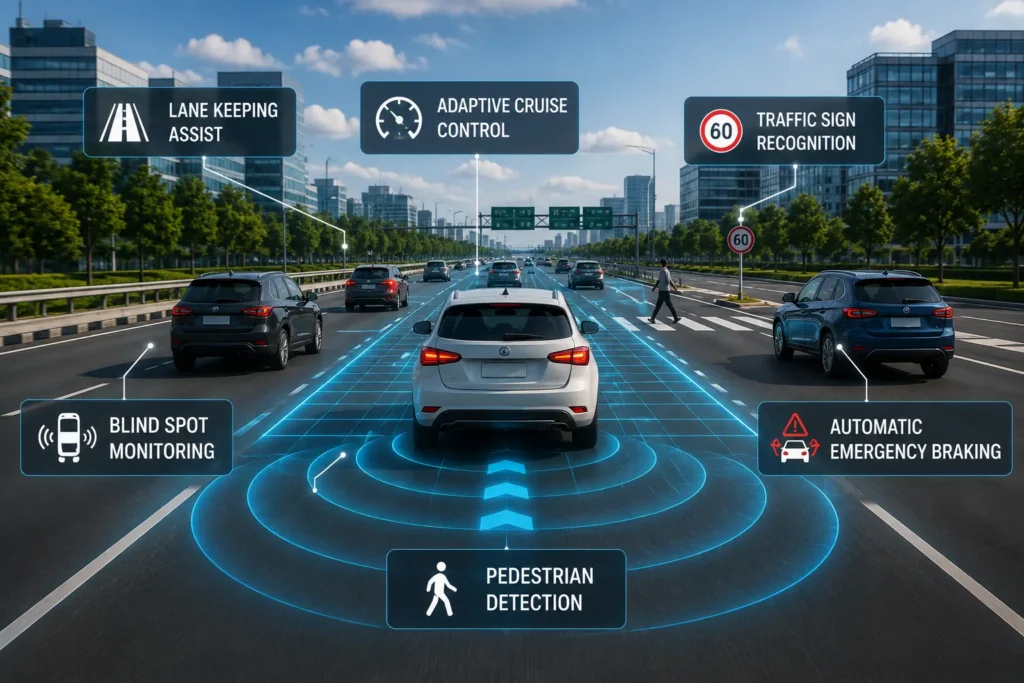
Smart driving refers to the use of artificial intelligence, sensors, software and connected technologies to make vehicles safer, more responsive and more capable of assisting drivers. Instead of relying only on mechanical systems, modern vehicles can process large amounts of information from their surroundings and use that information to support driving decisions.
At the heart of this transformation is AI in cars. Cameras, radar, ultrasonic sensors and other systems can collect information about vehicles, pedestrians, road markings, traffic conditions and potential obstacles. AI algorithms can then interpret this data and help the vehicle respond appropriately.
Some examples of smart car technology already available in modern vehicles include:
- Automatic emergency braking
- Adaptive cruise control
- Lane departure warning and lane-keeping assistance
- Blind-spot monitoring
- Driver monitoring systems
- Intelligent parking assistance
- Traffic-aware navigation
- Voice-based vehicle controls
- Predictive vehicle maintenance
These technologies do not all make a vehicle autonomous. Many are designed to assist the driver while the driver remains responsible for controlling the vehicle.
This distinction is important because smart driving, ADAS technology and autonomous driving are related but not identical concepts. Smart driving covers a broad range of intelligent vehicle functions, while autonomous driving represents a much higher level of vehicle automation in which the driving system can take on more of the driving task under defined conditions.
As AI and sensor technology continue to improve, the capabilities of AI-powered cars are expected to expand further, connecting driver assistance, vehicle intelligence and mobility services into a more integrated driving experience.
How AI Is Transforming Modern Vehicles
Artificial intelligence is no longer limited to experimental autonomous vehicles. Automotive AI is increasingly being integrated into everyday vehicles, where it can improve safety, convenience, efficiency and the overall driving experience.
Advanced Driver Assistance Systems
One of the most visible applications of AI-powered driver assistance is through Advanced Driver Assistance Systems (ADAS). These systems use cameras, radar, sensors and software to monitor the vehicle’s surroundings and assist the driver.
Depending on the vehicle, ADAS technology can provide features such as:
- Automatic emergency braking
- Adaptive cruise control
- Lane departure warning
- Lane-keeping assistance
- Blind-spot monitoring
- Traffic-sign recognition
- Forward collision warning
- Driver monitoring
These systems can reduce the workload on the driver and provide additional safety support, but they do not necessarily make a vehicle autonomous. The capabilities and limitations of each system depend on the vehicle and the specific technology being used.
AI-Based Perception and Decision Making
Modern AI-powered cars can process information from multiple sensors to build an understanding of their surroundings. Computer vision can help identify road markings, vehicles, pedestrians, traffic signs and other objects, while sensor-fusion systems can combine information from different sources.
Machine-learning models can then help interpret this information and support vehicle functions in real time. This ability to process complex environmental data is one of the foundations of modern AI driving technology.
Intelligent Navigation and Traffic Management
AI can also make navigation more intelligent. Modern navigation systems can analyze traffic conditions, road closures, travel times and historical patterns to recommend more efficient routes.
When combined with connected car technology, vehicles can potentially receive information from cloud services and other connected systems, helping drivers respond to changing traffic conditions more effectively.
Predictive Maintenance
Another growing application of AI in cars is predictive maintenance. Vehicle systems can monitor operating conditions and identify patterns that may indicate a developing issue.
Instead of relying only on fixed service intervals, intelligent vehicle systems can potentially help identify maintenance needs earlier. This can improve vehicle reliability and help owners understand when particular components may require attention.
Intelligent Parking and Vehicle Control
AI is also making parking easier through automated parking assistance, surround-view cameras and sensor-based systems. Depending on the vehicle, these technologies can help identify suitable parking spaces and assist with steering or other parts of the parking process.
Together, these applications demonstrate that smart car technology is not limited to the idea of a completely self-driving vehicle. AI is already being used across multiple parts of the driving experience, with automation gradually becoming more capable and sophisticated.
Driving Automation Levels: From Driver Assistance to Autonomous Vehicles
The terms autonomous driving, self-driving cars and driver assistance are often used interchangeably, but they describe different levels of vehicle automation. Understanding these levels helps explain what modern AI car technology can actually do today and what remains under development.
Read More: ADAS Levels Explained
The SAE automation framework classifies driving systems from Level 0 to Level 5, with each level representing a different amount of responsibility handled by the vehicle and the human driver.
Level 0: No Driving Automation
At Level 0, the driver performs the driving task, although the vehicle may provide warnings or momentary assistance.
Examples can include:
- Forward collision warnings
- Lane departure warnings
- Blind-spot alerts
- Automatic emergency braking
These features can support the driver, but they do not continuously control the vehicle.
Level 1: Driver Assistance
Level 1 systems can assist with either steering or acceleration and braking, but not both at the same time as a sustained driving function.
Adaptive cruise control or lane-keeping assistance can fall within this level depending on how the system operates.
The driver remains responsible for monitoring the road and controlling the vehicle.
Level 2: Partial Driving Automation
Level 2 systems can assist with both steering and acceleration or braking under appropriate conditions.
This is where many advanced ADAS technology systems available in modern vehicles fit. The vehicle can handle certain driving tasks simultaneously, but the driver must remain attentive and ready to take control.
This distinction is particularly important when discussing smart driving because a vehicle offering advanced driver assistance is not necessarily a self-driving car.
Level 3: Conditional Driving Automation
At Level 3, the automated driving system can perform the complete driving task under specific conditions and within its defined operating limits.
Unlike Level 2, the system can take responsibility for driving during those conditions. However, the driver must be prepared to respond when the system requests a takeover.
Availability of Level 3 systems depends on factors such as vehicle capability, operating conditions and local regulations.
Level 4: High Driving Automation
Level 4 systems can perform the driving task without human intervention within specific conditions or designated operating areas.
For example, an automated mobility service could operate without a human driver within a defined geographic area or under particular environmental conditions.
The key difference is that the system is designed to handle the driving task within its operational limits rather than requiring continuous human supervision.
Level 5: Full Driving Automation
Level 5 represents the highest level of vehicle automation. A Level 5 system would be capable of performing the entire driving task under all roadway and environmental conditions in which a human driver could operate.
At this level, the vehicle would not be restricted to a particular route, geographic area or specific operating conditions.
Why These Levels Matter
The progression from Level 0 to Level 5 shows that autonomous mobility is not a simple switch between manual and self-driving operation. It is a gradual development from driver warnings and assistance toward increasingly capable automation.
For consumers, understanding these differences is essential. Marketing terms such as “smart driving” or “autonomous” should always be considered alongside the actual capabilities and limitations of the vehicle’s system.
As AI-powered cars become more sophisticated, the important question is not simply whether a vehicle has AI, but how much of the driving task the technology is designed and legally permitted to perform.
How AI and Sensors Help Cars Understand the Road
For a vehicle to assist with driving, it needs to understand what is happening around it. This is where a combination of sensors, software and automotive AI becomes important.
Modern AI-powered cars can use several types of sensors to collect information about their surroundings. AI systems can then process this information to identify objects, understand road conditions and support specific driving functions.
Cameras and Computer Vision
Cameras are widely used in modern vehicles because they can capture visual information such as:
- Road markings
- Traffic signs
- Traffic lights
- Vehicles
- Pedestrians
- Bicycles
- Road obstacles
Computer-vision systems can analyze these images and identify objects or situations that may be relevant to the vehicle’s safety systems.
Radar
Radar sensors use radio waves to detect objects and estimate their distance and movement.
They can be particularly useful for functions such as adaptive cruise control and collision detection because radar can measure the position and relative movement of objects ahead of the vehicle.
LiDAR
LiDAR uses laser pulses to create detailed information about the surrounding environment. It can provide precise distance measurements and is being used in some advanced automated-driving systems and development programs.
However, LiDAR is not a universal requirement for every AI in cars application. Different manufacturers and technology developers use different combinations of sensors depending on the intended vehicle function.
Ultrasonic Sensors
Ultrasonic sensors are commonly used for short-range detection, particularly during parking and low-speed manoeuvres.
They can help detect nearby objects and support parking assistance systems.
Sensor Fusion
No individual sensor is perfect in every situation. AI driving technology can therefore combine information from multiple sensors, a process commonly referred to as sensor fusion.
For example, a camera may provide visual information about a road sign while radar provides information about the distance and movement of another vehicle. Combining these inputs can give the vehicle’s software a more comprehensive understanding of its surroundings.
From Detection to Action
The sensors themselves do not make a vehicle autonomous. They provide information that software and AI systems can interpret.
A simplified process looks like this:
Sensors → Data Processing → Object Recognition → Environment Understanding → Driving Assistance or Automated Response
This combination of hardware and software is a fundamental part of modern smart car technology. As computing power, machine learning and sensor capabilities continue to improve, vehicles can process increasingly complex information while supporting a wider range of driving functions.
How AI Is Improving Vehicle Safety
One of the most important applications of AI in cars is improving road safety. AI-powered systems can continuously process information from cameras, radar and other sensors, helping vehicles identify potential hazards and provide assistance when necessary.
Collision Detection and Automatic Emergency Braking
Modern vehicles can use cameras and radar to monitor the road ahead. If the system detects a potential collision, it can warn the driver and, in supported vehicles and situations, apply the brakes automatically.
Automatic emergency braking is an example of how AI-powered driver assistance can provide an additional layer of protection when a driver does not respond quickly enough to a developing hazard.
Lane and Blind-Spot Assistance
Lane-related systems can monitor road markings and help detect when a vehicle is moving outside its lane without an appropriate indication.
Blind-spot monitoring can also alert drivers when another vehicle is travelling in an area that may be difficult to see through the mirrors.
These technologies can reduce some of the workload involved in everyday driving, although drivers must continue to remain attentive and understand the limitations of the systems.
Driver Monitoring
AI-based driver-monitoring systems can use cameras and other inputs to assess signs of driver attention or distraction.
Depending on the vehicle, these systems may detect behaviours such as prolonged distraction or signs that the driver is not adequately monitoring the road.
Driver monitoring becomes particularly important as vehicles offer more advanced ADAS technology, because greater automation does not eliminate the need for appropriate human supervision in systems that require the driver to remain responsible.
Predicting and Responding to Potential Hazards
AI can also help vehicles identify patterns and potential risks using information collected from their surroundings.
For example, a vehicle may detect a rapidly approaching object, a pedestrian entering its path or changing traffic conditions and provide an appropriate warning or assistance response.
The objective is not simply to make the vehicle react faster. It is to help the system interpret a complex driving environment and support the driver with timely information.
AI Is an Additional Safety Layer
Despite these advances, AI should not be viewed as a replacement for responsible driving.
The effectiveness of any safety or driver-assistance system depends on factors such as sensor performance, road conditions, weather, system limitations and correct driver use. Smart driving works best when intelligent vehicle technology and attentive human driving work together.
As AI-powered cars become more capable, the role of AI in safety is likely to expand, but understanding what a particular system can—and cannot—do will remain essential for drivers.
Connected Cars and the Rise of Intelligent Mobility
The future of smart driving is not limited to what happens inside an individual vehicle. As cars become increasingly connected to cloud services, mobile networks and other road users, connected car technology is creating a broader ecosystem of intelligent mobility.
How Connected Cars Work
Connected vehicles can exchange information with external digital services and, where supported, other connected systems. This connectivity can support functions such as:
- Real-time traffic information
- Cloud-based navigation
- Remote vehicle monitoring
- Over-the-air software updates
- Emergency assistance
- Vehicle diagnostics
- Location-based services
By combining connectivity with AI in cars, vehicles can process information from both their onboard sensors and external data sources.
Vehicle-to-Everything Communication
Vehicle-to-Everything, commonly known as V2X, is designed to allow vehicles to communicate with different elements of the transportation environment.
Depending on the implementation, this can include communication between:
- Vehicle and vehicle (V2V)
- Vehicle and infrastructure (V2I)
- Vehicle and pedestrians or other road users (V2P)
- Vehicle and network services (V2N)
The broader goal is to allow relevant information to move between vehicles, infrastructure and other connected systems, potentially helping vehicles and drivers respond more effectively to changing road conditions.
AI and Real-Time Traffic Information
Connected data can become even more useful when combined with automotive AI. AI systems can analyze traffic patterns, road conditions and historical information to help generate more intelligent navigation recommendations.
For example, an intelligent navigation system may identify congestion and suggest an alternative route based on current conditions rather than relying only on a predetermined route.
Over-the-Air Software Updates
Modern connected vehicles can also receive software updates remotely. This allows manufacturers to improve certain vehicle functions, introduce software enhancements and address some issues without requiring every update to be installed manually at a workshop.
As vehicles become more software-defined, software updates are becoming an increasingly important part of vehicle ownership.
From Connected Cars to Smart Mobility
The combination of smart car technology, connectivity and AI could eventually create a more coordinated transportation ecosystem.
Cars, public transport, traffic infrastructure and mobility services could increasingly exchange information, helping transportation systems become more efficient and responsive.
However, this future also introduces challenges involving cybersecurity, data privacy, infrastructure compatibility and network reliability. Intelligent mobility will therefore depend not only on better AI, but also on secure and reliable systems connecting the wider transportation environment.
AI for Vehicle Efficiency, Maintenance and Driver Experience
The role of AI in cars extends beyond safety and driving assistance. Modern vehicles increasingly use software and data to improve efficiency, simplify maintenance and personalize the experience for drivers and passengers.
Predictive Vehicle Maintenance
Traditional vehicle maintenance often follows fixed service intervals. AI-based systems can add another layer by analyzing vehicle data and identifying patterns that may indicate potential problems.
Sensors can monitor factors such as temperature, pressure, operating conditions and component performance. When unusual patterns are detected, intelligent diagnostic systems can help identify areas that may require inspection.
Predictive maintenance cannot eliminate mechanical failures, but it can help drivers and service teams identify potential issues earlier and make maintenance more data-driven.
Improving Energy Efficiency
AI can also help optimize how a vehicle uses energy.
In electric vehicles, software can analyze factors such as driving behaviour, traffic conditions, terrain and battery characteristics to improve energy management and provide more accurate range estimates.
In conventional vehicles, intelligent systems can similarly optimize certain engine, transmission and climate-control functions to improve efficiency.
This makes AI car technology relevant not only to autonomous mobility but also to the everyday goal of reducing energy consumption.
Personalized Driving Experience
AI can also make vehicles more responsive to individual users.
Depending on the vehicle and software, intelligent systems can learn preferences related to:
- Navigation
- Cabin temperature
- Seating
- Infotainment
- Frequently used destinations
- Voice commands
- Driving-related settings
The result can be a more personalized experience in which the vehicle adapts to the driver’s preferences rather than requiring every setting to be adjusted manually.
AI-Powered Voice Assistants
Voice interaction is another growing area of smart car technology. Natural-language systems can allow drivers to control compatible vehicle functions, navigation and entertainment features through conversational commands.
As AI-based language systems become more capable, voice interfaces could become less dependent on rigid commands and better at understanding natural conversations.
Balancing Convenience With Privacy
Greater personalization also means vehicles can process increasing amounts of user and vehicle data.
This makes data protection and cybersecurity important considerations as connected car technology becomes more advanced. Drivers should understand what information their vehicle collects, how it is processed and what services may have access to it.
The future of smart driving will therefore depend not only on making vehicles more intelligent, but also on making those systems secure, transparent and reliable.
Smart Driving and AI-Powered Cars in India
India’s automotive market is gradually moving toward more connected and intelligent vehicles. While the country’s road conditions, traffic patterns and infrastructure create different challenges from many other markets, smart driving technology is becoming increasingly relevant to Indian drivers.
Modern vehicles sold in India are already adopting a growing range of ADAS technology, connected features and intelligent safety systems. Depending on the model and variant, drivers may find features such as adaptive cruise control, lane assistance, automatic emergency braking, blind-spot monitoring and driver-alert systems.
Why AI Matters on Indian Roads
Indian driving conditions can vary significantly between cities, highways and rural roads. Heavy traffic, motorcycles, pedestrians, unpredictable road behaviour and changing road surfaces create complex environments for both drivers and vehicle technology.
AI-based systems can potentially help drivers by processing information from multiple sensors and providing warnings or assistance. However, these systems must operate within their designed capabilities, and drivers should not assume that an ADAS-equipped vehicle can handle every situation independently.
Growth of Connected Vehicle Technology
Connected car technology is also becoming more common in India’s automotive market. Depending on the manufacturer and vehicle, connected services can provide features such as remote vehicle functions, vehicle status information, navigation services, emergency assistance and software updates.
As connectivity and automotive AI develop further, vehicles could become increasingly capable of using real-time information to provide more useful and personalized services.
The Role of Driver Assistance
For the foreseeable future, driver assistance is likely to remain more relevant to everyday Indian motorists than fully autonomous vehicles.
Advanced safety systems can provide an additional layer of support, but their effectiveness depends on road conditions, system design and responsible driver use. Drivers should always understand the operating limitations of the technology fitted to their vehicle.
India’s Future Mobility Landscape
India’s growing automotive technology ecosystem, expanding digital infrastructure and increasing interest in electric and connected vehicles could support further development of smart mobility.
The future may bring more sophisticated driver assistance, connected transportation systems, intelligent traffic management and automated mobility services. However, the pace of adoption will depend on technology, infrastructure, regulation, cost and how effectively these systems can operate in India’s diverse road environment.
For Indian consumers, the most meaningful transition may therefore be gradual: vehicles becoming safer, more connected and more intelligent before highly automated driving becomes widely practical.
Challenges of AI and Autonomous Driving
Despite rapid advances in automotive AI, making vehicles increasingly intelligent also creates significant technical, regulatory and ethical challenges. The transition from driver assistance to higher levels of driving automation is much more complicated than simply adding more sensors or software.
Safety in Complex Driving Situations
Real-world roads can present situations that are difficult for AI systems to interpret correctly. Unpredictable driver behaviour, unusual road layouts, poor visibility, damaged road markings and unexpected obstacles can challenge even sophisticated systems.
An AI system must therefore be able to operate within clearly defined conditions and recognize when it has reached its limitations.
Weather and Environmental Conditions
Heavy rain, fog, dust, glare and other environmental conditions can affect cameras, radar and other sensors differently.
Because AI-powered cars rely on sensor data to understand their surroundings, maintaining reliable perception across a wide range of conditions remains an important engineering challenge.
Cybersecurity and Data Privacy
As vehicles become more connected, cybersecurity becomes increasingly important. Connected vehicles can process information relating to the vehicle, its location, driving patterns and user preferences.
Manufacturers therefore need robust security measures to protect vehicle systems and user data from unauthorized access.
Regulation and Legal Responsibility
Higher levels of autonomous driving also raise questions about regulation and responsibility.
When a vehicle performs part or all of the driving task, it becomes important to establish how systems should be tested, approved and monitored, and how responsibility is determined when something goes wrong.
Regulations can also differ between countries and regions, which can affect where particular automated-driving technologies can be deployed.
Cost and Infrastructure
Advanced sensors, computing hardware and software can increase vehicle development and manufacturing costs. Some automated functions may also depend on suitable road infrastructure, high-quality mapping, reliable connectivity or clearly defined operating environments.
This can make widespread adoption more difficult, particularly in markets where infrastructure and road conditions vary significantly.
Human Trust and Overreliance
One of the most important challenges is human behaviour.
Drivers may become overly confident in an advanced assistance system and pay less attention than required. This can be particularly dangerous when a system is capable of assisting with multiple driving functions but still requires active driver supervision.
For smart driving to improve safety, drivers must understand the difference between assistance and autonomy and use each system according to its intended purpose.
AI Must Be Developed Responsibly
The future of autonomous driving will depend not only on better algorithms, but also on rigorous testing, clear regulations, reliable hardware, cybersecurity and responsible human interaction.
The objective should not simply be to create cars that can perform more tasks automatically. The larger goal is to develop AI car technology that is predictable, transparent, safe and genuinely useful in the environments where it is deployed.
Read More: Automotive Innovation
The Future of Smart Driving and Autonomous Mobility

The development of smart driving is likely to continue well beyond today’s driver-assistance systems. As artificial intelligence, sensors, computing power and connectivity improve, vehicles could become increasingly capable of understanding their surroundings and assisting with more complex driving tasks.
More Advanced Driver Assistance
In the near term, one of the most important developments is likely to be the continued improvement of ADAS technology.
Systems could become better at understanding complex traffic situations, detecting hazards and assisting drivers across a wider range of road conditions. Improvements in sensor technology and AI models may also make these systems more responsive and reliable.
However, greater capability does not automatically mean that every vehicle will become fully autonomous. The technology will continue to operate within defined limits depending on the vehicle, software and operating environment.
Expansion of Automated Mobility
Higher levels of driving automation could gradually expand in controlled environments.
Automated mobility services, including driverless transport in defined areas, could become an important part of future urban transportation. These systems can operate within carefully mapped and monitored environments, making it easier to manage the conditions in which automation is used.
This approach could be particularly relevant for robotaxi services, automated shuttles, logistics and other specific mobility applications.
AI and Software-Defined Vehicles
The future vehicle is also becoming increasingly software-driven. Instead of remaining unchanged after purchase, vehicles can receive software improvements, connected services and new digital capabilities throughout their lifecycle.
This could allow AI-powered cars to become more capable over time, although the availability of new functions will depend on hardware, software compatibility, regulations and manufacturer policies.
Smarter Roads and Connected Mobility
The future of smart mobility may also involve closer communication between vehicles and infrastructure.
Traffic signals, road infrastructure, connected vehicles and mobility services could exchange information to improve traffic management and help transportation systems respond more efficiently to changing conditions.
When combined with connected car technology, these developments could create a transportation environment in which vehicles are not operating as isolated machines but as part of a wider digital mobility network.
What the Future May Look Like
The transition toward autonomous mobility is unlikely to happen as a single dramatic shift from conventional cars to completely self-driving vehicles.
Instead, the industry is likely to progress through increasingly capable stages of assistance and automation. Some technologies may become common in everyday vehicles, while higher levels of autonomy may initially remain limited to specific vehicles, roads, services or operating conditions.
The long-term future of smart driving will therefore depend on more than AI alone. Advances in safety, infrastructure, regulation, cybersecurity, computing and consumer acceptance will all play a role in determining how quickly intelligent and autonomous mobility becomes part of everyday transportation.
Frequently Asked Questions About Smart Driving
What is smart driving?
Smart driving refers to the use of AI, sensors, software and connected technologies to make vehicles safer, more efficient and more capable of assisting drivers. It includes technologies such as ADAS, intelligent navigation, automated parking, driver monitoring and connected vehicle services.
How is AI used in cars?
AI in cars can be used to interpret information from cameras and other sensors, identify objects and road conditions, assist with driving tasks, improve navigation, monitor vehicle systems and personalize the driving experience.
Are AI-powered cars the same as self-driving cars?
No. AI-powered cars can use artificial intelligence for many different functions without being fully autonomous. Driver assistance, navigation, predictive maintenance and voice systems can all use AI while the driver remains responsible for operating the vehicle.
What is ADAS technology?
ADAS technology, or Advanced Driver Assistance Systems, includes electronic systems designed to assist drivers with specific driving or safety tasks. Depending on the vehicle, these can include automatic emergency braking, adaptive cruise control, lane assistance and blind-spot monitoring.
What is the difference between ADAS and autonomous driving?
ADAS generally assists the driver with specific functions, while higher levels of autonomous driving allow the automated system to perform more of the driving task under defined conditions. The driver responsibilities and system capabilities depend on the automation level.
Are self-driving cars available today?
Automated-driving technology is already being tested and deployed in specific applications and controlled environments, but fully autonomous vehicles capable of driving anywhere under all conditions are not yet a normal consumer reality.
How do AI cars understand their surroundings?
AI-driven vehicle systems can combine information from cameras, radar, LiDAR, ultrasonic sensors and other sources. Software and machine-learning systems can process this information to identify objects, road features and potential hazards.
Is smart driving useful for Indian roads?
Yes, but the effectiveness of any system depends on its design and operating limitations. Smart driving technology can provide useful safety and convenience features in India, while challenging traffic patterns, road conditions and infrastructure make responsible driver supervision particularly important.
What is the future of smart driving?
The future of smart driving is likely to involve increasingly capable driver assistance, connected vehicles, intelligent mobility services and higher levels of automation in specific environments. The pace of adoption will depend on technology, safety, regulation, infrastructure and consumer acceptance.
Ride And Tech Verdict
Smart driving is no longer just a vision of the future. AI is already changing everyday vehicles through driver assistance, intelligent safety systems, connected services, predictive maintenance and increasingly sophisticated in-car technology.
At the same time, it is important to separate today’s AI-powered cars and ADAS technology from the idea of completely autonomous or self-driving vehicles. Most current systems are designed to assist drivers within specific limitations rather than remove the need for human attention.
The next stage of automotive innovation will likely be defined by how effectively AI, sensors, connectivity and vehicle software work together. As these technologies mature, cars could become safer, more efficient and increasingly capable of handling complex driving tasks.
For India, the transition is likely to be gradual. Advanced driver assistance and connected-car features may become increasingly common before higher levels of autonomous mobility become practical on a large scale.
The real promise of smart driving is therefore not simply about creating cars that drive themselves. It is about building vehicles that understand their surroundings better, support drivers more effectively and become a more intelligent part of the wider transportation ecosystem.
Ride And Tech — Where Ride Meets Tech.
Drive Smarter. Ride Smarter.
Copyright (c) Ride And Tech. All rights reserved.

2 thoughts on “Smart Driving: How AI Is Transforming Cars and the Future of Mobility”