


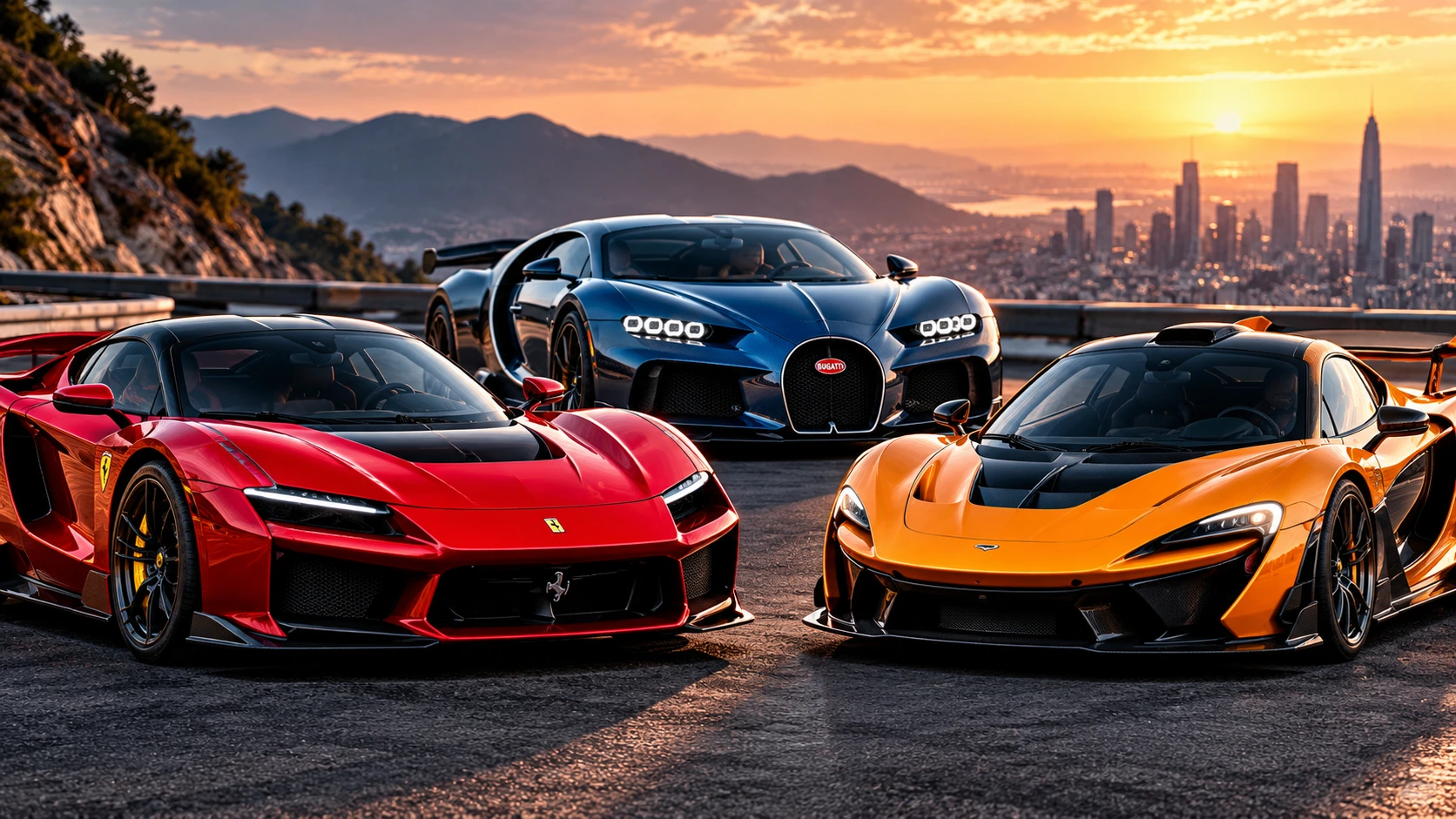
When talking about the world’s most extreme road cars, the terms supercar vs hypercar are often used interchangeably. That is understandable because both describe cars built far beyond the performance level of ordinary sports cars, but the two categories are not always the same.
A supercar typically combines extraordinary performance, exotic design, advanced engineering and a highly focused driving experience. A hypercar pushes those ideas even further, often using cutting-edge materials, extreme aerodynamics, hybrid or electric power, very limited production and engineering that can approach motorsport territory. The difficult part is that there is no single universal rulebook that officially determines where a supercar ends and a hypercar begins.
That makes the supercar vs hypercar debate more interesting than simply comparing horsepower or top speed. Modern cars such as the Ferrari F80, Bugatti Tourbillon, McLaren W1 and other ultra-exclusive machines show how blurred the boundary has become, with manufacturers and automotive publications sometimes using different terminology for similar levels of performance.
What Is a Supercar?
A supercar is generally an exceptionally high-performance road car designed to deliver performance, technology and styling far beyond mainstream sports cars. Koenigsegg, for example, describes a supercar as an exceptionally high-performance and luxurious sports car characterized by speed, powerful engines, advanced aerodynamics, technology and distinctive design.
The traditional supercar formula usually includes a powerful engine, a lightweight construction philosophy, sophisticated suspension, strong braking performance and a body designed around both visual drama and aerodynamic efficiency. Many modern supercars also use carbon-fibre structures, active aerodynamic systems, dual-clutch transmissions and sophisticated electronic control systems.
However, being a supercar does not necessarily require four-figure horsepower or a seven-figure price tag. The category has expanded considerably as technology has become more accessible, which means some modern supercars can deliver performance that would have been considered hypercar territory a generation ago. MotorTrend notes that even the definition of a supercar has become increasingly difficult to establish as performance levels continue to rise.
Cars such as the Chevrolet Corvette, Porsche 911 GT3 RS, Ferrari models and Lamborghini’s performance cars demonstrate why the supercar vs hypercar distinction cannot be based on one specification alone. A car can deliver extraordinary acceleration and cornering performance while still being positioned by its manufacturer as a supercar.
Read More: Bugatti Tourbillon vs Ferrari F80 vs McLaren W1
What Is a Hypercar?
A hypercar is generally considered the extreme end of the high-performance road-car spectrum. It takes the core ideas of a supercar and combines them with an even greater emphasis on engineering, performance, technology, exclusivity and often bespoke construction.
The Bugatti Veyron played an important role in establishing the modern idea of the hypercar. Bugatti describes the Veyron project as the creation of an unprecedented vehicle type capable of producing more than 1,000 PS while pushing the boundaries of automotive engineering.
The modern hypercar can therefore be thought of as more than simply a very fast car. It is often a technological showcase for its manufacturer, bringing together an extremely powerful powertrain, advanced aerodynamics, exotic materials, sophisticated chassis technology and a highly limited production run.
That is why the supercar vs hypercar difference often becomes clearer when the entire engineering package is considered rather than looking only at acceleration or top speed.
Supercar vs Hypercar: The Key Differences
There is no official global checklist separating the two categories, but several characteristics are commonly associated with hypercars. Looking at those characteristics provides a more useful way to understand the supercar vs hypercar relationship.
1. Performance
Performance is the most obvious difference between a supercar and a hypercar, but it is not enough by itself to define the category.
Modern supercars can accelerate from 0-100 km/h in extremely short times and can reach top speeds well above 300 km/h. Some can also deliver enormous levels of downforce and lap-time performance, particularly in track-focused variants.
Hypercars generally push those numbers even further, but their performance is often accompanied by a much broader engineering package. A hypercar may combine extreme acceleration with active aerodynamics, advanced hybrid assistance, carbon-fibre construction and sophisticated energy management.
This is one reason the supercar vs hypercar distinction cannot simply be reduced to a horsepower competition.
2. Power
Power is another major difference, although there is no universal horsepower threshold.
The Bugatti Veyron famously crossed the 1,000-PS mark, helping establish a new era of ultra-high-performance production cars. Modern hypercars have pushed power levels substantially further, particularly through hybridisation.
The Ferrari F80, for example, has a combined maximum output of 1,200 hp from its V6 hybrid powertrain, while Ferrari officially describes the car as a new supercar rather than using the hypercar label. It is limited to 799 examples.
This is an excellent example of why the supercar vs hypercar terminology cannot be determined by horsepower alone.
3. Acceleration
Acceleration is one of the areas where the gap between conventional sports cars and modern supercars has almost disappeared.
A current supercar can deliver acceleration that was once associated exclusively with the world’s most exotic machines. Hybrid assistance has made it possible to combine an internal-combustion engine with electric motors that deliver instant torque and additional power.
Hypercars often use this technology to achieve even more dramatic acceleration while simultaneously improving traction and power delivery. The electric motors are not necessarily there only to increase the headline horsepower figure; they can also provide precise torque control and support the internal-combustion engine during different phases of driving.
4. Top Speed
Top speed has historically been one of the most visible measurements in the supercar vs hypercar discussion.
The Bugatti Veyron helped redefine expectations by becoming the first production car to cross the 400-km/h barrier, according to MotorTrend’s historical overview.
However, top speed alone is no longer enough to identify a hypercar. Some cars are engineered primarily around acceleration, cornering, braking or track performance rather than achieving the highest possible terminal velocity.
A hypercar may therefore be technologically more extreme than another car without necessarily having the higher maximum speed.
5. Aerodynamics
Aerodynamics is another major area where hypercars can separate themselves from ordinary high-performance cars.
Supercars already use carefully shaped bodywork, splitters, diffusers, wings and other aerodynamic elements to control airflow. Track-focused versions can add sophisticated active systems that change aerodynamic characteristics depending on speed and driving conditions.
Hypercars frequently take this concept even further. The McLaren W1, for example, combines a carbon-fibre monocoque with an active aerodynamic package capable of generating substantial downforce.
The important point in the supercar vs hypercar comparison is that aerodynamics is not simply about adding a large rear wing. The entire body, floor, cooling system and suspension can be developed around aerodynamic performance.
6. Materials and Construction
Supercars commonly use lightweight materials such as aluminium, carbon fibre and advanced composites. Reducing mass improves acceleration, braking, handling and efficiency, making lightweight construction an important part of performance engineering.
Hypercars often take this philosophy to another level. Their structures may use bespoke carbon-fibre monocoques, specialised composites and components developed specifically for one vehicle rather than shared across a manufacturer’s wider range.
MotorTrend has argued that a unique platform or chassis can be an important characteristic of a hypercar because developing a bespoke structure requires substantial engineering investment.
7. Technology
Technology is perhaps the biggest differentiator in the modern supercar vs hypercar conversation.
A supercar can already feature advanced suspension systems, torque-vectoring, carbon-ceramic brakes, sophisticated traction control, active aerodynamics and hybrid powertrains. A hypercar may combine several of these technologies into a much more specialised package.
Modern hypercars can use electric motors not only for additional power but also for torque management and energy recovery. They may also feature complex aerodynamic systems, highly advanced cooling strategies and lightweight components produced using specialised manufacturing methods.
The goal is not simply to make the specification sheet impressive. The technology is generally integrated to achieve a specific combination of performance, efficiency and driver control.
Supercar vs Hypercar: Price and Exclusivity
Price is another characteristic often associated with the supercar vs hypercar distinction, although it is not an official rule.
Supercars can range from several hundred thousand dollars to well beyond a million dollars depending on the manufacturer, specification and rarity. Hypercars are frequently positioned at the very top of the market, with prices reaching several million dollars for the most exclusive models.
Production numbers can be equally important. A manufacturer may build thousands of examples of a particular supercar while producing only a few hundred examples of a hypercar.
The Ferrari F80 provides a useful current example. Ferrari announced a production run of only 799 cars, reflecting the model’s highly exclusive positioning.
Exclusivity alone, however, does not automatically make a car a hypercar. A limited production run can exist for many reasons, including special editions, collector models and track-focused derivatives.
Is Every Extremely Fast Car a Hypercar?
No. This is where the supercar vs hypercar debate becomes particularly complicated.
A car can have 1,000 horsepower, accelerate extremely quickly and still be described as a supercar by its manufacturer or by some automotive publications. Conversely, another vehicle with similar performance may be widely accepted as a hypercar because of its price, engineering, rarity, construction and overall positioning.
MotorTrend’s 2026 examination of the terminology demonstrates exactly how difficult this boundary has become. Its analysis points out that some cars widely regarded as hypercars can fail a particular definition based on horsepower, production numbers, chassis construction or price.
The result is that supercar vs hypercar should be treated as a useful classification rather than a rigid scientific measurement.
Where Do Track-Focused Cars Fit?
Track-focused road cars make the distinction even harder.
Some supercars are designed primarily for road use but receive extreme performance variants with additional downforce, lighter materials, revised suspension and more aggressive tyres. Others are effectively road-legal track machines with limited practicality.
A car does not automatically become a hypercar simply because it is faster around a circuit than another hypercar. Track performance is only one part of the equation.
This is why the supercar vs hypercar classification should consider the car’s overall engineering philosophy rather than one lap time.
Examples of Modern Supercars
The modern supercar category includes a wide variety of cars, and manufacturer terminology can differ significantly.
Ferrari’s F80 is officially described by Ferrari as a supercar, despite producing 1,200 hp and being limited to 799 units. Koenigsegg also describes its own high-performance models under the supercar category while emphasising exceptional speed, technology, aerodynamics and engineering.
Other cars commonly discussed within the broader supercar segment include high-performance Ferrari, Lamborghini, McLaren, Porsche and Chevrolet models. The exact classification can vary depending on whether the discussion is based on manufacturer positioning, price, performance or automotive-media convention.
Examples of Modern Hypercars
The hypercar category includes some of the most technologically ambitious road cars ever developed.
The Bugatti Veyron helped establish the modern hypercar era through its combination of extreme power and speed. Its successor, the Chiron, continued that approach with even greater performance.
More recent examples include the McLaren W1, which combines a 1,258-hp hybrid powertrain with a carbon-fibre monocoque and active aerodynamic technology.
The Ferrari F80 also demonstrates how difficult the terminology has become. Its specifications and limited production are characteristic of what many enthusiasts would call a hypercar, yet Ferrari officially places it within its supercar lineage.
How Hybrid and Electric Power Are Changing Hypercars
Electrification has fundamentally changed the supercar vs hypercar landscape.
Electric motors can deliver instant torque, making them particularly useful for improving acceleration and traction. Hybrid systems can also allow manufacturers to use smaller combustion engines while adding substantial electrical power.
This technology has helped modern performance cars reach power outputs that would have been extremely difficult to achieve using an internal-combustion engine alone.
However, electrification also makes horsepower a less useful classification tool. If several electric motors can dramatically increase output, simply saying that a car has more than a particular horsepower figure no longer tells us whether it should be considered a hypercar.
The more meaningful question becomes how the powertrain, chassis, aerodynamics, materials and software work together as one engineering system.
Read More: Winter Car Care Tips
Why the Line Between Supercars and Hypercars Is Blurring
The biggest change in the supercar vs hypercar relationship is that supercars are becoming extraordinarily capable.
Technology that was once reserved for the most expensive cars is gradually moving into lower segments. Hybrid systems, carbon-fibre components, advanced electronics, active aerodynamics and sophisticated chassis control are no longer exclusive to the very top of the automotive world.
At the same time, hypercars are becoming increasingly specialised. Manufacturers are using them as technology showcases, engineering demonstrators and ultra-exclusive halo products.
That creates an overlap in which a modern supercar can outperform an older hypercar, while a new hypercar may focus on engineering sophistication rather than simply chasing a top-speed record.
Supercar vs Hypercar: Frequently Asked Questions
Is a hypercar faster than a supercar?
Generally, hypercars are positioned at the extreme end of road-car performance, but there is no universal rule requiring every hypercar to be faster than every supercar. Modern supercars can have extraordinary acceleration, top speed and track capability, so performance figures alone cannot establish the classification.
Is a hypercar always more expensive than a supercar?
Not necessarily, although hypercars are usually positioned at the highest end of the performance-car market. Price is one factor used when discussing the distinction, alongside engineering, exclusivity, technology and production volume.
Does 1,000 horsepower make a car a hypercar?
No. Four-figure power can be an important characteristic of some hypercars, but it is not an official universal threshold. The Ferrari F80 illustrates this point because it produces 1,200 hp while Ferrari officially calls it a supercar.
Are electric cars hypercars?
An electric car can be classified as a hypercar if its overall performance, engineering, technology and positioning fit the category. Electric power itself does not automatically make a vehicle a hypercar.
What is the main difference between a supercar and a hypercar?
The simplest way to understand the supercar vs hypercar difference is that a supercar represents an exceptionally high-performance sports car, while a hypercar generally pushes performance, technology, engineering, exclusivity and price to an even more extreme level. The boundary is not officially fixed, so some cars can reasonably be described differently depending on the criteria being used.
Ride And Tech Verdict
The supercar vs hypercar debate does not have a single specification that settles every case. Horsepower, acceleration and top speed are important, but they tell only part of the story when modern performance cars are becoming increasingly sophisticated.
A supercar can now deliver performance that would have been considered hypercar territory in the past, while today’s hypercars are increasingly defined by the complete engineering package: bespoke construction, advanced aerodynamics, hybrid or electric technology, extreme performance and limited production.
The most useful way to look at the supercar vs hypercar distinction is therefore not as a strict mathematical boundary. A supercar is already an extraordinary road car; a hypercar generally represents the manufacturer’s attempt to push that concept toward the absolute limits of performance, technology and exclusivity.
Ride And Tech — Where Ride Meets Tech.
Drive Smarter. Ride Smarter.
Copyright (c) Ride And Tech. All rights reserved.
