


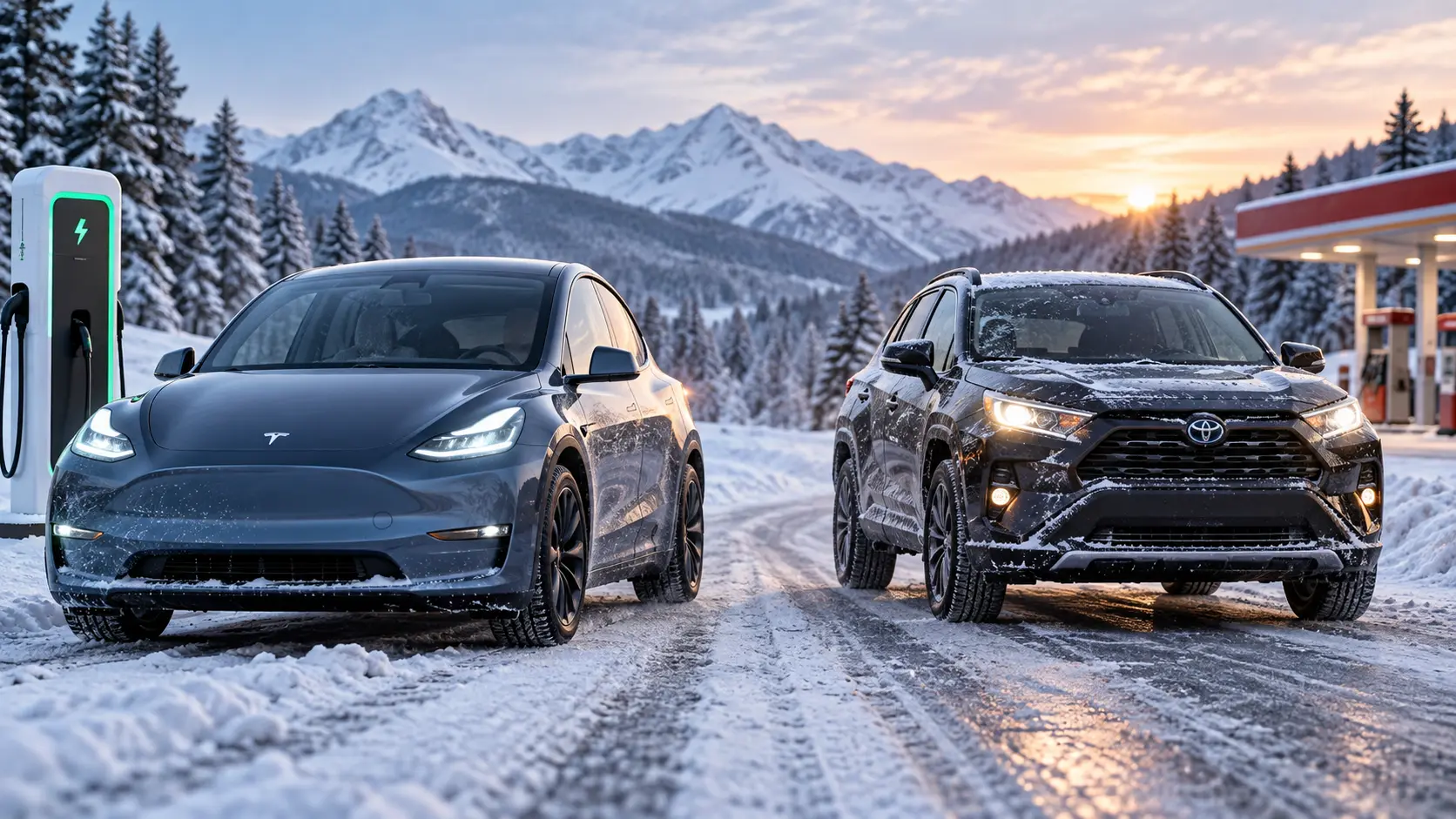
EVs vs Gas Cars in Winter is a more complicated comparison than it first appears. Cold weather changes the way every vehicle operates, from engine warm-up and fuel economy to battery performance, cabin heating and charging. Electric vehicles face a particularly noticeable challenge because low temperatures can reduce battery efficiency and increase the energy required to heat the cabin.
That makes the common claim that EVs perform better than gas cars in winter far too simplistic. Modern EVs have sophisticated battery thermal management, heat pumps, preconditioning and traction-control systems that can make them very capable in cold conditions, but that doesn’t mean they escape the efficiency penalty of winter. In fact, recent testing shows that EV range can fall significantly as temperatures drop.
The more useful question is therefore not which powertrain magically wins in winter. It is where each technology has an advantage, where it struggles and what drivers can do to minimize the effects of cold weather.
How Cold Weather Affects EVs
The biggest winter challenge for an EV is its high-voltage battery. Lithium-ion batteries rely on electrochemical reactions that become less efficient at low temperatures, which can temporarily reduce the amount of usable energy available and affect charging performance.
Cold weather also creates another major energy demand: heating. An EV does not have a hot combustion engine producing large amounts of waste heat that can simply be redirected into the cabin. Instead, it must use electrical energy for cabin heating and battery thermal management. The U.S. Department of Energy identifies HVAC energy consumption, particularly cabin heating, as a major contributor to reduced winter EV range.
The result is that an EV can still drive perfectly well in cold weather, but the driver may see fewer kilometres of usable range and, in some circumstances, slower charging than the same vehicle would achieve in moderate temperatures.
EV Winter Range Can Drop Significantly
This is the biggest correction to the original article.
Cold weather does not make an EV more range-efficient than a petrol car. Instead, EVs can experience a substantial reduction in range when temperatures fall, particularly when the vehicle is also being used for heating and short trips.
AAA’s 2026 laboratory testing of three EVs found an average 39% reduction in calculated driving range at 20°F compared with 75°F conditions. The individual vehicles varied considerably, demonstrating that thermal-management systems, battery size, vehicle efficiency and other factors can make a significant difference.
That doesn’t mean every EV will lose exactly 39% of its range. Real-world results depend on temperature, speed, driving style, wind, tyres, cabin temperature, battery state of charge and the vehicle’s thermal-management strategy. The important takeaway is simply that winter range should be planned conservatively rather than assuming the official rated range will remain unchanged.
Gas Cars Also Lose Efficiency in Winter
Petrol cars aren’t immune to cold weather either.
A conventional internal-combustion engine generally needs more energy during cold operation because lubricants are thicker, the engine and exhaust system take longer to reach operating temperature and fuel consumption can increase during warm-up. Cabin heating also interacts differently with the powertrain because the combustion engine produces waste heat that can be used for heating once the engine is warm.
The U.S. Department of Energy estimates that a conventional gasoline vehicle can see roughly a 15% reduction in fuel economy during 20°F city driving compared with 77°F conditions, although the actual effect varies by vehicle and conditions. The same source notes that the impact can be substantially larger for all-electric vehicles.
So the winter comparison is not EVs lose range while gas cars are unaffected. Both powertrains are affected, but the mechanism and scale of the penalty are different.
Read More: Affordable Electric Cars That Are Transforming the Global Car Market
Why EVs Can Still Be Excellent Winter Cars
The fact that EVs lose range in winter doesn’t mean they are poor cold-weather vehicles. Modern EVs have several technologies designed specifically to manage low temperatures and maintain predictable performance.
Battery thermal-management systems can heat or cool the high-voltage battery to keep it within a more suitable operating range. Many newer EVs can also precondition the battery before driving or before arriving at a fast charger, while cabin preconditioning allows the vehicle to be warmed before the journey begins.
That technology is one of the biggest differences between today’s EVs and early electric cars. Drivers don’t simply have a large battery sitting in freezing conditions; the vehicle actively manages its temperature.
EV Preconditioning Is One of the Biggest Winter Advantages
Preconditioning is particularly useful in cold weather.
A compatible EV can warm its cabin and, depending on the vehicle, its battery while the car is still connected to a charger. That means some of the energy required to heat the vehicle comes directly from the electrical supply rather than being taken from the battery during the journey.
The Department of Energy recommends warming an EV while it is still plugged in when possible, while Recurrent similarly highlights preconditioning as one of the most effective ways to preserve winter range.
For an owner who leaves home with a warm cabin and a properly conditioned battery, the real-world winter experience can therefore be much better than simply getting into a cold EV and immediately turning the heater to maximum.
Heat Pumps Can Reduce Winter Energy Loss
Not all EV heating systems are equally efficient. Some use resistance heating, while others employ heat pumps that can extract usable heat from the surrounding environment.
The U.S. Department of Energy says heat pumps can use significantly less power than resistance heating in many cold-weather conditions. Its research found that heat-pump-equipped EVs can be 3–4 times more efficient for heating than systems relying solely on radiant/resistance heating, although heat-pump effectiveness decreases in extremely cold conditions.
This makes a heat pump an important feature for buyers living in genuinely cold climates. It does not eliminate winter range loss, but it can reduce the amount of battery energy consumed simply to keep occupants warm.
What About EV Traction on Snow and Ice?
This is an area where the original article had a reasonable idea but overstated the conclusion.
Electric motors can deliver torque very quickly and modern EVs can use sophisticated electronic traction control to manage wheel slip. Many EVs also have their battery mounted low in the chassis, which contributes to a low centre of gravity.
However, instant torque does not automatically mean better winter traction. Tyres remain one of the most important factors in grip, and a vehicle’s weight, suspension, drivetrain configuration and electronic controls also matter.
An EV with excellent traction control and appropriate winter tyres can perform very well on snow, but simply being electric doesn’t make a vehicle immune to slippery roads. Drivers still need to brake and accelerate smoothly and adapt to the available grip.
Regenerative Braking Can Be Limited in Cold Weather
The original article’s claim that regenerative braking is a major winter advantage also needs correcting.
Regenerative braking can help recover energy during deceleration, but a cold battery may not be able to accept energy at the same rate as a warm battery. As a result, many EVs temporarily reduce regenerative braking when the battery is cold.
This can change the driving feel immediately after starting a cold EV. Instead of getting the full amount of one-pedal or regenerative braking expected under normal conditions, the driver may experience reduced regeneration until the battery reaches a suitable temperature.
On icy roads, reduced regeneration can sometimes actually be useful because abrupt deceleration from the driven wheels isn’t desirable when grip is limited. But drivers should understand that regenerative braking is not inherently a winter safety feature.
Charging Can Take Longer in Cold Weather
Cold temperatures can also affect charging.
A battery-management system may restrict charging power when the battery is too cold, particularly during DC fast charging. This is done to protect the battery and maintain appropriate charging conditions rather than because the charger itself has necessarily become less powerful.
Modern EVs increasingly use battery preconditioning to address this problem. Some vehicles can automatically warm the battery when the navigation system is directing the driver to a compatible fast charger, helping the battery reach a more suitable temperature before charging begins.
For long winter journeys, this means charging stops may require more planning than they would in moderate weather. Drivers should leave additional range in reserve rather than planning every stop around the absolute minimum battery level.
Where Gas Cars Have a Winter Advantage
The comparison should also acknowledge where conventional cars remain convenient.
A petrol car can generally be refuelled in a few minutes, regardless of whether the outside temperature is below freezing. A driver travelling long distances in a cold region can therefore stop, fill the tank and continue without waiting for a battery to reach its optimum charging temperature.
That doesn’t mean gasoline cars are more efficient in every winter situation. It simply highlights one of the practical advantages of liquid-fuel infrastructure: refuelling is quick and energy-dense, while an EV depends on its battery capacity and the availability and speed of charging infrastructure.
For drivers who regularly travel long distances through extremely cold regions, this can still be an important consideration.
Where EVs Have a Winter Advantage
EVs have their own practical strengths.
An EV does not require a traditional engine warm-up sequence before it can deliver propulsion, and it can precondition the cabin while connected to the charger. There is also no engine oil to warm to operating viscosity, and the electric drivetrain has fewer moving parts than a conventional internal-combustion powertrain.
That simpler drivetrain architecture can reduce certain maintenance requirements over the life of the vehicle, although EVs still have tyres, brakes, suspension components, cooling systems and other parts that require normal care.
The strongest winter advantage is therefore not “EVs are better in the cold.” It is that modern EVs can actively manage their battery and cabin temperatures to make cold-weather operation more predictable.
EVs vs Gas Cars in Winter: Which Is Better?
There is no universal winner.
For short urban trips, an EV can be very convenient because it can be preconditioned while plugged in and does not need a conventional engine warm-up. If home charging is available, the owner can also start the day with a predictable state of charge.
For long-distance winter travel, the equation becomes more complicated. Reduced EV range and potentially slower cold-weather charging mean drivers need to plan more carefully, while a petrol car can generally refuel much faster.
For snow and slippery roads, neither powertrain automatically wins. Tyres, drivetrain configuration, traction control, vehicle weight and driving technique are more important than whether the energy comes from a battery or petrol tank.
And for extreme cold, the vehicle’s thermal-management technology becomes increasingly important. An EV with battery preconditioning and a heat pump may be much better suited to winter use than an EV without those systems.
How to Improve EV Range in Winter
EV owners can reduce the effect of cold temperatures by changing a few habits.
Precondition the cabin and battery while plugged in whenever the vehicle supports it. This reduces the amount of energy that must be taken from the battery immediately after departure.
Use seat and steering-wheel heating where available instead of relying entirely on high cabin temperatures. These systems provide targeted warmth and can consume less energy than aggressively heating the entire cabin.
Plan additional charging margin for winter journeys. A route that is comfortable at moderate temperatures may require another charging stop when temperatures fall significantly.
Drive smoothly and reduce unnecessary high-speed driving. Cold weather already increases energy demand, so aggressive acceleration and high speeds can make the range penalty worse.
Check the manufacturer’s winter guidance. Battery chemistry, thermal-management systems and charging behaviour differ between EV models, so there is no single winter rule that applies equally to every electric car.
What About Winter Maintenance?
EVs generally have fewer conventional powertrain components than petrol cars, which means there is less engine-related maintenance. There is no engine oil, spark plugs or conventional exhaust system to service.
But that doesn’t make an EV maintenance-free in winter. Tyres remain critical, the 12-volt battery still matters, washer fluid needs to be suitable for the climate, and charging equipment should be kept free of ice and snow.
The Department of Energy also recommends protecting the vehicle from extreme exposure where possible and taking care with outdoor charging equipment in freezing or snowy conditions.
The Bigger Lesson About EVs in Winter
The biggest mistake is to think about winter EV performance in terms of a simple good versus bad comparison.
Cold temperatures affect both powertrains. Petrol cars lose fuel economy, while EVs can experience a much larger reduction in usable range because battery performance and cabin heating consume additional energy. At the same time, modern EVs have developed sophisticated thermal-management systems that can reduce some of those disadvantages.
The result is a more nuanced picture. An EV can be an excellent winter vehicle, but buyers in cold climates should pay particular attention to battery thermal management, heat-pump availability, preconditioning, charging performance and real-world winter range rather than relying solely on the vehicle’s official range figure.
EVs vs Gas Cars in Winter FAQs
Do EVs perform better than gas cars in winter?
Not necessarily. Both EVs and gasoline cars are affected by cold weather, but EVs generally experience a larger efficiency and range penalty because battery performance is temperature-sensitive and cabin heating consumes electrical energy.
How much range does an EV lose in winter?
The reduction varies considerably by vehicle and temperature. AAA’s 2026 testing found a 39% average reduction in calculated EV range at 20°F compared with 75°F across three tested EVs, but individual vehicles showed different results.
Does cold weather damage an EV battery?
Normal cold-weather operation does not mean the battery will be damaged. Modern EVs use battery-management and thermal-management systems to control temperature, although charging and performance can be restricted when the battery is very cold.
Is regenerative braking reduced in cold weather?
It can be. A cold battery may have limited ability to accept regenerative energy, so an EV can temporarily reduce regenerative braking until the battery reaches a more suitable temperature.
Does a heat pump help EVs in winter?
Yes. A heat pump can use less electrical energy for cabin heating than a resistance heater in many conditions, helping reduce winter range loss. Its effectiveness does decline in extremely low temperatures.
Should I precondition my EV before driving in winter?
Yes, when the vehicle supports it. Preconditioning while the EV is still connected to a charger can warm the cabin and, on some vehicles, the battery without using as much stored energy for that initial heating.
Ride And Tech Verdict
The idea that EVs simply perform better than gas cars in winter doesn’t survive a closer look. Electric vehicles can be extremely capable in cold weather, but their batteries are sensitive to low temperatures and their range can fall substantially when heating and battery conditioning are added to the energy equation.
Where modern EVs have improved dramatically is in how they manage that problem. Battery thermal management, preconditioning and heat pumps can make winter driving far more predictable than it was in the early days of electric mobility. But those technologies don’t eliminate the underlying physics, and drivers should still plan for reduced range and potentially slower charging in severe cold.
For a buyer choosing between an EV and a petrol car, the right question is therefore not “Which one wins winter?” It is “Which powertrain fits my climate, driving pattern and charging or refuelling needs?” In moderate winter conditions with home charging and a well-equipped EV, electric driving can be remarkably convenient. In extreme cold or frequent long-distance travel, the advantages and disadvantages become much more balanced.
Ride And Tech — Where Ride Meets Tech.
Drive Smarter. Ride Smarter.
Copyright (c) Ride And Tech. All rights reserved.

1 thought on “EVs vs Gas Cars in Winter: Why Electric Vehicles Perform Better on Cold Days”