



For years, the cleverest thing your car could do was help you drive. It could keep you in your lane, maintain a safe distance from the vehicle ahead, warn you about a potential collision or even hit the brakes when you failed to react in time. Useful? Absolutely. Revolutionary? Not quite.
Now the industry is trying to push the idea much further.
The next generation of automotive intelligence isn’t just about adding another camera, another sensor or another driver-assistance feature. Autonomous agents could allow cars to understand a driver’s intentions, process information from multiple vehicle systems and work out what needs to happen next.
Imagine telling your car, “Get me home, avoid the traffic and stop somewhere to charge if necessary.” Instead of requiring separate commands for navigation, charging and route selection, an advanced automotive AI system could potentially handle the whole job as one task.
That is the interesting bit about autonomous agents. They are not simply there to answer questions or perform one predefined function. The ambition is to create systems that can understand a goal, reason through the steps required and interact with different parts of the vehicle to achieve it.
But let’s not get carried away. An AI agent sitting in a car doesn’t suddenly make it a Level 5 autonomous vehicle. Fully driverless motoring remains a much harder engineering and safety problem. For now, the more realistic transformation is happening somewhere between today’s driver assistance and tomorrow’s highly automated vehicles.
And that raises a much more interesting question than “When will cars drive themselves?”
What happens when the car starts understanding what you actually want it to do?
Read More: Global Auto News: How Electric and Smart Vehicles Are Shaping the Future of Mobility
What Are Autonomous Agents in Cars?
An autonomous agent is a little different from the usual software hiding behind your dashboard. Traditional vehicle systems are generally designed to perform a specific job: adaptive cruise control maintains a set distance, lane-keeping assistance helps keep the car between the lines, and automatic emergency braking steps in when a collision looks imminent.
An autonomous agent is supposed to work at a higher level. Rather than simply reacting to one instruction or one sensor input, it can potentially combine information from the car, its surroundings and the driver’s request to work towards a particular goal.
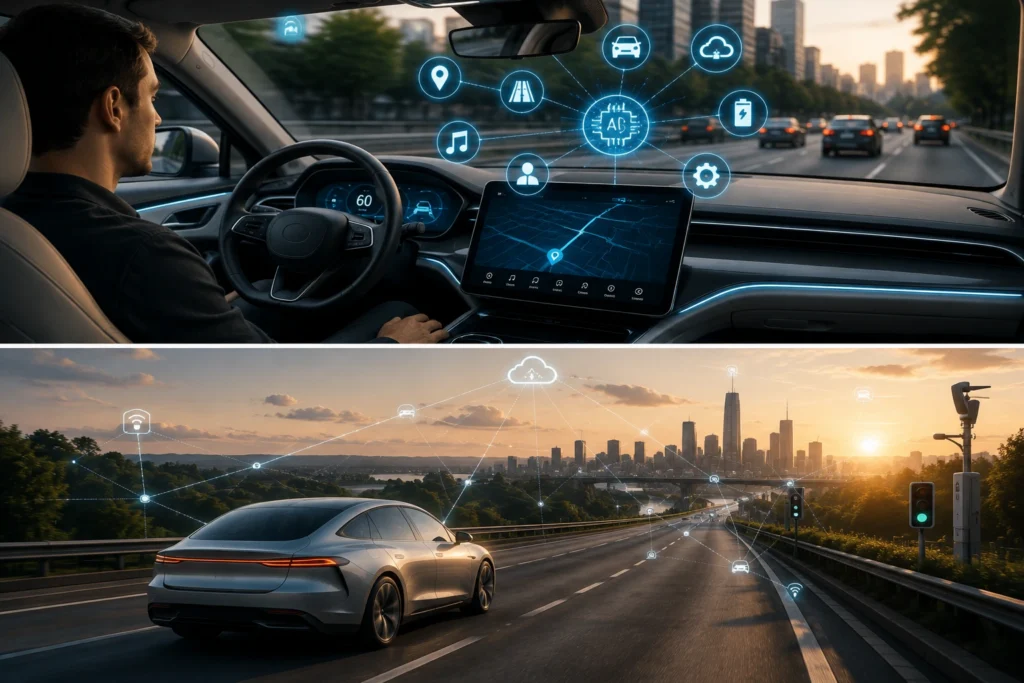
That could mean bringing together cameras, radar, navigation data, vehicle sensors, traffic information and even information from connected infrastructure. The agent can then interpret that information and decide which actions are needed.
Think of it as the difference between telling your car what to do and telling it what you want to achieve.
Ask a conventional system to find a charging station and it might simply show you nearby chargers. A more capable automotive AI agent could potentially consider your remaining range, traffic conditions, your preferred route and the availability of chargers before recommending where to stop.
That’s where autonomous agents in cars start to get genuinely interesting. The car isn’t just executing isolated commands anymore; it is attempting to understand the bigger picture.
Of course, there’s an important caveat. The word autonomous can make this sound closer to science fiction than it really is. An autonomous agent doesn’t automatically mean a completely driverless car. The intelligence responsible for planning a task and the systems responsible for safely controlling a vehicle are not necessarily the same thing.
That distinction matters because the future of automotive AI isn’t simply about removing the driver. It could first be about giving the driver a car that is considerably better at understanding, planning and helping.
Autonomous Agents vs ADAS vs Self-Driving Cars
It’s easy to lump all of this technology into one bucket and call it “autonomous driving”. The reality is rather more complicated — and understanding the difference matters if we’re going to talk seriously about where autonomous agents fit into the car.
ADAS, or Advanced Driver Assistance Systems, is the starting point. These systems are designed to help the human behind the wheel. Adaptive cruise control, lane-keeping assistance, blind-spot monitoring and automatic emergency braking can all reduce the workload, but the driver remains responsible for driving.
Then things get more interesting with automated driving. At higher levels of automation, the vehicle can take over more of the driving task under specific conditions. The crucial phrase here is under specific conditions. A system designed for a motorway, for example, may have very different capabilities and limitations from one designed to operate a driverless taxi within a mapped urban area.
Self-driving cars take that idea further, with higher levels of automation allowing the vehicle to perform the driving task within its defined operating conditions. Level 4 systems can operate without a human driver in suitable environments, while Level 5 would mean full automation in essentially all driving situations.
And then there are autonomous agents.
An autonomous agent isn’t simply another level on the SAE automation ladder. Instead, think of it as an intelligent layer that can potentially understand a driver’s goal and coordinate different vehicle functions to achieve it. It could sit alongside driving and other vehicle systems, helping connect navigation, communication, vehicle settings, charging and eventually automated driving capabilities.
| Technology | What it mainly does |
|---|---|
| ADAS | Helps the driver |
| Automated driving | Takes over parts of the driving task under defined conditions |
| Self-driving systems | Can perform the driving task within their operational limits |
| Autonomous agents | Can understand goals and coordinate multiple vehicle functions |
That’s an important distinction because autonomous agents don’t automatically mean Level 5 autonomy. A car can have a sophisticated AI agent and still require a human driver.
And that’s probably the more realistic near-term future. Rather than waking up one morning to find every car capable of driving anywhere without supervision, we’ll likely see vehicles gradually become better at understanding what their occupants want — while automated driving capability develops alongside them.
What Could Autonomous Agents Actually Do?
This is where the idea of autonomous agents starts to move beyond the usual futuristic talk about cars driving themselves. The biggest change may not be what happens when you turn the steering wheel, but how many small decisions the car can make before you even get there.
Imagine finishing work on a Friday evening and telling your car: “Take me home, avoid the traffic and stop for a charge if I need one.”
Today, that could mean opening navigation, checking your range, finding a suitable charging station and adjusting the route yourself. A capable automotive AI agent could eventually bring those jobs together. It could look at your remaining battery range, traffic conditions, road closures, charging availability and your usual preferences before working out a route.
And it doesn’t have to stop there.
Autonomous agents in cars could potentially manage a growing list of everyday tasks:
- Route planning: choosing a route based on traffic, road conditions and your preferences.
- Charging and fuel: finding a suitable charging station or fuel stop before range becomes a problem.
- Vehicle settings: adjusting climate control, seating, mirrors or other settings according to the occupants.
- Parking: helping find available parking and, where supported, handling parts of the parking process.
- Maintenance: recognising vehicle information and reminding you when servicing or repairs may be required.
- Communication: handling calls, messages and other connected functions while keeping the driver’s attention on the road.
- Personalisation: learning preferences such as favourite routes, charging locations or cabin settings.
The interesting part is that these aren’t necessarily separate features. The strength of autonomous agents comes from connecting them.
For example, if your car knows that you’re heading home, it could consider the traffic ahead, your battery level and the weather before deciding whether your usual route still makes sense. If you’re running low on charge, it could factor a charging stop into the journey rather than waiting for you to ask.
That’s a very different proposition from simply having a voice assistant sitting on the dashboard.
The car becomes less like a collection of individual electronic features and more like a system that can understand a goal and work through the steps required to achieve it.
And if the technology develops as expected, that could be one of the biggest changes brought by automotive AI — not necessarily making every journey driverless, but making the car far better at figuring out what needs to happen next.
The Benefits of Autonomous Agents
Let’s be honest: nobody buys a car because its processor has another few billion operations per second. They buy it because they want the thing to make life easier — and, ideally, make the journey better.
That’s where autonomous agents could earn their keep.
The obvious headline is safety. A vehicle that can continuously monitor its surroundings doesn’t get distracted by a phone notification, tired after a long day at work or lose concentration halfway through a motorway journey. Advanced driver-assistance systems already do some of this today. The potential with autonomous agents is to combine that awareness with a much wider understanding of what is happening around the vehicle.
But safety isn’t the only reason this technology matters.
Safety without the superhero claims
The promise isn’t that AI will magically eliminate crashes. Roads are messy, unpredictable places, and even very sophisticated systems can encounter situations they weren’t designed to handle.
What autonomous agents could offer is consistency.
They don’t get bored after two hours in traffic. They don’t become impatient because somebody has been crawling along in the overtaking lane. And they don’t decide that checking a notification is more important than watching the road.
If autonomous driving systems eventually become capable enough to handle more of the driving task, that consistency could become one of their biggest advantages.
Less faff, more driving
Then there’s convenience.
Imagine getting into the car on a cold morning and not having to think about whether the cabin needs warming up, which route is best or where you’ll charge later in the day. Your car already knows the destination, understands your preferences and has access to the information required to plan the journey.
That’s where AI in cars becomes genuinely useful rather than simply another impressive demonstration at a motor show.
The best technology is usually the stuff you stop noticing because it just works.
Making mobility more accessible
There is also a much bigger prize here.
For people who cannot drive because of age, disability or other limitations, increasingly capable autonomous vehicles could eventually provide a level of independence that conventional cars simply cannot.
We’re not there yet, and it would be irresponsible to suggest otherwise. But if automated driving becomes reliable enough in increasingly complex environments, the benefit isn’t merely that existing drivers get a more relaxing commute.
It could mean that some people who currently depend on somebody else for transport gain a new degree of freedom.
And then there’s efficiency
A car that can see further ahead than the driver, understand traffic conditions and plan its route intelligently could potentially avoid unnecessary stops, harsh acceleration and inefficient detours.
For an electric vehicle, that could mean better energy management. For a petrol or diesel car, it could mean less wasted fuel.
But again, let’s keep the brakes on the hype train. Autonomous agents won’t automatically make every journey greener. How much energy and congestion they save will depend on how the technology is used, how many vehicles are on the road and how the wider transport system evolves.
The real promise is simpler: a car that spends less time reacting and more time intelligently planning what comes next.
And that brings us to the awkward question nobody can avoid — how much of the driving are we actually prepared to hand over to the machine?
Can Autonomous Agents Really Drive?
This is where things get a little more complicated — and where the marketing departments need to be kept on a fairly short leash.
It is tempting to look at an impressive demo, watch a car negotiate a junction without human input and conclude that fully autonomous driving is just waiting for someone to press the right button. It isn’t.
Autonomous agents may become an important part of how future vehicles understand situations and decide what to do, but making a car actually drive itself safely is a much bigger engineering problem.
A useful way to think about it is that an autonomous car needs several layers of intelligence working together.
The vehicle has to see what is around it. Cameras, radar and other sensors need to identify vehicles, pedestrians, cyclists, road markings and hazards. It then needs to understand what those objects are doing. A pedestrian standing near a crossing is one thing; a pedestrian who has started walking into the road is quite another.
Then comes the really difficult bit: what should the car do next?
Should it brake? Change lane? Wait? Continue? Is that gap actually large enough? Is the cyclist about to move across the vehicle’s path? What happens when the road layout doesn’t quite match the map?
This is where increasingly capable automotive AI could become useful. An autonomous agent could potentially help interpret the wider context and plan a sequence of actions rather than simply responding to one isolated event.
But planning isn’t the same as controlling a two-tonne machine at 80km/h.
The systems responsible for vehicle control still need to be extraordinarily predictable. A human driver can make a judgement call in a strange situation and immediately adjust when it turns out to be wrong. An AI system needs to be validated against an enormous range of possibilities before we’re comfortable letting it make those decisions without supervision.
That’s also why self-driving cars are arriving in stages rather than appearing everywhere overnight. Level 4 autonomous vehicles can operate without a human driver within defined conditions, while Level 5 would require the vehicle to handle essentially every driving situation.
We’re nowhere near being able to casually throw the keys to an AI and say, “You take it from here.”
And perhaps that’s not the point.
The more interesting future may be a car where autonomous agents handle increasingly complicated decisions while specialised safety and driving systems keep everything within their limits.
In other words, the future probably isn’t one giant AI brain replacing every other system in the car.
It’s a team effort.
And getting that team to behave safely when the road throws something completely unexpected at it is going to be the hard part.
The Challenges on the Road to Autonomous Agents
Here’s the bit where we put the champagne back in the fridge.
Because while autonomous agents sound brilliant on paper, a car isn’t a chatbot with four wheels. If an AI gets a question wrong, you can laugh at the odd answer. If a car gets a decision wrong at 100km/h, the consequences are rather less amusing.
The road is full of surprises
One of the biggest problems for autonomous driving is dealing with situations that don’t behave as expected.
A neatly marked motorway on a sunny afternoon is one thing. A temporary road closure, faded lane markings, heavy rain, a cyclist filtering through traffic or a pedestrian stepping out from behind a parked vehicle is another.
Human drivers are remarkably good at dealing with these odd little moments because we’ve spent our entire lives learning how roads work. Teaching a machine to handle every possible combination of events is considerably harder.
And that’s before we get to roads that were never designed with AI-powered cars in mind.
India will be a particularly interesting test
Take an Indian city during rush hour.
You’ve got cars, bikes, auto-rickshaws, buses, pedestrians, delivery vehicles and the occasional animal all competing for the same patch of road. Lane markings can disappear, traffic patterns can change in seconds and the vehicle in front may suddenly decide that a completely different interpretation of the road is the correct one.
For an autonomous vehicle, that’s an enormous amount of information to process.
An autonomous agent may be able to reason about the situation, but reasoning alone isn’t enough. The underlying sensors, maps, software and vehicle-control systems all have to work reliably together.
Then there’s cybersecurity
The smarter the car becomes, the more valuable it becomes to someone who wants to break into it.
An automotive AI agent could eventually have access to navigation, communications, vehicle settings and other connected functions. That creates enormous potential, but it also creates a larger attack surface.
A future car that can make decisions on your behalf needs to be exceptionally good at knowing who is actually allowed to give it instructions.
And who is responsible when things go wrong?
This might be the biggest question of all.
If a human driver makes a mistake, responsibility is relatively straightforward. But what happens when an autonomous agent makes a decision, the automated driving system follows it and something goes wrong?
Is it the driver? The manufacturer? The software developer? The company operating the autonomous service?
Regulators and manufacturers will have to answer questions like these before highly automated vehicles can become commonplace.
There is another risk that gets less attention: trust.
If your car handles more and more of the driving, you may become less prepared to take over when it suddenly needs you. That’s one of the awkward contradictions of automated driving. The better the system becomes, the easier it may be for the human to stop paying attention.
So yes, the technology is exciting. But the smartest autonomous agents will ultimately need to know not only what they can do, but also when they shouldn’t.
What Autonomous Agents Could Mean for Indian Roads
If there’s one place where the promise of autonomous agents will have to prove itself rather than simply look impressive in a technology demonstration, it’s India.
Indian roads don’t exactly follow the script.
A car might have to deal with motorcycles squeezing through gaps, pedestrians crossing wherever they can find space, inconsistent lane markings, sudden roadworks and traffic patterns that can change from one junction to the next. Add monsoon rain, dust, poorly marked diversions and the occasional surprise obstacle, and you’ve got a rather serious test for any autonomous driving system.
This doesn’t mean India can’t adopt autonomous vehicles. It means the technology will need to be exceptionally good at understanding context.
A system trained primarily around predictable roads and clearly defined lanes may have a much harder time when the road itself becomes ambiguous. That’s where more capable autonomous agents could eventually have an advantage: not because they magically understand chaos, but because they could potentially combine more sources of information and reason about what is happening rather than relying entirely on predefined scenarios.
There could also be a more gradual route to adoption.
Highways, controlled-access roads, dedicated autonomous transport services and carefully mapped urban zones are likely to be easier environments for advanced automation than a chaotic city-centre junction at rush hour.
And that’s probably the sensible way to look at the future.
We don’t need every car in India to suddenly become a Level 5 robotaxi. If AI in cars can first make driving safer, navigation smarter and vehicle management easier, that’s already a pretty worthwhile step forward.
The technology can then earn its way towards greater autonomy.
The Road Ahead for Autonomous Agents
The most interesting future isn’t necessarily a car that simply says, “Don’t worry, I’ll drive.”
It’s a car that understands the journey before you do.
It knows where you’re going. It understands the traffic ahead. It knows how much fuel or battery you have left. It remembers that you prefer quieter routes. It can arrange a charging stop, adjust the cabin and perhaps even tell you that the car needs servicing before a small problem becomes an expensive one.
That’s the real promise of autonomous agents.
They could turn the vehicle from a collection of clever but largely separate features into something that feels much more coordinated.
But the transition will be gradual. Self-driving cars will continue to develop alongside better sensors, mapping, computing and vehicle-control systems, while automotive AI becomes increasingly capable of understanding context and handling more complicated tasks.
And there’s a good chance that we’ll barely notice some of the most important changes.
The best automotive technology has a habit of disappearing into the background once it works properly.
You don’t marvel at ABS every time you brake hard. You don’t congratulate adaptive cruise control for maintaining a gap in traffic. Eventually, today’s futuristic AI-powered cars may feel just as ordinary.
The interesting question isn’t whether cars will become smarter.
It’s how much responsibility we’ll eventually be comfortable giving them.
Frequently Asked Questions
What are autonomous agents in cars?
Autonomous agents are AI-based systems designed to understand goals, process information and coordinate multiple vehicle functions to perform tasks. They go beyond traditional driver-assistance features that are usually designed for a specific function.
Are autonomous agents the same as self-driving cars?
No. An autonomous agent is not automatically a self-driving system. It can potentially help coordinate vehicle functions and make decisions, while autonomous driving systems are specifically responsible for performing the driving task within defined operating conditions.
Can autonomous agents drive a car without a human?
Not necessarily. The presence of an autonomous agent does not mean a vehicle has Level 5 autonomy. Highly automated driving requires additional perception, planning, control, safety and validation systems.
How could autonomous agents improve driving?
They could potentially combine navigation, traffic information, vehicle data, charging or fuel requirements and driver preferences to plan and manage a journey more intelligently.
Will autonomous agents make cars safer?
They have the potential to improve safety by helping systems respond consistently and by reducing some tasks associated with human distraction or fatigue. However, autonomous agents cannot guarantee that accidents will be eliminated, and their safety depends on the complete vehicle system.
Could autonomous agents work on Indian roads?
Potentially, but Indian roads present a particularly demanding environment for autonomous driving because of mixed traffic, unpredictable road behaviour, changing infrastructure and varying road markings. Systems would need extensive testing and validation for local conditions.
When will fully autonomous cars become common?
There is no reliable date for widespread Level 5 autonomous cars. Some Level 4 autonomous services are already operating in controlled areas, but fully autonomous driving across all roads and conditions remains a much harder challenge.
Will autonomous agents replace human drivers?
Not in the foreseeable future simply because an autonomous agent exists. The more likely path is a gradual increase in automation, with AI first taking on more planning, assistance and vehicle-management tasks before driving automation expands further.
Ride And Tech Verdict
Autonomous agents could become one of the most important developments in automotive technology, but their real significance isn’t simply about replacing the driver.
The more immediate transformation could be the way a car understands and manages a journey. Instead of treating navigation, charging, vehicle settings, communication and driver assistance as completely separate functions, autonomous agents could eventually bring them together around what the driver actually wants to accomplish.
But there is still a long road ahead. Safety validation, unpredictable road conditions, cybersecurity, regulation and human trust all need to be addressed before highly autonomous vehicles can operate everywhere without supervision.
And India could be one of the toughest proving grounds. Our roads bring together cars, bikes, pedestrians, changing road layouts and plenty of situations that don’t appear in a neat test scenario.
Our verdict? Autonomous agents are more interesting than simply asking when cars will become fully driverless. They could fundamentally change what we expect from a car long before Level 5 autonomy becomes reality. The smartest car of the future may not simply be the one that drives itself — it may be the one that understands what you need before you have to ask.
Ride And Tech — Where Ride Meets Tech.
Drive Smarter. Ride Smarter.
Copyright (c) Ride And Tech. All rights reserved.

2 thoughts on “The Future of Autonomous Agents in Cars: Beyond Driver Assistance”