


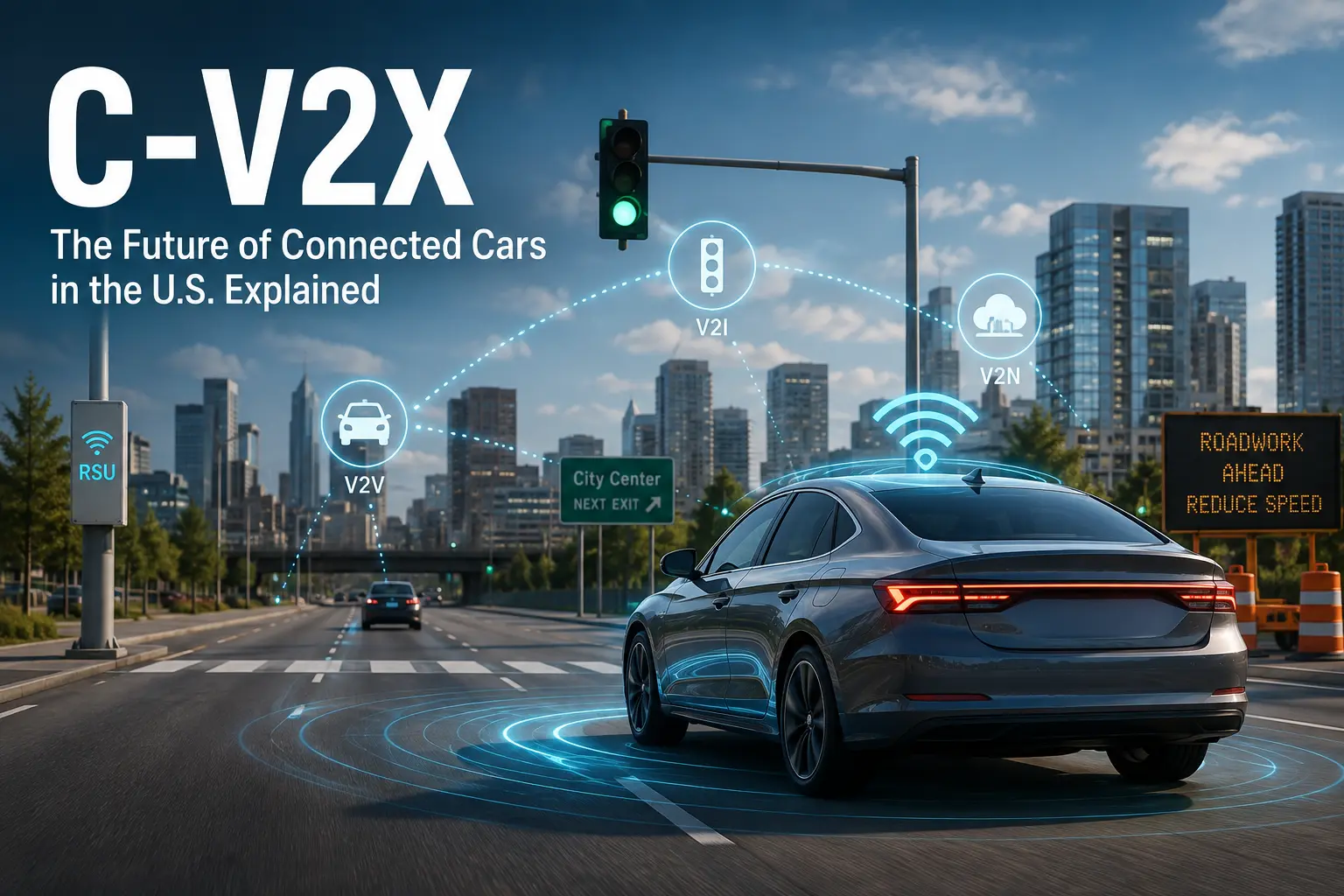
Cars are becoming increasingly good at seeing what is directly around them, but the next step in road safety is giving them the ability to know what is happening beyond their own sensors. That is where C-V2X comes in. Short for Cellular Vehicle-to-Everything, the technology allows vehicles to exchange information with other vehicles, roadside infrastructure and connected road users, creating another layer of awareness that cameras, radar and lidar cannot provide on their own.
The idea behind C-V2X technology is relatively simple: instead of every vehicle operating as an isolated machine, connected cars can share information about traffic, hazards, road conditions and their movements. That could mean a vehicle receiving an early warning about a car braking several vehicles ahead, an approaching emergency vehicle communicating with traffic infrastructure, or a roadside system telling vehicles that a signal is about to change. These applications make Vehicle-to-Everything technology particularly interesting as advanced driver assistance and automated driving continue to develop.
The U.S. is now moving beyond the experimental stage. Federal regulators have established a C-V2X framework for the upper portion of the 5.9 GHz band, while the U.S. Department of Transportation is pushing real-world deployments of connected-vehicle technology. For American roads, C-V2X is therefore becoming less about what connected cars might eventually do and more about how the infrastructure needed to make those conversations possible is being built today.
What Is C-V2X and Why Does It Matter?
At its simplest, C-V2X gives vehicles another way to understand what is happening around them by allowing them to exchange information beyond the range of their own onboard sensors. A connected car can communicate directly with another vehicle, receive information from roadside infrastructure or connect through cellular networks to access wider traffic and cloud-based services. That makes C-V2X technology less about replacing cameras, radar or lidar and more about adding another source of information to the vehicle’s decision-making process.
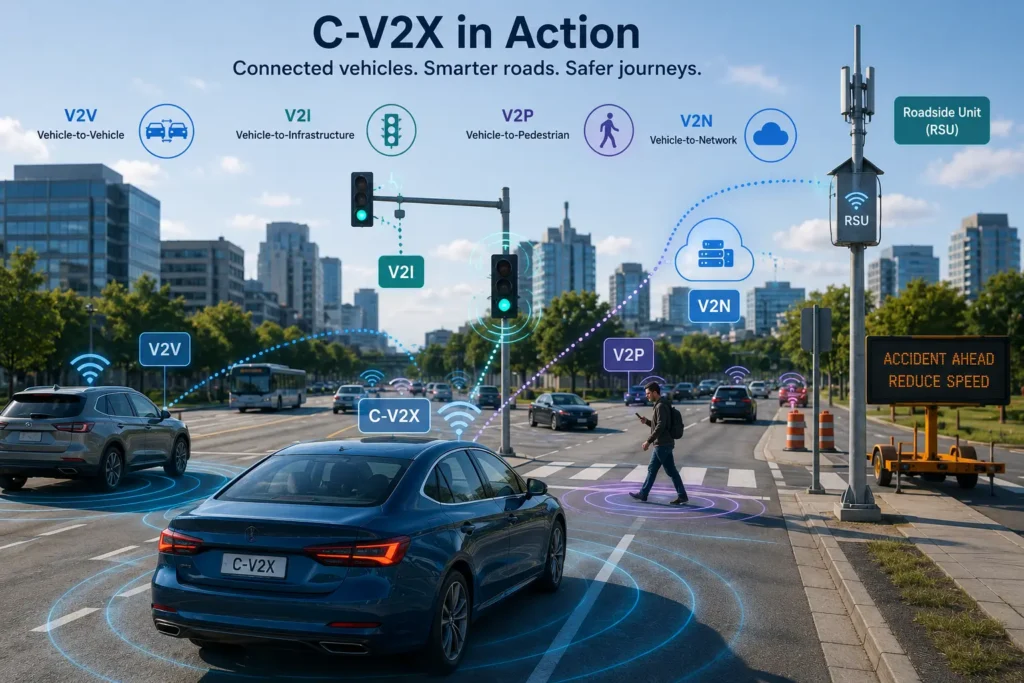
This is where the wider idea of Vehicle-to-Everything becomes important. V2X covers several forms of communication, including Vehicle-to-Vehicle (V2V), Vehicle-to-Infrastructure (V2I), Vehicle-to-Pedestrian (V2P) and Vehicle-to-Network (V2N). A car could, for example, receive a warning from another vehicle about sudden braking, communicate with a traffic signal or receive information about a road hazard before that hazard is visible to its own sensors. For connected cars, the advantage is an expanded view of the road rather than simply a faster version of existing vehicle connectivity.
The real promise of C-V2X in the United States is therefore its ability to support safety and traffic applications at scale. It can help vehicles and infrastructure share time-sensitive information that a driver or individual vehicle might otherwise discover too late. It is not autonomous driving by itself, and it cannot eliminate the need for conventional safety systems, but it could become an important additional layer as roads, vehicles and traffic infrastructure become increasingly connected.
Read More: Software-Defined Vehicles
How C-V2X Lets Vehicles Talk to the Road Around Them
The useful part of C-V2X is not simply that one vehicle can talk to another. Its real value comes from creating a wider communication layer around the vehicle. Through Vehicle-to-Vehicle communication, cars can share information such as position, movement and braking events, potentially giving following vehicles an earlier warning than their own sensors could provide. Vehicle-to-Infrastructure communication takes the idea beyond the car itself, allowing vehicles to exchange information with traffic signals, roadside units and other connected road equipment.
The same principle can extend to pedestrians, cyclists and wider network services. V2P communication can help connected vehicles receive information about vulnerable road users, while Vehicle-to-Network communication can connect the vehicle to cloud services and wider traffic systems. These different applications are why C-V2X automotive technology is being considered for everything from collision warnings and emergency-vehicle priority to smarter traffic management and future automated-driving systems.
There is an important caveat, though: the benefits depend on enough vehicles and infrastructure actually being connected. A car cannot receive a warning from a roadside unit that doesn’t exist, nor can it communicate with another vehicle that lacks the necessary technology. That makes deployment just as important as the communication technology itself. The long-term promise of C-V2X is therefore not about giving a single car a magical new sense; it is about gradually turning the road itself into a connected system.
Why the U.S. Is Moving Away From DSRC
For years, the U.S. connected-vehicle debate was split between DSRC and C-V2X. Dedicated Short-Range Communications was the earlier approach for vehicle connectivity, using the 5.9 GHz Intelligent Transportation Systems band for direct communication. C-V2X technology, meanwhile, offered a cellular-based route that could support both direct vehicle communication and wider network connectivity, making it attractive as cellular technology continued to evolve.
The regulatory picture has now become considerably clearer. In November 2024, the Federal Communications Commission adopted rules that established C-V2X as the technology for Intelligent Transportation Systems operations in the upper 30 MHz of the 5.9 GHz band, while providing a transition path away from DSRC. The rules became effective in February 2025. That is an important change because it moves the U.S. conversation beyond simply asking which technology might win and towards building an ecosystem around the chosen approach.
The shift does not mean every American road suddenly becomes C-V2X-enabled. Vehicles, roadside equipment and supporting infrastructure still need to be deployed, and those systems need to work together reliably. But for C-V2X in the United States, the regulatory direction is no longer particularly ambiguous. The technology now has a defined place in the country’s 5.9 GHz ITS framework, giving automakers, infrastructure providers and transport authorities a clearer foundation on which to build connected-road applications.
C-V2X and the 5.9 GHz Safety Band
The 5.9 GHz band is one of the most important pieces of the U.S. C-V2X puzzle because it provides dedicated spectrum for Intelligent Transportation Systems. In its 2024 rules, the FCC designated the upper 30 MHz of the band, from 5.895 to 5.925 GHz, for C-V2X-based ITS operations. That matters because safety-critical communication needs a reliable path between vehicles and infrastructure rather than depending entirely on ordinary consumer cellular traffic.
For drivers, the technical details matter less than what the spectrum can enable. A connected vehicle could receive information from a roadside unit about a traffic signal, roadworks or an approaching hazard, while another vehicle could transmit a warning about sudden braking or a developing collision risk. These are the kinds of V2X safety applications that make low-latency direct communication useful, particularly when the information needs to reach nearby vehicles quickly rather than travel through a distant cloud service first.
The 5.9 GHz allocation is therefore more than a technical footnote in the C-V2X automotive story. It is part of the infrastructure needed to make connected-road applications dependable at scale. The challenge now is turning that regulatory framework into real roadside deployments and getting enough vehicles equipped to make the communication network genuinely useful.
Where C-V2X Is Already Being Deployed
The C-V2X story in the U.S. is no longer limited to demonstrations and technology trials. The U.S. Department of Transportation has been pushing real-world deployment through its national V2X strategy and funding programmes, with projects designed to put connected-vehicle technology into actual road environments. In 2024, USDOT announced nearly $60 million in grants for projects in Arizona, Texas and Utah, supporting applications including emergency-vehicle priority, vulnerable-road-user detection, transit and freight signal priority, and roadside communication infrastructure.
These projects matter because they show what C-V2X deployment is supposed to look like when it leaves the laboratory. Instead of treating connectivity as another feature buried inside a vehicle’s infotainment system, the technology can connect the car with traffic signals, roadside units and transport systems. An approaching emergency vehicle, for example, could communicate with infrastructure to help clear a route, while connected road equipment could share information about hazards or changing traffic conditions with nearby vehicles.
The U.S. Department of Transportation’s national deployment plan also reflects a broader push to accelerate V2X technology across American roads. The goal is not to make every vehicle autonomous overnight, but to build a connected transport environment where vehicles and infrastructure can exchange useful safety and mobility information. That gradual approach is important: the value of C-V2X will ultimately depend less on how impressive a demonstration looks and more on how widely the technology becomes available to ordinary drivers.
What C-V2X Could Mean for Drivers
For most drivers, C-V2X will only become interesting when it starts doing something useful on an ordinary journey. The most obvious benefit is safety. A connected vehicle could receive an alert about a car braking suddenly ahead, a vehicle approaching an intersection, roadworks around a blind bend or an emergency vehicle moving through traffic. Because the information can come from another vehicle or roadside infrastructure, the warning does not necessarily depend on the hazard already being visible to the driver’s own sensors.
Traffic management is another area where C-V2X technology could make a noticeable difference. Connected traffic signals can communicate with vehicles and transport systems, helping coordinate traffic flow and potentially giving priority to buses, emergency vehicles or freight. In cities, that could mean fewer unnecessary stops and better use of existing road infrastructure. For connected cars, the bigger idea is that the vehicle becomes part of the traffic system rather than simply reacting to whatever happens immediately in front of it.
There is also a longer-term connection with automated driving. V2X technology can provide information that onboard cameras, radar and lidar cannot always see, such as what is happening around a corner or several vehicles ahead. That could help advanced driver-assistance systems make better decisions, particularly in complex traffic environments. But C-V2X should not be mistaken for autonomous driving itself. It is another information source, and its usefulness will depend on reliable infrastructure, widespread vehicle adoption and systems that can interpret the information safely.
The Challenges C-V2X Still Has to Solve
The biggest challenge for C-V2X is not proving that vehicles can communicate; it is building enough of the surrounding ecosystem for that communication to become genuinely useful. A connected car passing through one C-V2X-enabled intersection is of limited benefit if the next several miles have no connected roadside infrastructure and most surrounding vehicles cannot exchange the same information. That makes widespread adoption a gradual process involving automakers, road authorities, infrastructure providers and technology companies rather than something a vehicle manufacturer can solve on its own.
Interoperability and cybersecurity are equally important. Different vehicles and roadside systems need to exchange information reliably, while safety-critical messages must be protected against manipulation or malicious interference. Privacy also needs careful consideration as connected vehicles increasingly share information about their location and movements. These challenges don’t make C-V2X technology impractical, but they do explain why deployment has to be approached as transport infrastructure rather than simply another feature added to a new car.
Cost is another hurdle, particularly for cities and road authorities that need to install and maintain roadside equipment. The U.S. regulatory framework gives C-V2X in the United States a clearer direction, but regulation alone cannot create a connected road network. The real test will be whether deployment can expand far enough for drivers to experience meaningful benefits rather than isolated demonstrations.
Is C-V2X the Future of Connected Cars?
The direction is becoming increasingly clear. C-V2X is not going to replace every safety system inside a car, nor will it suddenly make today’s vehicles autonomous, but it can give connected cars something they have never had before: a shared understanding of what is happening beyond their own sensors. As more vehicles, traffic signals and roadside systems become connected, that extra layer of information could make advanced driver-assistance systems more responsive and help traffic infrastructure work more intelligently.
For the U.S., the important change is that C-V2X technology now has both regulatory backing and a growing deployment strategy behind it. The FCC’s move to establish C-V2X in the upper 30 MHz of the 5.9 GHz ITS band, combined with USDOT’s push for real-world V2X projects, gives the technology a clearer path than it had a few years ago.
The real measure of success, however, will not be how sophisticated the technology sounds. It will be whether a driver can eventually travel through an American city and receive useful warnings, smarter traffic signals and better information without having to think about the technology working underneath it. If that happens at scale, C-V2X could become one of those pieces of automotive technology that drivers rarely see but increasingly rely on — quietly turning the road itself into part of the connected car.
Frequently Asked Questions About C-V2X
What does C-V2X mean?
C-V2X stands for Cellular Vehicle-to-Everything. It is a communication technology that allows vehicles to exchange information with other vehicles, roadside infrastructure, pedestrians and wider networks. The technology is designed to support safety, traffic-management and connected-vehicle applications.
How is C-V2X different from V2X?
V2X is the broader concept of communication between vehicles and their surroundings, while C-V2X is a specific cellular-based technology used to enable those communications. V2X includes applications such as V2V, V2I, V2P and V2N, while C-V2X provides the communication technology that can support them.
Is C-V2X being used in the United States?
Yes. The U.S. has established a regulatory framework for C-V2X operation in the upper 30 MHz of the 5.9 GHz Intelligent Transportation Systems band, while the U.S. Department of Transportation is supporting real-world V2X deployments across several states.
Does C-V2X make cars autonomous?
No. C-V2X technology is not an autonomous-driving system by itself. It provides vehicles with additional information about their surroundings that can complement cameras, radar, lidar and other driver-assistance technologies. Its role is to improve awareness and support safer, more coordinated driving.
Why is C-V2X important for connected cars?
C-V2X can allow connected cars to receive information that their own sensors may not be able to detect, such as a hazard around a corner, an approaching emergency vehicle or changing traffic-signal conditions. If adoption becomes widespread, it could make both vehicles and road infrastructure more responsive and better connected.
Ride And Tech Verdict
C-V2X is one of those technologies that could become far more important than it looks from inside the car. Drivers may never see the roadside units or think about the communication happening between vehicles, but that invisible layer could eventually provide warnings and traffic information that conventional onboard sensors cannot deliver on their own. The U.S. has also moved beyond simply debating the technology, with the FCC establishing its C-V2X framework for the upper 30 MHz of the 5.9 GHz ITS band and USDOT supporting real-world deployment projects.
The catch is that C-V2X only becomes truly valuable when enough vehicles and infrastructure are connected. That means the technology has a long road ahead, with deployment costs, interoperability, cybersecurity and adoption still needing to be addressed. But the underlying idea is compelling: instead of every car reacting independently to what its sensors can see, vehicles and the road infrastructure can begin sharing information about what is happening around them.
Our verdict: C-V2X isn’t the technology that will make cars autonomous, but it could make the roads themselves smarter. If the U.S. can turn its current regulatory direction and pilot projects into a genuinely widespread network, C-V2X could become an important piece of the connected-car future — working quietly in the background while making everyday driving safer and more predictable.
Ride And Tech — Where Ride Meets Tech.
Drive Smarter. Ride Smarter.
Copyright (c) Ride And Tech. All rights reserved.

3 thoughts on “C-V2X: How Connected Cars Are Changing the Future of U.S. Roads”