



Your car battery may be one of the easiest parts of a vehicle to forget about—until the engine refuses to start. A healthy battery does much more than start the engine. It supplies electrical power when required, works with the vehicle’s charging system and supports everything from lights and electronics to modern safety and convenience features.
The good news is that proper car battery care can help reduce the risk of unexpected failure and may extend the useful life of the battery. Most conventional automotive batteries have a finite lifespan, with many lasting around three to five years, although climate, driving habits, vibration, battery type and charging-system condition can make a significant difference.
This guide explains car battery maintenance, the warning signs of a weak battery, what causes battery drain, how weather affects battery health, and when it may be time for car battery replacement.
Important: This article focuses primarily on conventional 12V car batteries used for starting and vehicle electrical systems. Battery packs used for fully electric vehicles are a different technology and should not be serviced using these procedures.
What Does a Car Battery Do?
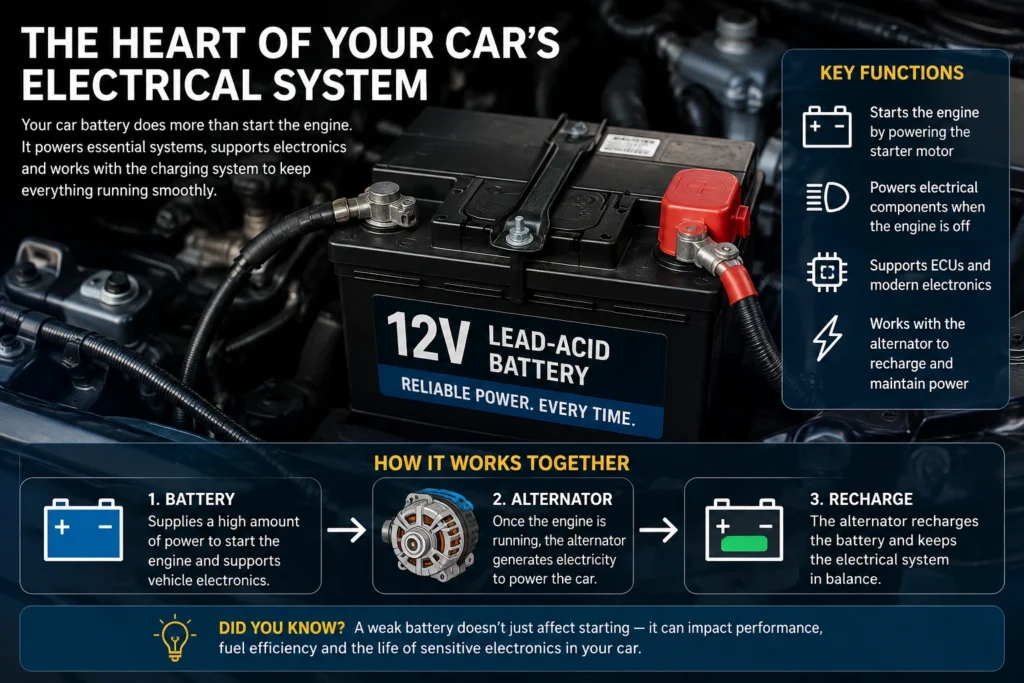
A typical 12V car battery provides the electrical energy required to start the engine and supports the vehicle’s electrical system when necessary.
When you start a conventional petrol or diesel vehicle, the battery supplies a large amount of electrical power to the starter motor. Once the engine is running, the alternator generally supplies electrical power and replenishes the battery.
This means the battery and charging system work together rather than operating independently.
A battery that repeatedly loses charge may therefore have a battery problem, a charging-system problem, excessive electrical load or another underlying issue.
Understanding this relationship is important because replacing the battery alone may not solve the problem if the alternator or another component is responsible for the discharge.
Read More: Bike Chain Maintenance
How Long Does a Car Battery Last?
There is no single answer to car battery lifespan because several factors influence how quickly a battery deteriorates.
Many conventional automotive batteries last approximately three to five years, although some can last longer under favourable conditions. AAA identifies time, heat and vibration among the major factors affecting battery life.
Your battery may age faster if:
- The vehicle is driven mainly on very short trips
- The car remains parked for long periods
- The battery is exposed to extreme heat
- The battery experiences excessive vibration
- The charging system is malfunctioning
- The battery repeatedly becomes completely discharged
- Electrical accessories continue operating when the engine is off
Therefore, battery age should be treated as a useful warning indicator rather than an exact replacement deadline.
10 Car Battery Care Tips to Extend Battery Life
Good car battery maintenance doesn’t require checking the battery every day. A few simple habits can help you identify problems early and reduce unnecessary stress on the battery.
1. Inspect the Battery Regularly
Start with a simple visual inspection.
Look for:
- Corrosion around the terminals
- Cracks in the battery case
- Swelling or deformation
- Loose connections
- Damaged cables
- A battery that isn’t securely mounted
A properly secured battery is important because excessive vibration can contribute to internal damage and shorten battery life.
If you notice a swollen, cracked or leaking battery, don’t attempt an improvised repair. Have it inspected or replaced by a qualified professional.
2. Keep the Battery Terminals Clean
Dirty or corroded car battery terminals can interfere with the electrical connection between the battery and the vehicle.
Corrosion may appear as a white, blue or greenish buildup around the terminals.
Excessive corrosion can increase electrical resistance and contribute to starting problems.
As part of routine car battery maintenance, inspect the terminals periodically and keep the connections clean and secure.
If you plan to clean battery terminals yourself, wear appropriate eye and hand protection and follow the vehicle and battery manufacturer’s instructions.
3. Avoid Excessive Short Trips
Frequent short journeys can be hard on a car battery.
Starting the engine requires a significant amount of electrical energy. A very short drive may not give the charging system enough time to replenish the energy used during starting.
If your vehicle is regularly used only for very short journeys, the battery can gradually lose its state of charge.
This doesn’t mean you need to take unnecessary long drives solely for the battery. Instead, be aware that repeated short trips can contribute to battery discharge and consider having the battery tested if starting performance begins to decline.
4. Don’t Leave Electrical Accessories Running
Lights, infotainment systems, charging devices and other electrical accessories can continue drawing power when the engine isn’t running.
Leaving headlights or other high-load accessories switched on can discharge the battery, sometimes enough to prevent the vehicle from starting.
Make it a habit to check that unnecessary electrical equipment is switched off before leaving the vehicle.
Modern cars often have automatic shut-off systems, but drivers shouldn’t rely entirely on them.
5. Drive the Car Regularly
Extended periods of inactivity can contribute to car battery drain.
Even when a vehicle is parked, some electrical systems continue consuming a small amount of power. Over a long enough period, this can reduce the battery’s state of charge.
If you know your vehicle will remain parked for an extended period, consult the owner’s manual about appropriate battery-maintenance or storage procedures. A suitable battery maintainer may be appropriate for some vehicles, but it should be compatible with the battery and vehicle’s electrical system.
6. Protect Your Battery From Extreme Temperatures
Temperature has a major effect on car battery health.
Car Battery in Hot Weather
High temperatures can accelerate battery degradation. AAA identifies heat as one of the major factors affecting battery life, and batteries operating in hot climates can have shorter lifespans.
Where practical, parking in a garage or shaded location can reduce prolonged exposure to extreme heat.
Car Battery in Cold Weather
Cold weather can make it harder for an engine to start and places additional demands on the battery.
A battery that is already weak may therefore show its problems more clearly during cold conditions.
Before extreme weather seasons, having an older battery tested can help identify potential problems before they leave you stranded.
7. Make Sure the Battery Is Properly Secured
A battery should be securely mounted using the vehicle’s designated hold-down system.
Excessive movement and vibration can damage internal battery components over time.
If the battery appears loose, don’t simply add improvised restraints. Have the correct mounting hardware checked and installed according to the vehicle manufacturer’s requirements.
8. Check the Charging System
A battery doesn’t work alone.
The alternator and charging system are responsible for supplying electrical power while the engine is running and replenishing the battery.
A malfunctioning charging system can cause persistent undercharging or overcharging, both of which can shorten battery life.
If a replacement battery repeatedly becomes weak, the charging system should be checked rather than repeatedly replacing batteries.
9. Test an Older Battery Periodically
A battery can sometimes fail without providing dramatic warning signs.
As a battery gets older, periodic testing can provide useful information about its condition.
AAA recommends testing a battery once it reaches around three years of age and annually thereafter.
A professional battery test can help determine whether the battery still has sufficient starting capacity or whether car battery replacement should be planned.
10. Follow the Manufacturer’s Battery Requirements
Not every vehicle uses the same battery.
Depending on the vehicle, you may encounter conventional flooded lead-acid batteries, AGM batteries, EFB batteries or other designs.
Some modern vehicles have battery-management systems that require specific replacement procedures or battery registration after installation.
Always check the owner’s manual or manufacturer specifications before replacing or servicing the battery.
Read More: Koenigsegg CCGT1 Unveiled at Monterey Car Week 2026
What Causes Car Battery Drain?
Understanding what drains a car battery can help prevent repeated starting problems.
Common causes include:
Leaving Lights On
Headlights, interior lights or other electrical equipment can discharge the battery when the engine isn’t running.
Long-Term Parking
A parked vehicle still uses a small amount of electricity for security, monitoring and other electronic systems.
Short Trips
Repeated short journeys may not provide enough time for the charging system to replenish the energy used during starting.
Electrical Faults
A faulty component or wiring problem can create an abnormal parasitic electrical draw.
Aging Battery
An old battery gradually loses its ability to store and deliver electrical energy.
Charging-System Problems
An alternator or related charging-system fault can leave the battery undercharged even when the vehicle is being driven.
If your battery repeatedly goes flat despite being relatively new, don’t automatically assume the battery itself is defective. The vehicle’s electrical and charging systems should also be inspected.
Weak Car Battery Symptoms You Should Never Ignore
Recognizing weak car battery symptoms early can help prevent an unexpected breakdown.
Here are some of the most common signs of a weak car battery:
Slow Engine Cranking
If the starter sounds noticeably slower than usual, the battery may be losing its ability to provide sufficient starting power.
However, slow cranking can also result from starter or electrical-system problems, so testing is important.
Clicking When Starting
A clicking sound when attempting to start the vehicle can be associated with a weak battery or poor electrical connections.
It can also indicate other starting-system problems, so don’t assume the battery is always responsible.
Dim or Flickering Lights
Headlights or other electrical components that appear unusually dim or behave inconsistently can indicate battery or charging-system problems.
Battery or Charging Warning Light
A battery-shaped warning light on the dashboard may indicate a problem with the charging system rather than simply a weak battery.
If the warning light remains illuminated while driving, have the vehicle checked.
Frequent Jump-Starts
If your vehicle repeatedly requires jump-starts, the battery may no longer be holding sufficient charge.
However, repeated discharge can also be caused by an electrical fault or charging-system issue.
Unusual Smell
A strong sulphur or rotten-egg smell can indicate a damaged or overcharged battery.
Swollen Battery Case
A swollen or deformed battery case can indicate serious battery damage or overheating.
Don’t continue using a visibly damaged battery without professional inspection.
How to Check Your Car Battery Health
A basic visual inspection can identify obvious problems, but a proper battery test is more useful for determining battery condition.
Step 1: Check the Battery Age
Look for the battery’s manufacturing or installation date if available.
If the battery is approaching the typical end of its service life, testing becomes increasingly important.
Step 2: Inspect the Terminals
Look for corrosion, loose connections or damaged cables.
Step 3: Look for Physical Damage
Check for swelling, cracks, leaks or other visible damage.
Step 4: Pay Attention to Starting Behaviour
Notice whether the engine is cranking slower than usual.
Step 5: Check the Dashboard
Look for battery or charging-system warning lights.
Step 6: Get a Professional Battery Test
A battery tester can provide a much better assessment than simply checking whether the engine starts.
If you’re experiencing repeated battery problems, have the battery, starting system and charging system checked together.
When to Replace a Car Battery
Knowing when to replace a car battery can prevent you from waiting until it completely fails.
Consider having the battery tested if:
- It is several years old
- The engine cranks slowly
- You frequently need jump-starts
- Electrical accessories are behaving unusually
- The battery warning light appears
- The battery is visibly damaged
- The battery repeatedly loses charge
- A battery test shows significantly reduced performance
Many batteries last around three to five years, but climate and usage can move that timeframe in either direction.
Don’t replace a battery based solely on age if it is performing well and testing healthy. Instead, use age as a reason to monitor its condition more closely.
Choosing the Right Replacement Battery
When car battery replacement becomes necessary, choosing the correct battery is essential.
There is no universal battery that fits every car.
Before purchasing a replacement, verify:
- Battery size
- Battery type
- Terminal position
- Required capacity
- Cold-cranking rating where specified
- Manufacturer requirements
- AGM/EFB compatibility where applicable
- Vehicle battery-management requirements
AAA notes that battery size, terminal configuration and starting-power specifications are important when selecting a replacement.
For modern vehicles, installing the wrong battery type can create charging or electrical-system problems.
If you’re unsure, use the vehicle manufacturer’s specification or consult a qualified technician.
AGM, EFB and Conventional Car Batteries: What’s the Difference?
Not all 12V batteries are identical.
Conventional Lead-Acid Batteries
Traditional flooded lead-acid batteries remain common in many vehicles.
Some designs require more maintenance than modern sealed batteries, while others are designed to be maintenance-free.
EFB Batteries
Enhanced Flooded Batteries are commonly used in vehicles with systems such as start-stop technology.
AGM Batteries
Absorbent Glass Mat batteries are designed for vehicles with higher electrical demands and certain start-stop applications.
AGM batteries use a different internal construction and charging requirements can differ from conventional batteries. AAA notes that some newer vehicles with AGM batteries require careful charging control.
Always follow your vehicle manufacturer’s specification when choosing a replacement.
Can You Extend Car Battery Life?
Yes, although no maintenance routine can prevent eventual battery aging.
The best approach is to reduce avoidable stress on the battery:
- Keep terminals clean
- Avoid leaving electrical accessories running
- Don’t ignore slow starting
- Drive the vehicle regularly
- Avoid repeated unnecessary short trips
- Protect the vehicle from extreme temperatures where practical
- Keep the battery securely mounted
- Check the charging system when problems occur
- Test an aging battery periodically
- Replace a damaged battery promptly
These habits won’t make a battery last forever, but they can help you identify problems early and potentially improve car battery life.
Common Car Battery Maintenance Mistakes
Even simple mistakes can contribute to battery problems.
Ignoring Corrosion
Corroded terminals can interfere with electrical connections.
Repeatedly Jump-Starting Instead of Investigating
A jump-start may get the car running, but repeated jump-starts should trigger a battery and charging-system inspection.
Assuming a New Battery Cannot Fail
A new battery can still be affected by an electrical fault, incorrect installation or charging-system problem.
Using the Wrong Battery
Installing a battery that doesn’t meet the vehicle’s specifications can create problems.
Leaving the Car Parked for Too Long
Long periods of inactivity can gradually discharge the battery.
Ignoring Dashboard Warnings
A battery or charging warning light should never be treated as something to ignore.
Car Battery Care Checklist
Use this simple checklist as part of your regular vehicle maintenance:
Every few months:
- Inspect battery condition
- Check terminals for corrosion
- Check that connections are secure
- Check that the battery is properly mounted
During regular servicing:
- Ask for the battery to be tested when appropriate
- Check the charging system
- Check battery age
Before extreme weather:
- Consider testing an older battery
- Check for corrosion or loose connections
Before long-term parking:
- Follow the manufacturer’s storage recommendations
- Consider an appropriate battery maintainer if recommended for your vehicle
Frequently Asked Questions About Car Battery Care
How long does a car battery usually last?
Many conventional car batteries last around three to five years, although climate, driving habits, vibration, battery type and charging-system condition can significantly affect lifespan.
How can I extend my car battery life?
Regular inspection, clean terminals, avoiding unnecessary electrical loads, limiting repeated short trips and addressing charging-system problems can all support better battery health.
What are the most common signs of a weak car battery?
Slow engine cranking, clicking during starting, dim lights, electrical problems, battery warning lights and frequent jump-starts can indicate a weak battery or another electrical-system problem.
What drains a car battery when the car is off?
Common causes include lights or accessories being left on, normal electrical consumption during long-term parking, electrical faults and an aging battery that can no longer hold its charge effectively.
Does hot weather reduce car battery life?
Yes. Excessive heat can accelerate battery degradation. Climate is one of the major factors affecting battery lifespan.
Does cold weather damage a car battery?
Cold weather makes starting more demanding and can expose weaknesses in an aging battery. A battery that is already degraded may struggle more during cold conditions.
How often should I check my car battery?
A visual inspection can be included during routine vehicle servicing. AAA recommends testing a battery once it reaches around three years old and annually afterward.
Can I clean corroded battery terminals myself?
Some owners can safely clean minor terminal corrosion using the correct protective equipment and manufacturer-approved procedure. However, damaged, leaking or swollen batteries should be handled by a qualified professional.
Should I replace my car battery after three years?
Not necessarily. Three years is a useful point to begin paying closer attention to battery condition, but actual replacement should be based on battery age, test results, symptoms and the vehicle’s operating environment.
Can a bad alternator damage a new battery?
Yes. A charging-system fault can cause undercharging or overcharging, which can reduce battery life. If a relatively new battery repeatedly loses charge, have the charging system checked rather than replacing the battery again.
Ride And Tech Verdict
A car battery is easy to overlook because it normally works quietly in the background. But when its condition deteriorates, the result can be anything from slow starting to a vehicle that won’t start at all.
Good car battery care is therefore less about complicated maintenance and more about regular inspection, correct usage and early detection.
Keep the terminals clean, pay attention to starting behaviour, avoid unnecessary battery drain and don’t ignore warning lights. If the battery is getting older, periodic testing can help you plan a replacement before an unexpected failure.
Most importantly, remember that the battery is only one part of the vehicle’s electrical system. If a battery repeatedly loses charge, the alternator, wiring and other electrical components should also be investigated.
A few minutes of preventive attention can potentially save you from being stranded at the worst possible time.
Ride And Tech — Where Ride Meets Tech.
Drive Smarter. Ride Smarter.
Copyright (c) Ride And Tech. All rights reserved.

2 thoughts on “Car Battery Care: How to Extend Your Car Battery Life and Avoid Sudden Failure”