



For decades, the idea of a car driving itself belonged more to science fiction than the showroom. Today, cars can already steer within lanes, maintain a set distance from traffic, recognise road signs, brake automatically and, in some circumstances, combine several of these functions at once. But there is still a substantial gap between a car that can assist its driver and a vehicle capable of genuinely taking over the driving task.
That distinction is at the heart of autonomous driving. It is not simply about adding a camera to the windscreen or giving a car a more sophisticated cruise-control system. A highly automated vehicle needs to understand its surroundings, predict what other road users may do, plan a safe path and control the vehicle continuously. It also needs to know when it can operate and what to do when the situation falls outside its capabilities.
The technology bringing that vision closer combines cameras, radar, LiDAR, positioning systems, powerful computers, software and artificial intelligence. Understanding how those pieces work together also makes it much easier to understand why today’s driver-assistance systems should not automatically be called self-driving cars.
What Is Autonomous Driving?
Autonomous driving refers to vehicle technology designed to perform some or all of the dynamic driving task using a combination of sensors, computing hardware and software. Depending on the level of automation, the system may assist the driver with individual functions or eventually perform the complete driving task within a defined operating environment.
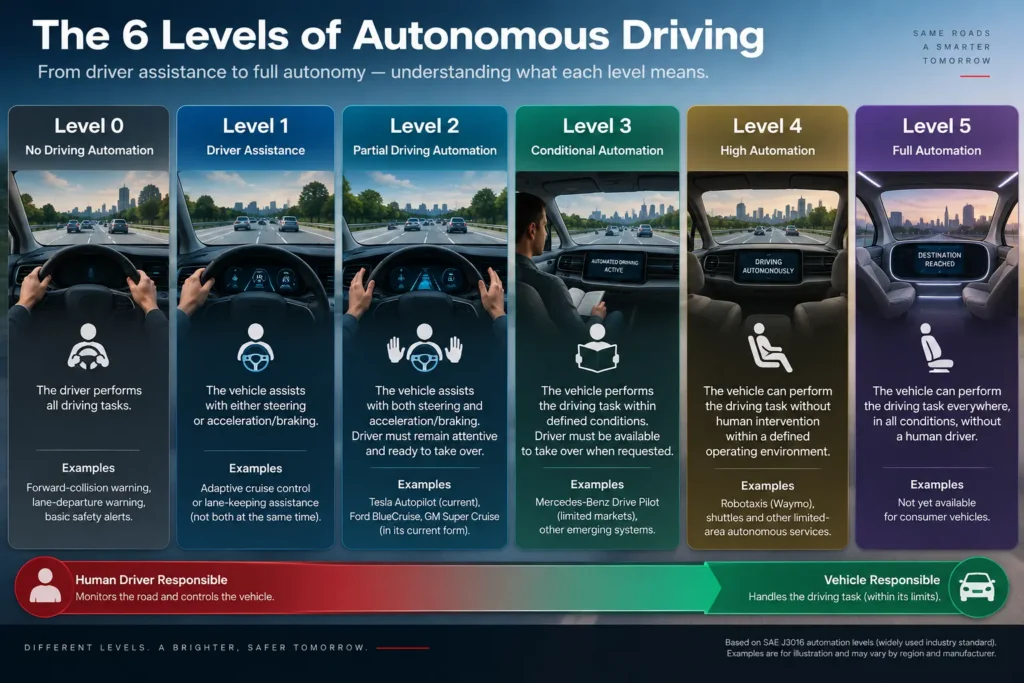
That last part is important. A vehicle that keeps itself centred in a lane while the driver watches the road is fundamentally different from a vehicle that can drive itself while the occupant is no longer responsible for monitoring the road. The Society of Automotive Engineers’ six-level framework, commonly used to describe driving automation, runs from Level 0 through Level 5 and separates these capabilities according to how much of the driving task the system performs and how much responsibility remains with the human.
This is why the phrase “self-driving” can sometimes create confusion. A modern car may have an impressive collection of driver-assistance features without being capable of operating independently. In fact, NHTSA currently describes consumer Level 2 systems as assistance technologies where the driver remains responsible and must remain engaged and attentive.
Read More: The Future of Autonomous Agents in Cars
How Does Autonomous Driving Work?
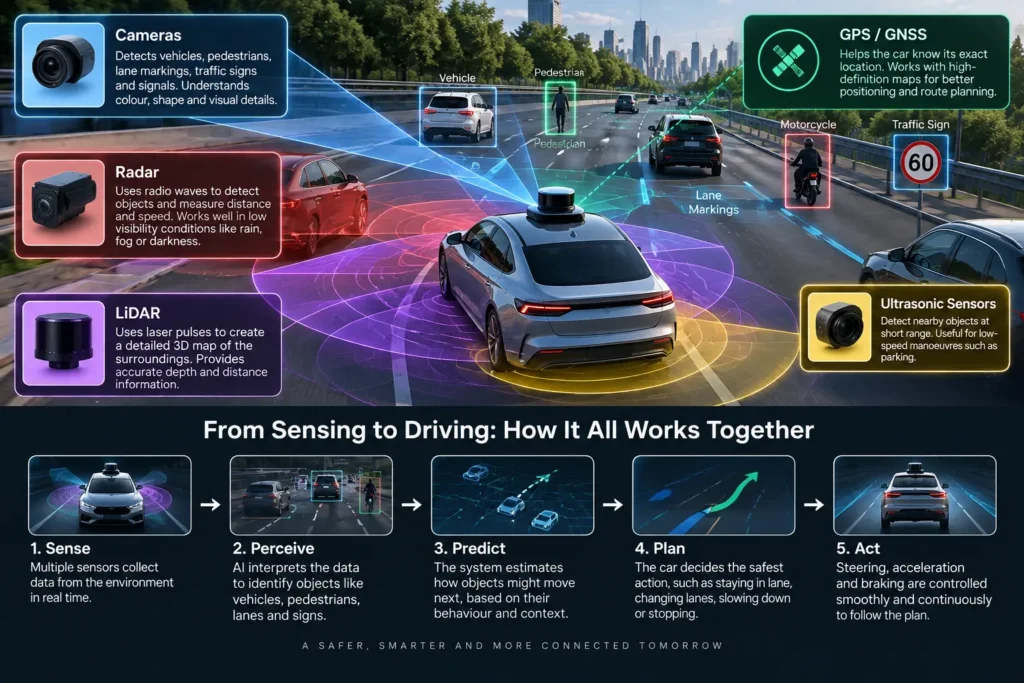
At a basic level, an autonomous vehicle has to solve a problem that human drivers handle almost instinctively. It must work out where it is, understand what is around it, predict what those objects might do, decide what it should do next and then control the steering, accelerator and brakes.
The process can be simplified into five stages: sense, perceive, predict, plan and act. Sensors collect information from the environment, software interprets that information, artificial intelligence helps identify objects and situations, the driving system plans a manoeuvre and the vehicle’s electronic controls execute it.
The difficult part is that these stages do not happen one after another like steps in a checklist. They operate continuously and extremely quickly. While the vehicle is moving, the system is constantly updating its understanding of the road and adjusting its planned response as traffic, pedestrians, weather and road conditions change.
The Sensors That Help a Car See the Road
A major part of autonomous driving technology is the sensor suite. No single sensor is perfect, which is why advanced systems can combine information from different types of sensors to build a more complete picture of the surrounding environment.
Cameras are particularly useful because they capture visual information similar to what a human driver sees. Software can use camera feeds to identify lane markings, traffic lights, signs, vehicles, pedestrians and other visual features. Cameras can provide rich information about colour and shape, but their performance can be affected by darkness, glare, rain, fog, dirt or an obstructed lens.
Radar works differently. Rather than relying on a conventional image, radar uses radio waves to detect objects and estimate information such as distance and relative movement. That makes it particularly useful for detecting and tracking vehicles and other objects, including in conditions where a camera’s visual information may be less reliable. NHTSA notes that radar, cameras and LiDAR can all be used in systems designed to detect and track vehicles, pedestrians and objects.
LiDAR, meanwhile, uses laser pulses to measure the environment and build a detailed representation of surrounding objects and surfaces. It can provide useful depth information and help an automated system understand the shape and position of objects around the vehicle. LiDAR is therefore an important technology in many autonomous vehicle development programmes, although different manufacturers use different combinations of sensors and approaches.
Positioning technology adds another layer. GPS or GNSS can help establish the vehicle’s location, while high-definition maps and other localisation techniques can provide additional information about the road environment. The vehicle can then compare what its sensors are seeing with where it believes it is.
What Is Sensor Fusion?
The real trick is not simply having more sensors. It is making them work together.
This is where sensor fusion becomes important. Instead of asking one camera, one radar or one LiDAR sensor to understand the entire environment, the vehicle’s computing system can combine information from multiple sources and use their respective strengths to form a more robust environmental model.
Imagine a vehicle approaching an object on the road. A camera may provide information about its appearance and classification, while radar can help estimate its distance and movement. LiDAR, where used, can contribute detailed spatial information. Combining these inputs can give the driving system a richer understanding than relying on one source alone.
NHTSA’s own automated-driving research and test systems list combinations including radar, LiDAR, cameras and GNSS, illustrating how multiple sensing technologies can form part of an automated-driving architecture.
Where Artificial Intelligence Fits In
Sensors generate enormous quantities of information, but raw sensor data is not enough to drive a car. The vehicle has to interpret what it is seeing.
Artificial intelligence and machine-learning techniques can help the system recognise objects and patterns within that information. Instead of merely detecting a shape, the software may need to determine whether it represents a pedestrian, cyclist, car, truck, traffic cone or another object, while also estimating how that object is behaving.
This is one of the areas where modern autonomous driving begins to look very different from traditional automotive electronics. A conventional electronic control system may be designed around a relatively specific set of inputs and rules. An automated-driving system has to deal with an enormous variety of real-world situations and continuously interpret an environment that is rarely identical from one moment to the next.
That is also why autonomous driving development is heavily dependent on testing and validation. A system has to demonstrate that it can handle not only ordinary situations but also unusual and difficult scenarios, sometimes referred to as edge cases.
How Does a Self-Driving Car Predict What Happens Next?
Seeing an object is only the beginning.
Suppose the vehicle detects a pedestrian standing near a road. The system needs more than a simple classification saying “pedestrian detected.” It needs to estimate whether the pedestrian is stationary, approaching the road, crossing it or likely to change direction.
The same applies to other vehicles. A car in the next lane could maintain its speed, brake suddenly, change lanes or turn. A vehicle attempting to merge could behave differently from what the autonomous system initially expected.
This predictive layer is crucial because safe driving is not simply a reaction to what has already happened. Human drivers constantly anticipate what other road users might do, and automated systems need their own way of modelling possible future movements.
The better the system can estimate those possibilities, the more effectively it can choose an appropriate response.
How Does the Car Decide What To Do?
Once the vehicle has built an understanding of its surroundings and estimated how those surroundings might change, it has to choose a manoeuvre.
The planning system may determine that the safest action is to continue straight, slow down, stop, change lanes, maintain a larger gap or follow a particular route around an obstacle. It must then translate that decision into precise vehicle-control commands.
This is where autonomous driving moves from perception into action. Steering, braking and acceleration have to work together smoothly, while the system continuously checks whether the manoeuvre remains appropriate.
If traffic suddenly changes, the original plan may no longer be suitable. The vehicle therefore has to recalculate rather than blindly follow an instruction generated a few seconds earlier.
The 6 Levels of Autonomous Driving
One of the easiest ways to understand autonomous driving is through the six-level automation framework.
Level 0: No Driving Automation
At Level 0, the driver performs the driving task. The vehicle can still have safety technologies such as forward-collision warnings, automatic emergency braking or lane-departure warnings, but these systems do not continuously take over the driving task.
NHTSA describes Level 0 as momentary driver assistance where the driver remains fully engaged and responsible for driving.
Level 1: Driver Assistance
Level 1 introduces continuous assistance with either steering or acceleration and braking.
Adaptive cruise control can manage speed and following distance, for example, while lane-keeping assistance can provide steering support. However, these functions do not mean the vehicle can drive itself independently. The driver remains responsible and attentive.
Level 2: Partial Driving Automation
Level 2 is where modern cars can begin to feel surprisingly sophisticated.
A Level 2 system can provide simultaneous assistance with steering and acceleration/braking under appropriate conditions. The vehicle may maintain its lane, adjust speed and follow traffic, but the driver remains responsible for the driving task and must monitor the environment.
This distinction matters enormously. Level 2 is driver assistance, not a car that has taken responsibility for driving. NHTSA explicitly describes today’s consumer Level 2 systems as requiring the driver to remain engaged and attentive.
Level 3: Conditional Automation
Level 3 is a major conceptual step because the automated system can perform the driving task under its defined operating conditions while the driver remains available to take over when requested.
The system, rather than the driver, is responsible for monitoring the driving environment while it is engaged within its operating conditions. However, the driver may still need to resume control when the system reaches a situation it cannot handle.
NHTSA currently describes Level 3 as conditional automation and notes that these systems are not widely available for consumer purchase.
Level 4: High Automation
Level 4 takes the concept much further. Within a defined operating environment, the system can perform the driving task without requiring a human driver to monitor the road.
The key phrase is defined operating environment. A Level 4 vehicle may be capable of autonomous operation in particular areas, routes, speeds or conditions without being capable of driving everywhere.
This is particularly relevant to autonomous mobility services and robotaxis, where vehicles can be designed to operate within carefully defined service areas. NHTSA describes Level 4 as high automation that can operate without a human driver within limited service areas.
Level 5: Full Automation
Level 5 represents the most ambitious definition of autonomous driving.
A Level 5 system would be capable of performing the driving task universally, without requiring a human to take over. In theory, the vehicle would not be restricted to a particular mapped area, road type or set of environmental conditions.
That is a much higher technical challenge than operating autonomously within a carefully controlled environment. NHTSA currently classifies Level 5 as full automation and states that such technology is not available for consumer purchase today.
Level 2 vs Level 3: Why the Difference Matters
The jump from Level 2 to Level 3 is not simply about adding another sensor or making the software slightly smarter. It changes the relationship between the driver and the vehicle.
With Level 2, the human remains responsible for monitoring the driving environment. The vehicle assists, but the driver has to stay engaged and ready to intervene. With Level 3, the automated system can take responsibility for the driving task within its operating conditions, although the driver may still be required to take control when the system requests it.
That difference has major implications for human-machine interfaces, system design, driver behaviour and safety validation. It also explains why marketing terminology around “self-driving” can be confusing when the underlying automation level is not clearly understood.
What Is an Operational Design Domain?
A key concept in autonomous driving is the Operational Design Domain, or ODD.
The ODD defines the conditions under which an automated system is designed to operate. Those conditions can include factors such as road type, geographic area, weather, lighting, traffic conditions, speed and other environmental limitations.
A system might therefore be highly capable within one environment but unsuitable outside it. A vehicle designed to operate autonomously on selected urban roads in good weather does not automatically become capable of handling every highway, mountain road, construction zone or severe-weather situation.
NHTSA identifies the Operational Design Domain as one of the important safety elements for automated-driving systems, alongside areas such as object and event detection, fallback behaviour, validation, cybersecurity and human-machine interaction.
Why Autonomous Driving Is So Difficult
Driving looks simple when everything goes according to plan. The difficulty appears when the road stops behaving predictably.
A vehicle can encounter faded lane markings, temporary roadworks, unusual traffic patterns, emergency vehicles, animals, pedestrians behaving unpredictably, debris, heavy rain, fog, glare or vehicles making unexpected manoeuvres. Human drivers are capable of improvising because they combine perception, experience, judgement and context.
An autonomous system has to turn that messy real-world environment into something that software can understand and act upon safely.
Weather is another major challenge. Rain can affect cameras and LiDAR, fog can reduce visibility, glare can complicate camera perception and dirt can obstruct sensors. Even when the sensors themselves continue functioning, the system still has to understand whether the information it is receiving is reliable enough to support a driving decision.
Then there are the edge cases. Roads contain countless situations that may occur rarely but still matter enormously when they do. Autonomous driving therefore requires extensive testing, simulation, validation and monitoring rather than simply proving that a vehicle can drive successfully on an ordinary road.
Can Autonomous Cars Drive Anywhere?
Not necessarily.
The phrase “autonomous car” can make it sound as though the vehicle can simply be switched on and driven anywhere. In reality, the capability of an automated system depends heavily on its design and operating conditions.
A vehicle may be capable of autonomous operation on a particular route but unable to operate safely outside that environment. This is why the ODD is so important and why autonomous-driving claims need to be considered alongside the conditions under which the technology is designed to operate.
The same principle applies to weather, road infrastructure and traffic complexity. A system that performs well on a well-mapped urban route may face a completely different challenge on an unmarked rural road during heavy rain.
Autonomous Driving vs ADAS
ADAS, or Advanced Driver Assistance Systems, and autonomous driving are related but they are not interchangeable terms.
ADAS generally refers to technologies designed to assist the driver. Adaptive cruise control, lane-keeping assistance, automatic emergency braking and other active-safety functions can reduce workload or help avoid collisions, but the driver may still remain responsible for monitoring and controlling the vehicle.
Autonomous driving at higher levels changes that relationship by allowing the automated system to perform more of the driving task. NHTSA currently distinguishes Level 2 ADAS from Levels 3–5 automated driving systems, reflecting this important difference in responsibility and system capability.
For car buyers, the practical lesson is simple: never judge a system by its marketing name alone. Look at what the vehicle can actually do, where it can do it, what level of automation applies and what the driver is still required to do.
Are Self-Driving Cars Available Today?
The answer depends on what is meant by “self-driving.”
Driver-assistance technology is already widely available in consumer vehicles. Systems capable of combining steering and speed assistance exist in the Level 2 category, but the driver remains responsible and attentive.
Higher-level automated driving is a different matter. NHTSA currently states that Level 3–5 technologies are not available on today’s vehicles for consumer purchase, while automated-driving systems continue to be developed, tested and deployed in limited environments.
That means the automotive industry is not starting from zero. The progression is already visible, but the final step toward broadly capable driverless transportation remains technically demanding.
Autonomous Driving and Robotaxis
One of the most interesting applications of autonomous driving may not be the privately owned family car at all. It could be the robotaxi.
A robotaxi service can operate within a defined geographical area, using vehicles and software designed specifically around that operating environment. The company can control or understand the routes, collect operational data and progressively expand the system’s capabilities as testing and validation improve.
This is one reason Level 4 automation is particularly interesting. A vehicle does not need to solve every possible road scenario on Earth to provide a useful autonomous transportation service. It needs to perform reliably within the environment for which it has been designed.
What Does the Future of Autonomous Driving Look Like?
The road to autonomy is unlikely to be one giant leap from conventional cars to completely driverless vehicles. It is more likely to be a gradual progression in which sensors become more capable, computing power increases, software improves and automated systems expand the conditions in which they can operate.
The near-term automotive landscape is therefore likely to contain a mixture of conventional driving, increasingly capable ADAS, more sophisticated Level 2 systems, limited higher-level automation and autonomous mobility services operating in defined environments.
Artificial intelligence will play an increasingly important role in that evolution. However, AI alone does not make a car autonomous. A production system also needs reliable sensors, vehicle control, computing hardware, validation, fallback strategies, cybersecurity and a carefully defined operating environment.
NHTSA’s current automated-driving guidance reflects that broader engineering challenge by identifying system safety, ODD, object and event detection, fallback behaviour, validation, human-machine interaction and cybersecurity among the areas that developers should consider.
Read More: How AI Works in Cars
The Road Ahead
The most interesting part of autonomous driving is not the idea of taking your hands off the steering wheel. It is the transformation of the vehicle from a machine that simply responds to driver commands into a system capable of continuously interpreting and responding to its environment.
That transformation requires several technologies to mature together. Cameras need to understand more, radar and LiDAR need to provide dependable environmental information, computers need to process enormous amounts of data, software needs to make increasingly complex decisions and the vehicle itself needs to execute those decisions safely.
There is also a human factor that cannot be ignored. Drivers have to understand what their vehicle can and cannot do. A technically advanced assistance system can still become dangerous if a driver treats it as something more capable than it actually is.
For that reason, the future of autonomous driving will be shaped not only by better technology, but also by better communication about its limitations.
Frequently Asked Questions
What is autonomous driving?
Autonomous driving is the use of vehicle hardware and software to perform some or all of the driving task without continuous human control, depending on the level of automation. Higher levels can perform the complete driving task within defined operating conditions, while lower levels provide assistance to the human driver.
Is Level 2 considered self-driving?
No. Level 2 provides simultaneous steering and acceleration/braking assistance, but the driver remains responsible for the vehicle and must remain engaged and attentive.
What is the difference between Level 2 and Level 3?
The major difference is responsibility. In Level 2, the human driver remains responsible for monitoring the driving environment. In Level 3, the automated system performs the driving task within its defined conditions, while the driver must remain available to take over when requested.
Does autonomous driving use artificial intelligence?
Modern automated-driving development can use AI and machine-learning techniques to interpret sensor data, recognise objects and understand complex road situations. However, autonomous driving is an entire vehicle system rather than an AI feature alone, requiring sensors, computing, software, vehicle controls and safety mechanisms to work together.
Why do autonomous cars use multiple sensors?
Different sensors have different strengths and weaknesses. Cameras provide rich visual information, radar can help detect and track objects and LiDAR can provide detailed spatial information. Combining these inputs through sensor fusion can help create a more comprehensive representation of the surrounding environment.
Can autonomous cars drive in bad weather?
That depends on the specific system and its operating conditions. Rain, fog, snow, glare, dirt and other environmental factors can affect sensing and perception. This is one reason automated systems are designed around defined operational conditions rather than assuming they can operate everywhere.
Are Level 5 self-driving cars available today?
No. NHTSA currently states that Level 5 full automation is not available for consumer purchase today. Level 5 represents a system capable of performing the driving task universally, without requiring a human driver.
Ride And Tech Verdict
Autonomous driving is no longer just a futuristic concept, but it is also not as simple as many headlines make it sound. The industry has already moved from basic safety warnings to sophisticated driver assistance, while higher levels of automation are being developed and tested in increasingly complex environments.
The biggest mistake is to treat every car with lane centring, adaptive cruise control or automated braking as a self-driving vehicle. Those technologies are important building blocks, but genuine automated driving requires the vehicle to perceive its environment, understand what is happening, predict what comes next, make decisions and control itself within clearly defined conditions.
The technology is moving quickly, but the destination is still being engineered. For now, the most useful way to understand autonomous driving is not to ask whether a car is simply “self-driving”, but to ask what it can actually do, under which conditions, and who remains responsible when the system reaches its limits.
Ride And Tech — Where Ride Meets Tech.
Drive Smarter. Ride Smarter.
Copyright (c) Ride And Tech. All rights reserved.
