


Ask ten car owners when they change their engine oil and you’ll probably get ten different answers. Some will swear by 5,000 km, others will wait for 10,000 km, while someone else will simply book the car in once a year and forget about it.
The slightly annoying truth is that none of those numbers is automatically right.
The engine oil change interval depends on the car, the engine, the oil specification and, perhaps most importantly, how the car is actually driven. Modern cars can go considerably longer between oil changes than older engines, but that doesn’t mean every owner should blindly follow a single kilometre figure.
Manufacturers themselves show how much this can vary. Hyundai’s published maintenance schedules, for example, list engine-oil replacement intervals by model, while Kia’s Indian maintenance schedules can specify different intervals under normal and severe operating conditions.
That last part is particularly relevant if most of your driving happens in traffic.
A car spending its life cruising smoothly on an open highway is having a very different experience from one doing short trips, sitting in traffic, idling for long periods and repeatedly crawling through stop-start conditions. Manufacturers explicitly classify several of these situations as severe usage and recommend more frequent maintenance as a result.
So before reaching for an arbitrary 5,000 or 10,000 km rule, it’s worth asking a better question: what does your owner’s manual say, and what kind of life is your engine actually leading?
So, How Often Should You Actually Change It?
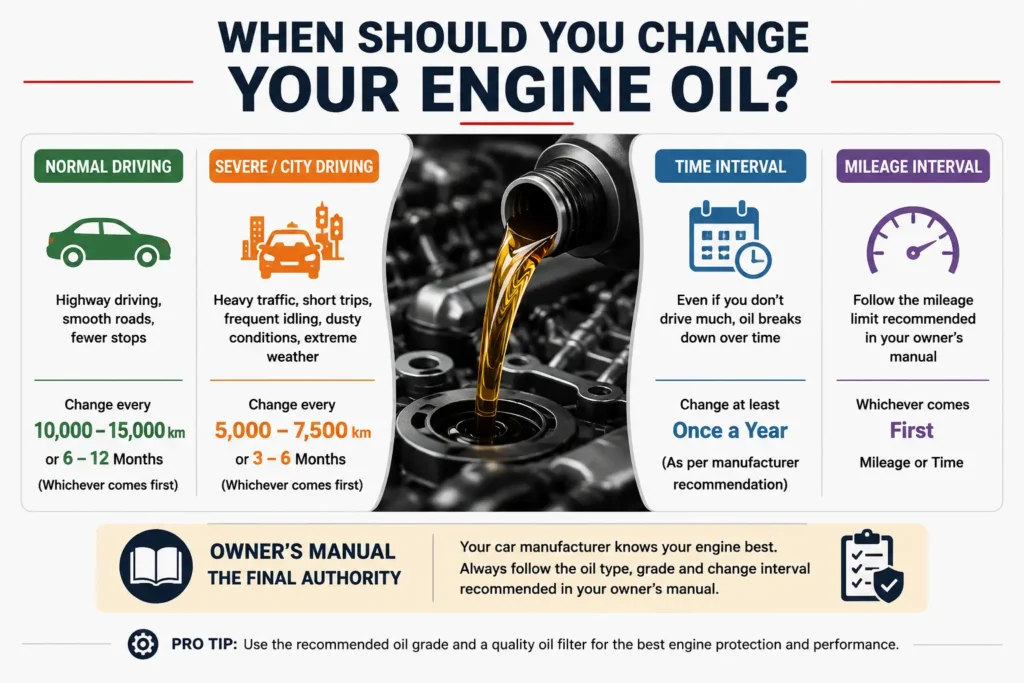
There isn’t a magic number that works for every car. For many modern cars, the recommended oil-change interval can fall somewhere around 10,000–15,000 km or once a year, but the exact requirement depends on the manufacturer and engine. Some vehicles have shorter intervals, while certain newer engines can go considerably longer when operated under normal conditions.
The owner’s manual is therefore the best place to start. It will normally give you both a distance and a time limit, and you should follow whichever comes first. If your car has covered only 4,000 km but a year has passed since the last service, the oil change may still be due.
The same applies in the opposite direction. If you’ve covered the recommended distance well before the annual service comes around, waiting simply because the calendar says you have time left isn’t particularly clever.
There is also a catch that matters to a lot of Indian car owners: the interval in the manual may change if your driving falls under what the manufacturer considers severe conditions. That’s where traffic, short journeys, dusty environments and frequent idling start to make a difference.
So, rather than asking “How many kilometres should I drive before changing the oil?”, the better question is “What does my manufacturer recommend for the way I use this car?”
That answer is far more useful than any universal 5,000 or 10,000 km rule.
Read More: Car Battery Care
Indian Traffic Changes the Equation
This is where the textbook answer meets real-world driving. A car that spends most of its life crawling through city traffic, idling at signals and making short trips is working harder than the odometer suggests.
Manufacturers explicitly recognise this. Kia classifies heavy traffic, frequent stop-and-go driving, extensive idling, short trips and repeated high-speed acceleration among severe driving conditions, for which the engine oil and filter should be serviced more frequently.
That makes a difference when deciding your engine oil change interval. If your daily commute is mostly bumper-to-bumper traffic, following the longest possible service interval in the manual may not be the most sensible approach. You should instead check whether your specific model has a separate severe-use schedule.
There is no need to invent an aggressive oil-change routine either. The manufacturer’s schedule remains the starting point; the important thing is recognising when your driving pattern falls outside the conditions used for the normal schedule.
In other words, 10,000 km of easy highway driving isn’t necessarily the same as 10,000 km spent crawling through city traffic. Your odometer measures distance. It doesn’t tell the whole story about what the engine has been through.
The Signs Your Engine Oil Needs Attention
You shouldn’t wait for the next service reminder to pay attention to your engine. Changes in the way a car sounds, feels or behaves can sometimes tell you that the oil needs checking sooner than expected.
A dashboard oil warning is the one to take seriously. It can indicate low oil pressure or another problem with the lubrication system, and continuing to drive with an active oil-pressure warning can cause serious engine damage. If the warning stays on while the engine is running, stop safely and follow the instructions in your owner’s manual rather than assuming the car simply needs an oil top-up.
There are less dramatic clues too. Unusual ticking or knocking noises, a noticeable drop in performance, worsening fuel economy, excessive smoke or an unusually low oil level can all justify an inspection. Darker oil on its own isn’t always proof that it needs replacing, because oil naturally picks up contaminants as it works, but thick, gritty or contaminated oil is worth investigating.
The important thing is not to treat these symptoms as a substitute for the service schedule. A warning sign can point to an oil problem, but it can also indicate something more serious. If the car is behaving differently, finding out why is more important than simply pouring in fresh oil and carrying on.
That is the difference between checking your engine oil and simply changing it because the calendar says so.
Oil Grade Matters More Than Most Owners Think
Changing the oil on time is only half the job. Putting the wrong oil back into the engine can be just as unhelpful, which is why the numbers printed on the bottle are worth understanding rather than treating as decoration.
The first thing to check is the SAE viscosity grade specified by your manufacturer, such as 0W-20 or 5W-30. That number describes how the oil behaves at different temperatures, and manufacturers can specify different grades for different engines and operating conditions. Kia, for example, warns that using a viscosity other than the recommended grade can result in engine damage.
Then there is the performance specification. API says owners should consult their vehicle’s owner’s manual before choosing an oil, rather than simply picking the newest or most expensive product on the shelf.
That is worth remembering when you’re standing at a parts counter being offered three different bottles that all claim to be “premium”.
The best engine oil isn’t necessarily the most expensive one. It’s the one that meets your car manufacturer’s required viscosity and specification.
For newer engines, especially turbocharged petrol engines, those specifications can be important for things such as deposit control, timing-chain wear and protection against low-speed pre-ignition.
So when it’s time for an engine oil replacement, don’t just tell the workshop to “put good oil in it”. Check what your car actually requires first.
Read More: Dutch GP Sprint Qualifying 2026
Should You Change the Oil Filter Every Time?
In most modern cars, yes. If you’re doing a full oil service, replacing the oil filter at the same time is the sensible approach. The filter is there to trap contaminants circulating through the lubrication system, and putting fresh oil through an old, loaded filter rather defeats the point of the service.
Hyundai’s Indian maintenance schedules list engine oil and the oil filter together in their periodic service requirements, while Mahindra maintenance schedules similarly specify changing the filter along with the engine oil.
There can be exceptions depending on the car and its service schedule, so the owner’s manual still gets the final say. But as a general rule, a car oil change should mean fresh oil and a fresh filter rather than trying to save a relatively small amount on the filter.
It’s also worth using a filter that meets the manufacturer’s specification. The filter is a small component compared with the cost of an engine, and Bosch notes that filter quality and correct replacement are important because the filter is responsible for removing contaminants from the oil.
If you’re already paying for the oil change, this isn’t really the place to cut corners.
Engine Oil Change FAQ
How often should you change engine oil?
The correct interval depends on the car and how it is driven. Follow the manufacturer’s recommended mileage or time interval, whichever comes first. Some manufacturers also specify shorter intervals for severe driving conditions.
Is changing engine oil every 5,000 km necessary?
Not necessarily. A 5,000 km interval may apply to some vehicles or severe-use schedules, but it is not a universal rule. Your owner’s manual should take priority over a generic kilometre figure.
Should engine oil be changed once a year even if the car has covered very few kilometres?
If the manufacturer’s schedule specifies an annual limit, yes. Maintenance schedules commonly use mileage or time, whichever comes first, so low annual mileage doesn’t automatically mean an oil change can be postponed indefinitely.
Does heavy traffic require more frequent oil changes?
It can. Frequent stop-and-go driving, extensive idling, short trips and heavy traffic are among the conditions manufacturers may classify as severe usage. In those situations, the vehicle may require a shorter engine oil change interval.
Should the oil filter be changed with the engine oil?
In most scheduled services, yes. Manufacturer maintenance schedules commonly list the engine oil and oil filter together as a replacement item. Always follow the specific schedule for your vehicle.
Our Verdict: Follow the Manual, Then Adjust for How You Drive
There is no prize for changing engine oil earlier than necessary, and there is certainly no prize for stretching the interval as far as possible. The sensible approach is to start with the manufacturer’s schedule and then consider how the car is actually being used.
For normal driving, follow the mileage or time interval specified in your owner’s manual, whichever comes first. If your car spends most of its life in heavy traffic, makes frequent short trips or sits idling for long periods, check whether the manufacturer has a separate severe-use schedule. Manufacturers such as Kia explicitly recommend more frequent servicing under those conditions.
The same principle applies to the oil itself. Use the specified grade and specification, change the filter according to the service schedule, and don’t treat a generic 5,000 or 10,000 km rule as gospel.
Our verdict is simple: the best engine oil change interval is the one recommended for your car and adjusted for the way you drive it. The owner’s manual knows your engine better than a workshop sticker ever will.
Ride And Tech — Where Ride Meets Tech.
Drive Smarter. Ride Smarter.
Copyright (c) Ride And Tech. All rights reserved.

1 thought on “Engine Oil Change Interval: How Often Should You Change Your Car’s Engine Oil?”