



The Mahindra XEV 9e review starts with a simple observation: this is not another electric SUV designed to look familiar. Mahindra has taken a very different approach with its flagship electric SUV coupe, combining a dramatic exterior, a large battery, rear-wheel drive, sophisticated suspension and a cabin packed with technology.
On paper, the XEV 9e promises the numbers buyers want from a premium EV, including up to 656km of certified range from the 79kWh battery and DC fast charging that can take the battery from 20 to 80 percent in around 20 minutes under suitable conditions. But the more important question for an owner is what happens away from the specification sheet.
Our Mahindra XEV 9e review looks at that real-world side of the SUV, including range, performance, charging, ride quality, cabin comfort, technology, safety and practicality. The aim is to understand whether Mahindra’s ambitious electric SUV is genuinely convincing as an everyday premium EV.
What Is the Mahindra XEV 9e?
The XEV 9e is a midsize electric SUV coupe developed on Mahindra’s dedicated INGLO electric architecture. Unlike an electrified version of an existing petrol or diesel SUV, it was engineered around an electric platform, allowing Mahindra to design the proportions, battery packaging and cabin around the requirements of an EV.
The design is one of the first things that separates it from more conventional electric SUVs. The sharply styled front, sloping roofline, illuminated elements and flush-looking surfaces give it a much more futuristic appearance, while the large cabin and substantial boot keep it relevant as a family vehicle.
There are two battery choices: 59kWh and 79kWh, both paired with a rear-mounted electric motor. The smaller battery version produces 231hp, while the larger battery version gets a 286hp motor.
Read More: Kia Carens Clavis EV Review
Mahindra XEV 9e Range: What Can You Expect?
Range is one of the biggest reasons buyers will consider the XEV 9e. The 59kWh version carries an ARAI-certified range of 542km, while the 79kWh version is certified for 656km on the Indian MIDC cycle.
Those numbers are useful for comparing variants, but they should not be treated as the distance every owner will achieve. Driving speed, temperature, air-conditioning use, traffic, tyre pressures, road gradients and driving style can all change an EV’s actual efficiency.
Independent testing provides a more useful picture. Autocar India’s 79kWh test car returned 425km in city driving and 488km on its highway loop, producing a combined real-world range of around 456km. CarWale’s separate test of the 79kWh Pack Three recorded 462.6km in heavy Mumbai rainfall.
That makes a realistic roughly 450–480km range window a more useful expectation for the larger battery under varied real-world conditions than simply looking at the 656km certified figure. Actual results will naturally vary with conditions.
Mahindra XEV 9e Real-World Range
The interesting part of the Mahindra XEV 9e review is how differently the SUV behaves depending on where it is driven.
Autocar’s test recorded 5.38km/kWh in city conditions, equivalent to approximately 425km from the 79kWh battery. The test took place in temperatures approaching 40°C, with the SUV weighing around 2,201kg and dealing with repeated stop-start traffic.
On the highway, efficiency improved to 6.18km/kWh, resulting in a calculated range of around 488km. The combined test figure was 5.78km/kWh, translating to approximately 456km.
That behaviour is worth understanding. Unlike a petrol SUV, where highway driving often hurts efficiency compared with city use, an EV can sometimes benefit from smoother cruising because regenerative braking and repeated acceleration are reduced.
For long-distance owners, the highway result is therefore particularly encouraging. A 450km-plus practical range gives the XEV 9e considerably more flexibility than many smaller-battery EVs.
Mahindra XEV 9e Performance
The larger 79kWh XEV 9e produces 286hp and 380Nm, giving this large SUV enough performance to feel properly quick. Autocar India recorded 0–100kph in 7.45 seconds during its road test.
The smaller 59kWh version uses a 231hp rear-mounted motor. That version is still considerably more powerful than most conventional family SUVs, but the 79kWh variant is the one that better matches the XEV 9e’s premium positioning.
The electric motor’s immediate torque delivery makes overtaking particularly effortless. There is no waiting for a gearbox to select a lower ratio or for an engine to build boost; the response arrives almost instantly when you press the accelerator.
Mahindra also provides different drive modes, including a more efficiency-focused Range mode and settings that alter the vehicle’s response. The result is an SUV that can be relaxed when you want it to be, but surprisingly quick when the road opens up.
How Does the XEV 9e Drive?
The Mahindra XEV 9e review would be incomplete without discussing its ride and handling because this is one of the areas where the SUV performs particularly well.
The vehicle uses independent suspension with a sophisticated semi-active damping system, and independent road testing has highlighted its ability to absorb broken surfaces while keeping body movements controlled. Autocar rated the ride as one of the XEV 9e’s biggest strengths.
That matters in India because premium SUV buyers are often asking for two things that do not always coexist: comfortable ride quality and controlled handling. A soft suspension can make a large vehicle float through corners, while an aggressively stiff setup can make rough roads tiring.
The XEV 9e manages to strike a more convincing balance. It remains substantial and comfortable without feeling completely disconnected from the road.
Mahindra XEV 9e on the Highway
Highway driving is arguably where the XEV 9e’s combination of range, refinement and stability makes the most sense.
The large battery gives it enough usable range for serious intercity travel, while the strong electric motor makes high-speed overtaking easy. The independent highway test figure of around 488km is also encouraging for owners planning longer journeys.
The vehicle’s size can initially make it feel substantial on narrower roads, but the steering and controlled body movements help once you become familiar with its dimensions. The high-speed ride is another strong point, with the suspension keeping the large SUV composed rather than allowing excessive movement.
As with every EV, however, planning remains important. The availability and output of DC fast chargers along your route can matter just as much as the car’s theoretical range.
Mahindra XEV 9e Charging Time
Charging is another area where the XEV 9e has strong numbers on paper.
The 59kWh battery supports DC charging at up to 140kW, while the 79kWh version can use charging speeds of up to around 175–180kW, depending on the specification and source. Mahindra quotes a 20–80 percent charging time of around 20 minutes under suitable fast-charging conditions.
That is the headline figure, but charger availability is the important real-world consideration. A vehicle capable of taking high charging power cannot necessarily receive that power from every public charger.
For home charging, Mahindra offers 7.2kW and 11kW AC options. Autocar’s range data indicates that a full 0–100 percent charge can take roughly 6–8 hours with an 11.2kW charger, while a 7.2kW setup can take approximately 8.7–11.7 hours, depending on battery size.
For most owners, overnight AC charging remains the most convenient way to use the vehicle. DC fast charging becomes more important when travelling long distances.
Mahindra XEV 9e Interior and Cabin Experience
Inside, the XEV 9e goes heavily into the technology theme.
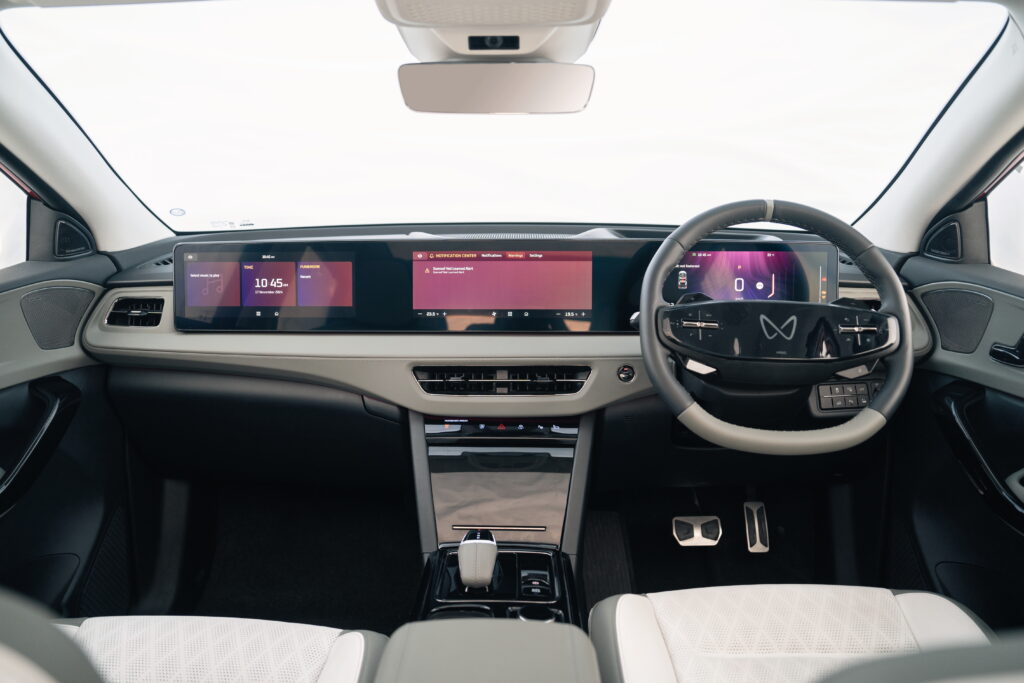
One of its defining features is the triple 12.3-inch screen arrangement, creating a wide digital display across the dashboard. The cabin also offers a panoramic glass roof, premium materials and a 16-speaker Harman Kardon audio system on higher specifications.
The front passenger also gets a dedicated display, which adds to the sense that Mahindra wanted the cabin to feel more like a connected digital environment than a conventional car interior.
There is, however, a trade-off. Autocar’s road test found the infotainment interface somewhat cluttered and confusing, while the lack of a privacy filter on the passenger screen can allow it to become distracting from the driver’s perspective.
So while the technology list is impressive, the user experience is not perfect. Mahindra has clearly prioritised feature density, but software usability matters just as much in a vehicle that relies heavily on screens.
Mahindra XEV 9e Practicality and Boot Space
The XEV 9e is a five-seat SUV, and its coupe-like roofline does not prevent it from offering useful luggage capacity.
Autocar lists a 663-litre boot along with a 150-litre front storage compartment, giving the vehicle considerable carrying capacity for family use. The main compromise is the relatively high loading lip, which can make lifting heavier luggage into the boot less convenient.
The rear-seat experience is another positive. Despite the sloping roof, independent testing has found the back seat comfortable enough for family use.
This is important because the XEV 9e’s dramatic exterior could easily have come at the expense of everyday practicality. Instead, Mahindra has managed to retain useful cabin and luggage space.
Mahindra XEV 9e Features
The XEV 9e is packed with technology, and the higher variants offer an unusually long equipment list.
Depending on the variant, buyers can get features such as triple screens, augmented-reality head-up display, panoramic glass roof, connected-car functions, wireless smartphone connectivity, premium audio, ventilated seats, ambient lighting and automatic parking assistance.
Mahindra’s digital architecture is also a major part of the vehicle. The company has developed the SUV around its MAIA software and computing architecture, with a Qualcomm Snapdragon 8295 platform and extensive connected-car capabilities.
This makes the XEV 9e particularly appealing to buyers who see technology as an important part of the ownership experience.
Mahindra XEV 9e Safety and ADAS
Safety is another strong area.
The XEV 9e has a five-star Bharat NCAP rating, while its safety package includes airbags, ABS, ESC and a comprehensive driver-assistance system. Higher-level ADAS hardware includes multiple cameras, radars and ultrasonic sensors, depending on the variant.
Mahindra’s higher specifications also offer Level 2+ driver-assistance capabilities, including features such as lane centering, blind-spot detection, cross-traffic alerts and emergency steering assistance.
The important distinction is that these systems remain driver assistance, not autonomous driving. The driver must continue to monitor the road and remain responsible for the vehicle.
Mahindra XEV 9e Price and Value
The XEV 9e sits in the premium end of India’s mainstream electric SUV market. Autocar currently lists the range from around ₹21.90 lakh to ₹31.25 lakh ex-showroom, although pricing and variant structures can change over time.
At this level, buyers are not simply paying for electric propulsion. They are buying a large premium-feeling cabin, strong performance, long-range battery options, advanced technology and a distinctive design.
The value equation therefore depends heavily on the variant. The smaller battery makes the entry price more accessible, while the 79kWh version is the more convincing choice for buyers who regularly travel longer distances and want the stronger motor.
Read More: Fatima Sana Shaikh Royal Enfield
Mahindra XEV 9e Pros and Cons
What We Like
- Distinctive SUV-coupe design
- Strong performance from the 79kWh version
- Large 79kWh battery option
- Useful real-world range for long-distance driving
- Excellent ride comfort
- Strong highway stability
- Spacious five-seat cabin
- Large boot and additional front storage
- Extensive technology and premium features
- Five-star Bharat NCAP rating
- Advanced ADAS package
What Could Be Better
- Infotainment interface can feel cluttered
- Passenger display can distract the driver
- High boot loading lip
- High-power public DC chargers are not available everywhere
- Larger battery version becomes expensive
- Real-world range remains well below the headline MIDC figure
Is the Mahindra XEV 9e Worth Buying?
The answer depends on what you expect from an EV.
If your priority is a compact city runabout, the XEV 9e is far more vehicle than you need. Its size, price and technology make more sense for buyers looking for a premium family SUV that can handle both daily commuting and longer highway journeys.
The 79kWh version is particularly convincing for this role. Its independently tested range of around 450–480km, depending on conditions, gives it enough flexibility for serious road trips while the fast-charging capability can reduce charging stops when a suitably powerful charger is available.
The strongest reason to choose the XEV 9e, however, may be the combination of comfort and performance. It does not feel like an EV that has sacrificed driving appeal for efficiency. Instead, it delivers strong acceleration, a composed ride and plenty of technology in a package that feels genuinely different from conventional SUVs.
Mahindra XEV 9e vs Its Alternatives
The XEV 9e sits in an increasingly competitive part of the Indian EV market, with alternatives including the Tata Harrier EV, BYD Atto 3 and VinFast VF7.
The Mahindra’s biggest advantage is the combination of its large battery, dramatic design, rear-wheel-drive layout, technology and ride comfort. It also has the benefit of being developed specifically for India’s market and road conditions.
The right choice will ultimately depend on priorities. Buyers who value range and space may prefer the XEV 9e, while others may prioritise a particular charging ecosystem, price, driving character or brand.
FAQs About the Mahindra XEV 9e
What is the real-world range of the Mahindra XEV 9e?
Independent testing of the 79kWh version has produced figures in the roughly 450–480km range, depending on conditions and test methodology. Autocar recorded 456km combined, while CarWale recorded 462.6km in heavy Mumbai rainfall.
How much range does the XEV 9e 79kWh claim?
The 79kWh version has an ARAI-certified MIDC range of 656km. This should not be interpreted as a guaranteed everyday driving range.
How fast does the Mahindra XEV 9e charge?
The 79kWh version supports DC fast charging at up to around 175–180kW, with a claimed 20–80 percent charging time of approximately 20 minutes under suitable conditions.
Is the Mahindra XEV 9e good for highway driving?
Yes. The large battery, strong performance, comfortable suspension and highway-tested range make it particularly well suited to long-distance driving. Autocar recorded around 488km of calculated highway range from the 79kWh version during its test.
Does the XEV 9e have ADAS?
Yes. Higher variants offer advanced driver-assistance features, including lane-centering and other assistance functions. The vehicle has multiple cameras, radars and ultrasonic sensors depending on specification.
Is the XEV 9e a good family car?
Yes, particularly for families that want a premium five-seat EV. Its comfortable rear seat, 663-litre boot and 150-litre frunk give it useful everyday practicality despite its coupe-inspired design.
Ride And Tech Verdict
The Mahindra XEV 9e review leaves a strong overall impression because the SUV does more than deliver a large battery and impressive range figure. It combines distinctive styling, strong performance, excellent ride comfort, useful family practicality and a technology-heavy cabin into a package that feels genuinely ambitious.
The 79kWh version is the standout choice for buyers who regularly travel beyond the city. Its certified 656km range is considerably higher than what independent testing achieves, but real-world results around the mid-400km mark are still strong enough to make the XEV 9e a credible long-distance EV.
There are compromises. The infotainment interface could be more intuitive, the high boot lip is not ideal and access to very high-power DC charging remains dependent on the public charging network. But those weaknesses do not overshadow the vehicle’s strengths.
For buyers looking for a premium Indian electric SUV that combines long-range capability, performance, comfort and technology without feeling conventional, the XEV 9e is one of Mahindra’s most convincing EVs yet.
Ride And Tech — Where Ride Meets Tech.
Drive Smarter. Ride Smarter.
Copyright (c) Ride And Tech. All rights reserved.

1 thought on “Mahindra XEV 9e Review: Range, Performance & Real-World Experience”