


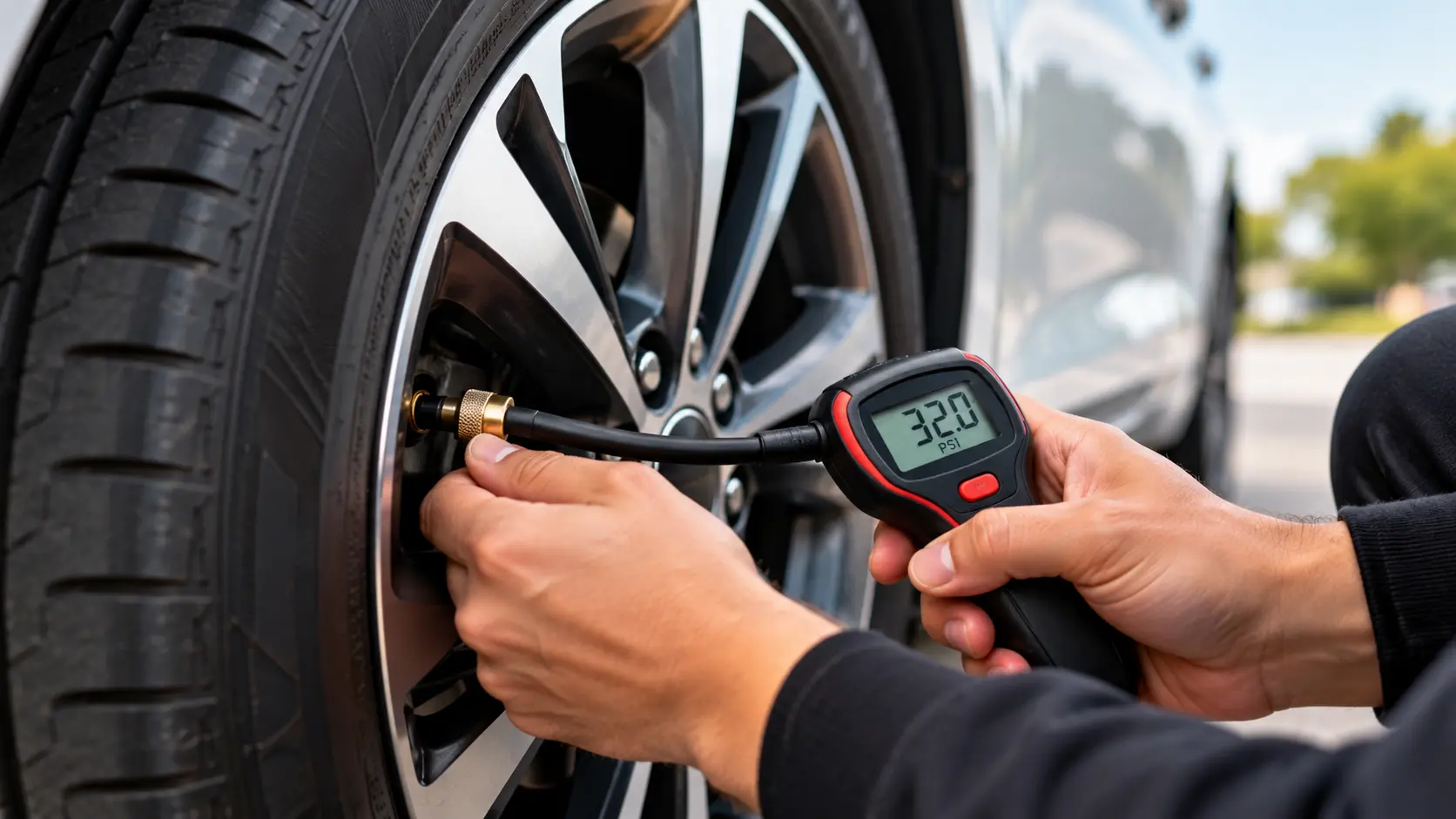
Your car’s tyres are the only parts of the vehicle that maintain direct contact with the road, yet checking their air pressure is one of the simplest maintenance tasks drivers often overlook. A tyre can look perfectly normal from the outside and still be underinflated, which can affect handling, braking, fuel efficiency and tyre life.
Learning how to check tyre pressure at home does not require expensive equipment or advanced mechanical knowledge. With a reliable pressure gauge, access to an air compressor and the correct pressure specifications for your car, you can carry out this essential check in just a few minutes.
For Indian drivers, this is particularly useful before highway journeys, during seasonal temperature changes and when travelling with a full load of passengers or luggage. Regular checks also help identify unusual pressure loss that may indicate a puncture, damaged valve or another tyre problem.
Why Is Checking Tyre Pressure Important?
Correct tyre pressure helps your car’s tyres maintain their intended contact with the road. When the pressure is too low or too high, the tyre may not perform as the manufacturer designed it to, potentially affecting steering response, braking, comfort and tread wear.
Underinflated tyres flex more as they roll, increasing rolling resistance and heat buildup. This can contribute to higher fuel consumption and accelerated tyre wear, while severe underinflation can increase the risk of tyre failure. Overinflated tyres can also cause uneven wear and compromise the intended balance between grip, comfort and handling.
Knowing how to check tyre pressure gives you a straightforward way to catch these problems before they become more serious. It is also a useful habit for drivers who regularly commute through city traffic, encounter potholes or travel long distances on Indian highways.
Read More: How to Clean Car Air Filter
What Is the Correct Tyre Pressure for Your Car?
There is no single tyre pressure that is correct for every car. The recommended value depends on the vehicle, tyre specification and sometimes the number of passengers or amount of luggage being carried.
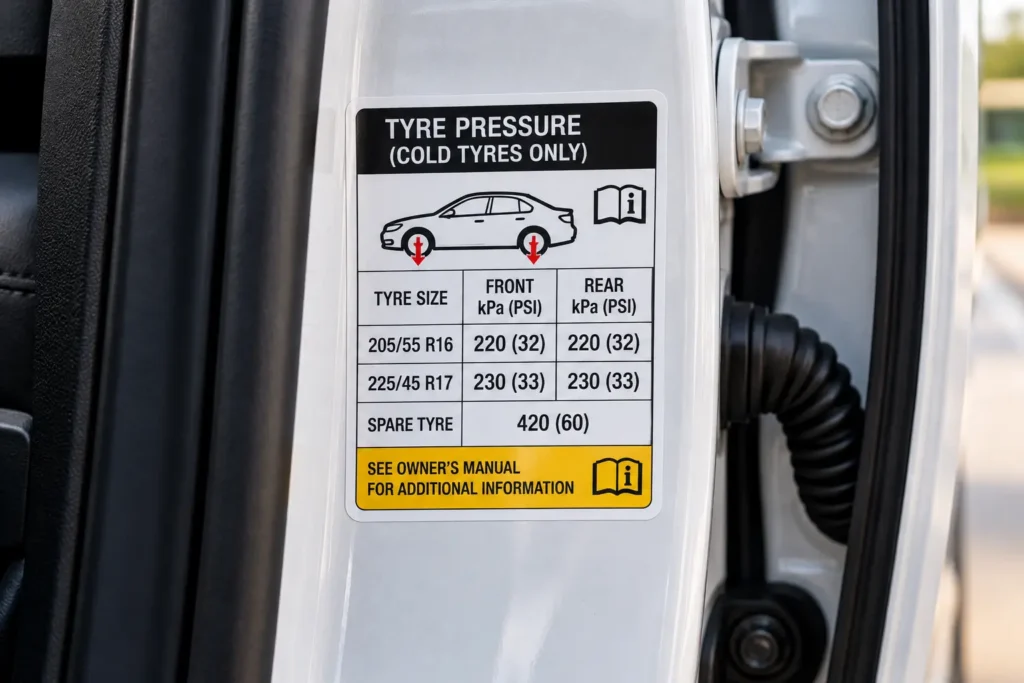
You can usually find your car’s recommended pressure in one of these places:
- A sticker on the driver’s door frame or door pillar.
- The inside of the fuel-filler flap.
- The vehicle owner’s manual.
- Official guidance from the vehicle manufacturer or an authorised service centre.
The manufacturer’s recommendation may specify different pressures for the front and rear tyres, as well as separate settings for normal driving and heavier loads. Follow the figures applicable to your driving conditions rather than assuming all four tyres require the same pressure.
One important distinction: the maximum pressure printed on the tyre sidewall is not the same as the vehicle manufacturer’s recommended operating pressure. Do not use the sidewall’s maximum figure as your everyday target. The vehicle placard or owner’s manual should be your primary reference.
7 Essential Steps to Check Tyre Pressure at Home
Step 1: Park the Car Safely and Let the Tyres Cool
Choose a flat, safe place to park your car away from moving traffic. Ideally, check the tyres before your first drive of the day or after the vehicle has been parked for at least three hours.
These are known as cold-tyre conditions. Driving warms the tyres and raises their internal air pressure, so measuring them immediately after a long journey can give a higher reading than a cold measurement. For the most reliable comparison with the manufacturer’s recommended figures, check the tyres when cold.
If you have just completed a journey and suspect that a tyre is dangerously underinflated, do not ignore the problem simply because the tyres are warm. Have the pressure checked and corrected safely, then recheck it under cold conditions later.
Step 2: Find the Recommended Tyre Pressure
Before using a gauge, locate the recommended pressure for your specific vehicle. Check the door-frame sticker, fuel-filler flap or owner’s manual, and note the recommended values for the front and rear tyres.
Tyre pressure is commonly measured in PSI (pounds per square inch) or bar. Make sure you understand which unit your reference and gauge use, because confusing the two can result in an incorrect adjustment.
If you frequently carry extra passengers or luggage, check whether the manufacturer specifies a separate pressure setting for a loaded vehicle. Following the appropriate specification is more reliable than using a generic tyre pressure chart.
Step 3: Get a Reliable Tyre Pressure Gauge
You can check pressure using a handheld gauge or a tyre inflator with a built-in pressure display. A digital gauge is convenient for home use, while a good-quality mechanical gauge can also work well when used correctly.
If you do not own a gauge, you can use the inflation equipment available at many petrol stations and tyre shops. For regular home maintenance, a portable compressor with a pressure display can be convenient, but its reading should be checked against a reliable gauge if accuracy is uncertain.
Keep your gauge clean and protected from damage. Using the same reliable gauge for routine checks also helps you compare readings consistently over time.
Step 4: Remove the Valve Cap and Measure the Pressure
Locate the tyre’s air valve and unscrew its small protective cap. Place the gauge firmly and straight against the valve stem, following the gauge manufacturer’s instructions, until a reading appears.
A brief hiss may occur while connecting or removing the gauge. A small amount of escaping air is normal during measurement, but avoid holding the gauge against the valve unnecessarily because prolonged air loss can affect the reading.
Record the pressure for each tyre and compare it with the correct specification. Do not rely on the tyre’s appearance alone, because a radial tyre can be underinflated without looking obviously flat.
Step 5: Inflate Tyres That Are Below the Recommended Pressure
If the reading is lower than the manufacturer’s recommendation, connect an air compressor to the valve and add air in short intervals. Check the pressure again as you approach the target to avoid overinflating the tyre.
Some automatic inflators allow you to enter a target pressure before connecting the nozzle. If yours has this feature, set the correct value and verify the final reading rather than assuming the machine has completed the adjustment perfectly.
When learning how to check tyre pressure, remember that the goal is to reach the recommended cold pressure—not to add as much air as possible. Once the pressure is correct, disconnect the nozzle and replace the valve cap securely.
Step 6: Correct Tyres That Are Overinflated
If the measured pressure exceeds the recommended cold value, release air gradually using the gauge’s release function or the appropriate valve procedure. Measure again after each small adjustment until you reach the specified pressure.
Be careful not to remove too much air in a single attempt. Rechecking after each adjustment is more accurate than trying to estimate the amount of air that needs to escape.
If the tyre was measured after driving and is warm, do not simply release air until it matches the cold-pressure figure. Tyre pressure normally rises as the tyre warms, so check it again when cold and follow the manufacturer’s guidance.
Step 7: Check All Four Tyres and the Spare
Repeat the procedure for every road tyre, including the rear tyres that may be less convenient to reach. Compare each reading against the correct front or rear specification and make sure all the valve caps are securely fitted afterwards.
If your car carries a spare wheel, inspect its pressure too. A spare tyre can lose air while sitting unused, leaving you with another problem when you need it during a puncture or roadside emergency.
Finally, pay attention to differences between tyres. If one tyre repeatedly loses pressure faster than the others, arrange an inspection for a possible puncture, damaged valve or rim-related leak instead of repeatedly topping it up without investigating the cause.
When Should You Check Tyre Pressure?
Tyres naturally lose some air over time, even when there is no obvious puncture. Michelin recommends checking tyre pressure monthly, while Bridgestone India recommends checking every two weeks, particularly before long journeys. A practical routine is to check at least monthly, inspect before a long road trip, and follow any stricter guidance in your vehicle manual
You should also consider checking pressure after hitting a substantial pothole or kerb, noticing a change in steering behaviour, or receiving a tyre-pressure warning. These situations do not always mean the tyre is damaged, but they justify a closer inspection.
| Situation | What to do |
|---|---|
| Routine maintenance | Check at least monthly |
| Before a long journey | Check all tyres and the spare |
| After a pothole or kerb impact | Inspect for damage and pressure loss |
| TPMS warning appears | Check pressure promptly and investigate the cause |
| One tyre loses air repeatedly | Seek a professional inspection |
How Does Incorrect Tyre Pressure Affect Your Car?
Underinflated Tyres
When a tyre has less air than recommended, its sidewalls flex more during driving. This can increase rolling resistance, raise operating temperatures and accelerate wear, particularly if the car continues to be driven at speed or with a heavy load.
Underinflation can also affect steering precision and braking performance. A tyre that repeatedly loses pressure should be checked for a puncture, leaking valve or other damage rather than being treated as a routine inflation issue.
Overinflated Tyres
Overinflated tyres can wear more heavily around the centre of the tread, depending on the tyre and operating conditions. They may also transmit more road impacts into the cabin, affecting comfort and the way the vehicle responds over uneven surfaces.
Neither overinflation nor underinflation is a useful shortcut to better performance. Follow the vehicle manufacturer’s pressure recommendation instead of experimenting with pressure to change grip, ride quality or fuel consumption.
Read More: Car Battery in Winter
Can Tyre Pressure Affect Fuel Efficiency?
Yes. Underinflated tyres increase rolling resistance, which means the vehicle needs more energy to keep moving. This can increase fuel consumption, although the exact effect depends on the degree of underinflation, the vehicle, driving conditions and other factors.
Maintaining the correct pressure is therefore a simple part of efficient car ownership. It will not solve every fuel-efficiency problem, but it helps keep the tyres operating within the conditions intended by the vehicle manufacturer.
What Is TPMS, and Can You Rely on It?
A Tyre Pressure Monitoring System (TPMS) uses sensors or other monitoring methods, depending on the vehicle, to detect certain tyre-pressure problems and alert the driver. Some systems display individual pressure readings, while others mainly provide a warning when pressure drops below a specified threshold.
TPMS is useful, but it should not replace regular manual checks. A warning may appear only after pressure has dropped significantly, and not every system provides a live numerical reading for each tyre. Continue checking pressure regularly even if your car has TPMS.
If a TPMS warning remains illuminated after you have corrected the pressure, consult the owner’s manual or have the system inspected. The warning may require a reset procedure or indicate a sensor or other system fault.
Common Tyre Pressure Checking Mistakes to Avoid
One common mistake is judging pressure by sight. A tyre may look adequately inflated while still being below its recommended pressure, so use a reliable gauge instead of relying on appearance.
Another mistake is following a generic online chart or the maximum pressure printed on the tyre sidewall instead of the vehicle-specific recommendation. Drivers should also avoid checking only the front tyres, forgetting the spare, or ignoring repeated pressure loss in one wheel.
Finally, never assume that a tyre is safe just because its pressure is correct. Cuts, bulges, exposed cords, embedded objects and other visible damage require attention independently of the pressure reading.
FAQs About How to Check Tyre Pressure
How often should I check car tyre pressure?
Check your tyre pressure at least once a month and before long journeys. More frequent checks may be appropriate if you notice pressure loss, drive on rough roads regularly or follow a stricter schedule recommended by your vehicle or tyre manufacturer.
Should I check tyre pressure when tyres are hot or cold?
Cold tyres provide the most useful reading for comparison with the manufacturer’s recommended pressure. Ideally, the car should have been parked for around three hours or driven only a short distance before the check.
Where can I find the correct tyre pressure for my car?
Look for the vehicle manufacturer’s recommendation on the driver’s door frame, fuel-filler flap or in the owner’s manual. The specified pressures may differ between the front and rear tyres or according to the vehicle’s load.
Can I check tyre pressure without a gauge?
You cannot accurately determine tyre pressure by visual inspection alone. A reliable handheld gauge or suitable inflator with a pressure display is the better choice for checking whether the tyres match the manufacturer’s recommendation.
What should I do if one tyre keeps losing pressure?
Check the pressure and inspect the tyre for obvious damage, but do not attempt to repair a potentially damaged tyre without the right equipment and expertise. Arrange a professional inspection for a possible puncture, faulty valve, damaged rim or another leak, especially if the pressure drops again soon after inflation.
Is the maximum PSI on the tyre the correct pressure?
No. The maximum pressure printed on the tyre sidewall is not automatically the recommended pressure for everyday driving. Use the vehicle manufacturer’s specification, which is designed for the particular vehicle and its intended tyre fitment.
Ride And Tech Verdict
Knowing how to check tyre pressure is one of the most useful skills a car owner can develop. It takes only a few minutes, requires minimal equipment and helps you identify underinflation, overinflation and unusual pressure loss before they develop into bigger problems.
Make tyre pressure checks part of your regular maintenance routine, use the manufacturer’s recommended figures, and measure pressure when the tyres are cold whenever possible. Before a long journey, inspect all four tyres and the spare, and never ignore repeated pressure loss or visible tyre damage.
For everyday drivers in India, where potholes, changing road surfaces and long highway journeys can place extra demands on tyres, this small habit can support safer handling, more consistent tyre wear and better fuel efficiency. Correct pressure is not just a maintenance detail; it is part of keeping your car ready for the road.
Ride And Tech — Where Ride Meets Tech.
Drive Smarter. Ride Smarter.
Copyright (c) Ride And Tech. All rights reserved.

1 thought on “How to Check Tyre Pressure at Home: 7 Essential Steps”