


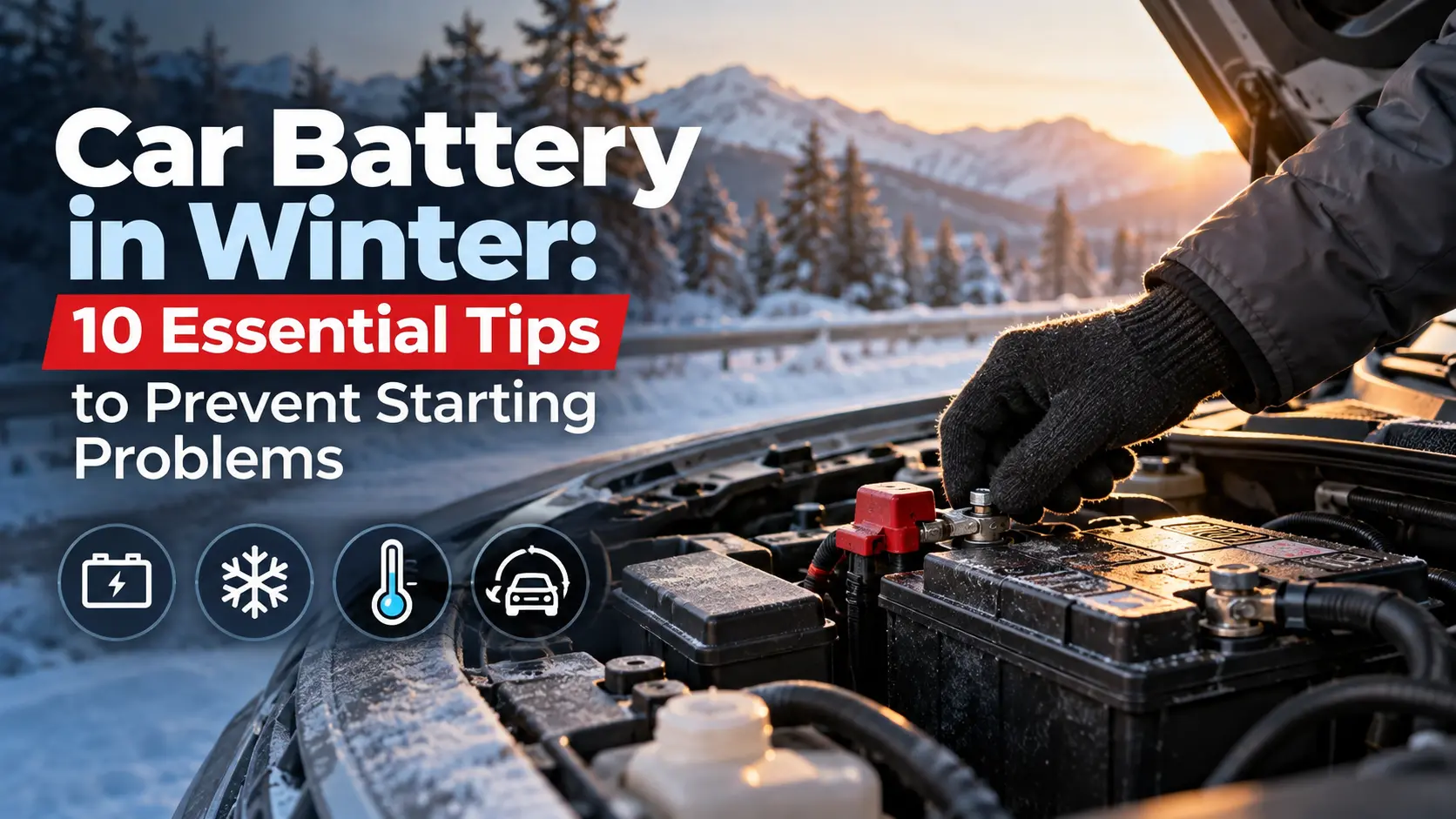
A weak car battery can remain unnoticed for months and then reveal itself on the coldest morning of the season. The engine turns slowly, the lights appear weaker than usual, and suddenly the simple act of starting the car becomes a roadside problem.
The reason is straightforward: cold temperatures slow the chemical reaction inside a conventional lead-acid battery, while starting an engine can require more electrical power in cold conditions. An older or partially weakened battery therefore has less margin when winter arrives.
That makes car battery in winter an important part of seasonal vehicle care. A few checks before temperatures fall can help identify a weak battery, reduce the chance of an unexpected no-start and give you time to replace or service the battery before it becomes an emergency.
Why Does Cold Weather Affect a Car Battery?
A conventional 12-volt automotive battery produces electrical energy through a chemical reaction. When temperatures fall, that reaction becomes slower, reducing the battery’s ability to deliver its full starting power. At the same time, the engine can require more effort to crank when the oil and mechanical components are colder.
This is why car battery in cold weather problems are often most obvious during the first start of the day. A battery that is already near the end of its useful life may still start the car reasonably well in moderate conditions but struggle when temperatures drop.
There is another important point that is often overlooked: cold weather does not necessarily cause all of the underlying battery damage. Heat can accelerate battery degradation over time, with the resulting weakness becoming obvious when colder conditions increase the demands placed on the battery.
Read More: Winter Car Care Tips
10 Essential Tips for Car Battery in Winter
1. Test the Battery Before Winter Gets Serious
The simplest way to reduce the risk of a winter starting problem is to test the battery before you actually need it.
A battery test can assess its condition and starting capability more accurately than simply checking whether the car starts normally. This becomes particularly important if the battery is several years old or the vehicle has already shown signs of slow cranking.
Battery lifespan varies with vehicle, climate, usage and battery type, but AAA notes that many modern automotive batteries typically last around three to five years, while other sources put some batteries in a wider range. Age alone does not prove that a battery is bad, but an older battery deserves closer attention.
2. Watch for Slow Engine Cranking
One of the clearest weak car battery symptoms is a noticeable change in how the engine cranks.
A healthy starting system should turn the engine over consistently. If the starter sounds slower than usual, the engine takes longer to fire or the vehicle increasingly struggles during the first start of the day, the battery deserves attention.
Slow cranking does not automatically mean the battery itself is defective. The starter, charging system, connections and other components can also contribute to starting problems. That is why repeated symptoms are a good reason to have the complete starting and charging system checked.
3. Inspect the Battery Terminals
Open the bonnet and inspect the battery terminals and cable connections. Look for loose connections, dirt or powdery corrosion around the terminals.
Corrosion can increase electrical resistance and interfere with charging or starting performance. AAA recommends keeping battery terminals clean and connections secure as part of basic battery maintenance.
If you are cleaning terminals yourself, wear appropriate eye and hand protection and follow your vehicle and battery manufacturer’s instructions. Do not work around a damaged, leaking or swollen battery as though it were a routine cleaning job.
4. Check the Battery Case for Damage
The battery itself should also be inspected for obvious physical problems.
A swollen, cracked, leaking or badly damaged battery case is a warning sign that should not be ignored. Such damage can indicate an internal battery problem and can create safety risks.
If the battery appears physically damaged, don’t attempt an improvised repair. Have it assessed and replaced by a qualified technician if necessary. AAA specifically lists swelling, cracking and deformation among signs that a battery needs attention.
5. Don’t Ignore Short-Trip Driving
Frequent short journeys can be hard on a car’s 12-volt battery because the starting process consumes energy and the alternator may not have enough time to replace it during a very short drive.
This does not mean every short trip damages the battery. The issue becomes more relevant when a vehicle is repeatedly started, driven for only a short distance and then parked, particularly if electrical accessories are also being used.
AAA recommends regular longer drives when possible and notes that repeated short trips may not give the alternator enough opportunity to recharge the battery fully.
6. Reduce Unnecessary Electrical Loads Before Starting
Before starting the engine, avoid leaving unnecessary electrical accessories operating if your vehicle’s design allows you to switch them off.
Heater blowers, audio systems, lights and other electrical equipment all consume power. Modern vehicles manage electrical loads intelligently, but there is still little reason to place additional demand on a marginal battery during a difficult cold start.
Once the engine is running, the vehicle’s charging system takes over the job of supplying electrical power and replenishing the battery, provided the charging system is functioning correctly.
7. Check the Charging System If the Battery Keeps Going Flat
A battery that repeatedly loses charge may not actually be the root problem.
The alternator and charging system are responsible for supplying electrical power while the engine is running and replenishing the battery. If the battery warning or charging-system light remains illuminated after the engine starts, that should be investigated rather than dismissed as a simple battery issue.
Repeated jump-starts are another warning sign. If the car needs to be jump-started more than once, have the battery and charging system properly tested instead of assuming another jump will permanently solve the problem.
8. Keep the Battery Secure
The battery should be properly mounted and should not move around excessively.
Vibration can contribute to physical stress and connection problems, so check that the battery’s mounting arrangement is secure if this can be done safely. AAA also recommends checking that battery connections are secure as part of routine maintenance.
Do not overtighten terminals or mounting hardware simply to make them feel immovable. Follow the vehicle manufacturer’s recommended procedure where available.
9. Know When a Battery Needs Replacement
Not every weak battery needs to be replaced immediately, but an aging battery showing multiple warning signs should not be trusted indefinitely.
Slow cranking, repeated jump-starts, dimming lights, corrosion, physical damage and an advanced battery age are all reasons to arrange a proper test. AAA lists these among common indicators of a battery approaching the end of its useful life.
Replacing a marginal battery before a long trip or particularly cold period can be far less inconvenient than discovering the problem in a parking lot or on the roadside.
10. Keep an Emergency Starting Plan
Even good maintenance cannot guarantee that a battery will never fail.
For longer journeys or areas where roadside assistance may take time to arrive, keeping suitable jumper cables or a compatible portable jump starter can provide an additional layer of preparedness. However, always check the vehicle owner’s manual first because manufacturers can have specific procedures for jump-starting modern vehicles.
Never attempt to jump-start a battery that is frozen or visibly damaged, and take care around batteries because they can present electrical, chemical and gas-related hazards.
How to Check a Car Battery at Home
A basic visual inspection is something many owners can perform, provided the battery is accessible and appears safe to inspect.
Start by checking the battery case, mounting, terminals and cables. Look for corrosion, loose connections, swelling, cracks or signs of leakage. You can also pay attention to how quickly the engine cranks and whether the vehicle’s lights appear unusually dim.
A multimeter can provide a voltage reading, but voltage alone does not tell the complete story about battery health. A battery may show a reasonable resting voltage and still fail to deliver adequate starting power under load.
For that reason, a proper battery-health or conductance test is more useful when you are trying to decide whether an aging battery needs replacement.
What Voltage Should a Car Battery Have?
A conventional 12-volt lead-acid battery is not actually sitting at exactly 12.0 volts when fully charged and at rest. A healthy, fully charged battery can typically show a voltage around the mid-12-volt range under suitable resting conditions.
However, the exact reading depends on the battery’s state of charge, temperature, how long the vehicle has been parked and the electrical system. A voltage reading should therefore be treated as one diagnostic clue rather than a definitive pass-or-fail test.
If you are unsure how to interpret the reading for your particular vehicle, follow the manufacturer’s specifications or have the battery professionally tested.
Does Winter Kill Car Batteries?
Not necessarily.
Cold temperatures can expose an already weakened battery because the battery becomes less capable of delivering its full starting performance while the engine may require more effort to crank. AAA also notes that heat can cause significant long-term battery damage, meaning a battery that fails in winter may have accumulated much of its underlying degradation during hotter months.
This distinction matters because replacing a battery only when winter arrives may address the immediate problem without addressing the reason it became weak in the first place.
Why Does My Car Struggle to Start in Winter?
If the engine turns slowly on a cold morning, the battery is one possible cause, but it is not the only one.
Potential causes include a weak battery, poor battery connections, a charging-system fault, a starter problem or increased mechanical resistance when temperatures are low. Modern vehicles also have increasingly complex electrical systems that can introduce additional diagnostic possibilities.
If the problem happens repeatedly, a proper starting and charging-system inspection is preferable to repeatedly attempting to start the vehicle or replacing parts based on guesswork.
What About Cars in India’s Winter?
Winter battery problems in India do not necessarily look like those experienced in extremely cold countries.
Most Indian cities do not regularly experience the deep freezing temperatures associated with severe winter conditions in northern Europe or North America. However, northern and higher-altitude regions can experience genuinely cold mornings, while seasonal temperature changes, vehicle age, battery condition and usage patterns can still expose a weak battery.
For many Indian owners, the more practical lesson is therefore not to treat car battery in winter as a problem that exists only below freezing. A battery that is already ageing or poorly maintained can reveal its weakness whenever conditions place additional demands on the starting system.
What If Your Car Battery Dies?
If your car does not start and you suspect a dead battery, first make sure the vehicle is in a safe location.
If you intend to jump-start it, follow the exact procedure specified in the owner’s manual. Different vehicles can have specific connection points and precautions, particularly modern cars with sensitive electronics. AAA also warns against attempting a jump-start when the battery is frozen or damaged.
Once the vehicle starts, don’t automatically assume the problem has disappeared. If the battery is old, repeatedly discharged or showing other warning signs, have it tested. A jump-start restores the ability to start the vehicle; it does not repair a failing battery.
Should You Use a Battery Maintainer?
A battery maintainer can be useful when a vehicle is parked for extended periods or is driven infrequently.
A car’s battery naturally loses charge over time, and regular driving allows the charging system to replenish it. If the vehicle spends long periods parked, a suitable battery maintainer can help maintain its state of charge. However, the correct type of charger depends on the battery and vehicle, so the owner’s manual should be checked first.
For a normally driven daily car, a battery maintainer is generally not a substitute for fixing an underlying battery or charging-system problem.
Read More: Mahindra XEV 9e Review
Car Battery in Winter: Common Mistakes to Avoid
One mistake is assuming that a car battery is healthy simply because the vehicle started normally yesterday. Battery performance can deteriorate gradually, and a cold morning can expose a weakness that was already present.
Another mistake is repeatedly jump-starting a vehicle without investigating why the battery keeps going flat. A failing battery, charging-system problem or parasitic electrical drain can all produce similar symptoms.
Owners should also avoid treating battery replacement as the only form of maintenance. Clean connections, proper mounting, regular use and periodic testing can all help identify problems before they become inconvenient failures.
Winter Battery Maintenance Checklist
Before the colder part of the season, take a few minutes to check:
- Battery age and service history
- Starting speed and engine-cranking behaviour
- Battery terminals and cable connections
- Corrosion around the terminals
- Battery case for swelling, cracks or leaks
- Battery mounting and security
- Charging-system warning light
- Headlight brightness and electrical behaviour
- Whether the vehicle is regularly driven
- Whether a professional battery test is due
This simple checklist is especially useful before a long winter road trip or when the vehicle is already showing signs of a weak battery.
FAQs About Car Battery in Winter
Why does my car battery die in winter?
Cold temperatures slow the chemical reaction inside a conventional battery and can reduce its ability to deliver starting power. At the same time, starting a cold engine can require more power, making an aging or weakened battery more likely to fail.
How do I know if my car battery is weak?
Slow engine cranking, dim or flickering lights, repeated jump-starts, corrosion, an old battery and a swollen or damaged case can all indicate a battery problem. However, some of these symptoms can also come from the charging system or other components, so proper testing is recommended.
How often should I check my car battery?
A yearly battery inspection is a sensible baseline, with more frequent checks appropriate for older batteries, vehicles used infrequently or cars already showing starting problems. AAA recommends routine battery checks and testing before winter in colder climates.
Does driving short distances damage a car battery?
Repeated short trips can prevent the charging system from fully replacing the energy used during starting, particularly when the vehicle is driven for only a few minutes at a time. Regular longer drives can give the charging system more opportunity to replenish the battery.
Should I replace my battery before winter?
If the battery is old, repeatedly struggles to start the vehicle or fails a proper battery-health test, replacing it before winter can be sensible. Battery age alone does not automatically mean replacement is necessary, so testing is preferable to guessing.
Can I jump-start a car in winter?
A jump-start may be appropriate when a healthy battery has simply become discharged, but always follow the vehicle manufacturer’s procedure. Never attempt to jump-start a battery that is frozen, visibly damaged or leaking.
Ride And Tech Verdict
A car battery in winter does not suddenly become a problem simply because the temperature drops. More often, cold conditions reveal a battery that was already ageing, undercharged or otherwise weakened.
The smartest approach is preventative rather than reactive. Check the battery before the season becomes demanding, inspect its terminals and physical condition, pay attention to slow cranking, and investigate repeated starting problems instead of relying on jump-starts.
For Indian drivers, the exact severity of winter conditions varies considerably by region, but the principle remains the same: a healthy battery gives you a much better chance of starting confidently when temperatures fall. A small inspection before winter is far easier than discovering a dead battery when you’re already late for work or preparing to leave for a long drive.
Ride And Tech — Where Ride Meets Tech.
Drive Smarter. Ride Smarter.
Copyright (c) Ride And Tech. All rights reserved.
