


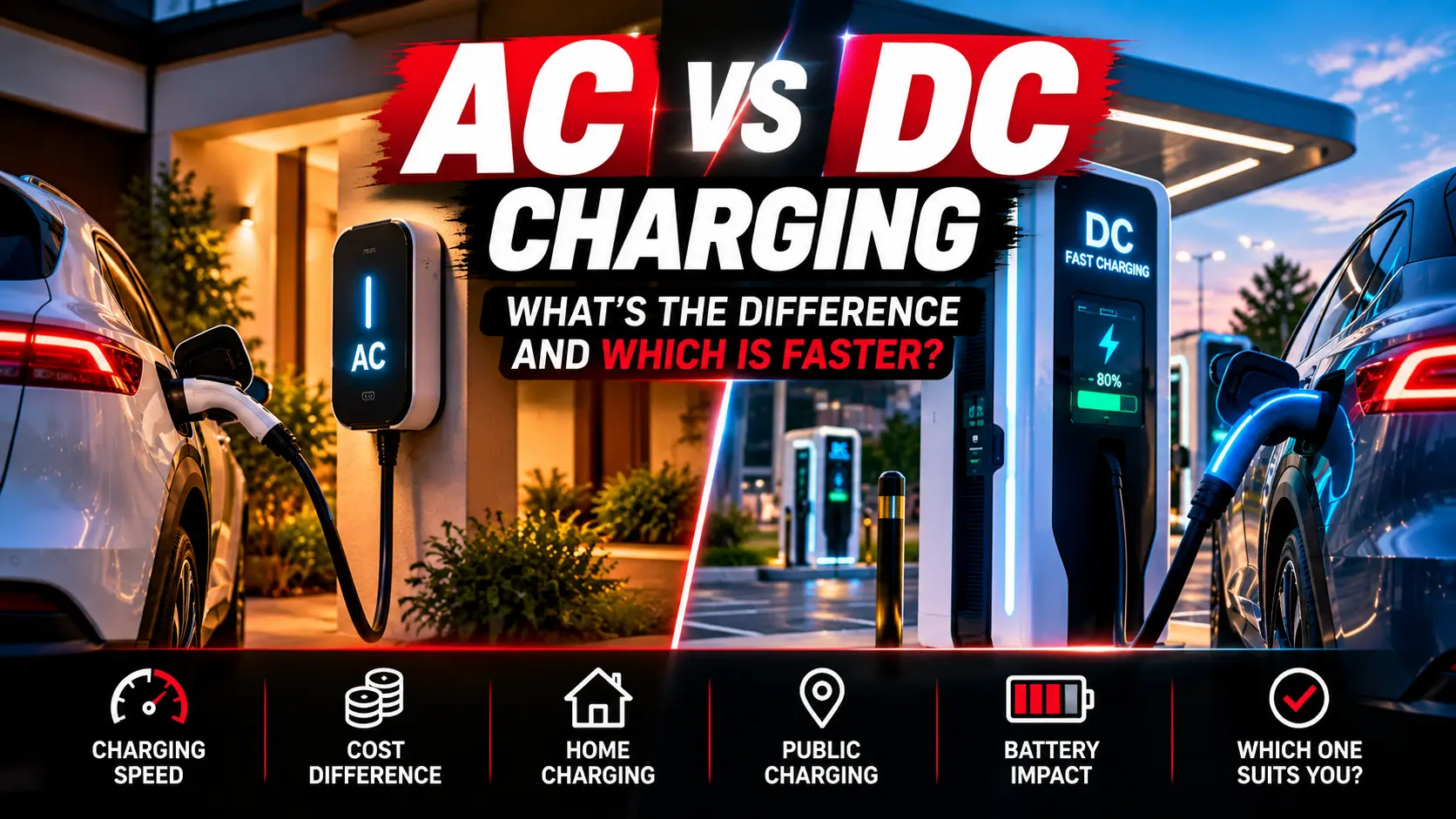
AC vs DC charging is one of the first concepts an EV owner needs to understand. Both methods ultimately put electrical energy into the vehicle’s battery, but they take very different paths to get there, and that difference affects charging speed, equipment, installation, cost and where each method makes the most sense.
For everyday EV use, AC charging is commonly associated with home, workplace and destination charging, where the car can remain plugged in for several hours. DC charging is designed for situations where getting back on the road quickly matters, particularly on highways and at public fast-charging stations. The U.S. Department of Energy describes AC charging as well suited to longer dwell times, while DC fast charging is intended for faster energy transfer and longer-distance travel.
Understanding AC vs DC charging also makes it easier to understand why an EV advertised with a 150 kW, 200 kW or higher charging capability may still charge much more slowly at home. The charging equipment, the vehicle’s onboard charger, the battery, temperature, state of charge and the available electrical supply all influence the actual charging rate.
What Is AC Charging?
AC, or alternating current, is the type of electricity supplied by the electrical grid in most homes and buildings. With AC charging, electricity reaches the vehicle as AC and the car’s onboard charger converts it into DC power that the high-voltage battery can store.
That onboard charger is an important part of the AC vs DC charging equation. Its maximum power rating limits how quickly the vehicle can accept AC electricity, even if the wall charger or electrical connection is capable of supplying more.
For example, if an EV has a 7.2 kW onboard AC charger, connecting it to an AC supply capable of 11 kW does not automatically mean the car will charge at 11 kW. The vehicle’s charging hardware remains one of the limiting factors.
How AC Charging Works
The basic process is relatively straightforward. Electricity travels from the grid to the AC charging equipment, through the vehicle’s charging connection and into the onboard charger. The onboard charger then converts the incoming AC electricity into DC electricity suitable for the battery.
This conversion happens inside the vehicle, which is why the onboard charger is such an important component when discussing AC vs DC charging.
AC charging can be slower than DC fast charging, but that is not necessarily a disadvantage. If an EV is parked overnight, there is often little reason to install or use a much more powerful DC system simply to reduce a charging session that already fits comfortably within the available parking time.
What Is DC Charging?
DC charging works differently because the charging equipment performs the AC-to-DC conversion outside the vehicle. The charger takes electrical power from the grid, converts it to DC and sends that DC power to the vehicle’s battery through the appropriate charging system.
This allows DC fast chargers to bypass the power limitations of the vehicle’s onboard AC charger. As a result, substantially higher charging power can be delivered when the vehicle, battery and charging station are all designed to support it.
That is the central reason AC vs DC charging can produce such a large difference in charging time.
How DC Fast Charging Works
A DC fast-charging station contains substantial power electronics capable of converting grid electricity into the DC power required by the vehicle. The charging system communicates with the EV to control the charging process while monitoring parameters such as voltage, current, temperature and battery state of charge.
Because the conversion happens in the external charger rather than the vehicle’s onboard AC charger, DC charging can operate at much higher power levels. The actual power delivered still depends on the vehicle’s maximum DC charging capability, battery conditions and the charger itself.
This is why a 350 kW charger does not mean every EV connected to it will receive 350 kW. The vehicle and charger continuously work within their respective limits.
AC vs DC Charging: What Is the Main Difference?
The simplest way to understand AC vs DC charging is to look at where the electricity is converted.
With AC charging, the grid supplies AC electricity and the vehicle’s onboard charger converts it into DC before it reaches the battery. With DC fast charging, the external charging station performs that conversion, allowing DC power to be delivered directly to the vehicle’s battery system.
| Feature | AC Charging | DC Charging |
|---|---|---|
| Electricity supplied to vehicle | AC | DC |
| AC-to-DC conversion | Inside the vehicle | Inside charging station |
| Typical use | Home, workplace, destination | Public fast charging, highways |
| Charging speed | Generally slower | Generally faster |
| Vehicle onboard charger limitation | Important | Bypassed for DC charging |
| Equipment cost | Generally lower | Generally higher |
| Ideal use | Long parking periods | Quick charging stops |
The table is a simplified comparison because charging speeds and equipment vary significantly between vehicles and markets.
AC vs DC Charging: Which Is Faster?
In general, DC charging is faster than AC charging when comparing a typical AC home or destination charger with a DC fast charger. The reason is not simply that DC electricity is inherently faster; rather, DC fast-charging equipment is designed to deliver much higher power and avoids the power limitations of the vehicle’s onboard AC charger.
The U.S. Department of Energy notes that DC fast charging can provide substantially more range in a short period than lower-power AC charging, although actual charging times depend on battery capacity, state of charge, vehicle capability and charging equipment.
However, the word “faster” needs context. A 7 kW AC charger operating for eight hours can add a substantial amount of energy while the car is parked overnight, whereas a high-power DC charger may add a large amount of energy during a much shorter stop.
So the faster technology is not automatically the more useful technology for every situation.
Why Is AC Charging Usually Slower?
The first limitation is the vehicle’s onboard charger. Since AC electricity must be converted to DC inside the vehicle, the onboard charger has a defined power rating.
Electrical supply is another factor. A home’s electrical connection may not have enough available capacity for a very high-power charger, and installation requirements can become more demanding as charging power increases.
The battery itself also matters. Even when a vehicle is connected to a powerful AC source, it cannot necessarily accept unlimited charging power. The vehicle’s charging system manages the current according to battery conditions and other technical limits.
Why Is DC Charging So Much Faster?
DC fast charging can deliver much higher power because the large AC-to-DC conversion equipment is located outside the vehicle. The vehicle does not have to rely on the same power limitations imposed by its onboard AC charger.
Modern DC charging systems can reach very high power levels, but the charger rating is only one part of the equation. The EV must be capable of accepting that power, and the battery management and thermal systems must be able to handle the charging conditions.
This is an important part of understanding AC vs DC charging because the number printed on a charging station is not necessarily the number your car will receive.
Why Doesn’t an EV Always Charge at the Advertised Power?
EV charging power is not necessarily constant throughout an entire charging session. The vehicle’s battery management system adjusts the charging rate according to factors such as state of charge, battery temperature and the vehicle’s charging limits.
A vehicle might therefore reach a high peak power level for part of a session and then gradually reduce the power as the battery becomes more charged. This is one reason charging time cannot be calculated simply by dividing battery capacity by the charger’s maximum advertised output.
The U.S. Department of Energy notes that charging time depends on several variables, including battery state of charge, battery capacity, battery type, onboard charger capability and charging equipment.
AC Charging at Home
For many EV owners, AC charging is the most practical everyday option. The vehicle can be plugged in after returning home and left to charge while the owner sleeps, works or carries out other activities.
The major advantage is not necessarily charging speed but charging convenience. If an EV only needs to recover the energy used during the day’s commute, several hours of AC charging may be more than sufficient.
Home charging also avoids making a separate trip to a public charging station every time the battery needs energy. The exact installation requirements depend on the vehicle, charger, electrical connection and local regulations, so homeowners should use qualified electrical professionals for installation.
DC Fast Charging on Highways
DC fast charging becomes more valuable when an EV is travelling long distances. Instead of waiting several hours, a driver can stop at a compatible fast charger, add a significant amount of energy and continue the journey.
This is particularly important for highway corridors where drivers may not have the luxury of leaving their vehicle parked for several hours. The U.S. Department of Energy identifies DC fast charging as an important part of making long-distance EV travel practical.
India is also developing charging infrastructure around different charging technologies and standards. The Ministry of Heavy Industries has documented the use of charging systems including CCS II and AC Type 2 in India’s EV charging infrastructure programmes, while later government material notes that Indian standards cover connectors, communication protocols and EV charging equipment.
AC vs DC Charging Cost
The cost comparison is more complicated than simply saying AC is cheap and DC is expensive. Electricity tariffs, charging-station pricing, installation costs, demand charges, location and the business model of the charging provider can all affect the final cost.
AC equipment is generally simpler and less expensive to install than high-power DC charging infrastructure. The U.S. Department of Energy notes that DC chargers can cost more to purchase, install and operate because of their additional power electronics, cooling and communications requirements.
For a private home user, AC charging can therefore make considerable sense because the vehicle can use a lower-power system over a longer period. For a highway charging operator, the economics are different because customers value shorter charging stops.
AC vs DC Charging and Battery Health
Fast charging is sometimes discussed as though it automatically damages an EV battery. That is too simplistic.
Modern EVs use battery management systems and thermal-management systems to control charging conditions. The charging rate can be reduced when necessary based on battery temperature, state of charge and other operating conditions.
The more useful question is not simply whether AC vs DC charging is “good” or “bad” for a battery. Instead, owners should follow the vehicle manufacturer’s charging recommendations and understand that different charging speeds are designed for different use cases.
For everyday charging, many owners may find AC charging convenient because the car remains parked for a long period. DC fast charging becomes especially useful when time matters.
AC vs DC Charging Connectors
Charging connectors vary between vehicles and markets, so compatibility should always be checked before using a public charger.
India’s charging ecosystem includes standards such as Type 2 AC and CCS-based DC charging, while government documents have also referenced Bharat charging specifications and other charging systems.
The important point is that connector type and charging method are related but not identical concepts. A connector tells you how the vehicle and charging equipment physically and electrically connect, while AC or DC describes the type of electrical power being delivered for charging.
AC vs DC Charging for Different EV Owners
For an owner who primarily charges at home and has several hours available, AC charging can fit naturally into the daily routine. Plugging in overnight can eliminate the need to wait beside the vehicle while it charges.
For someone who regularly drives long distances, DC fast charging becomes much more important. Shorter charging stops can make highway travel more practical, particularly when suitable charging stations are available along the route.
For commercial fleets, the decision becomes even more complicated because vehicles may have different duty cycles and charging windows. Some fleets can use AC charging during long parking periods, while others may require high-power DC charging to keep vehicles operating.
How 800V and 1000V Systems Change DC Charging
The next step in understanding AC vs DC charging is looking at high-voltage EV architectures. Modern EVs are increasingly moving beyond traditional lower-voltage battery systems, with 800V architectures becoming an important technology for high-power charging.
Higher voltage can allow a vehicle to achieve high electrical power without requiring the same level of current that a lower-voltage system would need. That can help with power delivery, charging performance and electrical-system design, although the vehicle, charger, battery and thermal system must all be engineered to support it.
This is where our existing Ultra-Fast EV Charging: How 800V and 1000V Systems Work article fits into the EV Charging cluster. The AC/DC distinction provides the foundation, while high-voltage architectures explain how modern EVs can push charging performance further.
Read More: How 800V and 1000V Systems Work
Common Misconceptions About AC and DC Charging
One common misconception is that AC charging and DC charging are simply two versions of the same charger with different speeds. They are actually different charging architectures, particularly in terms of where AC-to-DC conversion occurs.
Another misconception is that connecting an EV to a higher-rated charger automatically makes it charge at that power. The vehicle’s own charging capability remains a critical limitation, and the charging system continuously manages power delivery.
It is also incorrect to assume that DC charging is always better. DC is valuable when charging speed matters, while AC can be extremely convenient when a vehicle is parked for several hours.
Which Charging Method Should You Use?
The best option depends mainly on how long the vehicle will be parked and how quickly you need additional range.
If the EV is parked overnight at home, AC charging is often the logical choice. If you are travelling on a highway and need to continue the journey after a relatively short stop, DC fast charging is much more useful.
For many EV owners, the ideal setup is therefore not choosing one technology and ignoring the other. It is having access to both and using each where it makes the most sense.
AC Charging Makes More Sense When:
- The vehicle will be parked for several hours.
- You are charging overnight at home.
- You are at work or another destination for an extended period.
- You want a lower-power everyday charging solution.
- You do not need to recover a large amount of range quickly.
DC Charging Makes More Sense When:
- You are travelling long distances.
- You need to add significant range during a short stop.
- You are using highway charging infrastructure.
- The vehicle supports high-power DC charging.
- Charging time is more important than the simplicity of a longer AC session.
Read More: How to Clean Car Air Filter
What Determines Actual EV Charging Speed?
The charger rating is only one part of the equation. Actual charging speed depends on the EV’s maximum AC or DC charging capability, battery size, battery state of charge, temperature, charger output and the electrical infrastructure supporting the charging station.
A useful way to think about AC vs DC charging is that the final charging speed is determined by the limits of the entire system rather than by a single number printed on the charging station.
For example, a high-power DC charger connected to an EV with a lower maximum DC charging rate will not force the battery to accept more power than the vehicle is designed to handle. The same principle applies to AC charging and the vehicle’s onboard charger.
Frequently Asked Questions
Is AC or DC charging better for an EV?
Neither is universally better. AC charging is generally more practical for longer parking periods such as overnight charging, while DC charging is designed for situations where the vehicle needs significant energy in a shorter period.
Is AC or DC charging faster?
DC fast charging is generally much faster than typical AC charging because the external DC charger can deliver power directly to the vehicle’s battery system while bypassing the power limitations of the onboard AC charger. Actual speed depends on the vehicle, battery, charger and operating conditions.
Can I charge an EV with AC at home?
Yes, many EVs are designed for AC home charging. The vehicle’s onboard charger converts the incoming AC electricity into DC power for the battery, and the maximum charging rate depends on the vehicle and electrical installation.
Why does DC fast charging cost more?
DC fast-charging equipment requires substantially more power electronics and infrastructure than a typical AC charging setup. Installation, cooling, electrical supply and operational requirements can therefore make high-power DC charging more expensive.
Does DC charging bypass the onboard charger?
Yes. In DC fast charging, the external charging equipment performs the AC-to-DC conversion and supplies DC power to the vehicle’s battery system, rather than relying on the vehicle’s onboard AC charger for that conversion.
Is AC charging slower because AC electricity is slower?
No. The difference is not that AC electricity is inherently slower. The key difference is the charging architecture: AC charging requires conversion inside the vehicle through the onboard charger, while DC fast charging performs the conversion in the external charging equipment and can deliver much higher power.
Can every EV use a DC fast charger?
Not necessarily. The vehicle must support DC charging and have a compatible charging connection and communication system. Even when a vehicle can use DC fast charging, its maximum accepted power may be considerably lower than the charger’s maximum output.
Ride And Tech Verdict
The simplest way to understand AC vs DC charging is to remember where the conversion happens. With AC charging, the vehicle’s onboard charger converts grid-supplied AC into DC for the battery, making it well suited to longer charging periods at home, work or destinations. With DC charging, the external charger performs that conversion and can deliver much higher power, making it particularly useful for rapid charging on longer journeys.
Neither technology replaces the other. A practical EV charging ecosystem needs both: AC for convenient everyday charging and DC for situations where charging time matters. Once that distinction is clear, terms such as DC fast charging, charging power, 800V architecture and ultra-fast charging become much easier to understand—and that is the foundation for making better sense of the rapidly evolving EV charging landscape.
Ride And Tech — Where Ride Meets Tech.
Drive Smarter. Ride Smarter.
Copyright (c) Ride And Tech. All rights reserved.
