

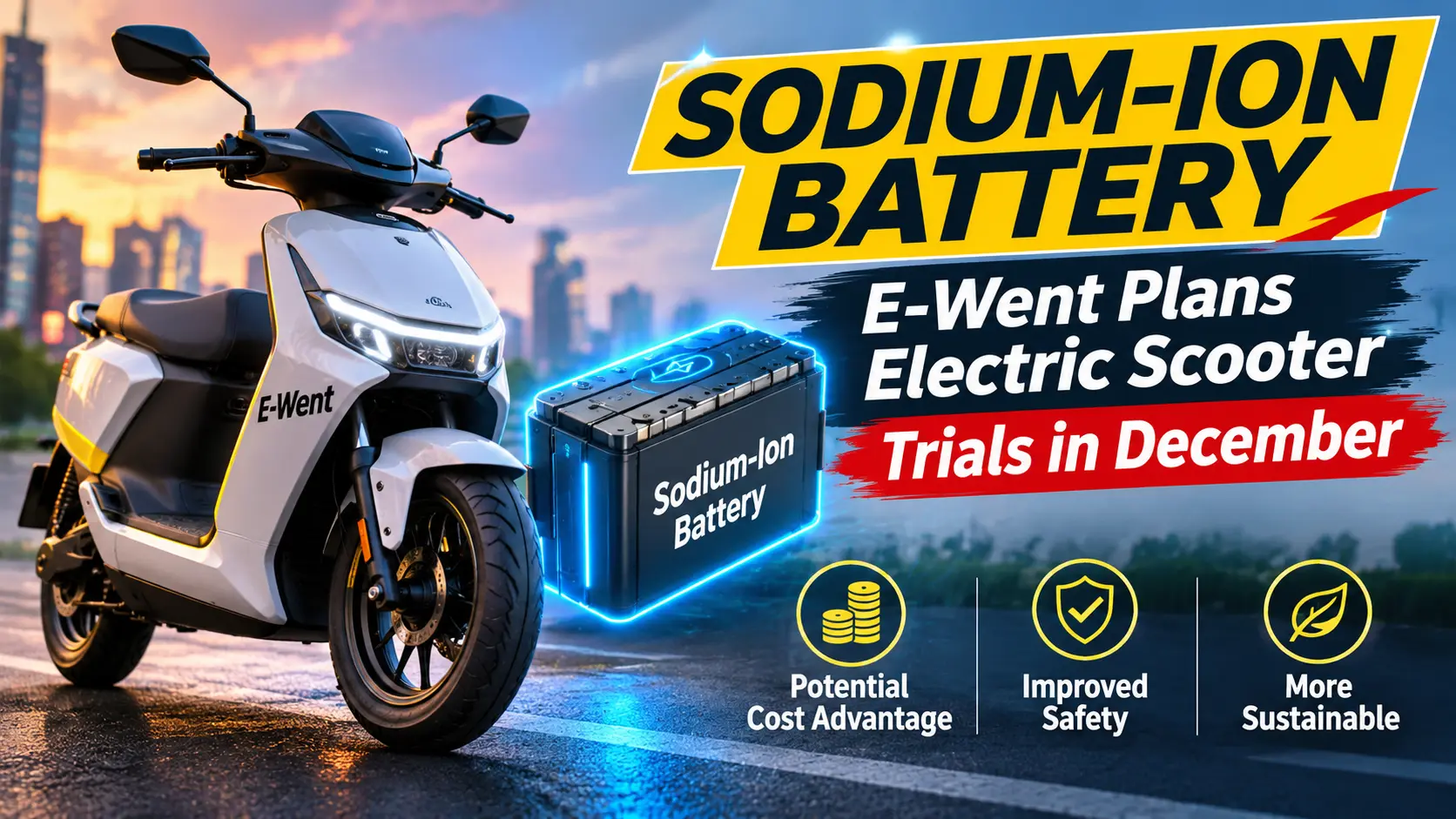
India’s electric two-wheeler market could soon see another battery chemistry enter the testing phase. Kolkata-based Saraogi E-Ventures, which sells electric scooters under the E-Went brand, plans to begin testing sodium-ion-powered scooters around December 2026. The company intends to put selected vehicles through trials before deciding whether the technology is suitable for future products.
The announcement is interesting because most electric scooters currently rely on lithium-ion batteries. A sodium ion battery could offer an alternative for manufacturers looking to diversify battery technology, but it also brings a practical challenge: lower energy density can mean a larger and heavier battery pack for comparable energy storage. E-Went says it will evaluate the economics and convenience before considering any commercial application.
Why Is E-Went Exploring Sodium-Ion Batteries?
According to founder and CEO Umang Kumar Saraogi, the company is exploring sodium-ion technology partly because of its potential safety advantages over conventional lithium-ion batteries. However, the company has not yet established whether the technology will meet the requirements of its future scooters.
E-Went currently uses lithium-ion technology in most of its models. Its proposed trials will involve deploying some scooters with sodium-ion packs and evaluating their performance in practical conditions. The company has not disclosed the battery supplier, capacity, test duration or the number of vehicles involved.
This is an important distinction. E-Went has announced a testing plan, not a confirmed new scooter launch. The results will determine whether the technology can move beyond the experimental stage for the company’s products.
Read More: Motorcycle Racing in India: FMSCI Opens Bidding for 2026 Championship
What Is a Sodium-Ion Battery?
A sodium ion battery works on a broadly similar principle to a lithium-ion battery. During charging and discharging, sodium ions move between the battery’s electrodes through an electrolyte, storing and releasing electrical energy.
The key difference is the material used to carry the charge. Instead of lithium, this chemistry uses sodium, an element that is widely available in nature. This creates an opportunity to diversify battery-material supply chains and reduce dependence on lithium-based chemistry.
However, the availability of sodium does not automatically make the complete battery cheaper. Cell manufacturing, electrode materials, processing, production scale and supply-chain maturity all influence the final cost. A commercially competitive battery needs to perform well across the entire manufacturing and ownership equation.
The International Energy Agency identifies sodium-ion batteries as an emerging technology entering a scale-up phase. It also highlights their lower energy density and less-developed manufacturing ecosystem compared with established lithium-ion technologies. A sodium ion battery is attracting attention because sodium is widely available and could help diversify battery-material supply chains. However, the commercial value of a sodium ion battery will depend on manufacturing costs, energy density and its ability to meet vehicle requirements.
Sodium-Ion vs Lithium-Ion: What Changes for Electric Scooters?
For electric two-wheelers, a sodium ion battery must deliver a practical balance between weight, range and affordability. A sodium ion battery with lower energy density may require more space to store the same amount of energy, making vehicle packaging an important consideration.
| Factor | Sodium-ion technology | Lithium-ion technology |
|---|---|---|
| Main charge carrier | Sodium ions | Lithium ions |
| Material availability | Sodium is widely available | Lithium supply is more geographically concentrated |
| Energy density | Generally lower | Generally higher |
| Battery packaging | Can require a larger pack | More compact for comparable energy storage |
| Manufacturing ecosystem | Still developing | More established |
| Commercial maturity | Emerging and scaling | Widely deployed in EVs |
The IEA’s 2026 assessment reports that leading sodium-ion cells can reach up to around 175 Wh/kg, compared with up to 205 Wh/kg for current LFP cells and 265 Wh/kg for NMC cells. These are cell-level figures, not guaranteed specifications for an electric scooter battery pack.
For a scooter manufacturer, this difference matters because a larger battery pack can affect under-seat storage, vehicle weight, handling and overall design. The actual outcome will depend on the cell chemistry, pack design and vehicle requirements.
Could This Technology Make Electric Scooters More Affordable?
One of the biggest questions surrounding sodium-ion technology is whether it can eventually improve the economics of affordable electric mobility. Sodium is more abundant than lithium, and the chemistry could help manufacturers diversify their raw-material requirements. However, lower raw-material dependence does not guarantee a lower retail price.
A sodium ion battery must compete on the cost of the complete battery pack, not just the price or availability of one element. Manufacturing scale, cell performance, warranty requirements, durability and the cost of integrating the pack into a scooter will all influence its commercial viability.
This is particularly relevant to E-Went’s target market. The company sees opportunities in electric two-wheelers priced below ₹1 lakh, where customers may place greater emphasis on purchase price, running costs and practical everyday usability than on premium features.
If the technology can deliver an acceptable combination of cost, range, packaging and reliability, it could become relevant to this segment. But that remains a possibility to be evaluated, not an established outcome of the planned trials.
Read more: India EV Sales October 2026: Why Market Share Fell Despite 76% Growth
Why the December Trials Matter
The proposed December testing programme is the first practical step in determining whether a sodium ion battery can meet E-Went’s product requirements. Laboratory performance and commercial suitability are different questions, particularly when a battery has to operate inside a vehicle used every day.
The company will need to understand how the packs perform under real-world riding conditions, how much space they require and whether their cost makes sense for its intended customers. Range consistency, charging behaviour, thermal management and long-term durability will also matter before any production decision.
E-Went has not announced a commercial launch date or confirmed that future scooters will definitely use this chemistry. The trial results and subsequent product decisions will be more meaningful than the announcement alone.
E-Went’s Wider Affordable EV Strategy
The battery initiative is part of a broader strategy to strengthen E-Went’s position in India’s price-sensitive electric two-wheeler market. Saraogi told PTI that the company’s monthly sales have increased from around 100 units four years ago to approximately 1,000–1,100 units currently.
The company operates in West Bengal, Jharkhand, Bihar, Chhattisgarh, Odisha, Assam, Telangana and Andhra Pradesh. Rather than immediately pursuing a nationwide expansion, its stated plan is to deepen its presence in these existing markets.
Saraogi also said the company’s revenue crossed ₹50 crore in FY26, with a target of ₹65 crore in the current financial year. These are company-reported figures, rather than independently audited figures presented in the interview.
The strategy highlights an important part of India’s EV market: growth does not depend only on premium electric scooters in major cities. Affordable products, regional dealer networks and local customer requirements can also shape the next phase of electric mobility.
Frequently Asked Questions
1. What is a sodium-ion battery?
A sodium-ion battery is a rechargeable battery that uses sodium ions to store and release electrical energy. It works on a similar principle to lithium-ion technology but uses different materials.
2. When will E-Went test sodium-ion batteries?
E-Went plans to begin trials around December 2026. The company has not announced the exact testing date or duration.
3. Will E-Went launch a sodium-ion electric scooter in India?
No commercial launch has been confirmed. The company will first evaluate the technology’s economics, convenience and practical performance before considering its use in future products.
4. Are sodium-ion batteries better than lithium-ion batteries?
Not in every respect. Sodium-ion technology offers potential advantages in material availability and low-temperature performance, but current cells generally have lower energy density and a less-developed supply chain.
5. Can sodium-ion batteries reduce electric scooter prices?
They could offer cost advantages in some applications over time, but lower scooter prices are not guaranteed. Battery manufacturing costs, pack design, production volumes and performance will determine commercial competitiveness.
6. Why could sodium-ion batteries be useful for electric scooters?
Their potential suitability for shorter-range electric mobility makes them worth exploring. However, manufacturers must balance cost and material availability against battery size, weight, range and durability.
Ride And Tech Verdict
E-Went’s planned sodium-ion battery trials are worth watching because they bring an emerging battery chemistry into the discussion around India’s affordable electric scooter market. The opportunity is clear: a wider choice of battery technologies could help manufacturers diversify supply chains and explore new cost structures.
But the technology still has to prove itself in a practical vehicle. Lower energy density, battery-pack dimensions, manufacturing economics and long-term performance cannot be ignored. For now, E-Went has announced a testing plan, not a production-ready scooter or a confirmed replacement for lithium-ion batteries.
The real story will begin when the December trials produce results. Until then, sodium-ion technology is a promising development to monitor rather than a reason to expect an immediate change in electric scooter prices or range.
Ride Smarter. Drive Smarter. Stay ahead with Ride And Tech.
Sources
- ETAuto – E-Went plans sodium-ion battery trials in December
- Business Standard – E-Went eyes mass market, to test sodium-ion batteries
- International Energy Agency – Global EV Outlook 2026: Electric vehicle batteries
- International Energy Agency – Sodium-ion battery momentum grows, but challenges remain
Ride And Tech — Where Ride Meets Tech.
Drive Smarter. Ride Smarter.
Copyright (c) Ride And Tech. All rights reserved.
