

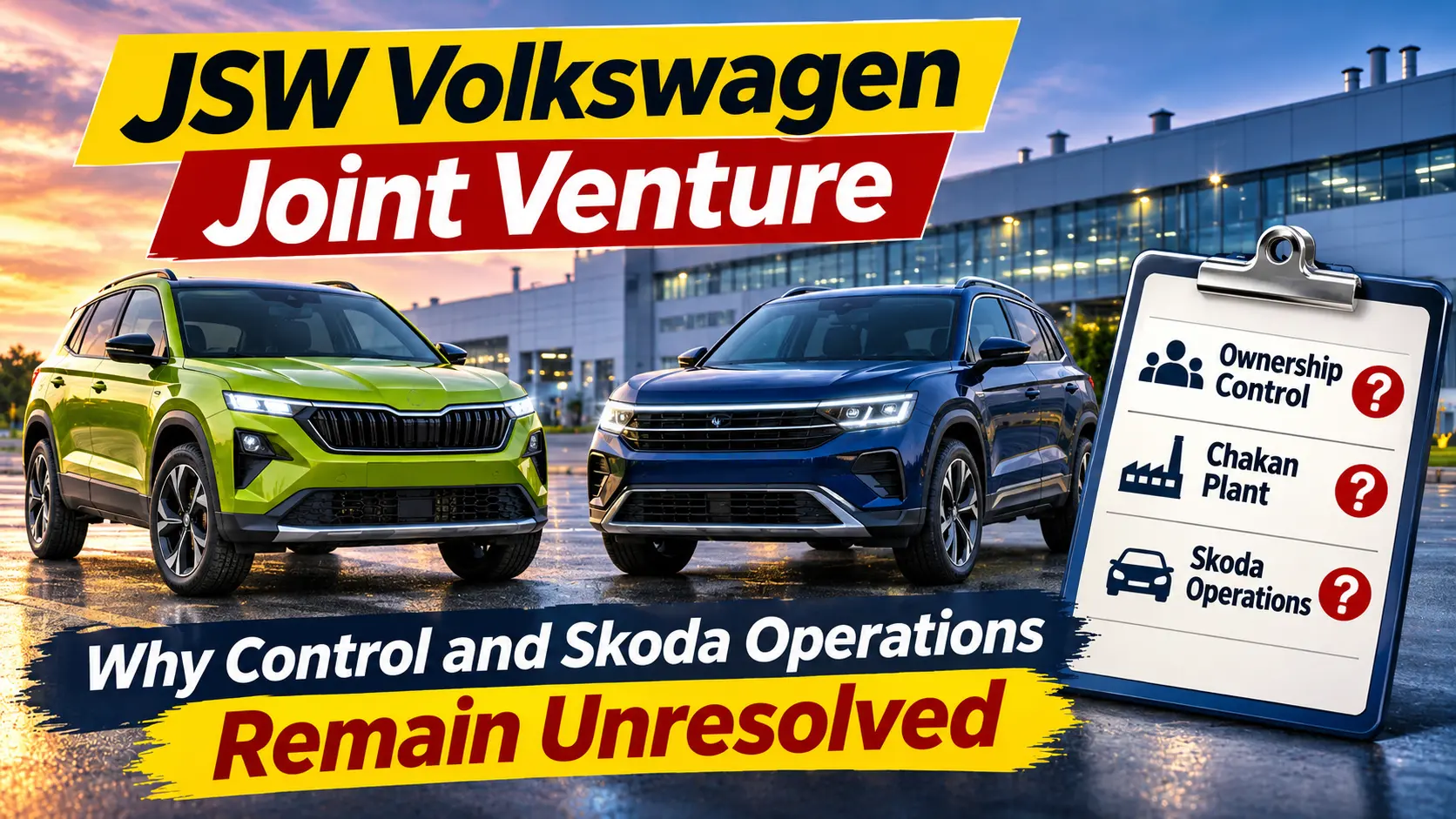
The proposed JSW Volkswagen joint venture in India is facing an important challenge: the two groups are yet to agree on how the partnership should be controlled and which parts of the existing Skoda Auto Volkswagen India business should come under its proposed structure.
According to a report published by Moneycontrol on November 23, negotiations have encountered differences over ownership, management control and the scope of operations. Sources cited in the report say JSW is seeking a 51% stake, while Volkswagen favours a jointly controlled arrangement.
The discussions also involve the future of selected Skoda models and manufacturing facilities, including the group’s Chakan plant in Maharashtra. However, these are reported proposals and negotiating positions, not final decisions announced by either company.
The development is significant because the proposed partnership could influence how Volkswagen and JSW approach product development, manufacturing, localisation and future vehicle investments in India.
Why Are JSW and Volkswagen Facing Differences?
JSW Group and Skoda Auto, which represents Volkswagen Group’s activities in India, signed a non-binding memorandum of understanding (MoU) in September 2026 to explore a strategic partnership.
The proposed collaboration is intended to combine Volkswagen Group’s automotive engineering and product capabilities with JSW’s manufacturing and business experience in India.
However, deciding the ownership and management structure is a major part of establishing such a partnership.
Moneycontrol’s November 23 report says JSW is seeking a 51% stake in the proposed venture, while Volkswagen is reluctant to surrender majority control of its Indian operations. The report attributes these positions to sources familiar with the discussions.
Volkswagen’s public position is somewhat different in emphasis. A Skoda Auto Volkswagen India spokesperson has stated that the proposed arrangement envisages a two-party partnership with joint control, clearly defined responsibilities and mechanisms for decision-making.
This difference between the reported negotiating positions and the company’s public statement is central to the current discussion. Neither side has announced a final agreement on ownership.
Read More: Sodium Ion Battery: E-Went Plans Electric Scooter Trials in December
What Could Happen to Skoda’s India Operations?
One of the most important questions surrounding the proposed JSW Volkswagen joint venture is how much of Skoda Auto Volkswagen India’s existing business would be included.
According to Moneycontrol, one proposal under discussion involves keeping a significant part of Skoda’s India operations outside the new partnership.
Under this reported possibility, selected premium models could be brought into the proposed arrangement, while India-developed mass-market vehicles would continue to be managed independently.
Skoda currently sells several locally manufactured or assembled vehicles in India, including:
- Skoda Kylaq: A compact SUV developed for the Indian market.
- Skoda Kushaq: A midsize SUV competing in one of India’s important passenger-vehicle segments.
- Skoda Slavia: A midsize sedan.
- Skoda Kodiaq: A locally assembled premium SUV.
- Skoda Octavia RS: An imported performance-oriented model.
The report also refers to the expected introduction of the imported Superb diesel in 2027 and the company’s evaluation of premium electric vehicles.
Keeping some of these operations outside the proposed partnership could create a more complicated business structure. The companies would need to define which products, assets, responsibilities and manufacturing arrangements belong to each business.
It is important to remember that the separation of Skoda operations remains a reported proposal, not a confirmed decision.
Why Is the Chakan Manufacturing Plant Important?
The Chakan manufacturing facility in Maharashtra is another important part of the negotiations.
According to Moneycontrol, discussions are taking place over whether the factory should be included in the proposed partnership or remain outside it.
The facility has an annual production capacity of approximately 225,000 vehicles. It manufactures the Skoda Kylaq, Kushaq and Slavia, along with the Volkswagen Taigun and Virtus. The plant also houses engine assembly operations.
If the facility remains outside the proposed JSW Volkswagen joint venture, the companies would need to work out how vehicles included in the partnership would be manufactured.
That could involve manufacturing agreements, production responsibilities, asset usage and commercial arrangements between the businesses.
The Volkswagen Group also operates another manufacturing facility at Chhatrapati Sambhajinagar in Maharashtra, with an annual capacity of approximately 60,000 vehicles, according to the Moneycontrol report.
For JSW, the manufacturing footprint is particularly relevant because the group is expanding its presence in the Indian automotive sector through several partnerships and new ventures.
What Does the Partnership Mean for India’s Automotive Industry?
The proposed JSW Volkswagen joint venture is important beyond the ownership discussions because it could influence the group’s long-term approach to the Indian market.
The September MoU identified several areas for potential cooperation, including passenger-vehicle development, manufacturing, localisation and research and development.
The proposed portfolio is expected to consider multiple powertrain technologies, including internal combustion engines, electric vehicles, plug-in hybrids and conventional hybrids.
For India, deeper localisation could help manufacturers improve production efficiency, strengthen domestic supplier participation and develop vehicles suited to local requirements.
The partnership could also create opportunities for future exports if India becomes a larger manufacturing base for selected products.
However, these possibilities depend on the final agreement. The companies still need to determine the investment structure, manufacturing responsibilities, product allocation and the extent of assets included in the venture.
Until those details are finalised, it would be premature to assume that the partnership will immediately lead to new models, factory transfers or a major expansion in production.
Why Is Volkswagen Interested in Retaining Control?
India has become an important market in Volkswagen Group’s international strategy, particularly through Skoda’s growing presence.
The Moneycontrol report highlights the difference in the recent sales performance of the two brands in India. According to Society of Indian Automobile Manufacturers data cited in the report, Skoda sold 44,133 vehicles between April and October 2026, compared with 18,043 vehicles for Volkswagen.
Skoda’s stronger recent performance helps explain why the structure of its Indian operations matters in the negotiations.
The proposed partnership is not simply about adding another investor to an existing business. It involves decisions about the future of brands, products, manufacturing assets and management responsibilities.
Volkswagen would need to consider how much operational independence it wants to retain, while JSW would need a structure that gives it a meaningful role in the proposed business.
Finding an arrangement that works for both companies will therefore be important before the MoU can progress towards a binding agreement.
What Happens Next?
The two groups have already held multiple rounds of discussions, but the latest report indicates that important questions remain unresolved.
The next stage will depend on whether both sides can reach agreement on ownership, management control and the scope of the proposed partnership.
The companies will also need to settle the allocation of manufacturing facilities, products, investments and responsibilities.
Another issue mentioned in the report is the ongoing customs-duty dispute involving Skoda Auto Volkswagen India. The company has contested the allegations, and the matter remains under litigation. How any potential liabilities would be treated in a future partnership has not been disclosed.
For now, the September MoU remains non-binding. A final agreement would require further negotiations and the relevant corporate and regulatory processes.
Frequently Asked Questions
1. What is the proposed JSW Volkswagen joint venture?
It is a proposed strategic partnership being explored by JSW Green Mobility and Skoda Auto, part of Volkswagen Group, to develop, manufacture and sell passenger vehicles in India and potentially overseas.
2. Why are JSW and Volkswagen reportedly facing disagreements?
A Moneycontrol report says the discussions involve differences over ownership and management control, with JSW reportedly seeking a 51% stake while Volkswagen favours joint control.
3. Will Skoda’s existing models be included in the partnership?
That has not been confirmed. A proposal reportedly involves bringing selected premium models into the partnership while keeping some India-developed mass-market models under independent management.
4. Will the Chakan factory become part of the proposed venture?
The factory’s future is reportedly being discussed. Neither company has announced whether the Chakan facility will be transferred or included in the proposed partnership.
5. Has JSW and Volkswagen’s partnership been finalised?
No. The companies signed a non-binding MoU in September 2026 to explore the partnership. Negotiations and discussions over the structure remain ongoing.
Ride And Tech Verdict
The proposed JSW Volkswagen joint venture could become an important development for India’s automotive manufacturing industry, but the latest negotiations show that combining two large businesses is more complicated than signing an MoU.
Ownership control, Skoda’s existing operations and the future of the Chakan manufacturing facility are among the major questions that need to be resolved.
For JSW, the partnership could strengthen its automotive ambitions through access to established vehicle platforms, engineering capabilities and manufacturing experience. For Volkswagen, India offers an important opportunity to expand its presence and strengthen its international manufacturing strategy.
However, the final outcome will depend on the structure both companies can agree upon. Until a binding agreement is announced, the reported proposals should be treated as part of ongoing negotiations rather than confirmed changes to their Indian operations.
Ride And Tech will continue tracking the discussions and any official announcement that clarifies the future structure of this proposed partnership.
Sources
- Moneycontrol – JSW-Volkswagen India JV talks hit speed bump over control, Skoda operations (November 23, 2026)
- Autocar Professional – Skoda Auto Volkswagen India and JSW sign non-binding MoU (September 9, 2026)
Ride And Tech — Where Ride Meets Tech.
Drive Smarter. Ride Smarter.
Copyright (c) Ride And Tech. All rights reserved.
