


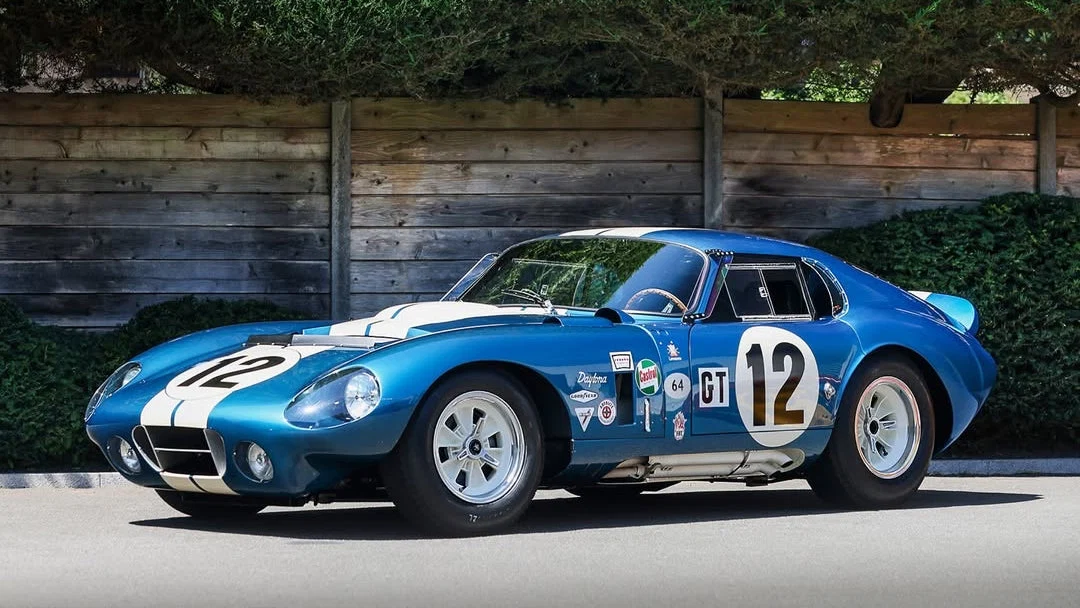
A 1964 Shelby Cobra Daytona Coupe has just made automotive history after selling for $42.905 million at the 2026 Pebble Beach Auctions, becoming the most expensive American car ever sold at auction. The record-breaking result places the legendary Cobra Daytona among the most valuable competition cars ever offered publicly and highlights the extraordinary demand for historically significant automobiles with exceptional rarity and provenance.
But the Shelby Cobra Daytona Coupe that achieved the result is far more than a rare classic car. Chassis CSX2300 was one of only six Daytona Coupes created to challenge Ferrari’s dominant 250 GTO in international GT racing. It competed during Shelby American’s championship-winning 1965 FIA GT campaign and later became the only Daytona Coupe to continue its competition career in Japan.
Its provenance is equally remarkable. CSX2300 was the only Cobra Daytona Coupe ever personally owned by Carroll Shelby, who reacquired the car in 1975 after its international racing career. That connection, combined with its competition history, rarity and survival, helps explain why this particular Shelby Cobra Daytona Coupe commanded such an extraordinary price.
The $42.9 million sale is therefore not simply another headline from Monterey Car Week. It is a story about one of America’s most important racing cars, its battle against Ferrari, the people who created it and the extraordinary journey that ultimately turned CSX2300 into a record-setting collector car.
A 1964 Shelby Cobra Daytona Coupe Just Set a Historic Auction Record
The 1964 Shelby Cobra Daytona Coupe has set a new benchmark for American collector cars after chassis CSX2300 sold for $42,905,000 at Gooding Christie’s Pebble Beach Auctions during Monterey Car Week 2026. The result was more than $20 million above the previous American-car auction record and made the Daytona Coupe the most valuable American car ever sold at auction.
The sale also represented a major result for Gooding Christie’s. The auction house described CSX2300 as its most valuable auction sale to date, while the car’s final price nearly doubled the previous American-car record of $22 million, set by a 1935 Duesenberg SSJ at Pebble Beach in 2018.
What makes the Shelby Cobra Daytona Coupe auction result particularly remarkable is that CSX2300 was not simply an exceptionally preserved American sports car. It was one of only six original Cobra Daytona Coupes built for a very specific purpose: taking on Ferrari’s dominant 250 GTO in international GT racing. Gooding Christie’s highlights its participation in Shelby American’s 1965 FIA GT Championship campaign and its later competition career in Japan.
The $42.9 million figure also puts the sale into the broader context of an extraordinary 2026 Monterey Car Week. The Daytona was among several headline-making results, but its combination of American racing history, extreme rarity and Carroll Shelby provenance gave it a unique position in this year’s collector-car market.
For CSX2300, however, the record is only the latest chapter. The story of why this particular Shelby Cobra Daytona Coupe became valuable enough to command $42.9 million begins with Shelby’s attempt to solve one of the Cobra’s biggest weaknesses: high-speed aerodynamic performance.
Read More: Pebble Beach Concours 2026
What Is the Shelby Cobra Daytona Coupe?
The Shelby Cobra Daytona Coupe was created to solve a very specific problem: the Cobra roadster was extremely competitive, but its open bodywork was not ideal for the high-speed European circuits where Ferrari’s 250 GTO had established itself as the car to beat. Carroll Shelby wanted an American-built GT car capable of challenging Ferrari for the international manufacturers’ championship.
The answer was a closed-cockpit Cobra with a much more aerodynamic body. Peter Brock designed the distinctive coupe shape, which was developed around the existing Cobra mechanical package but with a major emphasis on reducing aerodynamic drag and improving high-speed performance. The resulting car became known as the Daytona Coupe after its debut at Daytona International Speedway.
Only six original Shelby Cobra Daytona Coupes were built, making the model exceptionally rare from the beginning. The cars were not created as a conventional road-car production run; they were purpose-built competition machines intended to take on Ferrari in international GT racing.
The Daytona Coupe retained the Cobra’s American V8 philosophy while introducing the aerodynamic advantages of a fixed roof. That combination was central to Shelby’s approach: use a relatively straightforward and serviceable American powertrain, but develop the chassis and bodywork to compete against highly sophisticated European racing machinery.
The project ultimately delivered exactly what Shelby wanted. The Shelby Cobra Daytona Coupe helped Shelby American win the 1965 World Manufacturers’ GT Championship, defeating Ferrari in the process. Shelby American’s own history describes the Daytona Coupe as the car that provided the aerodynamic advantage needed to beat Ferrari on Europe’s fastest circuits.
That racing purpose is fundamental to understanding the $42.9 million auction result. The car that sold at Pebble Beach was not simply one of six rare classic Cobras. It was a surviving piece of the American campaign that challenged Ferrari’s dominance — and one with an unusually important individual history of its own.

Why Shelby Built the Daytona Coupe to Beat Ferrari
The Shelby Cobra Daytona Coupe was born from a simple but ambitious objective: beat Ferrari in international GT racing. The regular Cobra had already demonstrated the effectiveness of its American V8-powered formula, but its open-top roadster body was at a disadvantage on long, high-speed circuits. Ferrari’s 250 GTO, with its carefully developed aerodynamics and strong high-speed performance, had become the benchmark Shelby American needed to overcome.
The solution was to give the Cobra a fixed roof and a completely different aerodynamic profile. Designer Peter Brock developed the distinctive fastback body, with the long rear section and Kamm-style tail designed to reduce drag while maintaining stability at high speed. Engineer Ken Miles also played an important role in developing and testing the car. The result was a machine that looked dramatically different from the conventional Cobra but retained the American V8 philosophy underneath.
Aerodynamics were crucial because the Daytona Coupe was intended for circuits where top speed could determine the outcome. The car needed to spend long periods at high speed while maintaining enough stability and efficiency to remain competitive over endurance-racing distances. Contemporary accounts of the Daytona’s performance show why the redesigned body mattered: the coupe was capable of approaching 200 mph in suitable conditions, giving Shelby a significant advantage over the open Cobra on fast sections of circuits such as Le Mans.
The project was also remarkable because of the resources behind it. Shelby American was a relatively small California operation taking on established European manufacturers with decades of racing experience. The Daytona Coupes were therefore not simply another new model; they represented an attempt to use American engineering, an American V8 and a highly focused aerodynamic design to challenge Ferrari on its own territory. Gooding Christie’s describes the six original Daytona Coupes as cars created specifically to defeat Ferrari’s 250 GTO.
The Ferrari rivalry gave the Daytona Coupe its purpose, but it also gave the car a much larger place in automotive history. This was not a battle between two similar cars developed by the same philosophy. It was a clash between Shelby American’s relatively unconventional approach and Ferrari’s established European GT racing expertise.
The first season did not immediately deliver the championship Shelby wanted. CSX2300 debuted during the 1964 Tour de France Automobile, where it demonstrated the Daytona’s potential but suffered mechanical problems. Ferrari ultimately secured the 1964 championship. Shelby returned with an improved campaign the following year, and the Daytona Coupes went on to help Shelby American secure the 1965 FIA World Manufacturers’ GT Championship.
That championship victory is central to understanding the modern value of the Shelby Cobra Daytona Coupe. Its rarity alone would make it desirable, but its six-car production run is backed by a genuine international racing achievement against one of the most respected manufacturers in motorsport history.
The Daytona Coupe was therefore not created simply to make the Cobra faster. It was created because Shelby believed an American sports car could take on Ferrari’s best GT racer — and the resulting machine eventually proved him right.
The Racing Story: How the Daytona Coupe Challenged Ferrari
The Shelby Cobra Daytona Coupe quickly proved that its aerodynamic redesign was more than a styling exercise. After the first cars entered international competition in 1964, the Daytona became a serious threat to Ferrari’s established dominance in GT racing. Its combination of a lightweight Cobra chassis, American V8 power and a much more efficient closed body allowed Shelby American to compete more effectively on high-speed circuits.
The 1964 season established the Daytona’s potential. At the 24 Hours of Le Mans, a Daytona Coupe finished first in its GT class and fourth overall, demonstrating that the new American coupe could compete with Europe’s established racing machinery over a full endurance event. The car also achieved GT-class success at events including the Tour de France and Goodwood’s Tourist Trophy.
However, the ultimate target remained Ferrari. The Daytona Coupes were developed specifically to challenge the Ferrari 250 GTO, and their racing results gradually turned the aerodynamic advantage into championship points. By the end of the 1965 season, Shelby American had achieved the objective that had driven the project from the beginning: the Shelby Cobra Daytona Coupe helped secure the 1965 FIA GT Manufacturers’ Championship, defeating Ferrari in the process.
The significance of that achievement becomes clearer when considering the scale of the competition. Shelby American was competing against manufacturers with long-established European racing programs, yet the Daytona’s focused development allowed a small American operation to produce a car capable of winning internationally. Its success gave the Cobra Daytona a place in motorsport history that went far beyond its tiny production run.
The six original Daytona Coupes also developed individual racing histories. Some competed extensively across Europe, while CSX2300, the chassis that has now sold for $42.905 million, continued its competition career beyond Shelby American’s factory program and later raced successfully in Japan through 1968. Gooding Christie’s identifies that continued competition history as one of the car’s major highlights.
That history is crucial to understanding the modern value of CSX2300. Collectors are not paying $42.9 million simply for an attractive 1960s coupe. They are paying for a documented piece of an international racing campaign that directly challenged Ferrari and ultimately helped deliver an FIA GT championship.
The Daytona Coupe’s greatest achievement was therefore not its rarity, but what Shelby’s six cars accomplished with that rarity: they turned an American Cobra into a genuine European GT championship contender.
CSX2300: The Daytona Coupe That Sold for $42.9 Million
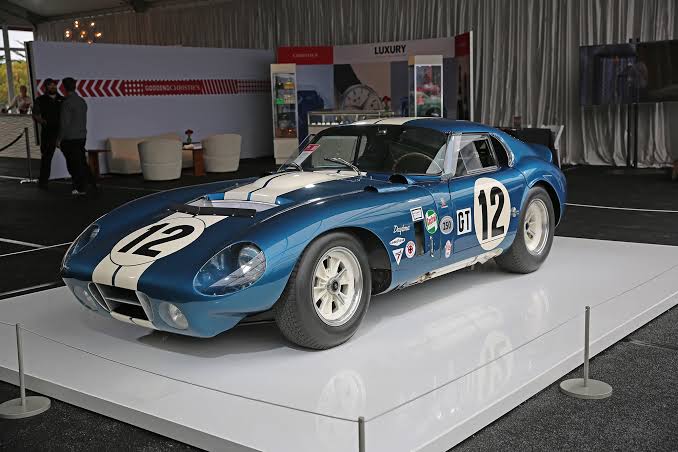
The Shelby Cobra Daytona Coupe that set the $42.905 million auction record was chassis CSX2300, one of the six original Daytona Coupes built for Shelby American’s campaign against Ferrari. Its individual history is a major reason why this particular car commanded such an extraordinary price. Gooding Christie’s describes CSX2300 as one of the most important American automobiles ever built and highlights its competition history, rarity and Carroll Shelby provenance.
CSX2300 made its competition debut at the 1964 Tour de France Automobile, driven by Bob Bondurant and Jochen Neerpasch. The car subsequently became part of Shelby American’s championship-winning 1965 campaign, helping establish the Daytona Coupe as a genuine international GT racing weapon rather than simply an aerodynamic experiment.
Its racing career also continued beyond Shelby American’s factory program. CSX2300 was the only Cobra Daytona Coupe to continue competing after the factory program ended, eventually racing successfully in Japan through 1968. That extended competition history makes the chassis particularly interesting to collectors because it documents a much broader racing life than many historically important cars that spent most of their later years in storage or private collections.
The car’s provenance becomes even more significant because Carroll Shelby himself eventually owned CSX2300. Shelby reacquired the Daytona Coupe in 1975, making it the only one of the original six to have been personally owned by the man whose name became synonymous with the Cobra and the Daytona project. That connection gives CSX2300 an additional layer of historical importance beyond its racing record.
This combination is extremely difficult to reproduce in the collector-car market:
- One of only six original Shelby Cobra Daytona Coupes
- Genuine international racing history
- Participation in Shelby American’s 1965 FIA GT Championship campaign
- Competition history continuing into Japan
- Direct ownership history involving Carroll Shelby
- Strong documented provenance
- Association with one of America’s most important racing programs
The result is a car whose value cannot be judged simply by comparing it with another 1960s sports car. CSX2300 represents a specific moment when Shelby American took on Ferrari, developed a purpose-built aerodynamic weapon and succeeded on the international GT stage.
That history helps explain why the Shelby Cobra Daytona Coupe auction result reached $42.905 million. The buyer was not simply purchasing one of six rare American coupes; they were acquiring one of the most historically significant surviving artifacts from Shelby’s successful challenge to Ferrari.
Carroll Shelby’s Connection to CSX2300
CSX2300’s provenance becomes even more significant because it eventually returned to the hands of the man who created the Shelby Cobra Daytona Coupe in the first place. After its racing career in Japan, the car was rediscovered by Cobra historian Michael L. Shoen, who helped broker its sale to Carroll Shelby in 1975.
Shelby’s ownership lasted until 1998, making CSX2300 the only one of the six original Daytona Coupes ever personally owned by its creator. That distinction gives the car a provenance that is exceptionally difficult to match. It was not merely a factory-built Shelby racing car; it became part of Shelby’s own personal history.
During Shelby’s ownership, CSX2300 was entrusted to Cobra specialist Mike McCluskey in Torrance, California, for a comprehensive restoration intended to return the car to its 1965 specification. The restoration helped preserve the Daytona’s identity as the championship-era competition car rather than turning it into a modern interpretation of the original.
Shelby subsequently displayed CSX2300 at important Cobra gatherings, including SAAC-9 in Anaheim in 1994 and the Cobra 30th Reunion at Sonoma in 1995. The car also appeared at the Monterey Historic Automobile Races, becoming one of the most visible surviving representations of Shelby’s racing legacy.
This direct connection to Shelby adds a unique layer to the car’s already extraordinary racing history. A collector could find another Daytona Coupe with competition provenance, but CSX2300 is the only one that can also claim to have been personally owned by Carroll Shelby himself.
That provenance is one of the key reasons the $42.905 million result cannot be viewed simply as the price of a rare 1960s racing car. The buyer acquired a car that connects Shelby American’s championship campaign, the Ferrari rivalry and Carroll Shelby’s personal legacy in a single surviving chassis.
What Makes the Shelby Cobra Daytona Coupe So Valuable?
The Shelby Cobra Daytona Coupe is valuable because several of the factors collectors prize most come together in a single model: extreme rarity, genuine racing success, important provenance and a direct connection to one of America’s most influential automotive figures. The $42.905 million sale of CSX2300 demonstrates just how much collectors can pay when those characteristics exist in one historically significant car.
Only Six Original Daytona Coupes
Rarity is the starting point. Only six original Shelby Cobra Daytona Coupes were built for the factory racing program. That means the supply of genuine cars is permanently limited, and every surviving example represents a significant part of Shelby American’s short but highly successful GT-racing campaign.
For a collector, this is fundamentally different from owning a rare road-going sports car that was produced in hundreds or thousands of examples. There are only a handful of authentic Daytona Coupes available in the world, and opportunities to purchase one are extremely unusual.
Genuine International Racing Pedigree
The Shelby Cobra Daytona Coupe also has something that cannot be recreated later: a genuine period racing history against Ferrari. The car was specifically developed to challenge the Ferrari 250 GTO, and Shelby American ultimately achieved its goal by winning the 1965 FIA International Championship for GT Manufacturers.
That championship is one of the most important parts of the Daytona’s value. The car isn’t valuable simply because it was designed by Peter Brock or because it carries Carroll Shelby’s name. It became historically important because the engineering concept worked in international competition.
Carroll Shelby Provenance
CSX2300 takes provenance to another level because it was the only original Daytona Coupe personally owned by Carroll Shelby. Shelby reacquired the car in 1975, giving the chassis a direct connection to the man responsible for the program.
For the collector-car market, that distinction can be enormously valuable. Two cars from the same limited production run can have dramatically different values when one has a documented connection to the creator, important owners or significant events.
An Irreplaceable Story
Perhaps the most important factor is that the Daytona Coupe cannot be separated from the story surrounding it.
It was created to solve the Cobra’s aerodynamic limitations, developed specifically to challenge Ferrari, raced internationally, contributed to a championship victory and, in the case of CSX2300, later returned to Carroll Shelby’s personal ownership. Those events happened decades ago and cannot be reproduced with another car.
That is why the Shelby Cobra Daytona Coupe auction result should not be interpreted simply as a $42.9 million valuation of a 1960s sports car. It represents the price collectors were willing to pay for a combination of rarity, racing history, provenance and irreplaceability that very few automobiles can match.
The record also reflects a broader pattern emerging from the 2026 Monterey auctions: the strongest prices are increasingly concentrated around cars with exceptional provenance, rarity and cultural significance rather than simply expensive or desirable specifications.
The $42.9 Million Auction: What Happened at Pebble Beach?

The record-setting Shelby Cobra Daytona Coupe auction took place at Gooding Christie’s Pebble Beach Auctions during Monterey Car Week 2026. Chassis CSX2300, offered as Lot 39, carried an estimate of more than $25 million before bidding began. It ultimately sold for $42,905,000 including the buyer’s premium, more than $20 million above the previous auction record for an American car.
The result was extraordinary even by Pebble Beach standards. Gooding Christie’s reported that the Daytona became the highest-grossing American car ever sold at auction and the most valuable car ever sold by the auction house. The previous American auction record had been held by the 1935 Duesenberg SSJ, which achieved $22 million at Pebble Beach in 2018.
The final figure also demonstrates how strongly collectors responded to CSX2300’s combination of rarity and provenance. The car was not merely one of six original Daytona Coupes; it was the ex-Carroll Shelby example, with a documented competition history and a direct connection to the creator of the program. Those characteristics helped separate it from other historically significant American cars appearing at the same event.
The sale also came during an exceptionally strong Monterey Car Week for the upper end of the collector-car market. Across the major auctions, headline cars generated enormous results, including a $40 million Ferrari Luce and a $34.655 million McLaren F1 GTR. The broader results suggested that buyers remained willing to spend heavily when a car offered exceptional rarity, provenance and historical significance.
For the 1964 Shelby Cobra Daytona Coupe, however, the $42.905 million result represents something more specific than a strong auction performance. It establishes a new benchmark for American automotive history and shows just how valuable an irreplaceable racing car can become when its engineering significance, competition record and provenance all converge in a single chassis.
How the Daytona Coupe Changed American Performance Cars
The Shelby Cobra Daytona Coupe did more than give Carroll Shelby a faster version of the Cobra. It demonstrated that American performance engineering could compete successfully on Europe’s most demanding GT circuits by combining a powerful American V8 with carefully developed aerodynamics. That formula helped Shelby American defeat Ferrari for the 1965 FIA GT Manufacturers’ Championship.
One of the most important innovations was the decision to move away from the open Cobra roadster’s body and create a purpose-built coupe. Peter Brock’s aerodynamic design reduced the drag that limited the roadster at high speeds, while the Daytona retained the lightweight Cobra concept and Ford V8 power. The result was a car designed around the realities of endurance and high-speed GT racing rather than simply adapting a road car for competition.
The Daytona Coupe also demonstrated the importance of aerodynamic efficiency in American racing-car development. At a time when engine power was often the easiest way to pursue performance, Shelby’s program showed that reducing drag and improving high-speed stability could produce a decisive advantage. That lesson became increasingly important across motorsport as manufacturers began treating aerodynamics as a fundamental part of vehicle performance.
Its success against the Ferrari 250 GTO gave that engineering philosophy international credibility. Shelby American was a comparatively small operation, yet the Daytona program ultimately delivered an FIA GT manufacturers’ championship against Ferrari. That achievement remains one of the defining moments in American motorsport history.
The Daytona’s influence also extends beyond its racing record. Its combination of a lightweight chassis, powerful V8 and aerodynamic body became part of the blueprint for later American performance cars: raw power alone was not enough; the car also needed to use that power effectively at speed.
That is why the Daytona Coupe remains important more than six decades after it first raced. It represents a point where American performance moved beyond the traditional muscle-car idea of simply adding more engine and demonstrated that aerodynamics, lightweight construction, engineering discipline and racing strategy could work together to beat an established European rival.
The $42.9 million CSX2300 sale therefore reflects more than collector demand for a rare Shelby. It also reflects the historical importance of a car that helped change perceptions of what an American racing machine could achieve.
Shelby Cobra Daytona Coupe vs Ferrari 250 GTO
The rivalry between the Shelby Cobra Daytona Coupe and the Ferrari 250 GTO is one of the defining stories of 1960s GT racing. The two cars approached performance from very different directions, yet they were ultimately competing for the same prize: victory in international GT competition.
The Shelby Cobra Daytona Coupe was developed from the Cobra platform with a Ford V8, a lightweight chassis and a purpose-built aerodynamic coupe body. Ferrari’s 250 GTO, meanwhile, evolved from Ferrari’s established front-engined V12 GT racing formula. The Daytona’s mission was particularly clear: improve the Cobra’s high-speed capability enough to challenge Ferrari on circuits where aerodynamic efficiency mattered.
| Key Difference | Shelby Cobra Daytona Coupe | Ferrari 250 GTO |
|---|---|---|
| Primary purpose | FIA GT racing | FIA Group 3 GT racing |
| Engine philosophy | Ford V8 | Ferrari V12 |
| Body style | Aerodynamic fixed-roof coupe | Front-engined berlinetta |
| Production | 6 original Daytona Coupes | 36 original 250 GTOs |
| Development goal | Challenge Ferrari at high speed | Maintain Ferrari’s GT dominance |
| Major championship achievement | Helped Shelby win the 1965 FIA GT Manufacturers’ Championship | Won the GT championship before the Daytona’s breakthrough |
The difference in production numbers is especially striking. Ferrari built far more 250 GTOs than Shelby built Daytona Coupes, but both have become exceptionally valuable because their importance is tied to their racing history rather than production numbers alone. The Daytona’s six-car production run makes an original example extraordinarily scarce, while the 250 GTO has become one of the world’s most recognised collector cars because of its competition pedigree and Ferrari provenance.
The Daytona also demonstrated that American engineering did not need to imitate Ferrari’s formula to compete with it. Shelby retained the advantages of the Cobra’s Ford V8 while addressing its high-speed aerodynamic limitations with Peter Brock’s purpose-built body. That combination eventually helped Shelby American take the 1965 FIA GT Manufacturers’ Championship, giving the Daytona a place in history as the American car that successfully challenged Ferrari’s established GT dominance.
That does not make the Daytona objectively “better” than the 250 GTO. They were products of different engineering philosophies and racing programs, and both became icons for different reasons. What makes the rivalry so compelling is that the Daytona was created specifically because Ferrari had established the benchmark Shelby needed to beat.
More than six decades later, that rivalry continues to influence collector values. A genuine Shelby Cobra Daytona Coupe carries the story of an American racing program that took on Ferrari and succeeded, while the 250 GTO represents one of Ferrari’s most celebrated eras of GT competition. The $42.9 million sale of CSX2300 shows that the Daytona’s place in that history is now being valued at an extraordinary level by the collector-car market.
How Rare Is the Shelby Cobra Daytona Coupe?
The Shelby Cobra Daytona Coupe is exceptionally rare because the original factory racing program produced only six Daytona Coupes. These were purpose-built competition cars created to challenge Ferrari’s 250 GTO, rather than a high-volume production model that could later become collectible. Gooding Christie’s identifies CSX2300 as one of those six original cars.
That tiny production run is one of the biggest reasons an authentic Shelby Cobra Daytona Coupe is so difficult to acquire. There are only a handful of genuine cars with direct links to the original Shelby American program, and each chassis has its own documented racing and ownership history.
CSX2300 is particularly important within that group. It was the only Daytona Coupe to continue its competition career beyond Shelby American’s factory program, racing in Japan through 1968. It was also later acquired by Carroll Shelby himself, making it the only original Daytona Coupe personally owned by its creator.
The rarity becomes even more significant when combined with the car’s racing credentials. A collector isn’t simply buying one of six old American sports cars; they are buying a surviving piece of a six-car program that helped Shelby American defeat Ferrari in the FIA GT Manufacturers’ Championship. That history cannot be recreated by building another Daytona-style car today.
There is also an important distinction between original Daytona Coupes and later replicas or continuation-style cars. Modern examples can reproduce the appearance and engineering concept, but they do not possess the provenance of one of the original six competition chassis. For the collector market, that historical authenticity is fundamental.
The scarcity of genuine cars is reflected in how rarely they appear at major public auctions. Before CSX2300’s record-breaking 2026 sale, the last public auction of an original Daytona Coupe was in 2009, when another chassis sold for several million dollars. The gap between major public offerings helps explain why a car of this calibre can generate extraordinary interest when it finally comes to market.
Ultimately, the Shelby Cobra Daytona Coupe’s rarity is not just about the number six. It is the combination of six original cars, genuine international racing history, Ferrari rivalry and individual chassis provenance that makes each surviving example so valuable.
And in the case of CSX2300, that combination culminated in the $42.905 million auction record achieved at Pebble Beach in 2026.
What Does the $42.9 Million Sale Mean for the Collector-Car Market?
The $42.905 million sale of the Shelby Cobra Daytona Coupe is significant not only because it created a new record for an American car at auction, but because it shows where the highest end of the collector-car market is placing its strongest bets. Buyers are demonstrating that they are willing to pay extraordinary sums for cars that combine rarity, documented competition history and irreplaceable provenance.
The size of the jump is particularly striking. The previous record for an American car at auction was the 1935 Duesenberg SSJ at $22 million, also sold at Pebble Beach in 2018. CSX2300 therefore did not simply take the record by a small margin; its $42.905 million result almost doubled the previous benchmark.
The result also needs to be viewed within the wider Monterey Car Week 2026 market. The Daytona was the headline sale at Gooding Christie’s, but other historically important cars also achieved major results, including a Ferrari 250 P at $18.705 million and a McLaren F1 GTR at $34.655 million elsewhere during the week. Across the major Monterey auctions, approximately $748 million in cars changed hands, indicating exceptionally strong demand at the upper end of the market.
However, the results also suggest that collectors are becoming highly selective. Recent analysis of the Monterey auctions shows that exceptional cars with unusual provenance, factory specifications or important racing histories attracted the strongest premiums, while less significant examples did not necessarily benefit from the same market strength.
That distinction is important for the Shelby Cobra Daytona Coupe. Its $42.9 million valuation should not be interpreted as evidence that every rare American classic is suddenly worth tens of millions of dollars. CSX2300 occupies an unusual position because it combines six-car rarity with an international racing record, Ferrari rivalry and direct ownership by Carroll Shelby.
The sale therefore reinforces a broader principle in the collector-car market: historical importance is becoming increasingly valuable when it is supported by authentic, documented provenance. A car that can be directly connected to a defining moment in motorsport history has something that money cannot simply reproduce.
For CSX2300, that history is precisely what made the record possible. The $42.9 million price is ultimately a reflection of how difficult it would be to ever recreate another car with the same combination of Shelby, Ferrari, championship racing, rarity and provenance.
Read More: LeBron James’ Mercedes-Maybach S 680
Shelby Cobra Daytona Coupe vs Ferrari 250 GTO
The rivalry between the Shelby Cobra Daytona Coupe and the Ferrari 250 GTO is one of the defining stories behind the Daytona’s legacy. The two cars came from very different engineering philosophies, but they were ultimately chasing the same objective: winning international GT races.
The Shelby Cobra Daytona Coupe combined a Ford V8-powered Cobra platform with a purpose-built aerodynamic coupe body, while Ferrari relied on its proven front-engine V12 GT formula with the 250 GTO. Shelby’s decision to create the Daytona was driven specifically by the need to challenge Ferrari’s advantage at high-speed circuits. Gooding Christie’s describes the six original Daytona Coupes as being created to defeat the 250 GTO.
| Key Difference | Shelby Cobra Daytona Coupe | Ferrari 250 GTO |
|---|---|---|
| Development purpose | Challenge Ferrari in international GT racing | Defend Ferrari’s GT dominance |
| Engine philosophy | Ford V8 | Ferrari V12 |
| Body style | Fixed-roof aerodynamic coupe | Front-engined GT berlinetta |
| Original production | Six factory Daytona Coupes | 36 original 250 GTOs |
| Major achievement | Helped Shelby American win the 1965 FIA GT Manufacturers’ Championship | Won the GT championship before the Daytona’s breakthrough |
| Core advantage | High-speed aerodynamic efficiency | Balanced GT performance and established racing development |
The production numbers are particularly revealing. Ferrari built substantially more 250 GTOs than Shelby built Daytona Coupes, yet both became extraordinarily valuable because their importance goes far beyond scarcity. The Daytona’s tiny six-car production run is backed by a genuine championship-winning racing history, while the 250 GTO has become one of the most celebrated collector cars in automotive history.
The Daytona also demonstrated that Shelby did not need to copy Ferrari’s engineering philosophy to compete with it. Instead, the American team retained the Cobra’s V8-powered character and addressed its high-speed limitations through aerodynamics. That approach ultimately helped Shelby American secure the 1965 FIA GT Manufacturers’ Championship, giving the Daytona Coupe its defining victory over Ferrari.
That does not make the Shelby Cobra Daytona Coupe objectively superior to the Ferrari 250 GTO. They were developed for the same racing environment but represented different approaches to achieving performance. The importance of their rivalry comes from the fact that Ferrari established the benchmark — and Shelby created the Daytona specifically to challenge it.
More than six decades later, that rivalry remains central to the Daytona’s collector value. The $42.905 million CSX2300 sale is ultimately a reflection of the car’s place in that historic American-versus-European GT battle, not simply its rarity as a six-car model.
FAQs About the Shelby Cobra Daytona Coupe
How much did the Shelby Cobra Daytona Coupe sell for?
The 1964 Shelby Cobra Daytona Coupe chassis CSX2300 sold for $42,905,000 at Gooding Christie’s Pebble Beach Auctions in August 2026. The result made it the most expensive American car ever sold at auction.
How many Shelby Cobra Daytona Coupes were built?
Only six original Cobra Daytona Coupes were created for Shelby American’s competition program. Their extremely limited production is one of the major reasons genuine examples are so valuable today.
What is CSX2300?
CSX2300 is one of the original Shelby Cobra Daytona Coupes and the specific chassis that sold for $42.905 million in 2026. It debuted at the 1964 Tour de France Automobile and later became a key participant in Shelby American’s 1965 FIA GT Championship campaign.
Why did Shelby build the Daytona Coupe?
The Daytona Coupe was developed to improve the Cobra’s high-speed performance and challenge Ferrari’s 250 GTO in international GT racing. Its fixed-roof aerodynamic body reduced the high-speed limitations of the open Cobra roadster.
Who designed the Shelby Cobra Daytona Coupe?
The distinctive Daytona Coupe body was designed by Peter Brock, with the development program involving Shelby American’s racing and engineering team. The aerodynamic design was central to the car’s ability to compete with Ferrari on high-speed circuits.
Did the Shelby Cobra Daytona Coupe beat Ferrari?
Yes. The Daytona program helped Shelby American win the 1965 FIA GT Manufacturers’ Championship, defeating Ferrari. That championship victory is one of the most important reasons the model remains historically significant.
Was CSX2300 owned by Carroll Shelby?
Yes. CSX2300 was later reacquired by Carroll Shelby, making it the only original Daytona Coupe personally owned by its creator. That provenance significantly strengthens the car’s historical importance.
Why is the Shelby Cobra Daytona Coupe so valuable?
Its value comes from a rare combination of factors: only six original cars were built, the model has genuine international racing success, it was created specifically to challenge Ferrari, and CSX2300 has the additional distinction of Carroll Shelby ownership.
Is the $42.9 million Shelby Daytona Coupe the most expensive American car ever sold?
Yes. CSX2300’s $42.905 million result established a new auction record for an American automobile, surpassing the previous $22 million record set by a 1935 Duesenberg SSJ in 2018.
Ride And Tech Verdict
The $42.905 million sale of the 1964 Shelby Cobra Daytona Coupe CSX2300 is not simply another record from Monterey Car Week. It is a reflection of what happens when rarity, competition history, engineering significance and exceptional provenance come together in one irreplaceable automobile.
The Daytona Coupe was created with a clear objective: challenge Ferrari’s 250 GTO. With only six original cars built, its racing success alone makes it one of the most important American competition cars ever produced. CSX2300 takes that story even further through its international racing career, continued competition in Japan and unique history as the only Daytona Coupe personally owned by Carroll Shelby.
That is why the $42.9 million Shelby Cobra Daytona Coupe auction result feels justified from a historical perspective. The buyer was not simply purchasing a rare classic car; they were acquiring a surviving piece of the Shelby-Ferrari rivalry and one of the clearest examples of American engineering successfully challenging the European GT establishment.
For Ride And Tech, the biggest takeaway is that CSX2300 demonstrates why automotive history can sometimes be more valuable than outright performance. Modern supercars may be dramatically faster, but very few cars can claim to have changed the course of international GT racing in the way the Daytona Coupe did.
Ride And Tech — Where Ride Meets Tech.
Drive Smarter. Ride Smarter.
Copyright (c) Ride And Tech. All rights reserved.

1 thought on “1964 Shelby Cobra Daytona Coupe Sells for $42.9 Million, Sets American Auction Record”