


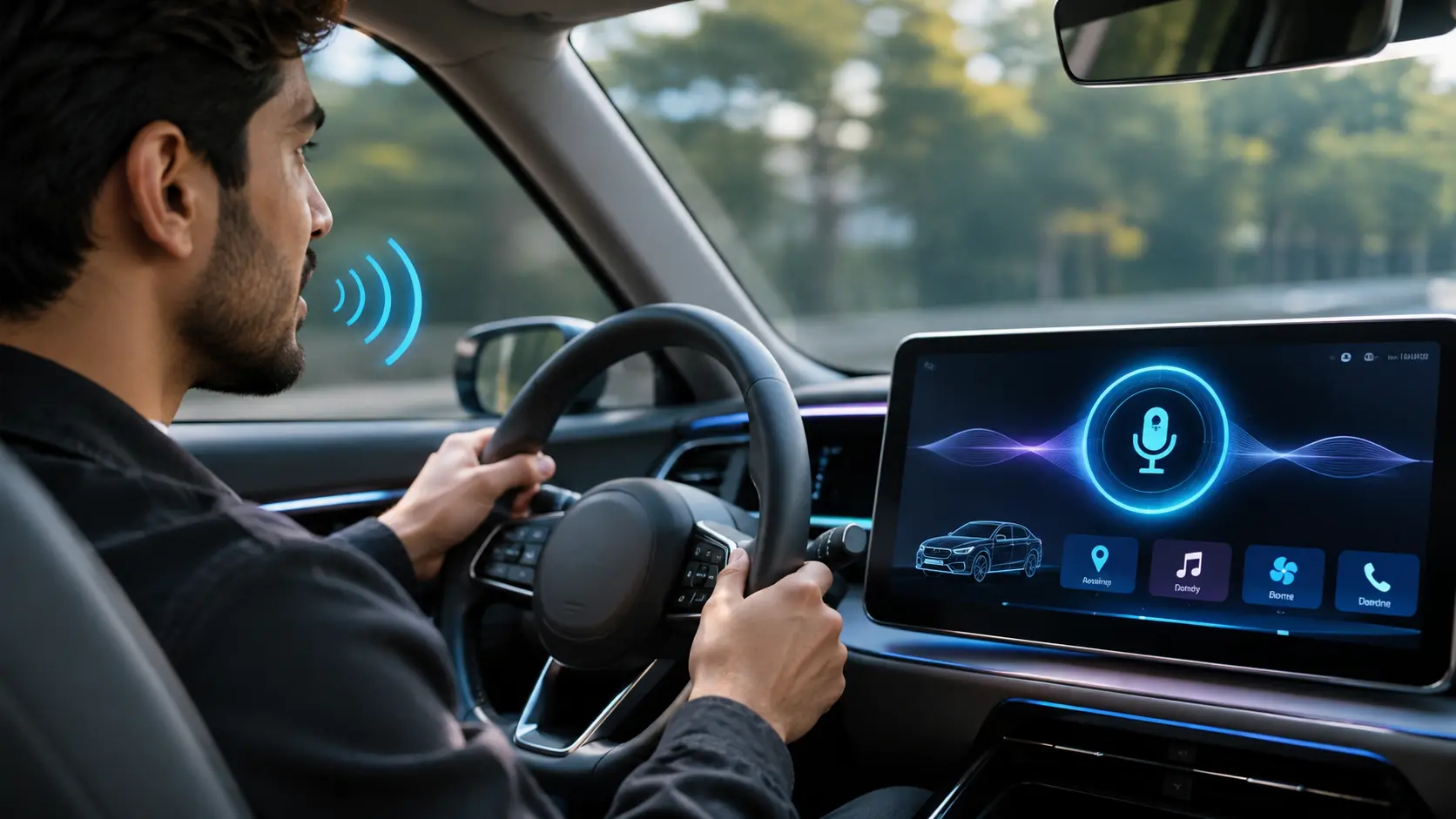
Modern cars are becoming more intelligent, and the way drivers interact with them is changing rapidly. Instead of searching through multiple menus or pressing physical buttons, drivers can now use natural speech to operate navigation, adjust cabin settings, make calls and access entertainment. What makes this possible is the development of AI-powered in-car voice assistants that can understand spoken instructions and respond to them through connected vehicle systems.
Earlier voice-control systems depended heavily on predefined commands. Drivers often had to remember specific phrases, and even small differences in wording could prevent the system from understanding a request. Newer systems are moving beyond these limitations by combining artificial intelligence, speech recognition and natural language processing. This allows drivers to communicate with their vehicles in a more conversational way.
The technology is also evolving beyond basic voice commands. Generative AI and more advanced language models are helping automotive manufacturers develop assistants that can understand context, respond to follow-up questions and provide more personalised information. But how do these systems actually work, and how much can they do inside a modern car?
Read More: AI Driver Monitoring Systems in Cars
What Are AI-Powered In-Car Voice Assistants?
AI-powered in-car voice assistants are software systems that allow drivers and passengers to interact with vehicle functions using spoken language. They combine microphones, speech-processing technology, artificial intelligence and the car’s infotainment or operating system to understand requests and perform supported actions.
For example, a driver might say, “Find a fuel station nearby,” “Reduce the cabin temperature” or “Play my favourite playlist.” The assistant processes the request, identifies what the person wants and communicates with the relevant vehicle system or connected application.
Unlike traditional voice-control systems, modern AI-powered in-car voice assistants can interpret more natural expressions instead of depending entirely on fixed command structures. Some systems can also understand follow-up questions and use previous conversation context to make their responses more relevant.
Their capabilities depend on the vehicle manufacturer, software version, available hardware, connected services and regional support. Not every car equipped with a microphone or voice button has the same level of artificial intelligence.
How Do In-Car Voice Assistants Understand Human Speech?
Understanding spoken language is more complicated than simply recognising individual words. People speak at different speeds, use different accents and often change their sentences while talking. A useful automotive assistant must process these variations and determine what the driver is trying to communicate.
The process generally involves several connected technologies.
1. Speech Recognition: Converting Voice into Text
The first stage is automatic speech recognition (ASR). When a driver speaks, microphones inside the cabin capture the audio and send it to the vehicle’s speech-processing system.
The system analyses the sound patterns and attempts to identify the words being spoken. It then converts the recognised speech into text or another structured representation that can be processed further.
Cabin noise makes this task particularly challenging. Road noise, air conditioning, music, conversations and engine sounds can interfere with microphone input. Automotive voice systems therefore use microphone placement, noise reduction and signal-processing techniques to improve speech capture.
The quality of speech recognition also depends on language support, pronunciation and the acoustic environment inside the vehicle.
2. Natural Language Processing: Understanding the Request
Recognising the words is only one part of the process. The system must also understand what those words mean in the context of the driver’s request.
This is where natural language processing (NLP) becomes important. NLP helps the assistant identify the intent behind a sentence and extract relevant information, such as a destination, contact name or requested vehicle setting.
Consider the difference between these two instructions:
- “Set the temperature to 22 degrees.”
- “It’s getting too warm in here.”
Both sentences communicate a similar requirement, but they use different wording. A basic command system may understand only the first instruction, while a more advanced assistant may interpret both and identify that the driver wants the cabin temperature reduced.
This ability to understand meaning rather than simply match words makes conversational interaction more practical.
3. Intent Recognition: Identifying What the Driver Wants
After processing the language, the assistant identifies the action required. This is commonly known as intent recognition.
For example, when someone says, “Take me to the nearest petrol pump,” the system needs to identify several things:
- The driver wants navigation assistance.
- The destination category is a fuel station.
- The location should be based on the vehicle’s current position.
- The navigation system needs to find a suitable destination.
Once the intent and relevant information are identified, the assistant can pass the request to the appropriate vehicle function or connected service.
The system may ask a follow-up question if the request is unclear. This is particularly useful when several contacts, destinations or possible actions match the same instruction.
4. Response Generation: Giving the Driver an Answer
After understanding the request, the assistant must decide how to respond. Some systems use predefined responses, while more advanced platforms can generate conversational answers using AI language models.
For a simple instruction, the system may respond with a short confirmation such as “Navigation started.” For a more complex question, it may provide additional information or ask the driver to clarify what they mean.
This combination of speech recognition, language understanding and response generation is what allows modern automotive assistants to move beyond traditional voice commands.
How AI-Powered In-Car Voice Assistants Control Vehicle Functions
Understanding a request is not enough to operate a car. The assistant must also communicate with the vehicle’s infotainment system, navigation software or supported electronic control functions.
Manufacturers integrate voice assistants with specific vehicle systems so that recognised commands can trigger permitted actions.
Some common applications include:
Climate control: Drivers may be able to adjust cabin temperature, fan speed or supported heating functions without searching through the infotainment menu.
Navigation: The assistant can accept destination requests, search for nearby locations and start route guidance through the integrated navigation system.
Entertainment: Drivers can request music, radio stations, podcasts or other supported media through connected applications.
Communication: Supported systems can make calls, send messages or read incoming notifications through compatible phone or vehicle services.
Vehicle information: Depending on the model, the assistant may provide information about certain vehicle settings, operating instructions or available features.
These capabilities are not universal. For example, a voice assistant may support climate control in one vehicle but only navigation and entertainment in another. Vehicle manufacturers determine which functions can be accessed through voice interaction.
Read More: How to Check Car Tyre Pressure at Home
Cloud-Based AI vs On-Device AI in Cars
One of the important developments in automotive voice technology is the way AI processing is performed. Some assistants rely on cloud computing, while others can process certain requests directly inside the vehicle.
Both approaches have advantages and limitations.
Cloud-Based Voice Assistants
Cloud-based systems send speech or recognised requests to remote servers for processing. These servers may run more powerful speech-recognition systems and language models than the hardware available inside a vehicle.
This approach can support complex questions, online information retrieval and conversational interactions. It also allows manufacturers to update AI capabilities without replacing the vehicle’s onboard hardware.
However, cloud-based processing usually depends on a suitable internet connection. Poor network coverage, connectivity interruptions or service availability can affect response times and supported features.
On-Device AI Voice Assistants
On-device AI processes supported tasks using computing hardware installed inside the vehicle. This can reduce dependence on continuous internet connectivity and may improve response speed for certain functions.
It can also provide privacy advantages when audio and requests are processed locally rather than transmitted to remote servers. However, the extent of these benefits depends on the system’s architecture and data-handling policies.
On-device processing also has hardware limitations. Running advanced AI models requires sufficient computing power, memory and software optimisation.
Why Automakers Are Exploring Hybrid AI Systems
Many automotive platforms are likely to combine both approaches. Basic vehicle commands and selected speech functions can be handled locally, while complex questions or online searches can use cloud-based services.
This hybrid approach can balance responsiveness, connectivity, computing requirements and privacy. It also allows a vehicle to retain some useful voice functions when an internet connection is unavailable.
How Generative AI Is Changing Automotive Voice Assistants
Traditional automotive voice assistants were mainly designed to execute specific commands. Generative AI introduces a different approach by allowing systems to understand more open-ended questions and produce natural conversational responses.
Instead of remembering a fixed command, a driver may be able to describe a situation in everyday language. The assistant can then interpret the request and determine whether it can perform the required action using supported vehicle functions or connected services.
For example, a driver might ask for a nearby restaurant, follow up by asking about its distance and then request navigation to that location. An advanced assistant connected to mapping and search services may be able to handle this sequence as a continuous conversation.
Automotive manufacturers are already exploring these capabilities.
Mercedes-Benz has been developing its MBUX Virtual Assistant with generative AI and conversational capabilities. Its collaboration with Google Cloud introduced an automotive AI agent designed to support more natural conversations and navigation-related information.
In April 2026, Mercedes-Benz also announced a partnership with Liquid AI to advance embedded, on-device intelligence for selected MBUX-equipped models in North America. The project focuses on improving speech understanding and contextual interaction without depending on continuous cloud communication.
These developments show how automotive voice assistants are evolving from simple command systems into more capable conversational interfaces. However, availability varies by model, market and software generation.
What Are the Limitations of AI Voice Assistants in Cars?
Despite their progress, AI voice assistants are not perfect. Their performance depends on several technical and practical factors, and drivers should understand these limitations before relying on them.
Background noise: Road noise, music, passengers talking and poor microphone conditions can make it difficult for the system to recognise speech correctly.
Language and accent recognition: Some systems support multiple languages, but recognition quality can vary depending on the language, regional accent and available training data.
Internet connectivity: Cloud-dependent features may become unavailable or respond slowly when the vehicle has poor network coverage.
Incorrect interpretation: An assistant may misunderstand a destination, contact name or vehicle command. Drivers should confirm important actions rather than assuming every instruction was understood correctly.
Privacy concerns: Voice systems may process audio, location information and connected-account data. Drivers should review the manufacturer’s privacy settings and understand which information is stored or transmitted.
Feature compatibility: Not every voice assistant can control every vehicle function. The available features depend on the car’s hardware, software and manufacturer integration.
Can AI Voice Assistants Make Driving Safer?
Voice interaction can reduce the need to operate certain infotainment controls manually. A driver may be able to request directions, make a call or adjust supported settings without navigating through multiple menus.
However, voice control should not be treated as a guarantee of safer driving. A conversation can still occupy the driver’s attention, especially when it involves complex questions, long responses or multiple follow-up requests.
The National Highway Traffic Safety Administration (NHTSA) identifies visual, manual and cognitive distractions as important risks. Even when a driver keeps both hands on the steering wheel and eyes on the road, a demanding conversation can still divert attention from driving.
For this reason, automotive voice assistants should prioritise simple, relevant tasks. Drivers should avoid lengthy interactions, complicated searches or activities that require reading and responding to detailed information while moving.
If an instruction needs careful attention, it is better to stop in a safe and legal location before interacting with the system.
What Does the Future Hold for AI-Powered In-Car Voice Assistants?
The next generation of automotive voice technology is likely to focus on contextual understanding, personalised assistance and deeper integration with vehicle systems.
Instead of responding only to individual commands, future assistants may be able to understand more of the driving situation and provide relevant information based on the vehicle’s location, settings and the driver’s requests.
Generative AI could also help drivers understand vehicle functions by referring to manufacturer-approved information, including the owner’s manual. This may make it easier to ask questions about warning indicators, operating features and maintenance instructions.
Another important development will be the integration of voice assistants with navigation, connected services and vehicle software. This could allow drivers to complete several related tasks through a single conversation.
However, automotive AI will need to meet stricter expectations than a general-purpose chatbot. Responses must be reliable, privacy controls must be clear and vehicle commands must operate within manufacturer-defined safety limits.
The long-term success of these systems will depend not only on how naturally they communicate, but also on how consistently and safely they perform in real driving conditions.
Frequently Asked Questions
1. How do AI voice assistants work in modern cars?
AI voice assistants use microphones, automatic speech recognition and natural language processing to understand spoken instructions. They identify the driver’s intent and communicate with supported vehicle systems or connected applications to perform the requested action.
2. Are AI-powered in-car voice assistants different from traditional voice control?
Yes. Traditional voice-control systems often depend on predefined commands and limited responses. More advanced AI assistants can understand natural language, interpret context and handle certain follow-up questions, depending on their capabilities.
3. Do car voice assistants need an internet connection?
Not always. Basic functions may work locally, depending on the vehicle’s system. However, cloud-based AI responses, online searches, connected navigation and some third-party services may require an active internet connection.
4. Can AI voice assistants control a car’s climate and navigation?
Many modern vehicles support voice control for selected functions such as cabin temperature, navigation, entertainment and communication. The available controls vary by manufacturer, model and software version.
5. Are AI voice assistants safe to use while driving?
They can reduce some manual interactions, but they do not eliminate driver distraction. Simple commands may be convenient, while complex conversations can take attention away from driving. Drivers should keep interactions brief and avoid demanding tasks while the vehicle is moving.
6. Will generative AI replace traditional car voice assistants?
Generative AI is likely to improve existing voice assistants rather than simply replace every traditional function. Automotive systems will still need reliable command execution, manufacturer-approved controls and predictable responses, particularly for vehicle-related operations.
Ride And Tech Verdict
AI-powered in-car voice assistants are changing how drivers interact with modern vehicles. What began as a basic voice-control feature is developing into a more intelligent interface capable of understanding natural language, interpreting requests and connecting multiple vehicle functions.
Speech recognition, natural language processing, cloud computing and on-device AI are making these systems more capable. Generative AI is taking the technology further by introducing conversational interaction and contextual responses that were difficult for traditional voice assistants to provide.
However, the real value of these systems will depend on reliability, privacy and safe operation. A voice assistant should make vehicle interaction simpler without becoming another source of distraction. As automotive manufacturers continue developing these technologies, the most successful systems will be those that combine intelligent responses with predictable vehicle control and a clear focus on driver safety.
Ride And Tech — Where Ride Meets Tech.
Drive Smarter. Ride Smarter.
Copyright (c) Ride And Tech. All rights reserved.

1 thought on “AI-Powered In-Car Voice Assistants: How Cars Understand and Respond to Drivers”