


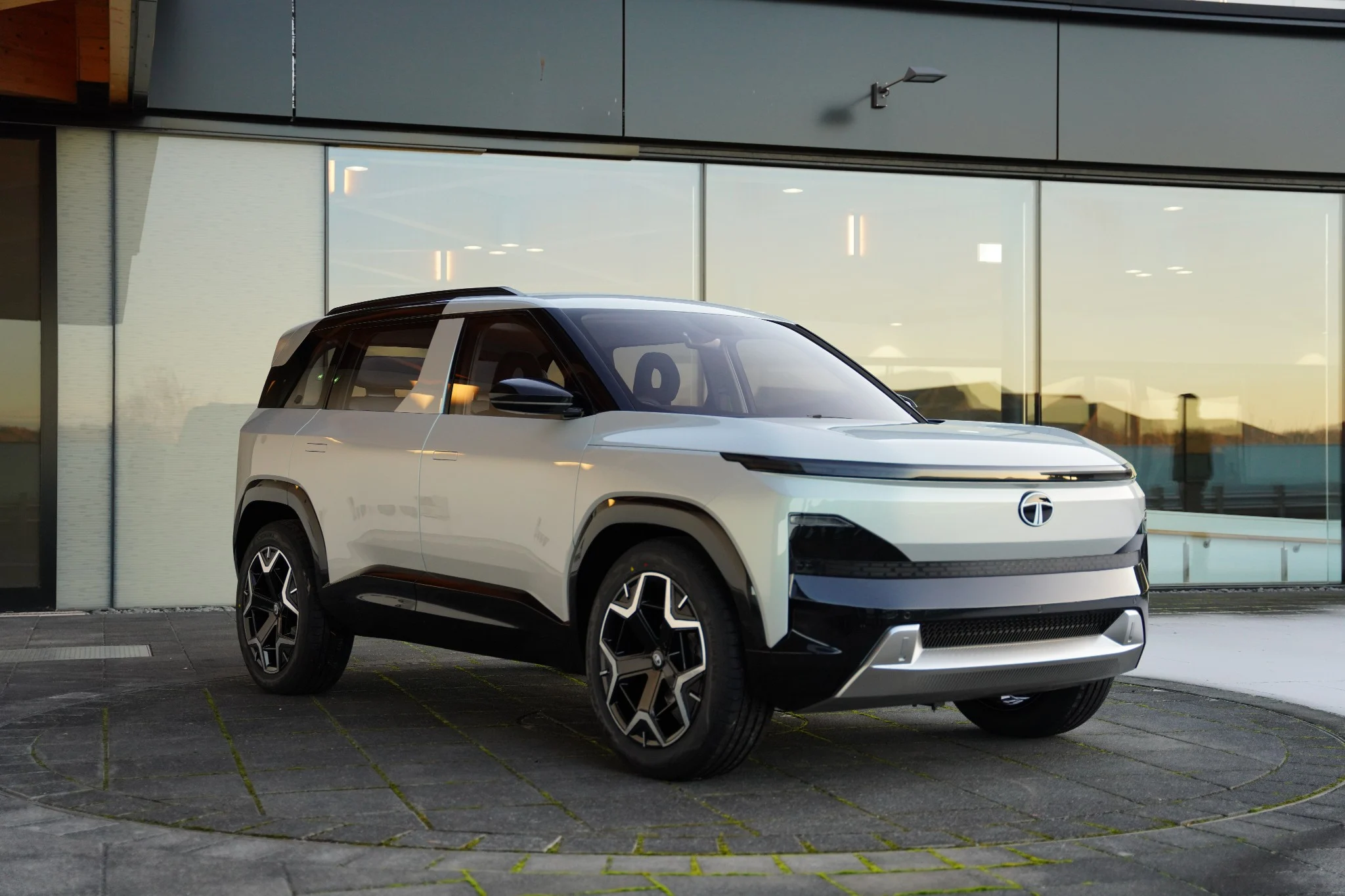
The Tata Sierra has returned, but its second coming is very different from the SUV that became an Indian automotive icon in the 1990s. The new Tata Sierra EV keeps the nameplate’s unmistakable upright silhouette while replacing the old-school diesel-era character with a modern electric powertrain, a technology-heavy cabin and the option of dual-motor all-wheel drive.
Tata Motors launched the production-spec Sierra EV in India on June 30, 2026, positioning it between the Curvv EV and Harrier EV in its electric SUV range. Prices start at ₹18.79 lakh ex-showroom and extend to ₹25.99 lakh for the top-end AWD variant. The SUV is offered with 63kWh and 75kWh battery packs, while the larger battery can also be paired with a dual-motor AWD system.
The interesting part is that the Sierra EV is not simply another electric SUV chasing maximum range. It combines a retro-inspired identity with a relatively large cabin, strong equipment levels, long-range battery options and an AWD version designed to give Tata a more capable electric SUV below the Harrier EV.
Tata Sierra EV: What’s New About the Modern Sierra?
The original Sierra earned its reputation through a distinctive three-door body, tall stance and large rear-side glass panels. The modern Sierra takes those visual ideas and translates them into a five-door SUV designed for today’s Indian family-car market.
The EV retains the upright proportions and distinctive side profile, but the details are considerably more contemporary. Connected lighting elements, flush-fitting door handles, modern alloy wheels and an EV-specific front treatment give it a much more sophisticated appearance without completely abandoning the visual identity that made the Sierra memorable.
That balance is important because Tata could have easily turned the Sierra name into another generic electric crossover. Instead, the production vehicle retains enough of the concept’s personality to make it immediately recognizable, while still offering the practicality expected from a modern five-door SUV.
Read More: The Future of Electric Vehicles
Tata Sierra EV Battery and Range
The Tata Sierra EV is available with two battery capacities: 63kWh and 75kWh. Tata’s official battery and range information lists a claimed MIDC range of 535km for the 63kWh version and up to 665km for the 75kWh rear-wheel-drive version. The 75kWh AWD version has a claimed MIDC range of 624km.
Those numbers need some context because MIDC figures are generated under controlled certification conditions and should not be treated as guaranteed real-world driving range. Tata’s own documentation also publishes C75 figures, which are much more conservative: around 440–460km for the 63kWh version, 510–530km for the 75kWh RWD and 480–500km for the 75kWh AWD.
That makes the 75kWh RWD Sierra particularly interesting for buyers who prioritise long-distance range. The AWD version sacrifices some certified range in exchange for additional traction and performance, which is exactly the kind of trade-off buyers should expect when moving from a single-motor to dual-motor electric SUV.
RWD or AWD: Which Tata Sierra EV Makes More Sense?
Tata has given the Sierra EV something that remains relatively uncommon in this price bracket: a choice between rear-wheel drive and dual-motor all-wheel drive. The 63kWh and 75kWh versions use rear-mounted electric motors, while the 75kWh AWD version adds a second motor to drive the front axle.
For most urban buyers, the RWD versions are likely to make more sense. They offer strong range figures without adding the weight, complexity and energy demand associated with the second motor. The 75kWh RWD version also delivers the Sierra EV’s headline 665km MIDC figure, making it the range-focused choice.
The AWD version is aimed at a different kind of buyer. Tata gives it up to 504Nm of torque, six terrain modes and an Off-road Assist function, while the top AWD variant also gets a Boost Mode. It is not intended to turn the Sierra into a hardcore off-roader, but the additional traction should make it more capable on loose surfaces and challenging conditions than the standard RWD versions.
Tata Sierra EV Performance and Driving Character
The Sierra EV’s performance story is less about outright acceleration numbers and more about how Tata has configured the different powertrain versions. The AWD version uses dual motors and develops up to 504Nm, with Autocar India listing a claimed 0–100kph time of 5.8 seconds.
That is quick enough to give the Sierra EV a genuinely brisk character, especially for a family-focused SUV. More importantly, the instant response of electric motors should make the Sierra feel effortless in everyday driving, where immediate torque matters more than chasing a headline top-speed figure.
The AWD system also gives the Sierra a stronger argument for buyers who regularly encounter broken roads, loose surfaces or steep terrain. Tata’s six terrain modes and Off-road Assist are designed to make better use of the dual-motor setup when traction becomes more important than simply maximising efficiency.
Tata Sierra EV Charging: What You Need to Know
Charging is another area where the original article needs to be corrected. The production Sierra EV is not based around the previously expected 150kW/30-minute claim mentioned in the old draft. Tata’s current published information says the Sierra EV can add up to 263km of range in 15 minutes using DC fast charging, while a 20–80 percent charge takes around 26 minutes under claimed conditions.
The actual charging experience will still depend on the charger, battery temperature, state of charge and other conditions. As with every EV, peak charging power is only one part of the equation; the charging curve and how long the vehicle can sustain higher power are equally important for long-distance travel.
The Sierra EV also supports Vehicle-to-Load and Vehicle-to-Vehicle charging, giving the larger battery pack additional usefulness beyond simply powering the car.
A Cabin That Finally Matches the Sierra’s Ambition
Inside, the Sierra EV moves decisively away from the utilitarian character associated with the original SUV. Tata has given it a technology-heavy cabin with a large infotainment display, digital instrumentation and a separate passenger display on higher versions.
The production Sierra EV features a 12.3-inch touchscreen, a 10.25-inch driver’s display and a 12.3-inch passenger display. Higher variants can also be equipped with a 12-speaker JBL Black sound system, panoramic sunroof, ventilated front seats and a range of connected and convenience features.
The cabin is therefore one of the biggest changes in the Sierra’s transformation. The original was defined by rugged simplicity; the electric version is trying to establish itself as a more premium family SUV where screen technology, comfort and cabin experience are part of the appeal.
Space and Practicality
The Sierra EV measures 4,340mm in length, 1,841mm in width and 1,750mm in height, with a 2,730mm wheelbase. That wheelbase is considerably longer than the figure quoted in the original article and gives the Sierra a more convincing foundation for passenger space. Ground clearance is listed at 205mm.
The rear seats use a 60:40 split arrangement and offer a recline function, giving owners some flexibility between passenger comfort and carrying luggage. For an SUV intended to handle both urban commuting and longer family journeys, that flexibility is more important than chasing a purely sporty cabin layout.
Tata Sierra EV Features
The equipment list is one of the strongest parts of the new Sierra EV, particularly on the higher variants. Tata offers features such as a panoramic sunroof, ventilated seats, JBL audio, connected-car technology, wireless smartphone connectivity and multiple camera systems depending on variant.
The top Empowered A 75 version takes the technology further with a head-up display, Level 2+ ADAS with 23 key functions, a 540-degree view system, Auto Park Assist and adaptive front and rear turn cameras. Tata also lists multiple terrain modes and Off-road Assist on the AWD version.
That equipment spread means the Sierra EV is not relying purely on its heritage to attract buyers. The name gets attention, but the specification is what makes the modern Sierra competitive against newer electric SUVs.
Tata Sierra EV Safety and ADAS
Safety equipment varies by variant, but Tata lists six airbags, electronic stability control and all-wheel disc brakes among the Sierra EV’s equipment. Higher versions add a considerably more sophisticated driver-assistance package.
The top-spec Sierra EV’s Level 2+ ADAS package includes 23 key functions, while the 540-degree camera system and Auto Park Assist are intended to make low-speed manoeuvring easier. These systems should be viewed as driver assistance rather than autonomous driving, and the driver remains responsible for controlling the vehicle.
Importantly, we should not repeat the original article’s claim that Tata “wants 5-stars again” as if a crash-test result were already confirmed. A safety rating needs to come from an actual published assessment rather than an expectation.
Tata Sierra EV Price in India
The Tata Sierra EV price in India starts at ₹18.79 lakh ex-showroom for the Pure 63 variant. The range extends to ₹25.99 lakh ex-showroom for the top Empowered A 75 AWD version.
The current variant structure includes Pure, Pure S, Adventure, Empowered and Empowered A trims. The 63kWh battery is available across several versions, while the 75kWh battery appears higher up the range and the AWD configuration is reserved for the top specification.
That pricing makes the Sierra EV considerably more accessible than the ₹25–32 lakh estimate in the original article suggested. More importantly, the starting price places it directly into a highly competitive part of India’s electric SUV market.
Tata Sierra EV vs Its Rivals
The Sierra EV sits in an interesting position within Tata’s own portfolio. It is larger and more premium in positioning than the Curvv EV, while remaining below the Harrier EV in Tata’s electric SUV hierarchy. That positioning gives it room to attract buyers who want something more distinctive than a conventional compact electric SUV without moving all the way into the Harrier EV’s price territory.
Its external rivals include electric SUVs such as the Hyundai Creta Electric, Mahindra BE 6 and Maruti Suzuki e Vitara. The Sierra’s biggest advantage may not be one individual specification but the combination of long claimed range, distinctive design, strong equipment and the availability of AWD.
For Tata, it also fills an important strategic gap. The company now has the Sierra EV alongside the Curvv EV and Harrier EV, giving its electric SUV portfolio a clearer progression in size, price and capability.
Is the Tata Sierra EV Good for Long-Distance Driving?
The 75kWh RWD version is the Sierra EV that makes the strongest case for long-distance travel. Its 665km MIDC claim is impressive on paper, while Tata’s published C75 estimate of 510–530km provides a more conservative reference point for buyers thinking about real-world usage.
The AWD version remains capable of long-distance travel, but its published C75 range is lower at around 480–500km. That is the price of adding a second motor and additional performance capability, and it reinforces the idea that buyers should choose the powertrain according to how they actually intend to use the SUV.
For highway touring, the combination of a large battery, fast DC charging, comfortable seating and a spacious cabin makes the Sierra EV much more convincing as a road-trip vehicle than the original draft suggested.
Tata Sierra EV: The Heritage Factor
There is another reason the Sierra EV matters that cannot be measured in kilowatt-hours. The Sierra name has genuine recognition among Indian enthusiasts, and Tata has managed to bring it back without simply producing a retro replica.
The modern Sierra keeps the visual attitude of the original while building an entirely different vehicle underneath. That makes the EV version particularly interesting because it represents the point where one of India’s memorable SUV names meets the country’s rapidly expanding electric-car market.
The result is not nostalgia for nostalgia’s sake. The Sierra EV is a serious modern SUV that happens to carry a name with history.
Frequently Asked Questions
What is the Tata Sierra EV price in India?
The Tata Sierra EV starts at ₹18.79 lakh ex-showroom and goes up to ₹25.99 lakh ex-showroom for the top Empowered A 75 AWD variant.
What is the Tata Sierra EV range?
The 63kWh version has a claimed MIDC range of 535km, while the 75kWh RWD version claims up to 665km. The 75kWh AWD version has a claimed MIDC range of 624km. Tata also publishes lower C75 range figures to provide a more conservative reference.
Does the Tata Sierra EV have AWD?
Yes. The 75kWh Sierra EV is available with a dual-motor all-wheel-drive system. Tata’s AWD version produces up to 504Nm of torque and gets six terrain modes and Off-road Assist.
What are the Tata Sierra EV battery options?
The Sierra EV is available with 63kWh and 75kWh battery packs. The 75kWh pack is offered in both RWD and AWD configurations.
How fast can the Tata Sierra EV charge?
Tata claims the Sierra EV can add up to 263km of range in 15 minutes using DC fast charging, while a 20–80 percent charge takes around 26 minutes under claimed conditions.
Does the Tata Sierra EV have ADAS?
Yes, but the advanced system is available on higher variants. The top Empowered A 75 version gets Level 2+ ADAS with 23 key features, along with a 540-degree view system and Auto Park Assist.
What are the main Tata Sierra EV rivals?
The Sierra EV competes in India’s electric SUV market against models including the Hyundai Creta Electric, Mahindra BE 6 and Maruti Suzuki e Vitara.
Ride And Tech Verdict
The Tata Sierra EV is much more interesting now that it has moved from years of concepts and speculation into an actual production SUV. The strongest part of the package is not one headline number but the way Tata has combined the Sierra’s distinctive identity with a 63kWh or 75kWh battery, up to 665km of claimed MIDC range, available AWD, a technology-rich cabin and a starting price of ₹18.79 lakh.
The 75kWh RWD version looks like the sweet spot for buyers who want maximum range and long-distance usability, while the 75kWh AWD version is the more intriguing choice for enthusiasts who want stronger performance and additional traction. Either way, this is no longer simply the Sierra we remember—it is Tata’s attempt to turn one of India’s most recognisable SUV names into a serious electric-era product.
Ride And Tech — Where Ride Meets Tech.
Drive Smarter. Ride Smarter.
Copyright (c) Ride And Tech. All rights reserved.

2 thoughts on “Tata Sierra EV: The Sierra Is Back With 665km Range, AWD and a Very Different Mission”