



EV charging is entering a new phase. For years, the conversation was mostly about whether an electric car could charge at 50kW, 100kW or 150kW. Now manufacturers are pushing beyond 250kW, 800V electrical architectures are becoming more common, 1,000V vehicles are arriving and charging systems capable of megawatt-level power are moving from concept to reality.
The important part, however, is that a bigger number on a charging station does not automatically mean an EV will charge at that speed. The vehicle’s battery voltage, charging hardware, battery temperature, state of charge and the charger’s available power all determine how quickly energy can actually enter the battery. Understanding that relationship is the key to understanding ultra-fast EV charging.
What Is Ultra-Fast EV Charging?
Ultra-fast EV charging refers to high-power DC charging designed to put a large amount of energy into an electric vehicle in a relatively short period. There is no single universal power rating that officially defines the term, but the latest generation of chargers increasingly operates above 250kW, with some new systems reaching far beyond that level.
That is a major step beyond many earlier public fast chargers. The International Energy Agency says next-generation ultra-fast chargers are providing more than 250kW, while charging technologies reaching the megawatt range are also being deployed. At the same time, only around 30% of battery-electric cars globally can currently benefit from ultra-fast charging, showing that the infrastructure is advancing faster than vehicle compatibility in many markets.
The practical benefit is simple: less time parked and more driving range added during a charging stop. But the real technology story sits underneath the charger’s headline power figure.
Read More: EV Charging in India
Why Are 800V and 1000V EVs Important?
The reason higher-voltage systems matter comes down to a basic electrical relationship: Power = Voltage × Current.
If a charging system wants to deliver more power while keeping current under control, increasing voltage is one way to achieve it. The IEA notes that battery-pack voltage plays an important role in faster charging because the power delivered to an EV is constrained by the maximum current that the charging station and vehicle charging system can handle.
For example, delivering 240kW at 400V would theoretically require 600 amps. At 800V, the same 240kW requires about 300 amps. That reduction in current can help the electrical system deliver high charging power without simply pushing progressively larger currents through the cables and components.
This is why 800V EV charging has become an important part of the industry’s push toward shorter charging stops. The technology isn’t about making electricity itself “faster”; it is about designing the vehicle’s electrical architecture to handle high power more efficiently.
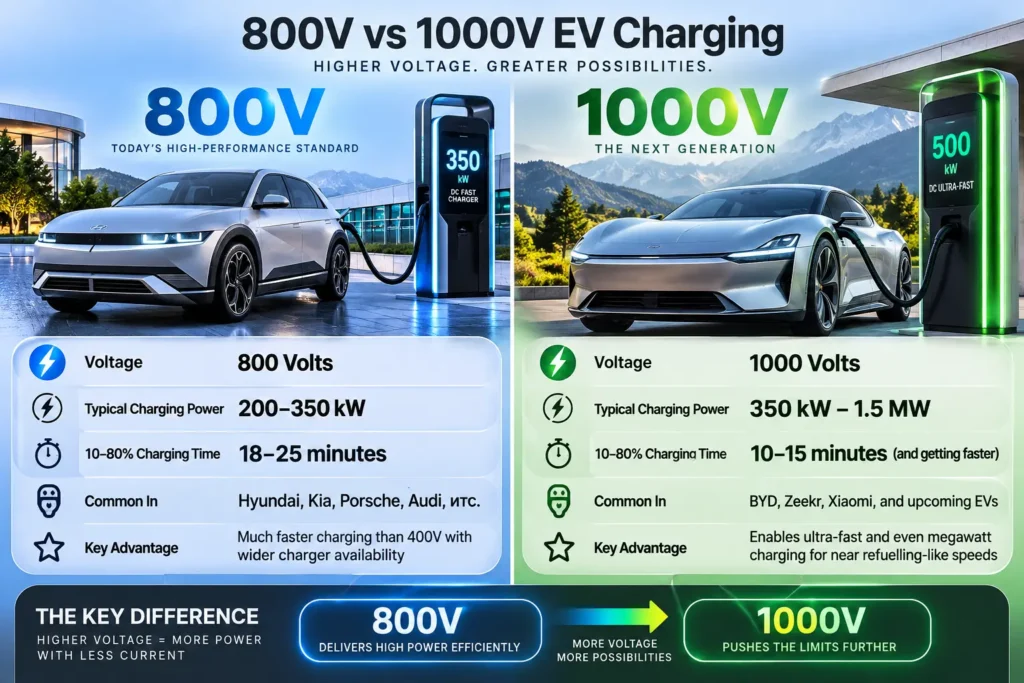
800V vs 400V EV Charging: What Is the Difference?
A 400V architecture has been widely used across earlier generations of electric vehicles, while newer high-performance EV platforms are increasingly adopting 800V systems. Hyundai’s E-GMP platform, for example, was designed around 800V charging while also supporting 400V charging infrastructure. Hyundai says its system can accept charging from both voltage levels through its multi-charging architecture.
The advantage becomes particularly noticeable when an EV is connected to a high-power DC charger. Porsche’s Taycan, which uses an 800V electrical architecture, can take advantage of substantially higher charging power at compatible stations; Porsche currently lists charging capability of up to 320kW on applicable Taycan configurations and notes that the vehicle’s maximum charging capability requires suitable 800V infrastructure.
That does not mean every 800V EV will automatically charge faster than every 400V EV. Battery chemistry, thermal management, charging software and the vehicle’s maximum accepted power are equally important.
How Does Ultra-Fast EV Charging Actually Work?
When you connect an EV to a DC fast charger, electricity does not need to pass through the vehicle’s normal AC-to-DC onboard charging process in the same way it does during AC charging. The external charger supplies DC power directly to the vehicle’s high-voltage battery system, subject to communication and safety controls between the car and charger.
The vehicle and charging station continuously communicate about how much power can safely be delivered. The car’s battery-management system monitors factors such as voltage, current, temperature and state of charge, while the charger adjusts its output accordingly.
This is why a 350kW charger does not mean every EV connected to it will receive 350kW. If the vehicle is limited to 150kW, the charger cannot turn it into a 350kW vehicle. The same applies in reverse: an EV capable of very high charging power cannot necessarily achieve its maximum rate if the charging station cannot provide it.
Why Does Charging Slow Down After 80%?
One of the biggest misconceptions about EV charging is that an EV should maintain its maximum charging power from 0% to 100%. In reality, charging power normally changes throughout the session.
When the battery has a lower state of charge and conditions are suitable, the vehicle can accept high power. As the battery approaches a higher state of charge, the charging system generally reduces power to manage battery conditions and protect the cells.
This is why manufacturers commonly quote rapid charging figures such as 10–80%, rather than 0–100%. Porsche, for example, lists an 18-minute 10–80% charging time for the Taycan under specified conditions using suitable 800V infrastructure.
For road trips, this also explains why stopping for a shorter period and continuing the journey can be more time-efficient than waiting for the battery to reach 100%.
Battery Temperature Matters More Than You Might Think
High-power charging generates heat, making thermal management one of the most important parts of ultra-fast EV charging.
A battery that is too cold may not be able to accept its maximum charging power immediately. Similarly, a battery that becomes too hot during an aggressive charging session may have its charging rate reduced to keep temperatures within the required operating range.
Modern EVs therefore use battery-conditioning systems to prepare the pack for fast charging. Porsche, for example, says its thermal-management strategy helps maintain high charging power across a substantial portion of the charging process, while its vehicles can condition the battery for an expected charging stop.
This is one reason two identical EVs can sometimes show different charging speeds depending on weather, battery temperature and how the vehicle has been driven before reaching the charger.
Does a 1000V EV Charge Twice as Fast as a 500V EV?
No. Voltage alone does not determine charging speed.
A higher-voltage architecture can make high-power charging easier to achieve at a manageable current, but the final charging rate depends on the entire electrical system. The battery pack, charging hardware, thermal management, software and charging station all have to work together.
The IEA says the first 1,000V models arrived in 2025, while announcements of charging times below 10 minutes have continued into 2026. However, the organisation also notes that vehicle compatibility with ultra-fast charging remains limited compared with the rapidly expanding charging infrastructure.
So when comparing a 400V, 800V or 1,000V EV, it is better to look at the actual charging curve and manufacturer-rated charging capability rather than judging the car purely by its voltage architecture.
How Fast Can an 800V EV Charge?
The answer varies considerably between models.
Hyundai’s E-GMP platform was designed to support 800V charging and, with a suitable 350kW charger, Hyundai has quoted 10–80% charging in around 18 minutes for vehicles such as the IONIQ 5 under specified conditions.
Porsche’s Taycan provides another example of what an 800V architecture can achieve. Depending on model and configuration, Porsche has quoted peak charging figures in the 270kW–320kW range, with charging performance dependent on the vehicle, battery and charging conditions.
These examples also demonstrate why 800V EV charging should not be treated as a single performance category. Two 800V vehicles can have very different battery capacities, peak power and charging curves.
What Is 250kW EV Charging?
A 250kW charger can theoretically deliver energy at a rate of 250 kilowatts when the vehicle and charging conditions allow it. In practice, the actual power delivered changes throughout the charging session.
The IEA identifies chargers above 250kW as the next generation of ultra-fast charging infrastructure and reports that their deployment is accelerating. However, only a small share of the global EV fleet can currently take full advantage of charging above this level.
This distinction is important for buyers. A 250kW charger is an infrastructure capability, not a promise that every EV plugged into it will charge at 250kW.
What Is Megawatt EV Charging?
Megawatt charging takes the same principle much further, pushing charging power into the 1MW-plus range.
For years, megawatt-scale charging was primarily associated with electric trucks and other heavy-duty vehicles because their much larger batteries require substantial amounts of energy during relatively short stops. The technology is now also becoming relevant to passenger vehicles, with BYD unveiling charging systems capable of up to 1.5MW in 2026.
At those power levels, charging infrastructure becomes a major electrical engineering challenge. Grid connections, cooling, cables, power electronics and site capacity all become increasingly important, meaning that simply installing more powerful chargers is not as straightforward as increasing a number on a screen.
Will Ultra-Fast Charging Damage an EV Battery?
Using a manufacturer’s approved fast charger does not automatically mean an EV battery will be damaged. Modern battery-management systems are designed to regulate charging according to temperature, state of charge and other operating conditions.
However, repeated high-power charging places greater thermal and electrical demands on the battery system than slower charging. Battery chemistry, cooling systems and charging strategy therefore matter when evaluating long-term durability.
For everyday use, owners do not necessarily need maximum charging power every time they plug in. AC home charging is often sufficient for overnight charging, while ultra-fast DC charging becomes particularly valuable when travelling long distances and time matters.
Does Ultra-Fast Charging Make EV Road Trips Easier?
It can, particularly when the vehicle has a strong charging curve and the route has compatible high-power chargers.
A useful way to think about charging is not simply “How many minutes does 0–100% take?”, but rather “How much driving range can I add during a practical stop?” The IEA estimates that, for an EV capable of using the power available, 15 minutes at a 150kW charger can add almost 180km of driving range under mixed driving conditions.
That makes charging speed increasingly relevant to long-distance EV travel. The limiting factor, however, can shift from the car to the infrastructure if high-power chargers are unavailable, occupied or unable to deliver their rated output.
What Are the Limitations of Ultra-Fast EV Charging?
Ultra-fast charging solves one problem — charging time — but introduces several infrastructure and engineering challenges.
High-power chargers require substantial electrical capacity, sophisticated power electronics and effective cooling. The IEA warns that as EV adoption and charging speeds increase, grid-capacity constraints could become more pronounced in some regions. Smart charging and technologies such as vehicle-to-grid can help manage electricity demand, but their availability and regulatory frameworks vary between markets.
There is also a simple compatibility problem. The world’s charging network can become extremely powerful, but that does not help an EV that cannot accept the available power. The IEA estimates that only about 30% of battery-electric cars currently have the ability to benefit from ultra-fast chargers.
What Should You Look for When Buying an EV?
If charging speed matters to you, don’t stop at the phrase “800V architecture” in a brochure.
Check the vehicle’s maximum DC charging power, claimed 10–80% charging time, charging curve, battery pre-conditioning capability and compatibility with different charging voltages. It is also worth checking whether the public charging network you actually use can provide the required power.
An EV with a slightly lower peak charging figure but a strong, sustained charging curve can be more useful on a road trip than a vehicle that advertises an impressive peak number but holds it only briefly. The most meaningful specification is therefore the energy added over a realistic charging stop, not the biggest kW figure in the brochure.
Read More: 2026 Mahindra Thar Facelift
The Future of EV Charging
The direction of travel is clear: higher-voltage architectures, more powerful chargers, better battery chemistry and smarter thermal management are gradually reducing the time required to replenish an EV.
The IEA says the first 1,000V models appeared in 2025 and that sub-10-minute charging announcements have continued into 2026. It also identifies ultra-fast and megawatt-scale charging as areas of continued expansion, while noting that battery technology and power electronics will remain critical to further improvements.
The next step may therefore not be one single breakthrough. Instead, the charging experience will improve through the combination of higher voltage, better batteries, more effective cooling, smarter software and a stronger charging network.
Frequently Asked Questions
What is ultra-fast EV charging?
Ultra-fast EV charging refers to high-power DC charging designed to replenish an EV significantly faster than conventional public fast charging. The latest generation includes chargers above 250kW, with some emerging systems reaching megawatt-level power.
Is 800V charging better than 400V charging?
An 800V architecture can support high charging power while requiring less current for the same power output. However, actual charging speed also depends on the battery, charger, thermal management and vehicle charging system.
What is the difference between 800V and 1000V EV charging?
The main difference is the electrical system’s nominal voltage. A 1,000V architecture can support very high charging power at lower current than an equivalent lower-voltage system, but it does not automatically make an EV charge faster.
Can every EV use a 350kW charger?
No. A 350kW charger can provide up to that amount of power, but the EV determines how much it can accept. If the vehicle is limited to 150kW, it will not charge at 350kW.
Does fast charging reduce EV battery life?
Fast charging creates greater thermal and electrical demands, but modern EVs use battery-management and thermal-control systems to regulate charging. Battery chemistry, temperature, charging frequency and the vehicle’s overall design all influence long-term battery performance.
What is the fastest EV charging technology?
Charging technology is moving into the megawatt range. BYD unveiled charging systems capable of up to 1.5MW in 2026, while the IEA reports continued development of ultra-fast and megawatt-scale systems.
Ride And Tech Verdict
Ultra-fast EV charging is becoming one of the most important developments in electric mobility because it attacks one of the biggest practical differences between EVs and conventional refuelling: time. But the headline charging number only tells part of the story.
The real breakthrough is the combination of 800V and 1,000V electrical architectures, high-power DC chargers, battery pre-conditioning, improved thermal management and smarter charging software. As these technologies mature, adding meaningful driving range during a short stop should become increasingly normal.
For EV buyers, the takeaway is simple: don’t buy an EV based on its peak charging number alone. Look at the complete charging picture — voltage architecture, maximum DC power, 10–80% time, charging curve, battery temperature management and the availability of compatible chargers on the roads you actually use. That is where the real-world advantage of ultra-fast EV charging is found.
Ride And Tech — Where Ride Meets Tech.
Drive Smarter. Ride Smarter.
Copyright (c) Ride And Tech. All rights reserved.

1 thought on “Ultra-Fast EV Charging: How 800V and 1000V Systems Work”