



Winter in India does not affect every car in the same way. A vehicle being driven through the cold mornings and dense fog of North India faces very different conditions from one operating through the comparatively mild winter of southern or coastal regions, but the basic principle remains the same: seasonal changes are a good reason to inspect the systems that keep your car reliable and safe.
That is where winter car care tips become useful. You do not necessarily need special winter equipment or a major service every time temperatures fall, but checking the battery, tyres, fluids, brakes, visibility systems and climate-control equipment before the colder months can help catch small problems before they become roadside problems. Recent winter-care guidance from automotive experts and manufacturers similarly highlights battery health, tyre pressure, coolant, brakes, defogging equipment and HVAC systems as areas worth checking.
For Indian drivers, winter preparation should therefore be based on the conditions where the vehicle is actually used. If you regularly drive in fog, travel into the mountains or park outdoors overnight, your preparation needs to be more thorough than that of someone driving short urban journeys in a warm coastal climate.
Why Does Winter Car Care Matter?
Cold weather can influence several parts of a vehicle, even when temperatures are nowhere near freezing. Battery performance can fall as temperatures drop, tyre pressure changes with temperature, rubber components can become less flexible and moisture inside the cabin can make visibility more difficult during cold mornings.
For most Indian cars, these effects are manageable rather than extreme. The bigger concern is that an already weak component can reveal its weakness when conditions become less forgiving. A battery that starts normally on a warm afternoon may struggle on a colder morning, while worn wipers or an ineffective defogger can suddenly become much more important when the windscreen starts misting up.
Good winter car care is therefore less about preparing for an extreme climate and more about making sure the vehicle is already in good mechanical condition.
Read More: Car Care After Monsoon
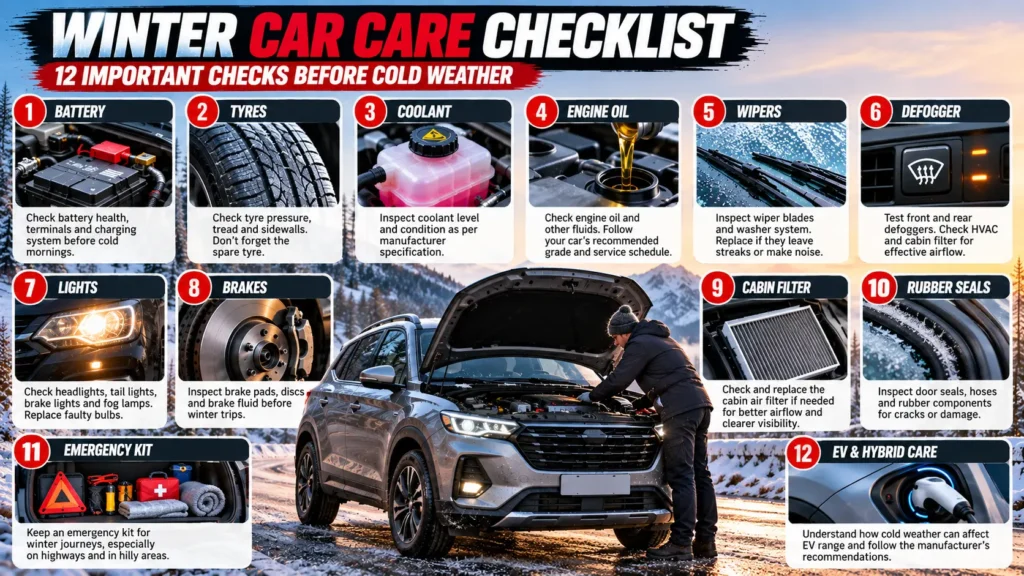
1. Check the Battery Before Cold Mornings Begin
The battery should be one of the first items on your winter inspection list, particularly if it is several years old or the car has recently shown signs of slow starting. Cold temperatures can reduce battery performance because the chemical reactions inside a battery slow down, which can make an already weak battery more difficult to start the engine.
Look for obvious signs such as slow cranking, dimming lights during startup, corrosion around the terminals or repeated difficulty starting the vehicle. If you notice these symptoms, have the battery and charging system tested rather than waiting for a complete failure.
For cars that are used infrequently, battery condition becomes even more important. Long periods of parking can gradually discharge the battery, while repeated short journeys may not give the charging system enough time to replenish the energy used during starting.
A proper battery test is more useful than simply checking whether the car starts today. If the battery is approaching the end of its expected service life, getting it tested before the coldest part of the season can prevent an inconvenient morning breakdown.
2. Check Tyre Pressure and Tread
Tyres are always important, but winter tyre care deserves extra attention because temperature changes can affect tyre pressure. The correct pressure should be taken from the vehicle manufacturer’s recommended specification, usually displayed on the driver’s-door placard or listed in the owner’s manual, rather than from the maximum pressure printed on the tyre itself.
Check the tyres when they are relatively cold and inspect them for uneven wear, cracks, cuts, bulges and damaged sidewalls. Do not forget the spare wheel, because discovering that your spare is underinflated only after a puncture is one of those avoidable problems that can turn a simple repair into a much longer roadside stop.
Tread condition matters just as much. In areas that experience rain followed by colder weather, worn tyres can reduce grip on wet or slippery surfaces, while mountain regions may require tyres appropriate for the specific conditions rather than ordinary all-season tyres.
Most Indian drivers do not need dedicated winter tyres simply because temperatures fall. Their necessity depends on the actual climate, road conditions and manufacturer’s recommendations, particularly in regions where snow or persistent sub-7°C temperatures are common.
3. Inspect the Coolant and Cooling System
It may seem strange to talk about the cooling system when the weather is becoming colder, but coolant remains important throughout the year. The system regulates engine temperature, protects against corrosion and, depending on the vehicle, contributes to cabin heating.
Check the coolant level only according to the procedure specified by the manufacturer and never open a hot cooling system. If the coolant is unusually low, discoloured or contaminated, the issue should be investigated rather than simply topping it up repeatedly.
The correct coolant type and mixture also matter. Do not assume that any coloured coolant is suitable for your vehicle, because different manufacturers can specify different coolant technologies and service procedures. Automotive guidance recommends following the vehicle’s recommended specification, particularly in colder climates.
This is one area where your owner’s manual is more useful than a generic internet recommendation.
4. Check Engine Oil and Other Fluids
Engine oil becomes more viscous as temperatures fall, which is why the correct oil specification matters more in extremely cold climates. That does not mean every Indian car needs a different oil grade in winter, however.
Your vehicle’s manufacturer specifies an appropriate viscosity range for the engine and operating conditions. Maruti Suzuki, for example, advises owners to check the vehicle type and manufacturer’s oil recommendations before using a particular grade.
If your scheduled service is approaching, winter can be a sensible time to have the engine oil, filters and other fluids inspected. Transmission fluid, brake fluid and washer fluid should also be checked according to the vehicle’s maintenance schedule.
The key winter car maintenance rule is simple: do not change fluids purely because the season changed. Change or service them when the vehicle’s maintenance requirements, condition and operating environment call for it.
5. Inspect Wipers and the Windshield Washer System
Visibility becomes one of the biggest concerns during winter mornings, particularly in regions affected by fog. Wiper blades that already leave streaks, skip across the glass or produce uneven wiping will make the problem worse when the windscreen becomes wet or misted.
Inspect the rubber blades for cracks, hardening and damage, and replace them if they no longer clear the glass properly. Also check the washer reservoir, spray nozzles and washer system so that you can clean the windscreen when road grime, dust or moisture reduces visibility.
A clean windscreen matters just as much as functioning wipers. Interior film and exterior dirt can scatter light from approaching vehicles, making night driving and foggy conditions more difficult. Good winter car care tips therefore include cleaning both sides of the windscreen rather than focusing only on the wiper blades.
6. Test the Defogger and Climate-Control System
A working defogger can be more important than many drivers realise during winter. When warm, moist air inside the cabin meets a colder windscreen, condensation can form on the glass and rapidly reduce visibility.
Check whether the front defogging vents deliver sufficient airflow and whether the rear defogger, if fitted, clears the rear glass properly. A clogged cabin filter, weak blower motor or HVAC problem can reduce airflow and make the process slower.
Modern climate-control systems often use the air-conditioning system during defogging because removing moisture from the cabin air helps clear the glass. Autocar India also notes that the AC compressor can operate in defrost mode even during winter, while a clogged cabin filter can restrict airflow.
If the windscreen starts fogging while driving, do not simply wipe it repeatedly with your hand. Use the vehicle’s defogging function and adjust the airflow so the glass can clear while maintaining proper control of the car.
7. Check Headlights, Tail Lights and Fog Lamps
Winter does not automatically mean you should drive with every light switched on, but reduced visibility makes functioning exterior lighting especially important.
Check the headlights, tail lights, brake lights, indicators and fog lamps before the season gets serious. Replace failed bulbs or address electrical faults instead of waiting for a night-time failure.
Fog also changes how headlights should be used. High beams can reflect off suspended moisture and make visibility worse, so drivers should use appropriate low-beam lighting and fog lamps where fitted and legally appropriate. Autocar India’s winter-driving guidance specifically advises against using high beams in fog because of this reflection effect.
Lighting is not just about seeing the road. Your tail lights and brake lights also allow vehicles behind you to understand what your car is doing when visibility is poor.
8. Inspect the Brakes Before Winter Trips
Cold weather itself does not suddenly make a healthy brake system unsafe, but winter is a good time to address any brake problem that already exists.
Pay attention to changes in pedal feel, unusual noises, vibrations, pulling under braking or a warning light on the dashboard. Brake fluid should also be inspected according to the manufacturer’s service schedule, particularly if the vehicle is due for maintenance.
This becomes especially important if you plan to travel through mountain areas during winter. Long descents, wet roads, reduced visibility and changing traction conditions can place considerably greater demands on the driver and vehicle.
Do not postpone a brake inspection because the car still stops normally. Preventive maintenance is about identifying deterioration before it becomes an emergency.
9. Check the Cabin Air Filter
The cabin air filter is easy to overlook because it does not directly affect the engine, but it can have a noticeable effect on cabin airflow and windscreen clearing.
A heavily clogged filter restricts airflow through the HVAC system. That can make heating and defogging less effective, particularly when the cabin needs stronger airflow on cold mornings.
If the filter is due for replacement, winter is a good opportunity to get it checked. Maruti Suzuki’s winter inspection programme has included the air/AC filter alongside the blower and defogger as part of its seasonal vehicle checks.
This is a small maintenance item, but it can make a noticeable difference to cabin comfort and visibility.
10. Inspect Rubber Seals, Hoses and Exterior Components
Temperature changes can expose weaknesses in rubber components that have already aged or deteriorated. Inspect visible hoses, door seals and other rubber components for cracks, brittleness or damage.
Door and window seals deserve particular attention if the car is regularly parked outdoors. A damaged seal can allow water, dust or outside air to enter the cabin and may contribute to wind noise or moisture problems.
After the monsoon season, this inspection becomes even more relevant in India. Moisture, dirt and prolonged exposure to rain can leave behind corrosion or damage that may become easier to spot during a broader seasonal check.
This creates a natural connection between our existing Car Care After Monsoon guide and these winter car care tips: the end of one season is an excellent time to prepare for the next.
11. Prepare for Fog and Cold-Weather Driving
Preparing the car is only half the job. The driver also needs to adapt to winter road conditions.
Dense fog can reduce visibility dramatically, particularly during early-morning highway journeys. Slow down when necessary, increase the gap to the vehicle ahead and avoid sudden acceleration, braking or lane changes when visibility and road grip are compromised.
Do not rely on hazard lights as a substitute for proper driving behaviour. Use the vehicle’s lighting correctly and follow local traffic rules, while remembering that the safest response to extremely poor visibility may be to delay the journey or stop at a safe location rather than continuing at normal speed.
If you’re travelling through mountainous areas, the preparation should be more comprehensive. Cold temperatures, wet surfaces, frost, snow or ice can require equipment and driving techniques that are not normally necessary in most Indian cities. Autocar India’s winter-driving guidance recommends gentler acceleration and braking inputs, smoother steering and greater following distance in slippery conditions.
12. EV and Hybrid Owners Need a Slightly Different Winter Checklist
Electric and hybrid vehicles also need seasonal attention, although their requirements differ from those of conventional petrol and diesel cars.
For EVs, colder temperatures can affect battery performance and therefore driving range, with the effect depending on the vehicle, battery chemistry, temperature and driving conditions. Autocar India’s winter-care guidance notes that EV range can fall in cold temperatures and recommends pre-conditioning the vehicle while it is connected to power where supported.
That does not mean an EV suddenly becomes unsuitable for winter. It simply means drivers should understand the conditions and plan longer journeys with an appropriate charging margin.
Hybrid vehicles still rely on a conventional 12V battery and may also have an internal-combustion engine, so the basic checks around battery condition, tyres, fluids, brakes and visibility remain relevant.
The important point is not to treat every EV or hybrid as mechanically identical. Follow the manufacturer’s recommendations for battery temperature management, charging and winter operation.
Read More: ADAS Explained
Winter Car Care Mistakes to Avoid
One of the biggest mistakes is assuming that every car needs a completely different maintenance routine once winter arrives. In much of India, a healthy, properly maintained vehicle does not need a special winter conversion; it needs a sensible inspection based on the climate and the way it is being used.
Another common mistake is changing engine oil, coolant or other fluids without checking the manufacturer’s specification first. More expensive or “winter” products are not automatically better for every vehicle, and using an incompatible fluid can create problems rather than solve them.
Drivers should also avoid letting the engine idle for a long time simply to “warm it up.” Modern vehicles are designed to operate without extended stationary warm-up periods, and manufacturer guidance generally recommends driving gently rather than waiting for the engine to reach full temperature while stationary.
Finally, never ignore a warning sign because the vehicle appears to be running normally. A weak battery, worn tyre, damaged wiper or ineffective defogger is easier and usually safer to address before the vehicle is needed on a cold, foggy morning.
Does Every Indian Car Need Special Winter Preparation?
No. This is one of the most important points for Indian car owners.
Winter conditions vary dramatically across the country. A vehicle operating in Delhi, Punjab, Haryana, Himachal Pradesh, Uttarakhand or Kashmir can encounter colder temperatures and dense fog, while vehicles in many coastal and southern regions may experience relatively mild winter conditions.
Therefore, winter car care India should be treated as a climate-specific approach rather than a universal checklist.
For most owners, the priority is simply ensuring the car is mechanically healthy, the battery is in good condition, the tyres are correctly inflated, the fluids meet manufacturer specifications and the visibility systems work properly.
If the vehicle will be driven into high-altitude or snowy regions, however, the preparation should go considerably further and should be based on the conditions expected along the route.
Winter Car Care Checklist
Before the colder months arrive, take a few minutes to work through this checklist:
- Check the battery condition and terminals.
- Inspect tyre pressure, tread and sidewalls.
- Check the spare tyre.
- Inspect coolant level and condition.
- Check engine oil and scheduled service requirements.
- Inspect brake performance and brake fluid.
- Replace damaged or worn wiper blades.
- Fill and test the windshield washer system.
- Test front and rear defoggers.
- Check the cabin air filter.
- Test headlights, tail lights and brake lights.
- Check fog lamps where fitted.
- Inspect door seals and visible rubber components.
- Check for warning lights on the dashboard.
- Prepare an emergency kit for longer winter journeys.
- EV owners should understand possible cold-weather range changes.
- Mountain travellers should prepare for the actual road and weather conditions expected.
A seasonal inspection does not need to become an expensive service unless the vehicle actually needs repairs or scheduled maintenance. The objective is to identify problems early and make sure the car is ready for the conditions in which it will be used.
Frequently Asked Questions
Do I need to change my engine oil before winter?
Not necessarily. Engine oil should be changed according to the manufacturer’s service interval and the specification recommended for your vehicle. In extremely cold climates, the recommended viscosity can become particularly important, but Indian car owners should not switch oil grades simply because winter has arrived.
Does cold weather reduce car battery performance?
Yes. Lower temperatures can reduce the battery’s ability to deliver starting power, which is why a weak battery may show problems more clearly during colder weather. Having an older or suspect battery tested before winter can help prevent starting failures.
Should I warm up my car before driving?
Modern cars generally do not require long periods of stationary idling before driving. Start the vehicle and drive gently while it reaches operating temperature, following the manufacturer’s instructions for your particular vehicle.
Does tyre pressure change in winter?
Yes. Changes in ambient temperature can affect tyre pressure, so it is important to check pressures regularly and maintain the manufacturer’s recommended setting. Do not use the maximum pressure printed on the tyre sidewall as your normal target.
How can I stop my car windows from fogging up?
Use the vehicle’s defogger and climate-control settings, direct airflow toward the windscreen and avoid unnecessarily recirculating humid cabin air when trying to clear condensation. A clean windscreen and a healthy cabin filter can also help the system work more effectively.
Do EVs need special winter maintenance?
EVs do not necessarily require a separate maintenance routine simply because winter arrives, but cold temperatures can affect battery performance and driving range. Owners should follow the manufacturer’s recommendations for battery temperature management, charging and pre-conditioning where supported.
Are winter tyres necessary in India?
Not for most Indian drivers. Dedicated winter tyres are primarily relevant to regions that regularly experience sufficiently low temperatures, snow or icy conditions. The appropriate tyre depends on the local climate, road conditions and vehicle manufacturer’s recommendations.
Ride And Tech Verdict
Good winter car care is not about turning an ordinary Indian car into a snow-ready machine. For most drivers, it is about making sure the basics are working properly before colder mornings, foggy roads and longer winter journeys expose weaknesses that might otherwise go unnoticed.
The battery, tyres, coolant, brakes, wipers, lights and defogging system deserve particular attention, while EV owners should also understand how lower temperatures can affect range and charging behaviour. The exact preparation should always depend on where you drive, how you use the car and what your manufacturer recommends.
The biggest advantage of following these winter car care tips is not that your car suddenly becomes better in winter. It is that you remove avoidable problems before they become inconvenient or dangerous ones.
And that is ultimately what good seasonal maintenance should do: prepare the car before the season tests it.
Ride And Tech — Where Ride Meets Tech.
Drive Smarter. Ride Smarter.
Copyright (c) Ride And Tech. All rights reserved.
