


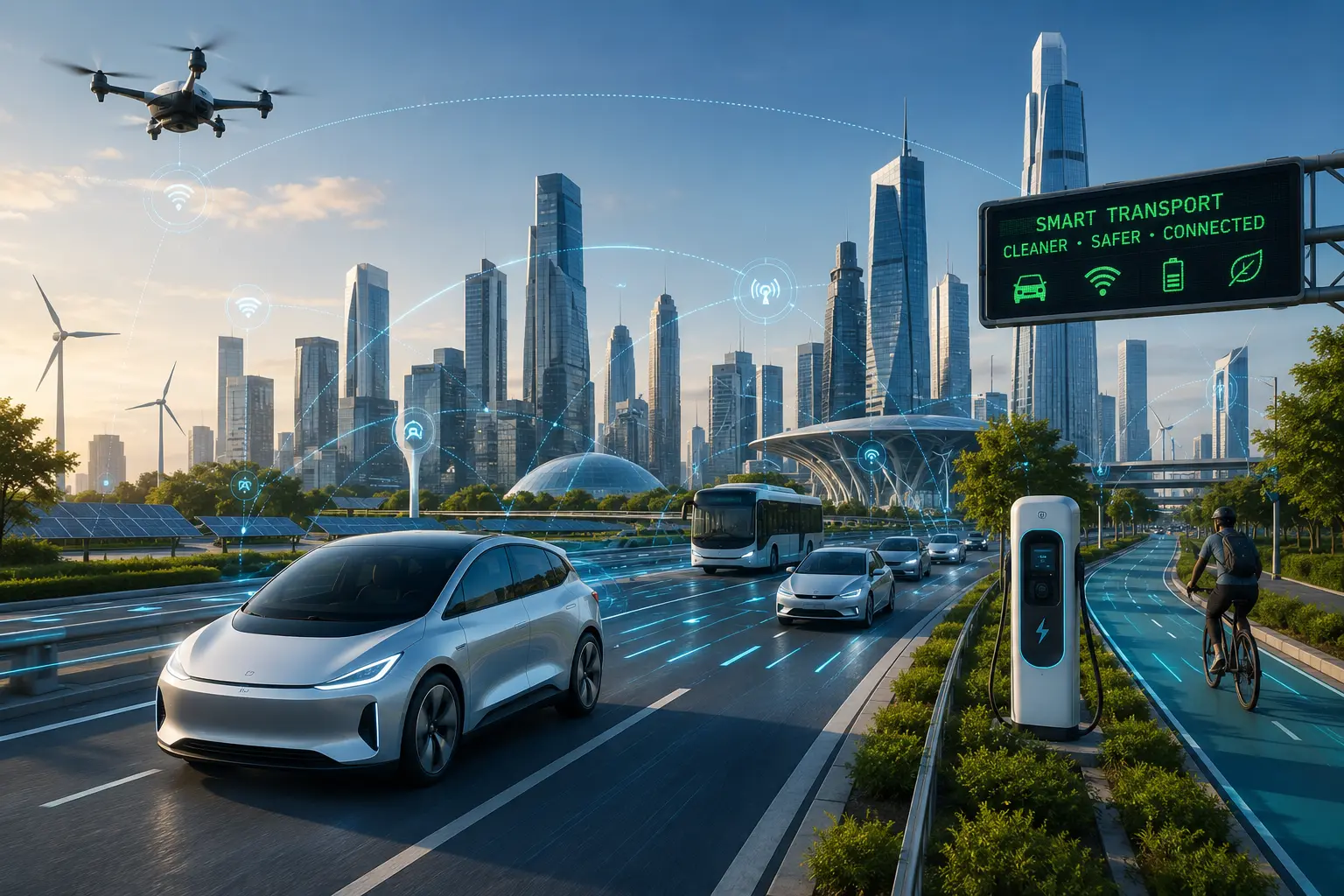
The way people and goods move through cities is changing rapidly. Rising urban populations, traffic congestion, emissions and growing demand for efficient travel are pushing governments and mobility companies toward smart transportation solutions that combine digital technology with cleaner and more connected ways of moving.
From electric vehicles and connected cars to artificial intelligence, intelligent traffic management and autonomous mobility, transportation is becoming increasingly data-driven. These technologies can help cities manage traffic more efficiently, improve the passenger experience and make mobility systems more responsive to changing demand. Current developments are also showing a shift from futuristic concepts toward real-world deployment of connected and autonomous mobility services.
At the same time, smart mobility is no longer limited to individual vehicles. Connected public transport, shared mobility, digital platforms, EV charging networks and intelligent transportation systems are increasingly being considered as parts of one broader urban mobility ecosystem.
In this article, we explore how smart transportation is evolving, the role of connected mobility and electric vehicles, and how technologies such as AI and autonomous vehicles could shape the future of mobility and the cities of tomorrow.
Future Mobility Trends: From Electric Vehicles to Connected Transport
The transition toward smart transportation is no longer limited to futuristic concepts. Cities and mobility companies are increasingly combining electric vehicles, connected infrastructure, real-time data and intelligent traffic systems to make transportation more efficient and responsive. Intelligent transportation systems can connect vehicles, road infrastructure and users while using data to improve traffic management, coordination and road safety.
One of the most visible changes is the growth of electric mobility. Electric cars, buses, scooters and bicycles are becoming an increasingly important part of urban transport, while charging infrastructure continues to expand alongside EV adoption. At the same time, shared mobility and digital transport services are helping people combine different modes of travel instead of depending entirely on private cars.
Another important development is the growing role of connected mobility. Vehicles can exchange information with other vehicles, infrastructure and digital services, creating a transportation ecosystem that can respond to traffic conditions and road information in real time. Recent developments in connected vehicle technology are also moving beyond small pilot projects toward wider deployment and integration.
Artificial intelligence is adding another layer to this transformation. AI can help analyse traffic patterns, optimize routes, manage fleets and support advanced driver-assistance and autonomous-driving systems. However, these technologies are developing at different levels of maturity, meaning that the future of mobility will likely involve a combination of human-driven, assisted, connected and increasingly automated transportation rather than an immediate shift to fully autonomous vehicles.
This combination of electrification, connectivity, automation and data is what makes smart transportation technology an important part of how cities could manage mobility in the coming years.
Read More: Future Mobility: How Smart Technology Is Revolutionizing Transportation
Innovation in Transportation and Smart Mobility Solutions
As cities become more densely populated, traditional transportation systems face growing pressure from congestion, inefficient traffic flow and rising environmental concerns. Smart transportation addresses these challenges by connecting vehicles, infrastructure, public transport and digital services into a more coordinated mobility ecosystem.
A major part of this transformation is connected mobility. Vehicles and infrastructure can exchange information through connected systems, allowing traffic authorities and mobility services to use real-time data for traffic monitoring, route management and other transportation decisions. The International Telecommunication Union identifies AI, IoT and automotive connectivity as important technologies for building more efficient, sustainable and interconnected transport systems.
AI and Intelligent Traffic Management
Artificial intelligence is becoming increasingly important in intelligent transportation systems. AI-powered systems can analyse traffic conditions and large amounts of mobility data to help manage traffic flows, identify congestion and support more responsive transport operations.
For example, intelligent traffic-management systems can adjust signals according to changing traffic conditions rather than relying only on fixed timings. Connected sensors and cameras can also provide real-time information that helps authorities monitor roads and respond to incidents more quickly.
India is also expanding its focus on intelligent transport infrastructure. The 2026 ITS India Congress is highlighting areas such as AI-powered traffic solutions, intelligent traffic management, connected infrastructure and integrated mobility systems.
Integrated Smart Mobility
The bigger opportunity comes when different forms of transportation work together. A smart mobility ecosystem can combine public transport, shared vehicles, electric mobility, digital ticketing, parking services and EV charging into a more connected experience.
Instead of treating every mode of transport as a separate system, cities can use digital platforms and real-time information to make switching between different modes easier. This approach can improve convenience while helping cities make better use of existing transport infrastructure.
The goal of smart transportation technology is therefore not simply to put more technology into vehicles. It is to create a transportation network in which vehicles, infrastructure and people can communicate and work together more efficiently.
EVs and Clean Energy Transport
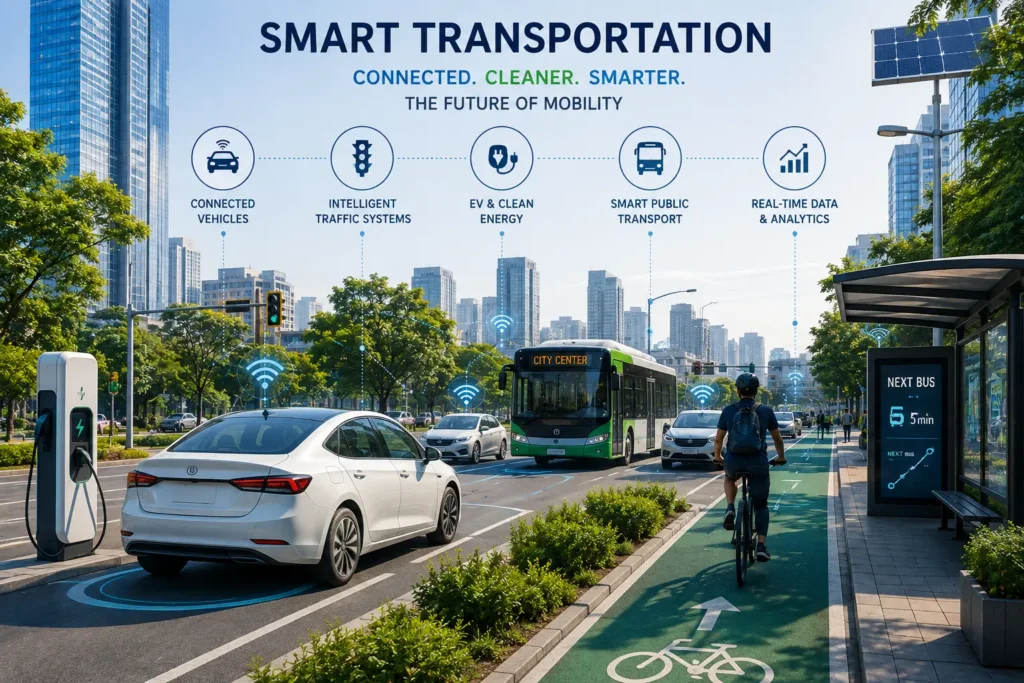
Electric vehicles are becoming one of the most important components of smart transportation, but electrification is about more than simply replacing petrol and diesel vehicles with batteries. A truly sustainable transportation system also depends on charging infrastructure, electricity networks, energy management and the way vehicles interact with the wider mobility ecosystem.
The global charging network is expanding rapidly. According to the IEA’s Global EV Outlook 2026, the number of public charging points worldwide exceeded 7 million at the end of 2025, after more than 1.8 million public chargers were added during the year. The IEA also expects charging infrastructure to continue expanding as EV adoption grows.
EVs Are Becoming Part of a Connected Energy System
The next stage of electric mobility is increasingly connected to the electricity grid. Smart charging can shift vehicle charging to periods when electricity demand is lower, while bidirectional charging and vehicle-to-grid (V2G) technology can potentially allow compatible EVs to return electricity to the grid when needed.
This creates a broader idea of clean transportation in which an electric vehicle is not just a means of getting from one place to another. It can become part of a connected energy and mobility network.
However, electrification also brings new challenges. Growing EV adoption can increase electricity demand and place pressure on local grids if charging is not properly planned. This makes smart charging, charging infrastructure planning and grid management important parts of the transition.
The future of smart transportation technology will therefore depend on how effectively cities combine EVs, charging networks, renewable or lower-carbon electricity, connected infrastructure and intelligent energy management. The goal is not simply to have more electric vehicles, but to build a cleaner and more efficient transportation ecosystem around them.
Autonomous Vehicles and the Future of Connected Mobility
Autonomous vehicles are becoming an increasingly important part of smart transportation, but the technology is developing gradually rather than replacing conventional driving overnight. Current deployments show that autonomous mobility is moving from testing toward controlled commercial services in selected cities and operating environments. For example, robotaxi services are expanding in the United States, while companies are continuing to work through regulatory, safety and operational challenges.
The potential goes beyond simply removing the driver. When autonomous vehicles are combined with connected mobility, they can communicate with digital platforms, navigation systems, road infrastructure and other vehicles. This could allow transportation networks to respond more effectively to changing traffic conditions and passenger demand.
Where Autonomous Mobility Could Make the Biggest Difference
One of the most practical applications could be shared autonomous transportation. Robotaxis, autonomous shuttles and automated public transport could provide on-demand mobility without requiring every passenger to own a vehicle. This could be particularly useful for people who cannot drive or for areas where conventional public transport is limited.
However, autonomous vehicles still face important challenges. Real-world roads contain unpredictable situations such as construction zones, emergency scenes and unusual driver behaviour. Recent robotaxi deployments have demonstrated that scaling autonomous services requires continued improvements in technology, safety monitoring, regulation and infrastructure.
This means the future of mobility is likely to develop through a combination of autonomous vehicles, human-driven cars, public transport and shared mobility rather than a single technology replacing everything else.
When combined with electric powertrains, connected infrastructure and intelligent transportation systems, autonomous vehicles could eventually become one component of a broader smart transportation ecosystem designed to make urban travel safer, cleaner and more efficient.
The Future of Smart Cities and Urban Mobility
The success of smart transportation will ultimately depend on how well cities integrate different forms of mobility rather than relying on a single technology. Electric vehicles, public transport, cycling, walking, shared mobility, connected infrastructure and autonomous systems all have a role to play in creating more efficient and accessible urban transport networks.
Modern urban-mobility planning is increasingly moving toward this integrated approach. The European Commission’s latest Sustainable Urban Mobility Planning guidelines, for example, emphasise transport systems that are sustainable, inclusive, efficient and connected across different modes.
More Connected and Inclusive Cities
A future smart mobility system could allow commuters to combine multiple modes of transport through connected digital platforms. A single journey might involve walking or cycling to a public-transport station, taking an electric bus or metro, and using a shared vehicle for the final part of the trip.
This approach can also improve accessibility. Better public transport, digital services and last-mile connectivity can make mobility more practical for people who do not own a car or cannot drive. Current research on smart urban mobility increasingly considers social inclusion alongside environmental and economic performance, rather than measuring success only through traffic speed or vehicle efficiency.
Technology Alone Is Not Enough
The development of connected transportation also brings challenges. Cities need reliable digital infrastructure, appropriate regulations, cybersecurity, data protection and investment in public transport and roads. Technology must support real-world mobility needs rather than simply adding more connected devices to existing systems.
This means the future of mobility will be shaped not only by electric cars or autonomous vehicles, but by how effectively cities combine technology, infrastructure and human needs.
The ultimate goal of smart transportation technology should be a mobility ecosystem that is cleaner, safer, more accessible and efficient—while giving people practical alternatives for how they travel.
Read More: ADAS Levels Explained
Challenges on the Road to Smart Transportation
Despite the potential of smart transportation, creating a truly connected and sustainable mobility system is not simply a matter of introducing more technology. Cities need to address infrastructure, cybersecurity, data protection, affordability and the different levels of technological readiness across transportation systems.
Infrastructure and Investment
Connected vehicles, EV charging networks, intelligent traffic systems and digital mobility platforms require significant infrastructure investment. Cities also need reliable communication networks and systems capable of processing large amounts of real-time mobility data.
This becomes particularly important as transportation becomes more connected. Recent industry research highlights cybersecurity, infrastructure modernization and the integration of AI and autonomous technologies among the major challenges facing transportation systems.
Data, Privacy and Cybersecurity
The growth of connected mobility also means that more transportation systems will depend on data. Vehicles, smartphones, charging networks and traffic infrastructure can generate information about movement and usage.
Protecting this information from unauthorized access while ensuring that connected systems remain secure will become increasingly important. A smarter transportation network must therefore be designed with cybersecurity and responsible data handling alongside convenience and efficiency.
Technology Must Remain Accessible
Another challenge is making smart mobility available beyond technologically advanced cities and higher-income users. If electric vehicles, shared mobility and digital transportation services are too expensive or difficult to access, the benefits of innovation may not reach everyone.
This is why the future of mobility should focus not only on faster vehicles and advanced automation, but also on affordable public transport, accessible infrastructure and practical solutions for different communities.
Ultimately, successful smart transportation technology will depend on how well innovation is combined with infrastructure, regulation, security and the everyday needs of people.
What Smart Transportation Could Look Like in the Coming Years
The next stage of smart transportation is likely to be less about a single breakthrough technology and more about bringing several systems together. Electric vehicles, connected infrastructure, intelligent traffic management, public transport, shared mobility and autonomous technologies can work as parts of one integrated transportation network.
This approach is increasingly reflected in current research on future transport systems, which emphasizes that technology needs to be combined with sustainability, accessibility, safety and effective urban planning.
For commuters, this could mean a more seamless journey where different modes of transport are connected through digital platforms. A person could use public transport for the main part of a journey, switch to a shared electric vehicle for the last mile, and receive real-time information about traffic, charging availability and route changes through a connected mobility platform.
For cities, the benefits could extend beyond convenience. Intelligent transportation systems can use real-time information and advanced technologies such as AI and IoT to improve traffic management, reduce congestion, support road safety and contribute to lower emissions.
The future will also require greater attention to accessibility. A successful smart mobility ecosystem should not only make transportation more technologically advanced but also ensure that public transport, shared mobility and other services remain practical and affordable for different groups of people.
Ultimately, the future of mobility will be defined by integration. The most successful cities may not be those with the most advanced individual vehicles, but those that can connect different transportation modes, infrastructure and digital services into a system that works efficiently for people and the environment.
Conclusion
The future of smart transportation is moving from an idea centered on individual futuristic vehicles toward a broader ecosystem that connects people, vehicles, infrastructure, energy and digital services. Electric vehicles, connected mobility, intelligent transportation systems, AI and autonomous technologies are developing alongside improvements in public transport and shared mobility.
The transition will not happen at the same pace everywhere. Cities still need to address infrastructure costs, cybersecurity, accessibility, data protection and the practical needs of different communities. Recent research also highlights that smart transport technologies need to be evaluated across environmental, social and economic factors rather than simply judged by how advanced the technology appears.
The most successful smart transportation systems will therefore be those that combine technology with thoughtful urban planning. Cleaner vehicles are important, but so are reliable public transport, walkable and cycle-friendly infrastructure, efficient charging networks and connected services that make different modes of transportation easier to use together. Current sustainable-mobility planning increasingly reflects this integrated approach.
As cities continue to evolve, smart mobility can help create transportation networks that are cleaner, more connected, inclusive and responsive. The real goal is not simply to make vehicles smarter, but to make urban mobility work better for people and the environment.
Ride And Tech — Where Ride Meets Tech.
Drive Smarter. Ride Smarter.
Copyright (c) Ride And Tech. All rights reserved.

2 thoughts on “Connected & Clean: The Future of Smart Transportation”