


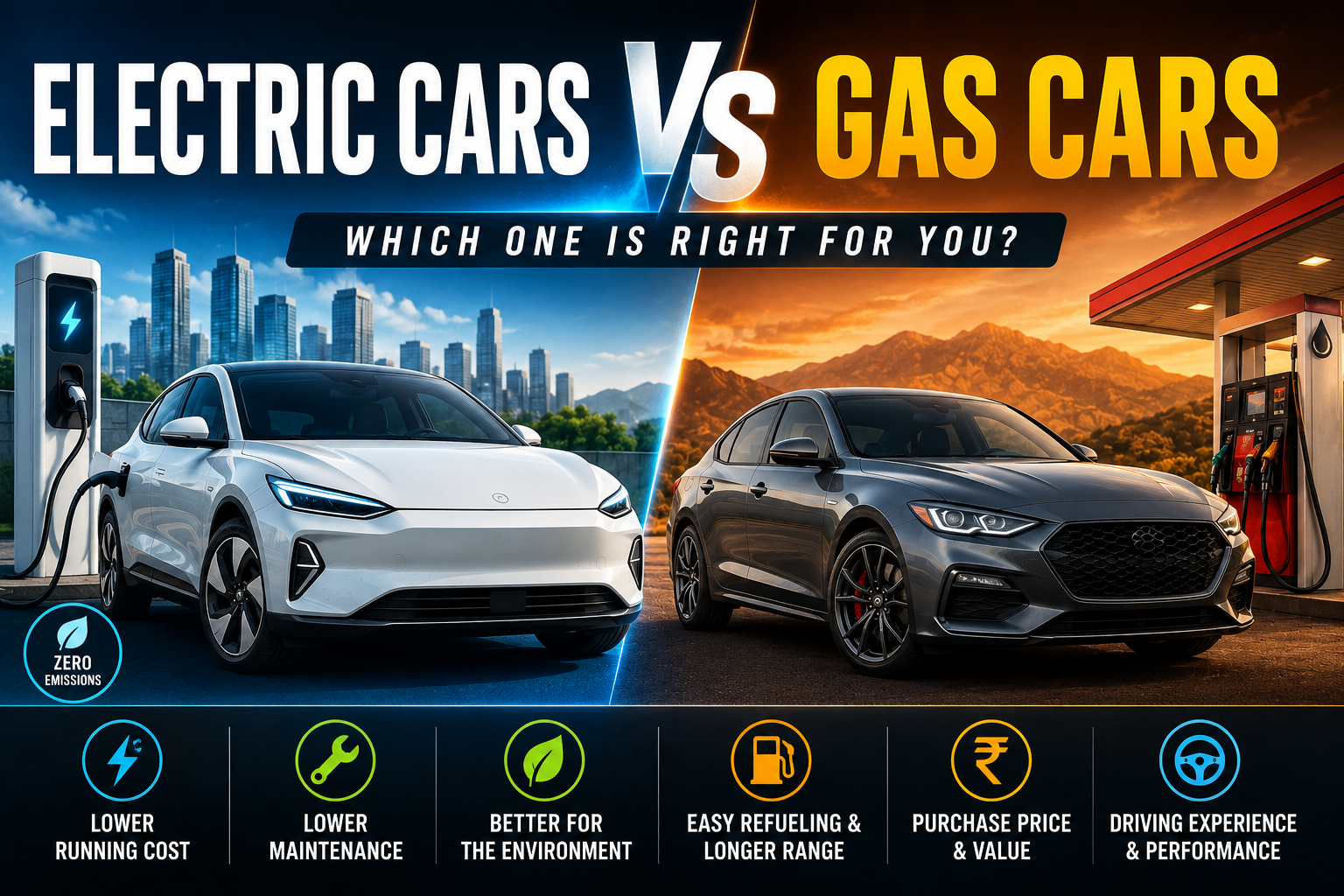
Choosing between Electric Cars vs Gas Cars is one of the biggest decisions for today’s car buyers. While gas-powered cars continue to offer convenience and widespread refuelling infrastructure, electric vehicles (EVs) are becoming increasingly popular thanks to their lower running costs, reduced maintenance, and environmental benefits. However, the right choice depends on factors such as your budget, driving habits, charging availability, and long-term ownership costs.
In this guide, we compare Electric Cars vs Gas Cars based on purchase price, fuel and charging costs, maintenance, performance, environmental impact, and overall value to help you decide which option best suits your needs.
Electric Cars vs Gas Cars: Quick Comparison
If you’re looking for a quick overview before diving into the details, here’s how Electric Cars vs Gas Cars compare across the factors that matter most to buyers. While electric vehicles offer lower running costs and reduced maintenance, gas-powered cars continue to provide greater convenience for long-distance travel and wider refuelling availability.
| Feature | Electric Cars | Gas Cars |
|---|---|---|
| Purchase Price | Generally higher upfront cost | Usually more affordable upfront |
| Running Cost | Lower electricity cost per kilometre | Higher fuel cost depending on petrol prices |
| Maintenance | Fewer moving parts and lower maintenance requirements | Regular servicing, oil changes, and engine maintenance required |
| Refuelling / Charging | Home charging or public charging stations | Fast refuelling at widely available petrol stations |
| Driving Range | Improving with newer models | Generally longer range on a full tank |
| Environmental Impact | Zero tailpipe emissions and lower lifetime emissions | Produces tailpipe emissions and relies on fossil fuels |
| Performance | Instant torque and smooth acceleration | Familiar driving experience with a wide range of engine options |
| Best Suited For | Daily commuting, city driving, and lower running costs | Long-distance travel and areas with limited charging infrastructure |
Verdict: There is no one-size-fits-all answer in the Electric Cars vs Gas Cars debate. The best choice depends on your driving habits, budget, and access to charging infrastructure. If you primarily drive within the city and want to reduce long-term ownership costs, an electric car can be a smart investment. However, if you frequently travel long distances or live in an area with limited charging facilities, a gas-powered car may still be the more practical option.
Purchase Price and Long-Term Ownership Costs
One of the biggest factors in the Electric Cars vs Gas Cars comparison is the total cost of ownership. While gas-powered cars generally have a lower purchase price, electric vehicles (EVs) often prove to be more economical over the long term due to lower running and maintenance costs.
At first glance, a gas car may appear to be the more affordable option because of its lower upfront price. However, many electric cars qualify for government incentives in certain regions, and their operating costs are significantly lower. Electricity is typically less expensive than petrol or diesel on a per-kilometre basis, allowing EV owners to save money over time.
Another advantage of electric vehicles is their simpler mechanical design. Unlike conventional internal combustion engine (ICE) vehicles, EVs have fewer moving parts, eliminating the need for regular oil changes, exhaust system repairs, and many engine-related maintenance tasks. This can result in lower servicing costs throughout the vehicle’s lifespan.
For buyers planning to keep their vehicle for several years, the higher initial investment in an electric car can often be offset by savings on fuel and maintenance. On the other hand, drivers who cover fewer kilometres annually or prioritise a lower purchase price may still find a gas-powered car to be the more practical choice.
Fuel Efficiency and Running Costs
One of the biggest advantages in the Electric Cars vs Gas Cars debate is the difference in energy efficiency and day-to-day running costs. Electric vehicles convert a much larger percentage of stored energy into movement, making them significantly more efficient than traditional internal combustion engine (ICE) vehicles.
Unlike gas-powered cars, which lose a considerable amount of energy as heat during combustion, electric cars deliver power directly to the wheels through an electric motor. This results in better energy utilisation and lower operating costs per kilometre. For most daily commuters, charging an EV is generally more affordable than regularly refuelling a gas-powered vehicle, especially when charging at home.
However, running costs can vary depending on factors such as electricity tariffs, fuel prices, annual driving distance, and charging habits. Drivers who have access to home charging often experience the greatest savings, while those relying primarily on public fast chargers may see slightly higher operating costs.
Although gas-powered cars continue to offer the advantage of quick refuelling and a well-established network of fuel stations, improvements in battery technology and the rapid expansion of charging infrastructure are making electric vehicles increasingly practical for everyday use.
Overall, if reducing day-to-day operating expenses is a priority, electric vehicles generally have the advantage. However, drivers who frequently travel long distances in regions with limited charging facilities may still find gas-powered cars to be the more convenient option.
Read More: Are Electric Cars the Future of Driving?
Environmental Impact: Which Is Greener?
Environmental impact is one of the key reasons many buyers consider Electric Cars vs Gas Cars. While electric vehicles (EVs) produce zero tailpipe emissions during driving, the overall environmental impact depends on factors such as battery production, electricity generation, and the vehicle’s entire lifecycle.
Gas-powered cars continuously emit carbon dioxide (CO₂) and other pollutants while driving, contributing to air pollution and greenhouse gas emissions. Electric vehicles eliminate these tailpipe emissions, helping improve air quality, particularly in urban areas.
However, manufacturing EV batteries requires significant amounts of raw materials and energy, resulting in higher emissions during production compared to conventional vehicles. The good news is that these initial emissions are typically offset over time through lower operating emissions, especially when the vehicle is charged using electricity from renewable sources such as solar or wind power.
Battery recycling technology is also advancing rapidly, allowing valuable materials like lithium, nickel, and cobalt to be recovered and reused. As renewable energy adoption increases and battery recycling continues to improve, the overall environmental benefits of electric vehicles are expected to become even greater.
For environmentally conscious buyers, electric vehicles generally offer a lower lifetime carbon footprint than gas-powered cars, although the exact environmental benefit depends on how the electricity used for charging is generated.
Maintenance and Service Costs
Maintenance is another major factor in the Electric Cars vs Gas Cars comparison. While both types of vehicles require regular inspections and routine care, electric vehicles generally have lower maintenance costs due to their simpler mechanical design.
Unlike gas-powered cars, electric vehicles do not require engine oil changes, spark plug replacements, fuel filter changes, or exhaust system repairs. With fewer moving parts, there are also fewer components that are likely to wear out over time, which can reduce both servicing costs and unexpected repair bills.
Gas-powered cars, on the other hand, require periodic maintenance to keep the engine, transmission, cooling system, and fuel system operating efficiently. Although service centres for conventional vehicles are widely available, the cumulative cost of regular servicing can be higher over the life of the vehicle.
Electric vehicles are not completely maintenance-free. Owners still need to maintain tyres, brakes, suspension components, cabin air filters, and the vehicle’s battery cooling system where applicable. Most manufacturers also provide long-term battery warranties, giving buyers added confidence in battery reliability.
For drivers looking to minimise maintenance expenses and workshop visits, electric vehicles generally offer a clear advantage. However, gas-powered cars may still be a practical option in regions where EV service centres or charging infrastructure are limited.
Electric Cars vs Gas Cars: Which One Is Right for You?
Choosing between Electric Cars vs Gas Cars ultimately depends on your lifestyle, driving habits, and long-term priorities. There is no single answer that fits every driver, as both vehicle types offer unique advantages.
An electric car is an excellent choice if you primarily drive in the city, have access to home or workplace charging, and want to reduce long-term running and maintenance costs. EVs also appeal to buyers looking for a quieter driving experience and a lower environmental impact.
A gas-powered car may be the better option if you frequently travel long distances, require quick refuelling, or live in an area where charging infrastructure is still developing. The lower upfront purchase price and widespread availability of fuel stations also make gas cars a practical choice for many buyers.
Before making your decision, consider factors such as your annual driving distance, local charging availability, maintenance costs, purchase budget, and long-term ownership plans. Evaluating these aspects will help you choose the vehicle that best meets your personal and financial needs.
Quick Recommendations
You need the convenience of quick refuelling.
Choose an Electric Car if:
- You mainly drive in cities or urban areas.
- You have convenient access to charging.
- You want lower running and maintenance costs.
- Reducing emissions is one of your priorities.
Choose a Gas Car if:
- You regularly travel long distances.
- Charging stations are limited in your area.
- You prefer a lower upfront purchase price.
Pros and Cons of Electric Cars vs Gas Cars
Both electric and gas-powered cars have their own strengths and limitations. Understanding these advantages and disadvantages can help you choose the vehicle that best suits your driving needs and budget.
Electric Cars
Pros
- Lower running costs due to cheaper electricity compared to petrol or diesel.
- Reduced maintenance requirements with fewer moving mechanical parts.
- Zero tailpipe emissions, helping improve air quality.
- Instant torque for smooth and responsive acceleration.
- Quieter and more refined driving experience.
Cons
- Higher upfront purchase price for many models.
- Charging takes longer than refuelling a gas-powered vehicle.
- Charging infrastructure may still be limited in some regions.
- Driving range can vary depending on battery size, weather conditions, and driving style.
Gas Cars
Pros
- Lower initial purchase price across many vehicle segments.
- Quick and convenient refuelling at widely available fuel stations.
- Longer driving range on a full tank in many cases.
- Extensive service network with experienced mechanics.
Cons
- Higher fuel expenses over long-term ownership.
- Regular maintenance such as oil changes and engine servicing.
- Produces tailpipe emissions that contribute to air pollution.
- More moving parts can result in higher maintenance costs as the vehicle ages.
Frequently Asked Questions (FAQs)
Are electric cars cheaper to run than gas cars?
In most cases, yes. Electric cars generally have lower running costs because electricity is often less expensive than petrol or diesel, and EVs typically require less maintenance over their lifetime.
Do electric cars require less maintenance?
Yes. Electric vehicles have fewer moving parts than gas-powered cars and do not require services such as engine oil changes or spark plug replacements. However, tyres, brakes, suspension components, and other wear items still require regular maintenance.
Are electric cars better for the environment?
Electric vehicles produce zero tailpipe emissions and generally have a lower lifetime carbon footprint than gas-powered cars. However, their overall environmental impact also depends on battery manufacturing and the source of electricity used for charging.
Are gas cars still worth buying?
Yes. Gas-powered cars remain a practical choice for drivers who frequently travel long distances, require quick refuelling, or live in areas where charging infrastructure is limited.
Which is better for daily commuting: Electric Cars or Gas Cars?
For most city commuters, electric cars are often the better choice due to their lower running costs, quieter operation, and reduced maintenance requirements. Gas-powered cars may be more suitable for drivers who regularly cover long highway distances.
Conclusion
The Electric Cars vs Gas Cars debate doesn’t have a one-size-fits-all answer. Both vehicle types offer distinct advantages, and the right choice ultimately depends on your budget, driving habits, and long-term ownership goals.
If you want lower running costs, reduced maintenance, and a more environmentally friendly driving experience, an electric vehicle can be a smart long-term investment. On the other hand, if you frequently travel long distances, need quick refuelling, or have limited access to charging infrastructure, a gas-powered car may continue to be the more practical option.
As battery technology continues to improve and charging networks expand, electric vehicles are becoming an increasingly attractive choice for many buyers. However, gas-powered cars still play an important role and remain a reliable solution for a wide range of drivers.
Before making your purchase, compare the total cost of ownership, maintenance requirements, driving range, and convenience to determine which vehicle best fits your lifestyle. Choosing the right car isn’t about following a trend—it’s about selecting the option that delivers the best value for your individual needs.
Looking for more expert automotive buying guides, car comparisons, EV news, and the latest technology updates? Explore more in-depth articles on Ride And Tech and stay informed before making your next automotive decision.
Copyright (c) Ride And Tech. All rights reserved.

3 thoughts on “Electric Cars vs Gas Cars: Which Is Better for Your Budget and the Environment?”