


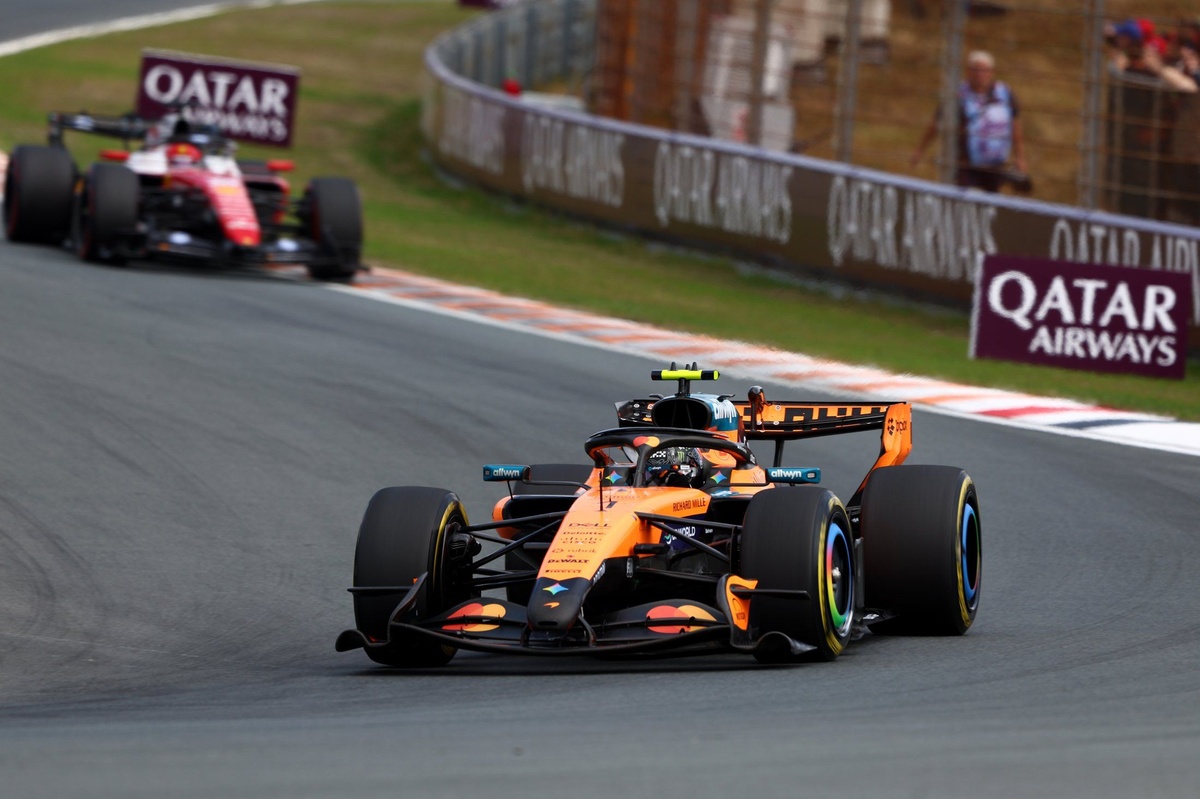
Winning a Formula 1 race usually means you have found something the others haven’t. At Zandvoort, McLaren found something slightly stranger: its McLaren MCL40 was so strong in the fast corners that the team had to tame it before Sunday’s Dutch Grand Prix.
That sounds backwards, but the data from Lando Norris’ car helped McLaren understand that outright speed in one part of the lap was creating a bigger compromise elsewhere. The result was a clever mid-weekend setup rethink — and a race-winning MCL40.
Why the McLaren MCL40 Needed a Rethink
The McLaren MCL40 looked brutally quick through Zandvoort’s high-speed sections, but that strength came with a catch. Its Sprint performance showed McLaren was extracting plenty of pace while also paying a price in tyre usage and slower corners.
Rather than simply chasing more performance, McLaren used Lando Norris’ data to rebalance the car for Sunday’s race. The aim was to make the McLaren MCL40 more manageable over a full stint, not just spectacular over one lap.
Read More: Dutch GP Sprint Qualifying 2026
What McLaren Changed
McLaren’s answer was not to chase even more outright pace. The team instead rebalanced the McLaren MCL40, sacrificing some of its extreme high-speed performance to make the car kinder to its tyres and more effective through the slower parts of Zandvoort.
That was a sensible trade for a Grand Prix rather than a qualifying lap. The Dutch circuit rewards confidence through its fast corners, but a car that destroys its tyres or struggles in the slower sections can quickly give away that advantage over a full race distance.
The result was a more usable package for Lando Norris — fast enough to fight at the front, but better suited to the demands of a Sunday afternoon. Norris ultimately converted pole into his second consecutive victory, beating Kimi Antonelli by 11.536 seconds.
What It Means for McLaren
The Dutch GP was a useful reminder that McLaren MCL40 performance isn’t simply about finding the fastest possible lap. The team had to understand where its advantage was coming from and where that same strength was creating compromises. After the Sprint, McLaren made setup changes that gave Norris more confidence for qualifying, and he responded by taking pole.
That matters beyond Zandvoort. McLaren now has a car capable of fighting at the front, but Norris still points to weaknesses on slower, higher-drag circuits. The Dutch GP win was another step forward, but the remaining championship fight will depend on whether McLaren can make the MCL40 consistently effective across a wider range of tracks.
What It Means for McLaren’s Title Fight
The Dutch GP win changes the mood around McLaren, but it doesn’t erase the McLaren MCL40’s weaknesses. The car has made a major step forward since the Hungarian GP, particularly in high-speed sections, and Mercedes’ Kimi Antonelli admitted after Zandvoort that McLaren is no longer clearly behind Mercedes on outright pace.
For Lando Norris, that’s encouraging — but the championship gap remains substantial. Norris is still 83 points behind Antonelli, while McLaren knows the MCL40 needs to work across more than just circuits that suit its strengths.
That makes the next few races particularly interesting. If McLaren can keep extracting performance from the MCL40 without having to make such significant compromises, Norris could turn this recent run of form into a genuine title challenge.
Ride And Tech Verdict
The McLaren MCL40 left Zandvoort looking like a car McLaren is finally beginning to understand. Its raw speed was never really the question; the clever part was recognising where that speed was costing the team and making the car more usable for the race. That mid-weekend adjustment helped Norris turn a difficult Sprint into pole and, ultimately, another victory.
McLaren didn’t need a faster MCL40 at the Dutch GP — it needed a smarter one. The team’s willingness to sacrifice a little outright performance for balance and tyre life was exactly the sort of decision that wins Grands Prix. The bigger question now is whether McLaren can make that same versatility work at tracks that expose the car’s remaining weaknesses.
Ride And Tech — Where Ride Meets Tech.
Drive Smarter. Ride Smarter.
Copyright (c) Ride And Tech. All rights reserved.

2 thoughts on “McLaren MCL40: Why McLaren Had to Detune Its F1 Car at the Dutch GP”