


Why do electric cars accelerate faster than petrol cars? This is one of the most common questions people ask after experiencing the instant acceleration of an electric vehicle for the first time. Whether it is a compact electric hatchback or a premium performance EV, the immediate surge of acceleration often surprises people who are used to driving conventional petrol-powered cars.
Many readers ask why do electric cars accelerate faster than petrol cars, especially after experiencing the instant acceleration of an electric vehicle for the first time. The answer lies in the unique way electric motors deliver power compared to traditional petrol engines. Unlike petrol engines that need to build engine speed (RPM) before delivering their maximum pulling power, electric motors can provide almost all of their torque the moment you press the accelerator pedal.
This instant response makes electric vehicles feel smoother, quicker, and far more responsive during everyday driving. It is one of the biggest reasons why modern EVs have changed how drivers experience performance on the road.
In this comprehensive guide, we will explain why electric cars accelerate faster than petrol cars, how electric motors work differently from internal combustion engines, and why instant torque has become one of the defining advantages of electric vehicle technology.
What Is Torque?
To understand why do electric cars accelerate faster than petrol cars, it is important to understand how torque influences acceleration and how electric motors generate it differently from internal combustion engines.
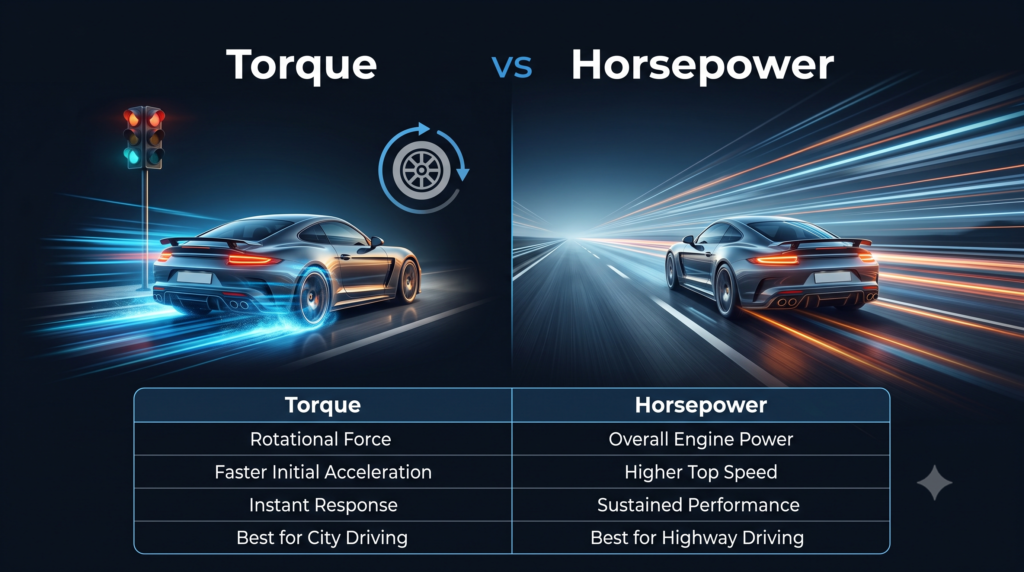
Torque is the rotational force that turns a vehicle’s wheels. In simple terms, it is the force responsible for getting a vehicle moving from a standstill.
Imagine tightening a bolt using a long wrench. The twisting force you apply to rotate the wrench is torque. Vehicles use exactly the same principle. The more torque available, the easier it becomes to move the car forward.
While horsepower determines how much work an engine can perform over time, torque determines how quickly that power is delivered to the wheels.
This is why two cars with similar horsepower figures can feel completely different during acceleration.
How Petrol Engines Generate Power
To understand why electric cars accelerate faster than petrol cars, we first need to understand how petrol engines produce power.
A petrol engine works by burning a mixture of fuel and air inside multiple cylinders. Each combustion cycle pushes pistons, rotates the crankshaft, and eventually transfers power to the wheels through a gearbox.
This process involves several mechanical stages:
- Fuel injection
- Air intake
- Compression
- Combustion
- Exhaust
- Gear transmission
Because of these multiple steps, a petrol engine cannot produce maximum torque immediately.
Instead, torque gradually increases as engine speed (RPM) rises. This is why drivers often need to press the accelerator harder or downshift gears to achieve strong acceleration.
Even modern turbocharged petrol engines experience a slight delay before delivering their full performance.
This delay is completely normal because combustion engines depend on increasing RPM before reaching peak torque.
How Electric Motors Work
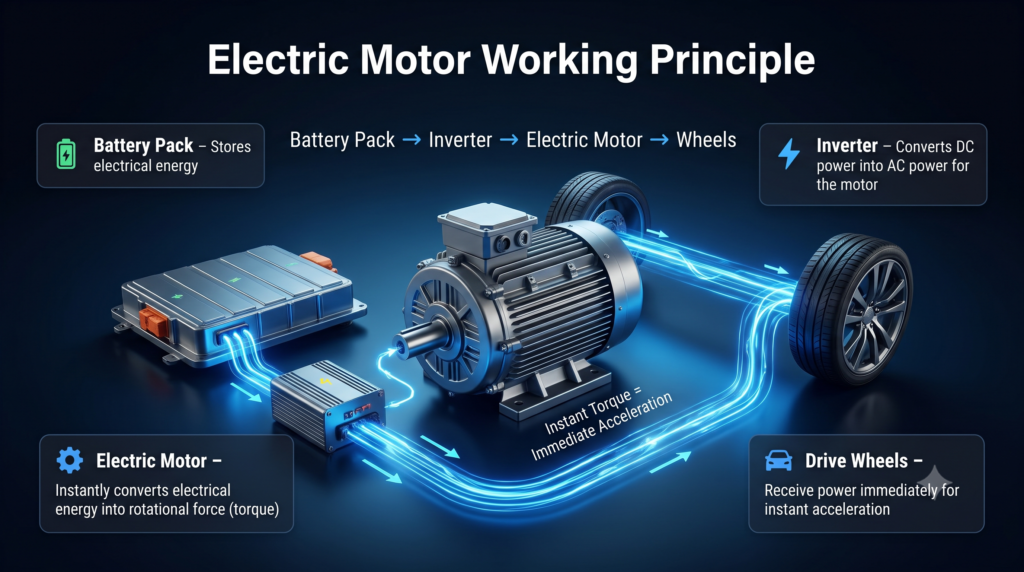
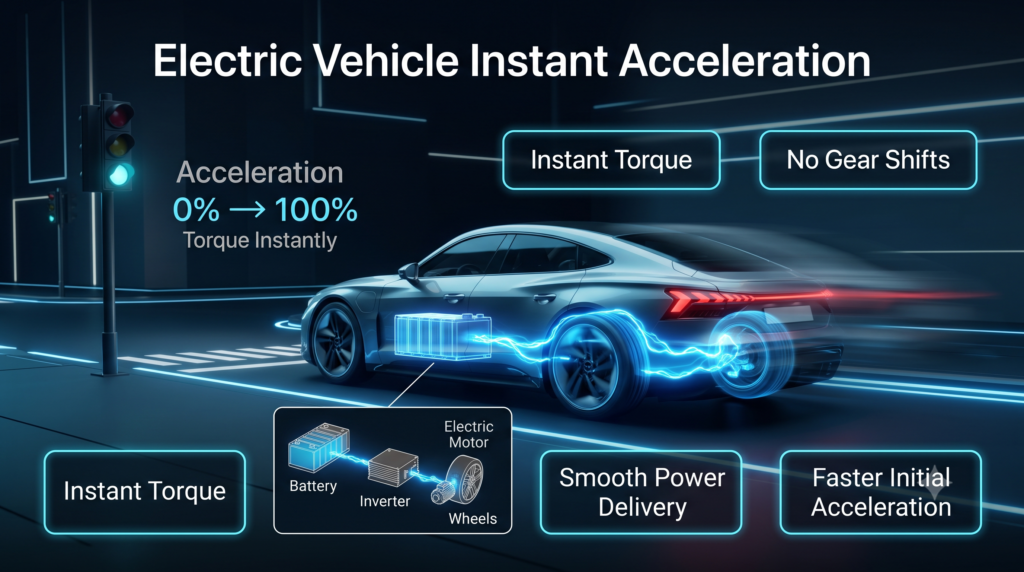
The working principle of an electric motor clearly explains why do electric cars accelerate faster than petrol cars. Because maximum torque is available almost instantly, electric vehicles respond immediately when the accelerator pedal is pressed.
Instead of burning fuel, an electric motor converts electrical energy stored in the battery directly into rotational movement.
When the driver presses the accelerator pedal, electricity flows almost instantly into the motor, creating magnetic fields that begin rotating the motor shaft.
Unlike petrol engines, electric motors do not require:
- Combustion
- Air intake
- Fuel ignition
- Multiple gear changes
- High RPM before producing torque
This allows the motor to respond almost instantly to driver inputs.
The result is immediate acceleration with virtually no delay.
What Is Instant Torque?
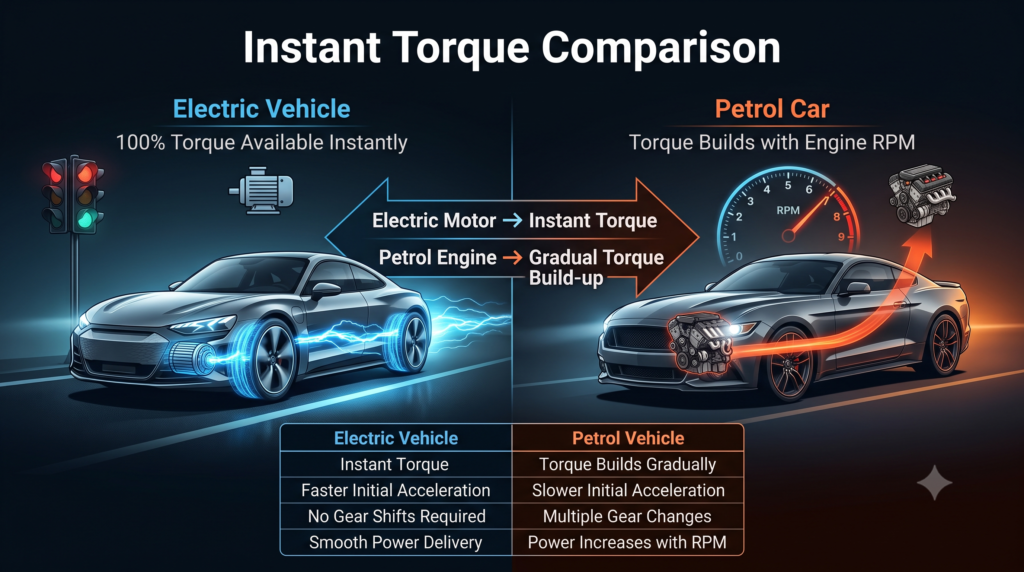
The biggest reason why electric cars accelerate faster than petrol cars is instant torque.
Unlike petrol engines that gradually build torque over thousands of engine revolutions, electric motors are capable of delivering nearly their maximum torque from zero RPM.
This means the moment the accelerator pedal is pressed:
- The motor immediately generates maximum pulling force.
- Power reaches the wheels almost instantly.
- There is no waiting for engine speed to build.
- Acceleration feels immediate and effortless.
This is why even family electric SUVs often feel significantly quicker than larger petrol SUVs during city driving.
The sensation is especially noticeable at traffic lights, roundabouts, and while overtaking slower vehicles.
Why Instant Torque Makes EVs Feel Faster
Many people confuse speed with acceleration.
Top speed and acceleration are not the same thing.
An electric vehicle may not always have the highest top speed, but it often reaches everyday driving speeds much faster than a comparable petrol vehicle.
For example:
- Traffic light launches
- Overtaking on highways
- Merging into traffic
- Climbing steep roads
In all these situations, instant torque provides a major advantage because maximum pulling force is already available.
The driver experiences smooth, continuous acceleration without waiting for gears to shift or RPM to increase.
Why Electric Cars Feel More Responsive
Another reason why electric cars accelerate faster than petrol cars is the simplicity of their drivetrain.
Most electric vehicles use a single-speed transmission instead of a traditional multi-speed gearbox.
This means there are no gear changes interrupting acceleration.
Benefits include:
- Smooth power delivery
- Continuous acceleration
- Fewer mechanical losses
- Faster throttle response
- Reduced drivetrain complexity
Without gear shifts, acceleration feels much more linear and refined, creating the impression that the vehicle is always ready to respond. Comparing both powertrains makes it easier to understand why do electric cars accelerate faster than petrol cars in everyday driving conditions, particularly during city traffic and overtaking.
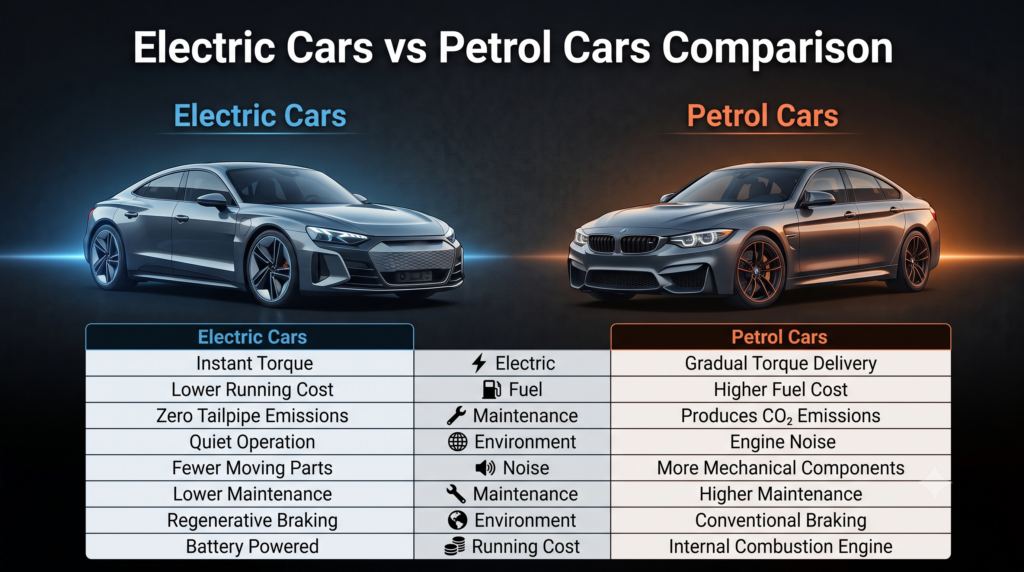
Electric Cars vs Petrol Cars: Which Accelerates Faster?
Now that we understand why electric cars accelerate faster than petrol cars, let’s compare both technologies side by side.
Although both vehicles are designed to transport passengers efficiently, the way they deliver power is completely different.
| Feature | Electric Cars | Petrol Cars |
|---|---|---|
| Torque Delivery | Instant | Gradual |
| Gearbox | Single-Speed (Most EVs) | Multi-Speed |
| Initial Acceleration | Extremely Quick | Slower |
| Engine Response | Instant | RPM Dependent |
| Maintenance | Lower | Higher |
| Power Source | Battery & Electric Motor | Internal Combustion Engine |
| Mechanical Parts | Fewer | More |
The biggest difference is that electric vehicles deliver power immediately, while petrol-powered cars require the engine to build RPM before maximum performance becomes available.
This simple difference explains why electric cars accelerate faster than petrol cars in most everyday driving situations.
Why Do Electric Cars Feel Faster Even with Less Horsepower?
Many drivers assume horsepower is the only factor that determines performance.
In reality, acceleration depends on how efficiently power reaches the road.
An electric car producing 180 horsepower can often feel quicker than a petrol vehicle producing 220 horsepower during city driving.
Why?
Because electric motors deliver maximum torque immediately.
Petrol engines must first increase RPM before reaching their peak torque.
This immediate response gives EVs a clear advantage in:
- Traffic-light launches
- Overtaking
- Urban driving
- Stop-and-go traffic
- Climbing inclines
This is another reason why electric cars accelerate faster than petrol cars during real-world driving.
Real-World Examples of Instant Torque
Several modern electric vehicles demonstrate how instant torque transforms driving performance.
Tata Nexon EV
One of India’s most popular electric SUVs, the Tata Nexon EV offers smooth and confident acceleration that feels noticeably quicker than many petrol compact SUVs in city traffic.
Hyundai Ioniq 5
The Hyundai Ioniq 5 combines instant torque with advanced 800V electrical architecture, allowing rapid acceleration while maintaining excellent efficiency.
Kia EV6
The Kia EV6 showcases how dual-motor electric powertrains can deliver sports-car-like acceleration without sacrificing everyday practicality.
Tesla Model 3 Performance
Tesla’s performance models have become famous for their explosive acceleration, largely because electric motors provide instant torque from a standstill.
Mahindra BE 6
As one of India’s newest electric SUVs, the Mahindra BE 6 highlights how modern EV technology is making high-performance acceleration accessible to a wider audience.
These examples clearly demonstrate why electric cars accelerate faster than petrol cars regardless of whether the vehicle is positioned as an affordable family SUV or a premium performance model.
Why Don’t Petrol Cars Produce Instant Torque?
Petrol engines depend on controlled combustion.
Every time the driver presses the accelerator:
- Fuel enters the cylinders.
- Air mixes with fuel.
- Compression occurs.
- Spark plugs ignite the mixture.
- Combustion creates power.
- RPM gradually increases.
Because this process takes time, maximum torque cannot be delivered immediately.
This delay is completely normal and is one of the main reasons why electric cars accelerate faster than petrol cars.
Does Battery Size Make Electric Cars Faster?
One common misconception is that larger batteries automatically make electric cars accelerate faster.
This is not entirely true.
Battery capacity mainly determines:
- Driving range
- Energy storage
- Charging intervals
Acceleration depends on several other factors:
- Electric motor output
- Torque
- Vehicle weight
- Traction
- Motor controller software
- Battery power delivery capability
A well-designed electric drivetrain with efficient power management often delivers better performance than simply increasing battery size.
Are Electric Cars Always Faster?
Although electric cars usually win in short-distance acceleration, petrol-powered vehicles still have certain advantages.
Examples include:
Longer High-Speed Driving
Performance petrol cars often maintain extremely high top speeds for extended periods.
Refuelling Convenience
Petrol vehicles can be refuelled in just a few minutes, while EV charging times vary depending on charging infrastructure.
Engine Character
Many enthusiasts still appreciate the sound, vibration, and driving engagement of high-performance petrol engines.
Motorsport Applications
Several forms of professional motorsport continue to rely on internal combustion technology, although electric racing is rapidly growing.
Therefore, while electric cars accelerate faster than petrol cars, the ideal choice still depends on the driver’s priorities and usage.
Common Myths About EV Acceleration
Myth 1
Electric cars accelerate faster because they have bigger batteries.
Reality
Battery size mainly affects driving range. Instant torque comes from the electric motor.
Myth 2
Electric cars are only quick at low speeds.
Reality
Many modern EVs continue to deliver impressive acceleration well beyond highway speeds.
Myth 3
Petrol sports cars are always faster.
Reality
Many high-performance EVs now outperform traditional sports cars in 0–100 km/h acceleration.
Myth 4
Electric cars lose power quickly.
Reality
Modern battery management systems help maintain consistent performance under most normal driving conditions.
The Future of Electric Vehicle Performance
The automotive industry continues to invest heavily in electric mobility.
Manufacturers are developing:
- Higher efficiency electric motors
- 800V electrical systems
- Advanced battery cooling
- Silicon carbide power electronics
- Torque vectoring
- Lightweight battery packs
These innovations will make future electric vehicles even quicker, more efficient, and more enjoyable to drive.
If you have ever wondered why do electric cars accelerate faster than petrol cars, the answer comes down to instant torque, efficient power delivery, and the simplicity of the electric drivetrain.
Frequently Asked Questions (FAQs)
Why do electric cars accelerate faster than petrol cars?
Electric cars accelerate faster than petrol cars because their electric motors deliver maximum torque almost instantly. Unlike petrol engines, which need to build engine RPM before reaching peak torque, electric motors provide immediate power the moment the accelerator pedal is pressed. This allows electric vehicles to respond more quickly and deliver smooth, rapid acceleration.
What is instant torque in an electric car?
Instant torque is the ability of an electric motor to produce its maximum rotational force from zero RPM. This immediate power delivery is one of the biggest advantages of electric vehicles and is the primary reason they feel quicker during everyday driving.
Are electric cars always faster than petrol cars?
Not necessarily. While most electric cars accelerate faster from a standstill because of instant torque, overall performance depends on factors such as motor power, vehicle weight, traction, aerodynamics, and top speed. High-performance petrol sports cars can still compete in certain driving conditions.
Why don’t petrol engines produce instant torque?
Petrol engines rely on a combustion process that requires fuel ignition, increasing engine speed (RPM), and gear changes before reaching maximum torque. Because of these mechanical processes, power builds gradually instead of being delivered immediately like an electric motor.
Does battery size make an electric car accelerate faster?
No. Battery size mainly affects the driving range of an electric vehicle. Acceleration depends on the electric motor, power electronics, software, traction, and the vehicle’s overall engineering rather than battery capacity alone.
Why do most electric cars use a single-speed transmission?
Electric motors operate efficiently across a wide range of RPM, allowing most electric vehicles to use a single-speed transmission. This reduces mechanical complexity, improves efficiency, and provides smoother acceleration without noticeable gear changes.
Are electric cars better for city driving?
Yes. Instant torque, smooth acceleration, regenerative braking, and quiet operation make electric vehicles particularly well suited for city traffic, frequent stops, and daily commuting.
Will future electric cars become even faster?
Yes. Advances in battery technology, motor efficiency, lightweight materials, and high-voltage electrical systems are expected to make future electric vehicles even quicker while improving driving range, charging speed, and overall efficiency.
Final Thoughts
Understanding why do electric cars accelerate faster than petrol cars helps explain one of the biggest technological advantages of modern electric vehicles. Instead of relying on engine revolutions and complex mechanical systems, electric motors deliver power almost instantly, creating a driving experience that feels smooth, responsive, and effortless.
While petrol-powered vehicles continue to offer benefits such as quick refuelling and a unique driving character, electric vehicles are redefining performance with instant torque, simplified drivetrains, and advanced electric motor technology. As battery technology and charging infrastructure continue to improve, electric vehicles are expected to become even more capable and efficient in the years ahead.
Whether you’re an automotive enthusiast, a first-time EV buyer, or simply curious about the future of mobility, understanding the science behind instant torque provides valuable insight into why electric vehicles are transforming the automotive industry.
About Ride and Tech
At Ride and Tech, we are passionate about making automotive technology simple, practical, and easy to understand. Our mission is to provide accurate, well-researched, and engaging content covering electric vehicles, automotive innovation, future mobility, vehicle technology, and the latest developments shaping the automotive industry.
As we continue to expand our automotive knowledge hub, our goal is to help readers make informed decisions through trusted guides, in-depth explanations, and expert automotive insights.
Thank you for reading. Stay connected with Ride and Tech for more informative articles that explore the future of driving and automotive technology.
Copyright (c) Ride And Tech. All rights reserved.

4 thoughts on “Why Do Electric Cars Accelerate Faster Than Petrol Cars? 5 Powerful Reasons”