


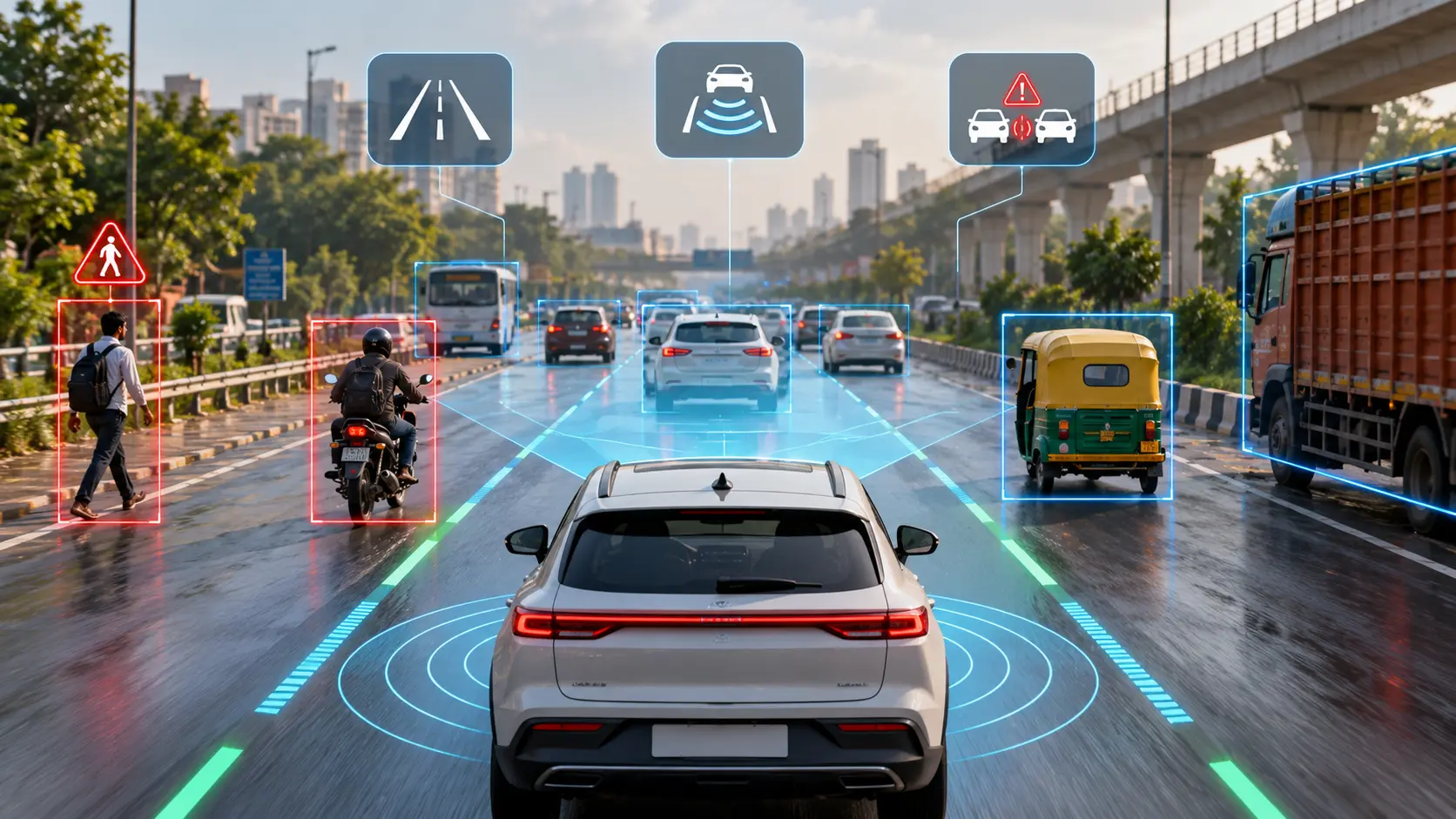
Advanced Driver Assistance Systems (ADAS) have become an important selling point in modern cars, especially as manufacturers introduce features such as adaptive cruise control, lane departure warning, lane-keeping assistance and automatic emergency braking. These technologies can make driving safer and reduce the workload on drivers, but their effectiveness depends on the vehicle, its sensors, road conditions and the driver’s response.
Understanding ADAS limitations in India helps drivers recognize that these systems are designed to assist with specific driving tasks, not handle every possible road situation. Their effectiveness depends on traffic conditions, visibility, sensor performance and the driver’s ability to respond. A system that performs well on a clearly marked highway may behave differently on a crowded urban road. That does not make ADAS useless; it means drivers need to understand what the technology can do, where it may struggle and when they must take control.
What Makes ADAS Challenging on Indian Roads?
ADAS uses a combination of cameras, radar, ultrasonic sensors and, in some vehicles, other sensing technologies to monitor the surroundings and support the driver. Depending on the model, the system may warn about a potential collision, maintain a following distance, assist with steering or apply the brakes in certain situations.
However, not every car has the same hardware or capabilities, and similarly named features may operate differently across manufacturers. The ADAS limitations in India discussed in this guide are practical considerations rather than a claim that every system will fail in every situation. The vehicle’s owner’s manual remains the best source for understanding the exact operating conditions and restrictions of its safety features.
Read More: ADAS Calibration Explained
1. Unpredictable Mixed Traffic Can Challenge ADAS
One of the biggest ADAS limitations in India is the variety of road users sharing the same space. Cars, buses, trucks, motorcycles, scooters, bicycles, pedestrians and animals may all appear within a short distance, particularly on busy city roads and smaller highways. Traffic may also move irregularly, with vehicles changing lanes or entering gaps at short notice.
Forward Collision Warning (FCW) and Automatic Emergency Braking (AEB) can help in certain collision scenarios, but their performance depends on what the system detects and how much time it has to respond. A motorcycle filtering between two cars, a pedestrian stepping into traffic or a vehicle cutting in close ahead can create a situation that develops faster than the system can reliably interpret.
Indian driving often involves negotiating space through visual cues and anticipating the actions of other road users. ADAS can support that process, but it cannot consistently predict every sudden manoeuvre or informal traffic interaction. Drivers should continue checking mirrors, monitoring blind spots and maintaining enough space to react independently.
2. Poor or Faded Lane Markings Can Affect Lane Assistance
Lane Departure Warning (LDW) alerts the driver when the vehicle appears to be drifting out of its lane, while Lane Keeping Assist (LKA) may provide steering assistance to help correct an unintended departure. These systems commonly rely on cameras to identify road markings and estimate the vehicle’s position. When the lane boundaries are clear, the technology has useful visual information to work with.
However, many Indian roads have faded markings, temporary diversions, overlapping old and new lines, incomplete lane boundaries or no clearly painted lanes at all. At construction sites, a camera may encounter conflicting markings or a road layout that does not match the usual pattern. In these situations, lane assistance may become unavailable, provide an unexpected warning or fail to identify the intended path correctly.
This is an important consideration when evaluating ADAS limitations in India, especially if your regular commute includes poorly marked roads. During a test drive, check whether lane assistance behaves consistently on the types of roads you use most often. Never rely on the system to choose the correct path through roadworks, intersections or confusing lane layouts.
3. Rain, Fog, Dust and Glare Can Reduce System Effectiveness
Weather can affect both the driver’s visibility and the sensors used by ADAS. Heavy rain, fog, road spray and airborne dust may make it harder for a camera to identify lane markings or for a system to detect and classify objects reliably. Bright sunlight, headlight glare and sudden changes between light and shadow can also affect camera-based recognition.
The exact effect depends on the vehicle’s hardware and the specific feature. Some systems may continue operating with reduced capability, while others may display a warning or temporarily switch off an affected function. Vehicle manuals from manufacturers such as Mahindra explicitly identify poor visibility, strong light and sensor obstruction among the conditions that can limit certain driver-assistance functions.
These limitations matter during Indian monsoons, early-morning fog and dusty journeys. Keep the windscreen and designated sensor areas clean, use appropriate lights and reduce speed when visibility or grip deteriorates. Even if ADAS remains active, it cannot restore lost tyre grip or make an obscured road safe to navigate at normal speed.
4. Sudden Obstacles and Roadworks Can Leave Little Time to React
Indian roads can change quickly. A parked vehicle may partially block a lane, a construction barrier may redirect traffic, a pothole may force a sudden manoeuvre, or a vehicle ahead may brake sharply. These situations demand more than detecting an object; the driver must judge the available space, road surface, traffic around the vehicle and the safest response.
Automatic Emergency Braking is designed to intervene in certain detected collision risks, but it is not a universal obstacle-avoidance system. Detection depends on factors such as the type of object, its position and movement, the vehicle’s speed and the system’s operating conditions. It may not prevent a collision in every scenario, and a warning-only feature cannot apply the brakes on the driver’s behalf.
For this reason, drivers should treat ADAS limitations in India as a reason to remain alert, not as a reason to distrust every safety feature. Look well ahead, leave a sensible following distance and anticipate likely hazards rather than waiting for a warning. If an obstacle requires a quick steering manoeuvre, assess the surrounding traffic yourself instead of assuming the vehicle will find a safe route around it.
5. Dirty, Blocked or Misaligned Sensors Can Affect ADAS
ADAS depends on its cameras and other sensors being able to gather useful information about the surroundings. Depending on the vehicle, a forward-facing camera may sit near the top of the windscreen, while radar sensors may be positioned behind the front grille or bumper. Dirt, mud, water droplets, stickers, damage or other obstructions can interfere with the information these components receive.
A dashboard warning such as “Camera Unavailable” or “Radar Blocked” should not be ignored. It may indicate a temporary visibility problem, but damage, incorrect alignment or a technical fault may require professional inspection. Certain repairs, including work around a sensor or a windscreen replacement on a vehicle with a camera-based system, may require calibration according to the manufacturer’s procedure.
This is a practical part of understanding ADAS limitations in India, particularly for drivers who frequently travel through muddy roads, construction zones or heavy rain. Follow the owner’s manual when cleaning sensor areas, and never assume that a system is functioning normally simply because the warning has disappeared. If a fault persists, get the vehicle checked by an authorised or suitably qualified service centre.
6. Automatic Emergency Braking Cannot Guarantee Collision Prevention
Automatic Emergency Braking (AEB) is one of the most important active safety features available in modern vehicles. When its operating conditions are met, the system can detect certain forward collision risks and apply the brakes if the driver does not respond appropriately. Depending on the vehicle, the system may also support pedestrian or cyclist detection.
However, AEB has defined operating limits. Its ability to respond can depend on vehicle speed, the relative speed of the object ahead, visibility, sensor performance and the type of hazard. A system designed primarily to detect vehicles travelling in the same direction may not respond in the same way to every stationary object, crossing vehicle, animal or unusual road situation. Drivers must consult the vehicle’s documentation to understand which objects and scenarios the system supports.
It is therefore misleading to assume that a car equipped with AEB cannot crash into another vehicle. The technology may help avoid some collisions or reduce their severity, but its intervention is not guaranteed. Maintain a safe distance, watch traffic beyond the vehicle directly ahead and apply the brakes yourself whenever necessary. Safety features should provide an additional layer of protection rather than replace basic defensive driving.
7. Driver Overconfidence Can Become the Biggest Risk
Perhaps the most overlooked limitation of ADAS is the way drivers may change their behaviour after experiencing its benefits. Adaptive Cruise Control can regulate speed and following distance in supported conditions, while lane-centering systems may provide sustained steering assistance on suitable roads. These conveniences can make a long highway journey less tiring, but they do not mean the driver can stop monitoring the road.
Most consumer ADAS features provide assistance rather than full driving automation. The driver must remain attentive, understand the system’s limitations and be prepared to steer, brake or accelerate as required. Even systems that provide both steering and speed control can require continuous supervision, depending on their automation level and operating conditions.
The danger is assuming that the car will always detect a hazard or make the correct decision. Looking at a phone, relaxing attention or following another vehicle too closely can leave little time to respond when the system reaches its limits. ADAS limitations in India are not only about roads and sensors; they also involve how responsibly drivers use the technology.
The right approach is to understand each feature before activating it, remain attentive throughout the journey and take control immediately when conditions demand it. ADAS is most valuable when it complements a careful driver, not when it encourages one to become less involved.
How to Check ADAS Before Buying a Car in India
A specification sheet can tell you which features a car offers, but it cannot fully explain how useful they will be on your daily routes. Before choosing a vehicle, evaluate the system’s functions, operating conditions and ease of use rather than judging it by the number of ADAS features listed in the brochure.
Use the following checklist when comparing ADAS-equipped cars:
- Check the exact features: Confirm whether the car offers forward collision warning, automatic emergency braking, lane departure warning, lane-keeping assistance, adaptive cruise control and blind-spot monitoring. Availability can vary by variant.
- Understand the operating limits: Ask which speeds, road conditions and types of obstacles each feature supports. Read the owner’s manual rather than relying only on a sales explanation.
- Test the alerts and controls: During a normal, safe test drive, understand the dashboard warnings, steering-wheel controls and method of switching features on or off. Never deliberately create a dangerous situation to test emergency braking.
- Consider your regular routes: Think about whether you mostly drive on highways, crowded urban roads, mountain roads or streets with inconsistent lane markings. A feature’s practical value depends partly on where you drive.
- Check maintenance requirements: Ask about sensor positioning, calibration after relevant repairs and the procedure for dealing with persistent system warnings.
- Compare driver support, not just feature count: A well-integrated system with clear alerts and predictable behaviour may be more useful to you than a longer list of features you rarely need.
These checks help buyers make a more informed decision about the ADAS limitations in India and whether a particular vehicle’s safety technology matches their driving needs. They also help set realistic expectations before the first long journey.
Read More: Bajaj Chetak Review
Is ADAS Useful for Indian Roads Despite These Limitations?
Yes. ADAS can offer meaningful safety benefits when its features are used in the conditions for which they are designed. Collision warnings may help drivers recognise developing hazards, emergency braking can intervene in certain forward collision scenarios, and lane assistance may help reduce unintended lane departures when road markings are suitable.
The important distinction is between assistance and autonomy. A car equipped with several driver-assistance features is not automatically capable of handling every traffic situation independently. Performance differs across models, and road infrastructure, visibility, sensor condition and driver behaviour all influence the results.
For Indian buyers, the most sensible approach is to choose a vehicle with safety features that suit their requirements, learn the system’s limitations and continue practising defensive driving. Manufacturers also have a role to play in developing and validating systems for the traffic patterns and road conditions in the markets where their vehicles are sold. Research presented at the 2026 Symposium on International Automotive Technology specifically examined how Indian road infrastructure and unpredictable driving behaviour can affect ADAS performance.
Frequently Asked Questions About ADAS in India
1. What are the main ADAS limitations in India?
The main ADAS limitations in India include inconsistent lane markings, unpredictable mixed traffic, poor visibility during heavy rain or fog, obstructed sensors and sudden road hazards. System performance also varies by vehicle and feature. Drivers must remain attentive and be ready to take control whenever assistance is insufficient.
2. Is ADAS safe to use on Indian roads?
Yes, ADAS can improve safety when used correctly and within its designed operating conditions. Features such as Forward Collision Warning and Automatic Emergency Braking may help drivers respond to certain collision risks. However, these systems cannot prevent every accident, so maintaining a safe distance and practising defensive driving remain essential.
3. Does ADAS work properly in heavy rain and fog?
ADAS performance can be affected by heavy rain, fog, road spray, dust and poor visibility. Cameras may struggle to identify lane markings or recognise objects, while some systems may issue warnings or temporarily disable certain functions. The extent of the impact depends on the vehicle and its sensors, so drivers should slow down and drive according to the conditions.
4. Can ADAS detect motorcycles, pedestrians and animals?
Some ADAS systems can detect motorcycles, pedestrians and certain animals, but detection capabilities vary between vehicles. Performance depends on factors such as the object’s movement, distance, visibility and the system’s supported detection range. Drivers should never assume that every road user will be detected in time.
5. Can a car with ADAS drive itself in Indian traffic?
Most consumer ADAS features provide driver assistance rather than fully autonomous driving. Adaptive Cruise Control and lane assistance may support speed, distance or steering control in specific conditions, but the driver generally remains responsible for supervising the road and responding to hazards. Always follow the vehicle manufacturer’s instructions for the particular system.
6. Is ADAS worth paying extra for in India?
ADAS may be worth the additional cost for buyers who want extra assistance with collision warnings, emergency braking or supported highway driving. Its value depends on the specific features offered, their performance, the driver’s regular routes and the vehicle’s overall safety package. Compare the actual equipment and limitations rather than choosing a car solely because it advertises a higher number of ADAS features.
7. How can drivers reduce the risks associated with ADAS limitations?
Drivers can reduce risk by reading the owner’s manual, keeping cameras and sensors clean, responding to system warnings and maintaining a safe following distance. They should remain alert, avoid distractions and take control when road conditions exceed the system’s capabilities. ADAS works best as an additional safety layer alongside responsible driving.
Ride And Tech Verdict
ADAS is a valuable development in automotive safety, but its real-world usefulness depends on more than the technology fitted to a car. India’s varied road conditions, mixed traffic, inconsistent lane markings and changing weather can challenge certain driver-assistance functions, while dirty or misaligned sensors and driver overconfidence can create additional risks.
Understanding ADAS limitations in India allows buyers to make better decisions and drivers to use these features more responsibly. The objective is not to avoid ADAS altogether, but to understand what each system can do, when it may struggle and how to respond when assistance is unavailable or insufficient.
Before buying an ADAS-equipped car, check its specific features, read the owner’s manual and assess whether the system suits your regular driving conditions. On the road, maintain a safe following distance, stay alert and remain ready to take control. ADAS should support good driving habits, never replace them.
Research Sources
This article draws on automotive engineering research, official vehicle-safety guidance and manufacturer documentation to explain the practical limitations of Advanced Driver Assistance Systems (ADAS). The sources below support the technical explanations; individual features and operating limits vary by vehicle and variant.
- SAE International — Market Research on Actual User Experience and Efficacy of ADAS Features in Indian Driving Conditions (2026). Research examining ADAS behaviour and challenges on Indian roads, including lane markings, road infrastructure and unpredictable driving patterns. Read the technical paper.
- SAE International — Adapting ADAS to Indian Driving and User Needs (2026). Research exploring how regional driving behaviour and infrastructure influence ADAS performance and user expectations. Read the technical paper.
- National Highway Traffic Safety Administration (NHTSA) — Driver Assistance Technologies. An official guide explaining the functions of systems such as Forward Collision Warning, Automatic Emergency Braking, Adaptive Cruise Control and Lane Keeping Assistance, along with the driver’s continuing responsibilities. Read the guide.
- Mahindra — XUV 7XO Owner’s Manual: General System Limitations. Manufacturer documentation describing conditions that may affect camera- and radar-based assistance, including poor visibility, strong light, uneven roads and obstructed sensors. These details apply to the documented vehicle and should not be treated as universal specifications for every ADAS-equipped car. Read the owner’s manual.
Ride And Tech — Where Ride Meets Tech.
Drive Smarter. Ride Smarter.
Copyright (c) Ride And Tech. All rights reserved.

1 thought on “ADAS in Indian Driving Conditions: 7 Limitations Every Driver Should Know”