


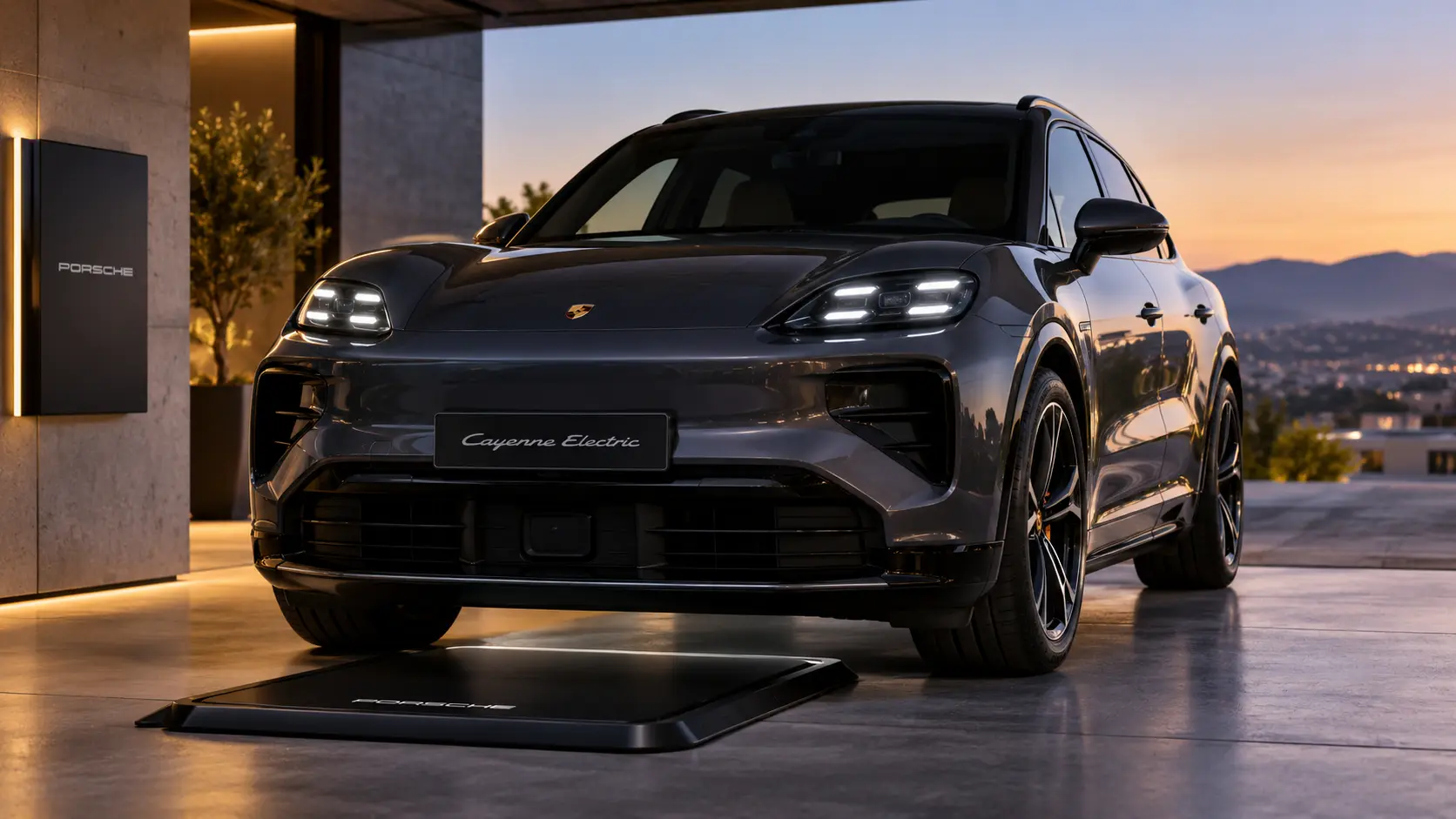
Imagine arriving home, parking your electric SUV in the garage and simply walking away. No charging cable to pull from the wall, no connector to plug into the car and no cable lying across the floor. That is now a reality for buyers of the Porsche Cayenne Electric, with Porsche Cayenne Electric wireless charging being introduced as an option for the production SUV.
The system uses inductive charging to transfer electricity from a floor-mounted charging plate to a receiver fitted underneath the vehicle. It can deliver up to 11kW of AC charging power, while Porsche quotes efficiency of around 90 per cent. The technology is now available to order in Germany and several other European markets, with a staged global rollout planned.
That makes the Cayenne Electric interesting for a reason that has little to do with its performance figures. Wireless EV charging has spent years looking like something from a technology demonstration. Porsche is now putting the hardware into a production vehicle that customers can actually order.
Porsche Cayenne Electric Wireless Charging: What’s New?
The idea is surprisingly simple. Instead of connecting the Cayenne Electric to a conventional AC wallbox with a cable, the driver parks the SUV over a dedicated charging plate installed in the parking space.
Once the vehicle is correctly positioned and placed in Park, the wireless charging process can begin automatically. Porsche also integrates the system with its parking assistance technology to help the driver position the vehicle accurately over the charging plate.
The system is being offered with the 2026-model-year Cayenne Electric and Cayenne Coupé Electric. Porsche says the floor plate is weather-resistant and can also be installed outdoors, making the technology relevant to owners who do not have a conventional enclosed garage.
The important point is that this is not simply a wireless charging demonstration. It is a production charging option designed around everyday home charging.
Read More: BGauss C12 MaxR
How Does Porsche Cayenne Electric Wireless Charging Work?
The technology is based on inductive charging, the same broad principle that many people already know from wireless smartphone charging.
The difference is scale.
A Porsche Wireless Charging Ground Pad is installed at the parking position. A separate receiver, known as the vehicle pad, is integrated into the underside of the Cayenne Electric. When the vehicle is positioned over the ground pad, electricity is transferred between the two units through an electromagnetic field rather than through a physical electrical connector.
There is therefore no cable carrying electricity between the charging equipment and the vehicle.
Porsche has also designed the system to tolerate some positioning error. Its technical explanation says the system can cope with misalignment of up to around 10cm, while software continuously checks the position and adjusts the charging parameters. The charging coils operate across a gap of roughly 12–18cm, depending on the vehicle’s position and ground clearance.
That matters because asking a driver to park with centimetre-perfect accuracy every evening would rather defeat the point of making charging more convenient.
Porsche Wireless Charging: 11kW and Around 90% Efficiency
The headline specification is 11kW of AC charging power.
That is important to put into context. Porsche Cayenne Electric wireless charging is not designed to beat the company’s high-power DC charging capability. The selling point is not dramatically faster charging; it is removing the physical connection between the car and the charger.
At 11kW, it is broadly in the territory of conventional AC home charging rather than rapid charging.
Porsche currently quotes efficiency of approximately 90 per cent, meaning around 90 per cent of the energy drawn from the grid is transferred to the vehicle’s battery according to Porsche’s specification.
That is one of the most important aspects of the technology. Wireless charging inevitably sounds less efficient than plugging a cable directly into the car, but Porsche’s stated figure puts the system much closer to conventional AC charging than the futuristic image of wireless power might suggest.
Porsche Cayenne Electric Wireless Charging: Key Specifications
| Feature | Porsche Wireless Charging |
|---|---|
| Charging type | Inductive AC charging |
| Maximum charging power | Up to 11kW |
| Claimed efficiency | Around 90% |
| Charging connection | Wireless |
| Ground hardware | Porsche Wireless Charging Ground Pad |
| Vehicle hardware | Porsche Wireless Charging Vehicle Pad |
| Activation | Automatic after correct positioning |
| Outdoor installation | Yes, ground pad is weather-resistant |
| Connectivity | LTE / Wi-Fi |
| App integration | My Porsche |
| Availability | Germany and selected European markets, staged global rollout |
Specifications and availability are based on Porsche’s current information and can vary by market.
What Hardware Does the Porsche Wireless Charging System Need?
The hardware behind Porsche Cayenne Electric wireless charging is what allows the system to transfer electricity without a physical cable connecting the vehicle to the charging equipment. This is where the system becomes more substantial than simply placing a large charging mat underneath the car.
Porsche describes three main elements: vehicle preparation, the wireless charging receiver integrated into the vehicle and the ground charging plate installed at the parking position.
The ground unit is the part that sits on the garage floor or parking surface. Porsche says it is weather-resistant, allowing outdoor installation, while the vehicle-side receiver is fitted underneath the Cayenne Electric.
Interestingly, the ground unit does not require a conventional wallbox to sit alongside it. The charging hardware is integrated into the floor-plate system, creating a relatively self-contained installation. UK technical reporting says the ground pad itself is approximately 60mm tall and weighs around 50kg.
That does mean this is not quite the invisible, flush-with-the-floor charging surface that some futuristic concepts have shown. The physical charging hardware remains part of the installation.
How Easy Is Porsche Cayenne Electric Wireless Charging to Use?
This is arguably where Porsche’s system makes the most sense.
The driver approaches the charging position and uses the vehicle’s assistance systems and display guidance to line up with the ground pad. Once the Cayenne Electric is correctly positioned and placed in Park, charging starts automatically.
Porsche has also integrated the system with the My Porsche app, allowing owners to monitor charging sessions and manage charging-related functions. Porsche says multiple vehicles can also be authenticated for use with the same wireless charging ground pad.
For an EV owner who charges at home every night, this could remove one of the least glamorous parts of EV ownership: handling the cable.
It sounds trivial until you do it hundreds of times.
Rainy evening? No cable.
Cold morning? No cable.
Coming home after a long journey? Park and leave.
That is the real proposition behind wireless EV charging.
How Much Does Porsche Wireless Charging Cost?
Here is where the futuristic convenience comes with a distinctly Porsche-sized caveat. The cost of Porsche Cayenne Electric wireless charging is therefore an important part of the technology’s appeal — and its biggest barrier for some buyers.
In the UK, the Wireless Charging Vehicle Pad costs £1,930, while the Wireless Charging Ground Pad costs £5,355. Together, the wireless charging hardware costs £7,285.
That is a significant premium over a conventional home charging installation.
The exact price will vary between countries, taxes and market-specific equipment packages, so the UK figure should not be treated as a global price. Porsche’s current European rollout is also being introduced market by market.
There is another consideration for buyers thinking several years ahead. Porsche has previously indicated that moving to a higher wireless charging rate in the future would require new hardware rather than simply a software update.
That makes the purchase more of a long-term hardware decision than simply buying a smarter wallbox.
Wireless Charging vs Conventional Plug-In Charging
For most EV owners, the question is not whether wireless charging works. It clearly does. Compared with conventional home charging, Porsche Cayenne Electric wireless charging prioritizes convenience rather than higher charging speed.
The more interesting question is whether it is better than plugging in.
In terms of maximum power, the answer is not necessarily. The Porsche system’s 11kW ceiling is comparable with standard AC charging rather than dramatically faster than it. Porsche itself offers conventional AC charging capability for the Cayenne Electric, while the vehicle can also use much higher-power DC charging for long-distance journeys.
The advantage is convenience.
With a conventional setup, you park, take the cable, connect it and later disconnect it. With wireless charging, the physical connection disappears from the routine.
For someone who charges every night at home, that could be more valuable than another few kilowatts of charging power.
The Advantages of Porsche Wireless EV Charging
The biggest advantage is obvious: there is no cable to plug in. For owners who charge at home frequently, Porsche Cayenne Electric wireless charging could remove one of the most repetitive parts of EV ownership.
But there are several smaller benefits behind that headline.
The system can be installed outdoors, is designed to work automatically and incorporates safety systems designed to detect foreign objects and living creatures around the charging area. Porsche says charging can stop automatically if a living creature approaches the vehicle or ground pad, or if a metallic object on the pad becomes dangerously heated.
The system is also connected to the vehicle’s digital ecosystem, including My Porsche, rather than operating as an isolated charging accessory.
For an owner who wants the simplest possible home-charging routine, those details matter.
Read More: How to Check and Top Up Engine Oil Yourself
What Are the Limitations?
Wireless charging is not magic, and the Cayenne Electric’s system has some obvious compromises.
First is cost. At £7,285 in the UK before considering installation circumstances, the system is considerably more expensive than many conventional home-charging solutions.
Second is power. An 11kW maximum makes sense for overnight charging, but it does not change the basic economics of long-distance EV charging. If you are travelling hundreds of kilometres, you will still want a high-power DC charging station rather than waiting at home for an AC system to do the work.
Third is the physical hardware. The ground pad is designed to sit at the parking position, so owners need a suitable installation area. It is weather-resistant, but it is not simply an invisible coil buried beneath every driveway.
And finally, there is the question of future-proofing. Porsche’s earlier technical information indicates that a future jump to higher wireless charging power would require new hardware rather than merely unlocking more power through software.
So this is a convenience upgrade, not a fundamental replacement for every other form of EV charging.
Why Porsche Wireless Charging Matters for the Future of EVs
This is the part of the story that makes the Cayenne Electric more interesting than the option list suggests.
Wireless EV charging has been demonstrated by manufacturers and technology companies for years. The challenge has never really been proving that electricity can be transferred inductively. The harder problem has been making the system efficient, safe, reliable, easy to use and commercially viable.
Porsche’s approach is significant because it brings those requirements together in a production vehicle.
The Cayenne Electric is one of the first series-production EVs to offer inductive charging at this level, and Porsche is now making the system available to customers rather than limiting it to a technology demonstrator.
That could have wider implications.
If customers become comfortable with the idea of simply parking over a charging surface, other manufacturers may have another reason to explore the technology. Over time, wireless charging could become particularly useful in locations where vehicles repeatedly stop in the same place: private garages, taxi ranks, fleet depots, parking facilities and potentially autonomous vehicles.
The technology could also become more interesting if charging power increases and installation costs fall.
For now, Porsche is effectively testing whether customers are willing to pay a considerable premium to make home charging disappear into the background.
And that may be the real beginning of the wireless EV charging story.
Frequently Asked Questions
Does Porsche Cayenne Electric wireless charging work without a cable?
Yes. Porsche Cayenne Electric wireless charging uses inductive technology to transfer electricity from a ground pad to a receiver fitted underneath the vehicle.
How fast is Porsche Cayenne wireless charging?
Porsche Wireless Charging can deliver up to 11kW of AC charging power.
How efficient is Porsche wireless charging?
Porsche currently quotes efficiency of around 90 per cent for the system.
Does the Porsche Cayenne need to be plugged in?
Not when using Porsche Wireless Charging. The driver parks over the ground pad and the charging process starts automatically once the vehicle is correctly positioned and placed in Park.
How much does Porsche wireless charging cost?
In the UK, the wireless charging vehicle pad is priced at £1,930 and the ground pad at £5,355, making the combined hardware cost £7,285. Prices vary by market.
Can Porsche wireless charging be installed outside?
Yes. Porsche says the wireless charging ground pad is weather-resistant and can be installed outdoors as well as indoors.
Is wireless EV charging faster than normal charging?
Not necessarily. Porsche’s system supports up to 11kW AC, so its primary advantage is convenience rather than outright charging speed. The Cayenne Electric can use much higher-power DC charging for rapid charging on longer journeys.
Ride And Tech Verdict
Wireless EV charging has always sounded like the sort of technology that belongs five or ten years in the future. Porsche has decided that the future can start now — provided you’re willing to pay for it.
The Cayenne Electric’s wireless system is not revolutionary because it suddenly charges an EV faster. At 11kW, it is fundamentally a home AC charging solution. What Porsche changes is the interaction between the driver and the charger.
Park. Align. Walk away.
At around 90 per cent claimed efficiency, automatic operation, safety monitoring and integration with the My Porsche ecosystem, the technology is convincing as a convenience feature. The £7,285 UK hardware price, however, makes it a premium proposition rather than an obvious replacement for a conventional wallbox.
But that may not be the point.
The significance of Porsche Wireless Charging is that inductive EV charging is moving another step away from laboratory demonstrations and into normal production-car ownership. If costs fall and charging power rises over the next few years, the simple act of parking and letting the car charge could become a much more familiar part of EV life.
For the moment, Porsche is asking an intriguing question with the Cayenne Electric: how much would you pay to never plug in again?
Ride And Tech — Where Ride Meets Tech.
Drive Smarter. Ride Smarter.
Copyright (c) Ride And Tech. All rights reserved.

1 thought on “Porsche Cayenne Electric Wireless Charging: How the 11kW System Works”