


Buying a new car in India has become increasingly complicated for budget-conscious buyers. It is no longer enough for an affordable car to simply have a low starting price; buyers also have to consider fuel costs, safety equipment, maintenance, practicality, resale value and whether the car will remain useful several years into ownership.
That is why the budget cars in India market remains important even as SUVs and feature-heavy models continue to dominate the headlines. Small hatchbacks still make a great deal of sense for first-time buyers, urban commuters and families that want a straightforward second car without stretching the household budget.
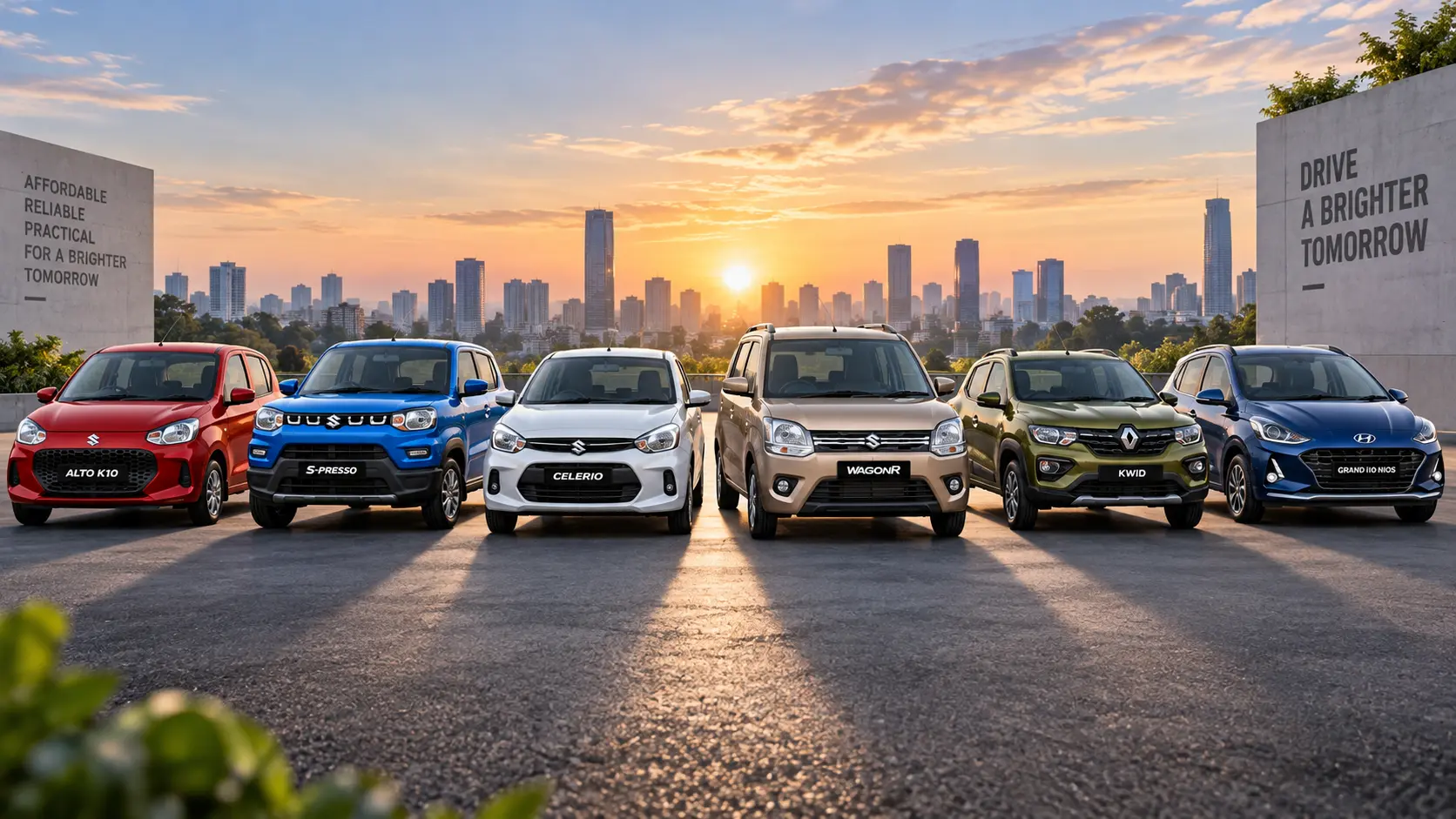
The market also offers more variety than the old “cheap car” label suggests. The current entry-level space includes petrol and CNG options, manual and automatic transmissions, modern infotainment systems and increasingly comprehensive safety equipment. Based on current manufacturer lineups, here are six affordable cars worth considering.
What Should You Look for in a Budget Car?
The cheapest car is not necessarily the best budget car. A genuinely sensible purchase should balance the upfront price with running costs, equipment, practicality and expected ownership experience.
Fuel efficiency is particularly important for buyers who drive regularly. A car that costs slightly more to purchase but uses less fuel over several years can sometimes prove cheaper to own than a cheaper vehicle with significantly higher running costs.
Safety should also be part of the decision. Features such as airbags, ABS with EBD, electronic stability control and parking sensors have become increasingly important in the entry-level segment. Buyers should therefore look beyond the headline price and compare what each variant actually provides.
1. Maruti Suzuki Alto K10: The Familiar Entry Point
The Maruti Suzuki Alto K10 remains one of the clearest examples of what an affordable Indian hatchback is supposed to do. It is compact enough for crowded city streets, available with petrol and S-CNG powertrains, and can be specified with an automatic AGS transmission. Maruti’s current lineup starts at ₹3.699 lakh ex-showroom, although prices vary by variant and location.
The Alto K10 uses a 998cc petrol engine and is also available with factory-fitted S-CNG. Higher variants can be equipped with features including a 17.78cm SmartPlay Studio system, while the current model also lists six airbags, ABS with EBD and reverse parking sensors on applicable variants.
Its biggest advantage remains its simplicity. The Alto K10 isn’t trying to be a premium car or a mini-SUV; it is designed to provide affordable everyday transportation in a compact package.
For a first-time buyer who spends most of their time in the city, that straightforward character can be more valuable than a long list of expensive features.
2. Maruti Suzuki S-Presso: A Small Car With a Different Personality
The Maruti Suzuki S-Presso takes the basic small-car formula and gives it a taller, more SUV-inspired appearance. It sits at the lower end of Maruti’s Arena range, with the current lineup starting at ₹3.499 lakh ex-showroom.
Like the Alto K10, the S-Presso is available with petrol and S-CNG powertrains, along with manual and automatic options depending on the variant. Its compact dimensions make it particularly suited to urban driving, while the taller body gives it a different seating position from a conventional low-slung hatchback.
The S-Presso also benefits from equipment such as ABS with EBD and electronic stability programme on the current range, although buyers should still compare individual variants carefully because equipment varies across the lineup.
Its appeal is therefore slightly different from the Alto. If you want an inexpensive city car but prefer a taller driving position and more crossover-like styling, the S-Presso deserves a place on the shortlist.
Read More: Mobility as a Service (MaaS)
3. Maruti Suzuki Celerio: Efficiency Is the Big Attraction
The Maruti Suzuki Celerio sits a step above the smallest entry-level hatchbacks and has long been positioned around efficiency and everyday practicality. The current Celerio starts at ₹4.699 lakh ex-showroom and is available with petrol and S-CNG options, as well as manual and automatic transmissions.
That makes the Celerio particularly interesting for buyers who want something more substantial than the cheapest hatchbacks without moving too far up the price ladder. Its compact footprint remains useful in cities, while the availability of an automatic transmission broadens its appeal to buyers who spend significant time in traffic.
The factory-fitted CNG option can also make sense for high-mileage users, particularly those with easy access to CNG infrastructure. However, buyers should calculate the higher upfront cost against their expected annual running distance before assuming CNG will automatically be the cheaper choice.
The Celerio is therefore less about being the absolute cheapest car and more about finding a practical balance between purchase price, efficiency and everyday usability.
4. Maruti Suzuki WagonR: The Practical Family Choice
The Maruti Suzuki WagonR is one of the most established names in India’s affordable family-car market. Its tall-boy design prioritises interior usability, while the current model is offered with petrol and S-CNG powertrains and manual or automatic transmission choices. Maruti currently lists the WagonR from ₹4.989 lakh ex-showroom.
Its biggest strength is practicality. The upright body makes it relatively easy to get in and out of, while the cabin layout focuses on usable space rather than sporty styling. That can make a meaningful difference for families using the car every day.
The availability of CNG also gives the WagonR an advantage for buyers who cover substantial distances and have convenient access to CNG stations. Meanwhile, the automatic option can make it easier to live with in heavy urban traffic.
For a buyer who wants a budget car that can handle more than just solo commuting, the WagonR is arguably one of the most logical choices in this group.
5. Renault Kwid: Small Footprint, SUV-Inspired Design
The Renault Kwid continues to occupy a distinctive position in the entry-level market. Renault currently lists the Kwid from ₹4.529 lakh, with features including 184mm claimed ground clearance, a 279-litre boot and a 20.32cm touchscreen system.
Those numbers help explain why the Kwid has remained relevant. It has the footprint of a small city hatchback but uses crossover-inspired styling and relatively generous ground clearance to create a different visual identity.
The current Kwid range includes Evolution and Climber versions, with higher versions adding equipment such as a reverse parking camera, steering-mounted audio controls and other convenience features.
The Kwid is particularly interesting for buyers who want an inexpensive car that doesn’t look quite as conventional as a traditional entry-level hatchback. Its compact dimensions also make it easy to manoeuvre and park in congested urban environments.
6. Hyundai Grand i10 Nios: A More Premium Budget Option
If your budget stretches beyond the entry-level hatchbacks, the Hyundai Grand i10 Nios becomes an interesting alternative. Hyundai currently lists it from ₹5.597 lakh ex-showroom, with petrol and CNG options and manual or automatic transmissions.
The Grand i10 Nios feels different from the smallest cars on this list because Hyundai places greater emphasis on cabin comfort, equipment and overall refinement. Depending on the variant, buyers can get features such as touchscreen infotainment, Android Auto, Apple CarPlay, rear AC vents and cruise control.
Hyundai also offers a broad range of variants, giving buyers more flexibility when deciding how much equipment they actually need. The CNG option adds another possibility for customers focused heavily on running costs.
The trade-off is simple: the Grand i10 Nios costs more than the smallest budget hatchbacks. But for someone who wants an affordable car that feels more complete as an everyday family vehicle, that additional investment can make sense.
Which Budget Car Is Best for First-Time Buyers?
There is no single answer because first-time buyers have very different requirements. Someone buying a car primarily for commuting through narrow city streets may value the Alto K10 or S-Presso, while a small family may find the WagonR’s practicality more useful.
The Celerio makes a strong case for buyers who prioritise efficiency and want the flexibility of petrol or CNG. The Kwid appeals to customers who want distinctive styling and a compact footprint, while the Grand i10 Nios is the better fit for buyers willing to spend more for additional comfort and equipment.
The right choice therefore depends on how the car will actually be used rather than which model has the lowest showroom price.
Petrol or CNG: Which Makes More Sense?
CNG can significantly reduce the running cost of a car for drivers who cover high annual distances, but it is not automatically the right choice for everyone. The initial price difference, local CNG availability and expected yearly mileage all need to be considered.
For someone driving only a few thousand kilometres per year, the lower purchase price of a petrol model may be more important than the fuel savings offered by CNG. For a daily commuter covering long distances, the calculation can move in the opposite direction.
The best approach is to estimate your annual kilometres and compare the expected fuel cost over several years. That gives you a much more realistic picture than simply choosing the fuel type with the lowest advertised running cost.
Are Budget Cars Still Worth Buying?
Absolutely — but the definition of a budget car is changing.
Today’s affordable cars are no longer stripped-down machines that exist only to provide basic transportation. Even relatively inexpensive models can offer automatic transmissions, connected or touchscreen infotainment, CNG powertrains and increasingly comprehensive safety equipment.
At the same time, buyers need to be realistic about what they are getting. A ₹4–5 lakh hatchback will not provide the same cabin space, highway performance, refinement or equipment as a ₹10 lakh SUV, and expecting it to do so misses the point of the segment.
The strength of these cars is their ability to provide simple, affordable and practical mobility without forcing buyers into a much larger financial commitment.
How to Choose the Right Budget Car
Before booking, consider your actual usage rather than buying purely on price. City driving, highway travel, annual mileage, number of passengers and parking conditions can all change which car represents the best value.
Also compare the variant rather than just the model. A car advertised at an attractive starting price may require a considerably more expensive variant to get the features you actually want, while another model might include those features lower in its range.
Finally, consider the complete ownership cost. Insurance, servicing, tyres, fuel, financing and depreciation all contribute to what the car will really cost you over several years.
Budget Cars in India FAQs
Which is the cheapest car in India?
Among the cars covered here, the Maruti Suzuki S-Presso currently has the lowest listed starting price at ₹3.499 lakh ex-showroom, followed by the Alto K10 at ₹3.699 lakh. Prices and schemes can change, so buyers should verify the current price before booking.
Which budget car is best for city driving?
The Alto K10, S-Presso, Celerio and Kwid are all compact options that can work well in urban environments. The best choice depends on your priorities, including size, automatic transmission availability, fuel type and budget.
Which budget cars are available with CNG?
The Alto K10, S-Presso, Celerio and WagonR are available with Maruti Suzuki’s factory-fitted S-CNG systems, while the Hyundai Grand i10 Nios is also available with a CNG powertrain.
Is an automatic budget car worth buying?
For buyers who spend a lot of time in congested city traffic, an automatic can significantly improve convenience. However, it generally costs more than the equivalent manual version, so the additional purchase price should be weighed against how frequently you will use the car in traffic.
What should I check before buying a budget car?
Look beyond the starting price and compare safety equipment, fuel economy, service costs, variant features, boot and cabin space, transmission options and resale prospects. A slightly more expensive car can sometimes offer better long-term value if it fits your usage better.
Ride And Tech Verdict
The Indian budget-car market has changed considerably, but the basic reason for buying one has not. For first-time buyers, young families and urban commuters, an affordable hatchback can still provide something that an expensive SUV cannot: simple mobility without a large financial commitment.
The strongest choices aren’t necessarily the cars with the lowest sticker price. The Alto K10 and S-Presso make sense when keeping the initial cost low is the priority, the Celerio and WagonR bring stronger practicality and efficiency arguments, the Kwid offers a distinctive entry-level alternative, and the Grand i10 Nios makes sense when the buyer can stretch the budget for a more comfortable and feature-rich experience.
For Ride And Tech, the biggest takeaway is simple: buy the budget car that matches your actual lifestyle, not simply the one with the lowest advertised price. A sensible choice should remain affordable not just on the day you buy it, but throughout the years you own it.
Ride And Tech — Where Ride Meets Tech.
Drive Smarter. Ride Smarter.
Copyright (c) Ride And Tech. All rights reserved.

1 thought on “6 Budget Cars in India That Still Make Sense for Value-Focused Buyers”