


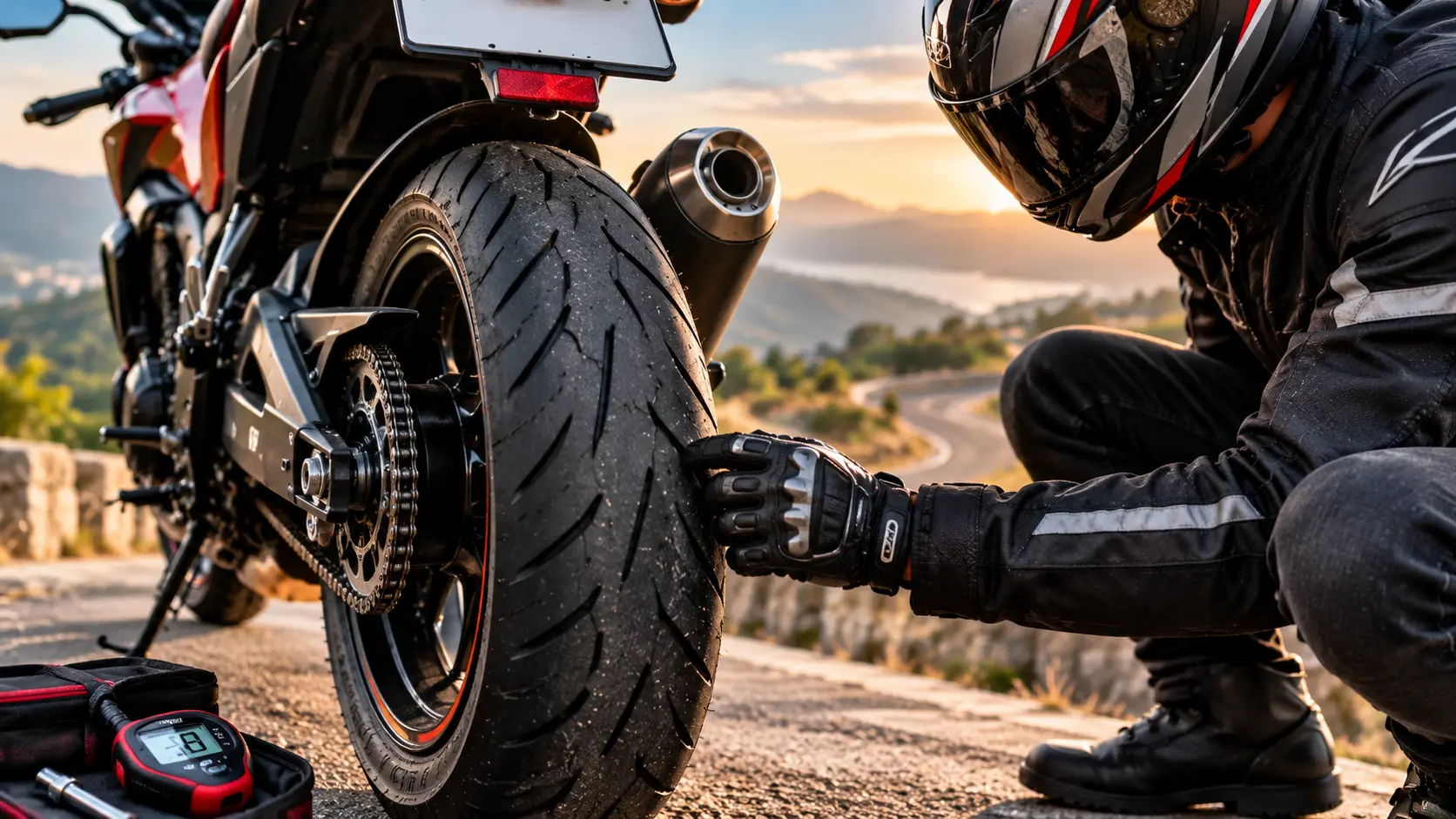
Your motorcycle tyres are the only part of the bike that actually touches the road, yet they are often treated as something to check only when the tread looks low or a puncture appears. That is a mistake. Tyre pressure, tread condition, sidewall damage, uneven wear and even the way a tyre has aged can all affect how confidently a motorcycle accelerates, brakes and turns.
Good bike tyre maintenance is therefore less about complicated mechanical work and more about developing a simple inspection routine. A few minutes spent checking your tyres regularly can help identify pressure loss, abnormal wear, punctures and damage before they turn into a much bigger problem, while also helping the tyres deliver the grip and stability they were designed to provide. Michelin, for example, recommends checking motorcycle tyre pressure every two weeks and before a long journey, with the tyres cold.
Why Bike Tyre Maintenance Matters More Than Most Riders Think
A motorcycle reacts to tyre condition much more directly than a car because the available contact area is relatively small and the tyres play a major role in steering, braking and cornering behaviour. The correct pressure helps the tyre maintain the intended contact with the road, while excessive or insufficient pressure can change handling and accelerate certain types of wear.
Tyres also lose performance gradually, which makes problems easy to overlook. A tyre may still appear usable while developing uneven tread wear, cracks, sidewall damage or reduced wet-road performance, so regular inspection should become part of normal motorcycle ownership rather than something reserved for servicing.
Read More: Bike Chain Maintenance
1. Check Your Bike Tyre Pressure Regularly
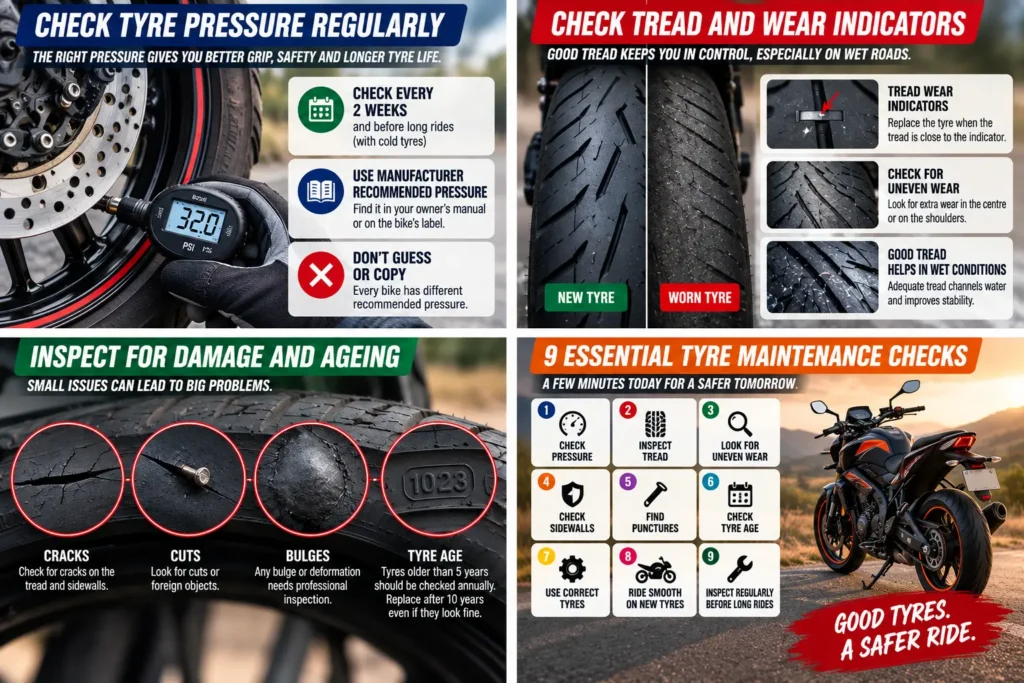
Bike tyre pressure should be the first checkpoint because pressure has a direct effect on handling, braking, tyre wear and overall ride behaviour. The correct number is not a universal PSI figure that works for every motorcycle; riders should follow the pressure recommended by the motorcycle manufacturer, normally found in the owner’s manual or on the bike’s information label.
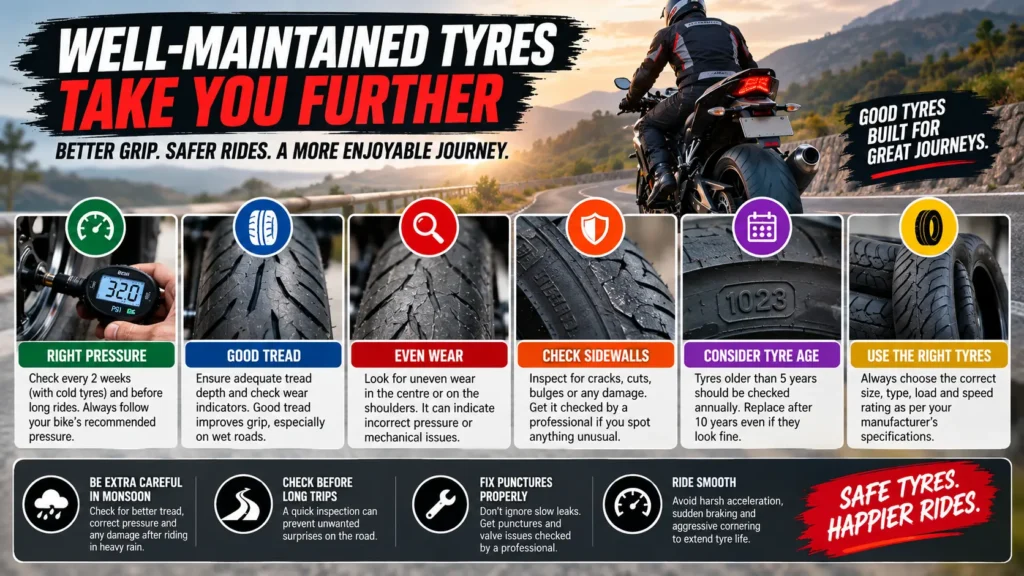
Michelin recommends checking motorcycle tyre pressure every two weeks and before long journeys, with the tyres cold. This matters because riding heats the tyre and raises its pressure, so checking immediately after a long ride can give you a misleading reading.
What happens when tyre pressure is too low?
Underinflation allows the tyre to flex more than intended and can increase heat build-up, accelerate wear and negatively affect handling. Michelin also warns that running underinflated can contribute to premature wear and irreversible tyre damage.
On a motorcycle, you may also notice heavier steering or a different feel through corners when the pressure is significantly wrong. If one tyre repeatedly loses pressure faster than the other, don’t simply keep adding air; investigate the possibility of a puncture, valve problem, rim issue or another leak.
What happens when tyre pressure is too high?
Overinflation can also be problematic because it changes the tyre’s contact characteristics and can contribute to accelerated wear in the centre of the tread. It can also alter the way the motorcycle feels over bumps and during cornering.
The solution is simple: don’t guess the pressure and don’t copy the number from another motorcycle. Use the manufacturer’s recommended cold pressure for your specific bike and tyre application.
2. Inspect the Tread Before Every Important Ride
The bike tyre tread is designed to provide the necessary road contact and, particularly on road tyres, help channel water away from the contact area. As the tread wears down, the tyre’s ability to perform can deteriorate, especially in wet conditions.
You do not need specialist equipment for a basic visual inspection. Look across the entire tread rather than checking only the centre, because motorcycles can develop different wear patterns depending on riding style, pressure, road conditions and how the bike is used.
A tyre that looks acceptable in the middle can still be heavily worn towards the shoulders, while a tyre used mainly on straight roads may develop more pronounced centre wear. Michelin specifically recommends checking tread depth and the uniformity of wear as part of regular motorcycle tyre care.
3. Learn to Read the Tread Wear Indicators
Most modern motorcycle tyres include tread wear indicators, usually small raised sections located inside the main tread grooves. These indicators provide a visual reference for how close the tyre is to its designed wear threshold.
If the surrounding tread is approaching the level of the wear indicator, the tyre needs serious attention and replacement should not be delayed. Michelin notes that its motorcycle tyre wear indicators are 0.8 mm high, while also stressing that the actual legal tread limit varies by country, so riders should not automatically treat 0.8 mm as a universal legal limit.
The more important lesson is that you should not wait until the tread is completely exhausted before thinking about replacement. Grip, particularly in wet conditions, can deteriorate as the tread becomes increasingly worn, so replacing a tyre before it reaches an unsafe condition is the smarter approach.
4. Check the Tyre for Uneven Wear
Bike tyre wear is not always uniform, and the pattern can tell you something about how the motorcycle is being used or whether another problem exists. Excessive centre wear, shoulder wear or an irregular pattern should not simply be dismissed as normal ageing.
Incorrect pressure is one possible cause. Michelin explains that overinflation can increase centre wear, while underinflation can increase shoulder wear, although mechanical issues, transmission components, suspension problems and aggressive riding can also contribute to unusual wear patterns.
Run your hand carefully across the tread only when the tyre is stationary and safe to inspect, and visually compare different areas of the tyre. If the wear looks substantially different from one section to another, have the motorcycle checked instead of assuming that a new tyre alone will solve the problem.
5. Inspect the Sidewalls for Cracks, Cuts and Bulges
The tread gets most of the attention, but the sidewall deserves just as much scrutiny during motorcycle tyre maintenance. Look for cuts, cracks, bulges, deformation or other visible damage, particularly if the motorcycle has recently hit a pothole, kerb or sharp road obstacle.
A tyre can suffer damage that isn’t immediately obvious from the tread surface. Michelin recommends paying particular attention to the tread and sidewalls during regular inspections and looking for foreign objects, deformation, cracking, penetration and other signs of deterioration.
A bulge or significant deformation is not something to monitor casually while continuing to ride normally. Tyre damage should be assessed by a qualified professional because the visible condition does not always reveal what has happened internally.
6. Don’t Ignore Small Punctures or Slow Pressure Loss
A tyre that repeatedly needs air is giving you information that should not be ignored. The problem could be a nail or other foreign object, a damaged valve, a rim-related issue or another source of pressure loss, and simply topping up the air every few days does not fix the underlying problem.
This is particularly important with tubeless tyres because a small puncture can sometimes cause a slow leak rather than an immediate flat. If the pressure drops significantly or repeatedly, have the tyre inspected properly rather than continuing to ride until the pressure becomes dangerously low.
After a puncture or significant impact, professional inspection is the safest approach. Michelin specifically advises that a flat or punctured motorcycle tyre should be inspected by a professional because internal damage may not be visible from the outside.
7. Check the Tyre Age and Signs of Rubber Ageing
A tyre does not become unsafe on a specific day simply because it reaches a certain age, but ageing is another factor riders should consider alongside tread depth and mileage. Exposure to sunlight, heat, storage conditions, load, speed, pressure and usage can all influence how a tyre ages.
Look for visible cracks or deterioration in the tread, shoulders and sidewalls, particularly if a motorcycle has been parked for long periods. Michelin notes that tyre lifespan cannot be predicted from manufacturing date alone because several usage and storage factors affect ageing.
For tyres that have been in service for five years or more, Michelin recommends annual professional examination. It also recommends replacing tyres that have not been replaced after ten years as a precaution, even if they still appear serviceable and have not reached their tread-wear limit.
8. Make Sure the Replacement Tyre Is Correct for Your Bike
Replacing a worn tyre is not simply a matter of finding one with the same diameter. Tyre size, construction, load rating, speed rating and the manufacturer’s approved fitment all matter, particularly on performance motorcycles.
When replacing tyres, follow the motorcycle manufacturer’s specifications rather than choosing solely on price or appearance. Michelin recommends using tyres in accordance with the vehicle manufacturer’s homologation requirements and warns against mixing radial and bias construction unless the manufacturer specifically permits it.
This is also where your existing Bike Chain Maintenance routine becomes relevant. Tyres and chain care are separate maintenance tasks, but both contribute to the way the motorcycle delivers power and behaves on the road, so a good maintenance routine should treat them as connected parts of overall motorcycle care rather than isolated jobs.
9. Pay Attention to New Tyres During the First Few Rides
New tyres deserve a little patience because the motorcycle can feel different after a tyre change. The profile, construction and compound may differ from the worn tyres you have just removed, and the rider needs some time to become familiar with the new behaviour.
Bridgestone recommends riding carefully for the first 100 km on new motorcycle tyres and avoiding extreme manoeuvres such as sudden acceleration, maximum braking and hard cornering during that period.
That does not mean a new tyre is inherently unsafe; it means the rider should allow themselves time to adapt to the new tyre’s behaviour. Smooth inputs and progressive riding are a much better approach than immediately testing maximum grip on public roads.
How Often Should You Check Your Bike Tyres?
There is no single inspection interval that covers every part of bike tyre care, because different checks make sense at different frequencies. Pressure should be checked regularly, while a quick visual inspection of the tread and sidewalls can become part of your normal pre-ride habit.
For pressure, Michelin’s motorcycle guidance recommends checking every two weeks and before long journeys, with the tyre cold. Its broader motorcycle tyre guidance also recommends regular inspection of condition, wear indicators, pressure and damage, while stressing that tyres should be checked more carefully when there are signs of abnormal wear or damage.
A practical routine for everyday riders is therefore straightforward: check pressure every couple of weeks, inspect the tread and sidewalls regularly, and give the tyres a more thorough examination before long-distance trips. If something looks or feels abnormal, don’t wait for the next scheduled service.
Read More: BMW M350 Replaces M340i With 443hp and Drift Mode
Bike Tyre Maintenance Checklist
A good bike tyre pressure check and inspection does not need to take more than a few minutes. Before a long ride, especially when travelling at highway speeds, run through these checkpoints:
- Check both tyres at their recommended cold pressure and adjust only according to the motorcycle manufacturer’s specification.
- Look across the complete tread for low tread, unusual wear or areas that appear significantly different from the rest.
- Locate the tread wear indicators and check how close the surrounding tread is to them.
- Inspect both sidewalls for cracks, cuts, bulges, deformation or impact damage.
- Look for nails, screws, stones or other objects embedded in the tread.
- Investigate repeated pressure loss instead of repeatedly topping up the tyre.
- Check for signs of ageing, particularly cracks or rubber deterioration.
- Confirm that replacement tyres match the motorcycle manufacturer’s approved specifications.
- After fitting new tyres, ride progressively and give yourself time to become familiar with their behaviour.
Bike Tyre Maintenance Mistakes Riders Should Avoid
One of the biggest mistakes is relying on appearance alone. A tyre can look reasonably healthy while carrying incorrect pressure or developing an internal problem, which is why pressure checks and visual inspections need to work together.
Another common mistake is using a generic pressure number found online instead of the motorcycle manufacturer’s recommended specification. Different motorcycles have different loads, chassis characteristics, tyre sizes and recommended pressures, so copying another bike’s setting can create more problems than it solves.
Riders should also avoid waiting until the tread looks completely finished before considering replacement. Tread wear, uneven wear, cracking, punctures, deformation and ageing all matter, and a tyre showing serious damage may require replacement even when plenty of tread remains.
What About Tubeless Tyre Maintenance?
Tubeless tyre maintenance is particularly important on modern motorcycles because slow punctures can sometimes go unnoticed until pressure has fallen considerably. Regular pressure checks make it much easier to identify a problem early, especially if one tyre consistently loses more air than the other.
A tubeless tyre should also be inspected after a serious pothole impact or if the motorcycle suddenly develops unusual handling. Do not assume that the absence of a visible puncture means there is no damage; the tyre, rim and valve should be checked when there is unexplained pressure loss or impact damage.
When Should You Replace Bike Tyres?
The answer to when to replace bike tyres should never depend on mileage alone. Riding style, motorcycle type, road surfaces, tyre compound, pressure, climate, load and storage conditions can all change how quickly a tyre wears or ages.
Replace a tyre when it reaches the relevant wear limit, but also pay attention to damage and deterioration before that point. Michelin advises riders to inspect for tread and sidewall damage, unusual wear, cracking, deformation and other signs of ageing, and recommends professional assessment when there is doubt about the tyre’s condition.
If a tyre has reached its wear indicators, has significant cracks or deformation, has suffered serious damage, or is showing abnormal wear that could compromise safety, continuing to use it simply to extract a few more kilometres is not worth the risk.
Frequently Asked Questions
How often should I check bike tyre pressure?
For road motorcycles, Michelin recommends checking tyre pressure every two weeks and before a long journey, with the tyres cold. Always use the motorcycle manufacturer’s recommended pressure rather than relying on a generic PSI figure.
Should bike tyre pressure be checked when hot or cold?
Bike tyre air pressure should normally be checked when the tyres are cold because riding heats the tyre and increases its pressure. Checking after a long ride can therefore produce a reading that does not represent the tyre’s normal cold pressure.
How do I know if my bike tyre is worn?
Look at the tread pattern and locate the tyre’s tread wear indicators. If the tread is approaching the indicator level, or if you notice uneven wear, cracking, deformation or other damage, the tyre should be assessed for replacement.
Can incorrect tyre pressure cause uneven wear?
Yes. Incorrect pressure can change the wear pattern significantly. Overinflation can contribute to increased centre wear, while underinflation can contribute to increased shoulder wear, although mechanical problems and riding conditions can also cause abnormal patterns.
How long do motorcycle tyres last?
There is no universal mileage figure because tyre life depends on several factors, including riding style, load, road conditions, pressure, storage and climate. Michelin recommends professional examination once tyres have been in service for five years or more and recommends replacing tyres that have not been replaced after ten years as a precaution.
Is tread depth the only reason to replace a bike tyre?
No. Motorcycle tyre safety also depends on the tyre’s overall condition. Cracks, bulges, deformation, serious puncture damage, unusual wear and ageing can all justify professional inspection or replacement even when tread remains.
Should I use the same tyre pressure for the front and rear?
Not necessarily. Motorcycle manufacturers commonly specify different pressures for the front and rear because the tyres perform different roles and carry different loads. Always follow the pressure specified for your particular motorcycle and riding conditions.
Is tubeless tyre maintenance different from tube-type tyre maintenance?
The inspection principles are broadly similar, but tubeless tyres can develop slow leaks from punctures, valves or rim-related issues without immediately going flat. Regular pressure checks are therefore especially useful for detecting problems before they become serious.
Ride And Tech Verdict
Bike tyre maintenance is one of the simplest forms of motorcycle care, but it has an outsized effect on how safely and confidently a bike performs. You do not need specialist equipment or an elaborate workshop routine to stay on top of it; consistent pressure checks, tread inspections and sidewall checks can reveal many problems before they become serious.
The most important habit is to stop thinking of tyres as consumables that only matter when they are worn out. Correct pressure, even wear, healthy sidewalls, appropriate fitment and sensible replacement decisions all work together to keep the motorcycle connected to the road. Combine that routine with regular chain care, brake checks and the other maintenance basics, and your bike will not only be easier to ride—it will be far easier to trust.
Ride And Tech — Where Ride Meets Tech.
Drive Smarter. Ride Smarter.
Copyright (c) Ride And Tech. All rights reserved.

2 thoughts on “Bike Tyre Maintenance: 9 Checks That Protect Grip, Tyre Life and Your Ride”