


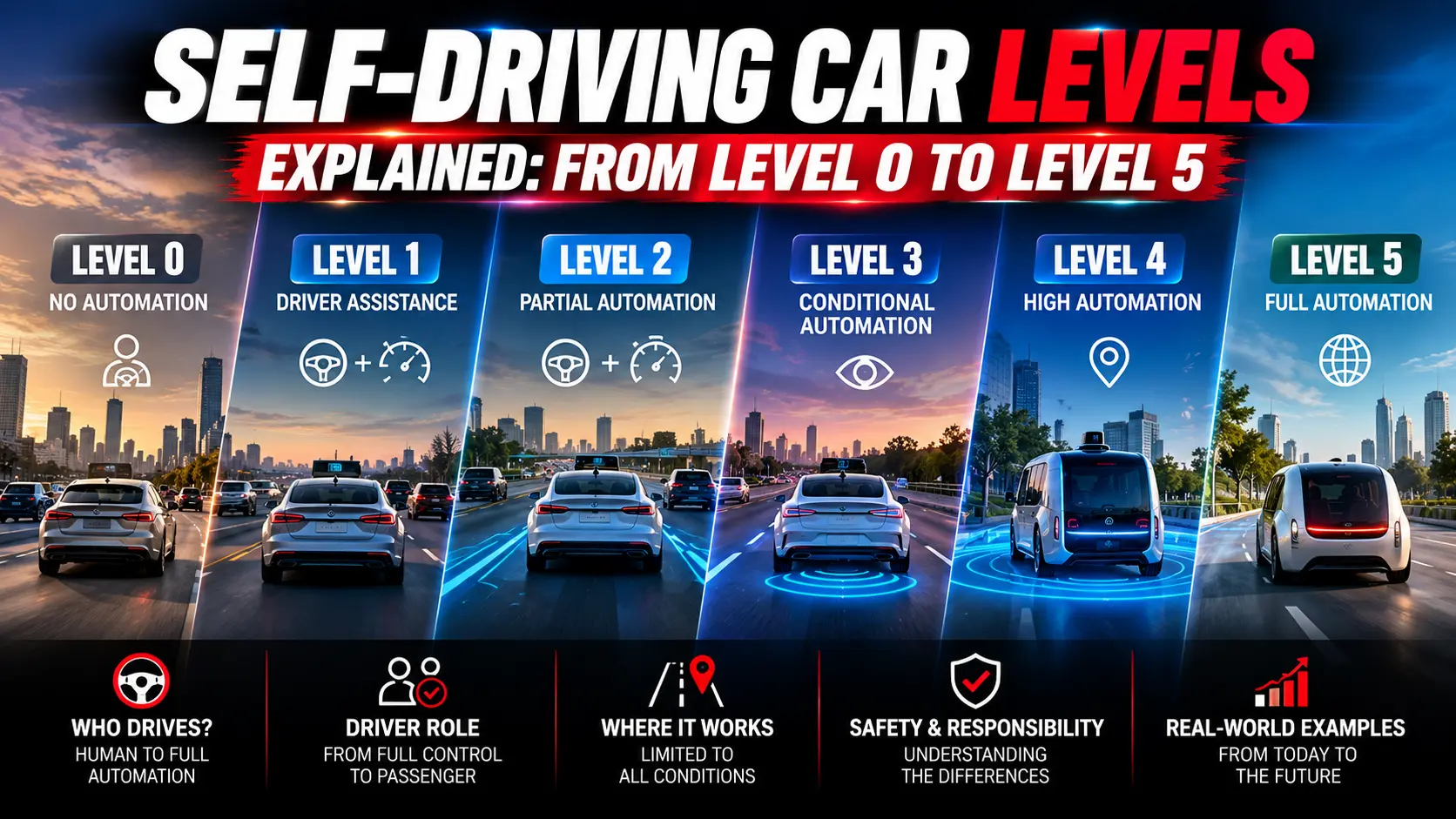
The phrase “self-driving car” covers a much wider range of technology than most people realize. A vehicle that can automatically maintain speed and lane position is very different from one that can drive without human intervention, yet both can be described casually as autonomous or self-driving.
That is why self-driving car levels matter. The SAE International J3016 framework divides driving automation into six levels, from Level 0, where there is no driving automation, to Level 5, where an automated driving system can perform the driving task under all conditions in which a human could drive. The current SAE taxonomy was revised in September 2026.
The important point is that these levels are not simply a ranking of how “smart” a car is. They describe who is responsible for the driving task, what the automated system can do, where it can operate and when the human driver must remain involved.
What Are the Self-Driving Car Levels?
The self-driving car levels are part of the SAE J3016 classification system for driving automation. The framework uses six levels:
- Level 0 — No Driving Automation
- Level 1 — Driver Assistance
- Level 2 — Partial Driving Automation
- Level 3 — Conditional Driving Automation
- Level 4 — High Driving Automation
- Level 5 — Full Driving Automation
The biggest dividing line comes between Levels 2 and 3. At Levels 0–2, the human driver remains responsible for driving and monitoring the driving environment. At Levels 3–5, the automated driving system can perform the complete dynamic driving task within its defined operating conditions, although the human’s role differs considerably between those levels.
Read More: Autonomous Driving Explained
Level 0: No Driving Automation
Level 0 is where traditional driving sits, although modern vehicles can still have plenty of electronic safety features. Under SAE’s classification, the vehicle does not provide sustained automated control of the driving task.
Features such as forward collision warnings, lane departure warnings and some emergency interventions can exist at Level 0 because they may warn the driver or provide momentary assistance without continuously controlling the vehicle. NHTSA similarly describes Level 0 as momentary driver assistance while the driver remains fully responsible and attentive.
The important distinction is that these features do not turn the car into an autonomous vehicle. The driver still performs the actual driving task.
What Does the Driver Do at Level 0?
The driver steers, accelerates, brakes and monitors the road. Safety systems may provide warnings or brief interventions, but they do not take over sustained driving.
This is why self-driving car levels should not be confused with the number of safety features fitted to a vehicle. A car can have automatic emergency braking, blind-spot monitoring and other sophisticated systems while still being classified at Level 0 for driving automation.
Level 1: Driver Assistance
Level 1 is the first step into sustained driving assistance. At this level, an automated system can continuously assist with either steering or acceleration and braking, but not both simultaneously as part of the same driving task. The driver remains responsible for the vehicle and must continuously supervise the system.
Adaptive cruise control is a common example of the type of technology associated with Level 1, because it can assist with acceleration and braking while the driver continues to steer. Lane-keeping assistance can also fit Level 1 when it provides steering support without simultaneously providing the other control function.
What Does the Driver Do at Level 1?
The driver remains fully engaged with the driving environment. If the system is providing speed control, the driver still handles steering; if it is providing steering assistance, the driver remains responsible for speed and braking.
This is an important step in understanding self-driving car levels because Level 1 is still fundamentally driver assistance, not autonomous driving.
Level 2: Partial Driving Automation
Level 2 is where things become much more interesting for today’s car buyers. A Level 2 system can provide sustained assistance with both steering and acceleration or braking, but the human driver must continue to monitor the driving environment and remain ready to intervene.
Many modern advanced driver assistance systems sit within this category. A system may help keep the vehicle centred in its lane while also controlling speed and following traffic, but the driver remains responsible for monitoring what is happening around the car.
NHTSA describes Level 2 as a system that provides continuous assistance with both acceleration/braking and steering while the driver remains fully engaged and attentive.
Why Level 2 Is Not Fully Self-Driving
This is probably the most important distinction in the entire discussion of self-driving car levels.
A Level 2 vehicle may appear highly automated because it can steer, accelerate and brake for extended periods. However, the driver is still expected to supervise the driving environment and remain responsible for the driving task.
In other words, hands-free capability does not automatically mean driver-free capability. A manufacturer can offer sophisticated Level 2 assistance without the vehicle being capable of taking full responsibility for driving.
Level 2 vs Level 3
The difference between Level 2 and Level 3 is not simply that Level 3 has better sensors or more powerful software. The fundamental change is the role of the automated driving system and the human driver.
At Level 2, the human continuously supervises the driving environment and remains responsible for driving. At Level 3, the system can perform the driving task within its defined conditions, and the driver is expected to respond when the system issues a request to take over.
That change in responsibility is what makes Level 3 such a significant step.
Level 3: Conditional Driving Automation
Level 3 is the first level in the self-driving car levels framework where the automated system can perform the complete driving task within defined operating conditions. The system also monitors the driving environment while it is operating.
However, Level 3 does not mean the vehicle can drive everywhere under every condition. The system operates only when its specified conditions are met, and the human driver must be available to take over when the system requests it or when the system can no longer operate as intended.
This makes Level 3 fundamentally different from Level 2.
What Happens When a Level 3 System Requests a Takeover?
The automated system can drive within its operational conditions, but it can eventually encounter a situation outside those conditions. When that happens, the system may issue a request for the driver to resume control.
The driver therefore still has an important role, but it is different from the continuous supervision required at Level 2. NHTSA describes Level 3 as a system that drives while the driver must remain available to take over when requested.
This transition between automated and human driving is one reason Level 3 requires careful consideration of human factors, system warnings and takeover behaviour.
Level 4: High Driving Automation
Level 4 takes another major step. A Level 4 system can perform the complete driving task within its defined operating conditions, and a human driver is not needed to take over and mitigate the risk when the system is operating within those conditions.
The limitation is the operating domain.
A Level 4 vehicle might be designed to operate without a human driver in a particular geographic area, on particular roads or under particular environmental and operational conditions. Outside that defined operating domain, the system may not be capable of operating.
This is why Level 4 can support genuine driverless services without meaning that a vehicle can travel anywhere in the world without human involvement.
Level 4 and Robotaxis
Robotaxis are one of the clearest examples of where Level 4 technology can become relevant. A vehicle can potentially operate without a human driver inside a defined service area, while the automated driving system handles the driving task.
The important part is the defined operating domain. A Level 4 system does not have to work everywhere to qualify as Level 4; it must be capable of performing the complete driving task within its specified conditions without requiring a human to take over.
Level 5: Full Driving Automation
Level 5 is the top of the self-driving car levels framework. A Level 5 automated driving system would be capable of performing the complete driving task under all conditions in which a human driver could operate the vehicle.
There is no defined geographical operating area that limits the system in the way a Level 4 system can be limited. The system is designed for universal driving conditions within the scope of the SAE definition.
At Level 5, the human occupant would not need to monitor the road or be prepared to take over. The person inside the vehicle could effectively be a passenger rather than a driver.
Does Level 5 Mean a Car Can Drive Anywhere?
In theory, the SAE definition describes Level 5 as automation under all conditions in which humans can drive. That is a much broader capability than Level 4’s restricted operating domain.
However, this should not be interpreted as saying that Level 5 passenger cars are already commercially available. NHTSA currently states that Level 3–5 technologies are not available for consumer purchase in today’s vehicles in the U.S.
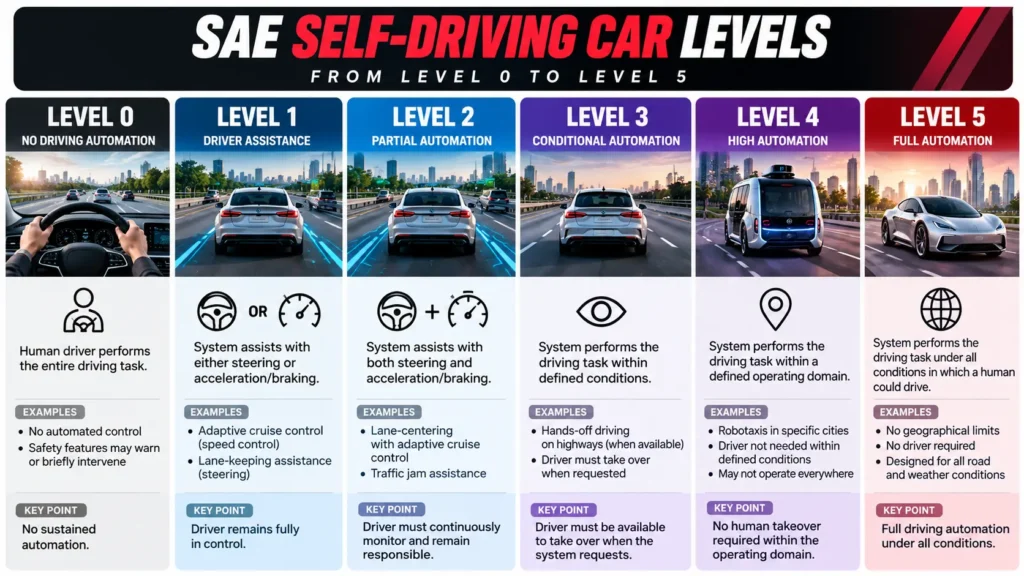
Self-Driving Car Levels at a Glance
The easiest way to understand the progression is to focus on who is doing the driving and who is monitoring the driving environment.
| Level | SAE classification | Who drives? | Human involvement |
|---|---|---|---|
| Level 0 | No Driving Automation | Human | Driver performs the driving task |
| Level 1 | Driver Assistance | Human | System assists steering or speed control |
| Level 2 | Partial Driving Automation | Human + system assistance | System assists steering and speed control; driver continuously supervises |
| Level 3 | Conditional Driving Automation | System within defined conditions | Driver must be available to take over when requested |
| Level 4 | High Driving Automation | System within defined conditions | Human takeover is not required within the system’s operating domain |
| Level 5 | Full Driving Automation | System | System drives under all conditions covered by the definition |
These descriptions follow the current SAE taxonomy and NHTSA’s public explanations, although the exact implementation of a system depends on its design and operating conditions.
Why Level 2 and Level 3 Are Often Confused
The jump from Level 2 to Level 3 is easy to misunderstand because both can involve a vehicle controlling steering, acceleration and braking.
The crucial difference is responsibility and supervision. Level 2 still requires the driver to continuously monitor the driving environment, whereas Level 3 allows the automated system to perform the driving task within defined conditions while the driver remains available for a takeover request.
That distinction also explains why simply adding more sensors or improving lane-centering does not automatically turn a Level 2 system into Level 3.
ADAS vs Autonomous Driving
Advanced Driver Assistance Systems, commonly called ADAS, include technologies designed to help drivers avoid crashes or reduce the effort required for parts of driving. Depending on the system, these technologies can exist across different levels of driving automation.
SAE’s framework specifically distinguishes driver support features from automated driving features. Levels 0–2 are generally considered driver-support territory, while Levels 3–5 involve automated driving systems that can perform the complete dynamic driving task within their applicable conditions.
This distinction is useful because marketing language can sometimes make a sophisticated assistance system sound more autonomous than its actual SAE classification.
What Sensors Do Self-Driving Cars Need?
The SAE levels themselves do not prescribe one particular sensor combination. A manufacturer or technology company can use different combinations of cameras, radar, lidar, ultrasonic sensors, positioning systems, maps and other technologies depending on the system’s design.
The important question is not whether a vehicle has a particular sensor, but whether the overall system can perform the required driving functions safely within its defined operating conditions.
This is another reason the self-driving car levels should not be treated as a simple technology checklist. Two systems can use different hardware architectures while being designed around similar levels of driving automation.
Do More Sensors Automatically Mean a Higher Automation Level?
No. Sensor count does not determine the SAE level by itself.
A vehicle can have cameras, radar and lidar while still requiring continuous human supervision. Conversely, an automated driving system’s classification depends on what the complete system can actually do and the conditions under which it can do it.
SAE J3016 is fundamentally a taxonomy based on the driving task and the role of the human and automated system, rather than a simple hardware specification.
Why the Operating Domain Matters
One of the most important concepts in higher self-driving car levels is the operating domain. An automated driving system may be designed to work only within particular geographic areas, road types, speeds, weather conditions or other defined circumstances.
This is particularly important for Level 4. A vehicle can potentially operate without a human driver inside a carefully defined service area while being unable to operate outside that area.
Therefore, saying that a vehicle is “Level 4” without discussing where and under what conditions the system works can leave out an important part of the story.
Can a Car Be Level 4 in One Situation and Level 2 in Another?
The classification applies to a particular driving automation feature and its defined operating conditions, rather than simply giving the entire vehicle a permanent intelligence score.
A vehicle can contain multiple systems with different capabilities, and the availability of a particular automated driving function can depend on the conditions in which it is designed to operate. That is why it is more precise to discuss the driving automation system or feature and its operational design domain rather than treating the SAE level as a universal label for every function on the vehicle.
How Self-Driving Car Levels Could Evolve
The progression from Level 0 to Level 5 is not necessarily going to happen in a simple, linear way for every manufacturer.
Some technologies are advancing rapidly in specific environments, while other challenges involve weather, road complexity, human behaviour, regulation, system validation and the enormous number of unusual situations that can occur on public roads.
Level 4 may therefore remain particularly important for applications where the operating environment can be tightly controlled or clearly defined. Level 5 represents a much broader technical challenge because the system would need to handle the full range of conditions in which human drivers can operate.
Read More: AC vs DC Charging
What This Means for Car Buyers
For consumers, understanding self-driving car levels is more useful than relying on terms such as “autopilot,” “autonomous,” “hands-free” or “self-driving” by themselves.
Before assuming what a vehicle can do, buyers should check the manufacturer’s description of the actual feature, its operating conditions, driver-monitoring requirements and limitations. A system that can steer and maintain speed on a highway may still require the driver to remain fully attentive and ready to intervene.
That distinction becomes especially important as ADAS technology becomes more common in mainstream vehicles.
Common Misconceptions About Self-Driving Car Levels
Does Level 2 mean the car drives itself?
No. Level 2 provides continuous assistance with steering and acceleration or braking, but the human driver remains responsible for monitoring the driving environment and the driving task.
Is Level 3 completely driverless?
No. Level 3 can perform the driving task within defined conditions, but the human driver must remain available to take over when requested.
Is Level 4 the same as Level 5?
No. Level 4 is restricted to its defined operating conditions, while Level 5 is designed to operate under all conditions in which a human could drive within the SAE definition.
Does ADAS mean a car is autonomous?
Not necessarily. ADAS features can provide warnings, momentary interventions or continuous assistance without making the vehicle an automated driving system. The SAE classification depends on what the system actually does and the role of the human driver.
Are Level 5 cars available today?
Level 5 remains a future-facing level of automation. NHTSA currently states that Level 3–5 technologies are not available on today’s vehicles for consumer purchase in the U.S.
Ride And Tech Verdict
The biggest lesson from the self-driving car levels is that automation is not simply about how many things a car can control. The real dividing line is who is responsible for the driving task, who monitors the road and under what conditions the automated system is allowed to operate.
Level 0 and Level 1 remain firmly in the driver-assistance world, while Level 2 can make a vehicle feel remarkably automated without removing the driver’s responsibility. Level 3 changes that relationship by allowing the system to perform the driving task within defined conditions, Level 4 removes the need for human takeover within its operating domain, and Level 5 represents the much broader goal of full driving automation.
For today’s drivers, the most important takeaway is simple: never judge a vehicle’s automation capability by marketing language alone. Understanding the SAE levels gives buyers and enthusiasts a much clearer way to separate genuine automated-driving capability from advanced driver assistance—and it provides the foundation for understanding where autonomous vehicles and intelligent automotive agents could go next.
Ride And Tech — Where Ride Meets Tech.
Drive Smarter. Ride Smarter.
Copyright (c) Ride And Tech. All rights reserved.
