



BMW has found a rather entertaining way to push the next-generation 3 Series into the future. While the Neue Klasse era is bringing an increasingly electrified direction to BMW, the combustion-powered 3 Series is not quietly fading into the background. Instead, the new BMW M350 is arriving with a six-cylinder engine, 48V mild-hybrid assistance, all-wheel drive and, most importantly, a proper drift function.
The M350 xDrive will replace the current M340i as the performance flagship of the combustion-powered 3 Series range. BMW says its development-phase powertrain produces a combined 443hp and 580Nm, with a provisional 0-100kph time of 4.1 seconds. The car has also completed its latest driving-dynamics testing at BMW’s Miramas facility in France and is now entering the final phase of series-production development.
That makes the BMW M350 more than a simple badge change. It is BMW’s attempt to push the M Performance formula closer to full-M territory while retaining the everyday usability that has always made the 3 Series such a compelling driver’s car.
BMW M350: What Is Changing From the M340i?
The outgoing M340i has already established itself as one of the sweet spots in the 3 Series family, combining a straight-six engine with serious pace without demanding the compromises associated with an M3. The BMW M350 takes that recipe and turns up almost every important ingredient.
The new car uses a 3.0-litre BMW TwinPower Turbo inline-six paired with a 48V mild-hybrid system. BMW quotes a combined output of 326kW, or 443hp, and 580Nm, while power is transmitted through an eight-speed BMW Steptronic automatic gearbox and the company’s xDrive intelligent all-wheel-drive system.
BMW’s development figures put the M350 at 4.1 seconds from 0-100kph, with a 250kph electronically limited top speed. Those figures are still provisional because the car remains a development-phase model, so they should not be treated as final homologated specifications.
The interesting part is how BMW has achieved this extra performance without abandoning the hybrid-assisted architecture becoming increasingly common across its combustion-powered range. The 48V system is not there to turn the M350 into an electric sports sedan; instead, it supports the combustion engine while helping BMW balance performance and efficiency.
Read More: Toyota Celica Returns
The Six-Cylinder Engine Is Still the Heart of the BMW M350
For enthusiasts, the most important detail may be sitting directly under the bonnet.
The BMW M350 retains the 3.0-litre turbocharged inline-six configuration that has become central to BMW’s modern performance identity. Rather than replacing displacement and cylinder count with a smaller electrified powertrain, BMW has chosen to keep the six-cylinder engine at the top of the combustion-powered 3 Series range. BMW says the M350 is the only version of the new combustion-engined 3 Series to receive the six-cylinder engine.
That matters because the M350 sits in an interesting part of BMW’s portfolio. It is not intended to replace the full M3, but it is clearly being developed to deliver more of the character enthusiasts associate with BMW’s serious performance machinery.
The result should be a car that can be driven to work without drama and then taken onto a challenging road or track without immediately feeling out of its depth. That dual personality has always been part of the appeal of the M Performance badge, and BMW appears determined to preserve it.
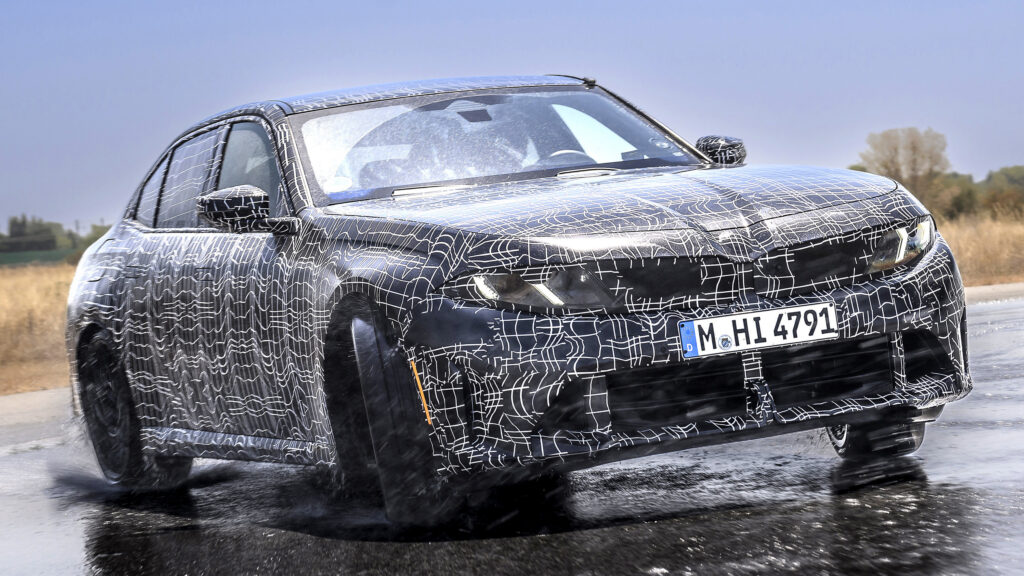
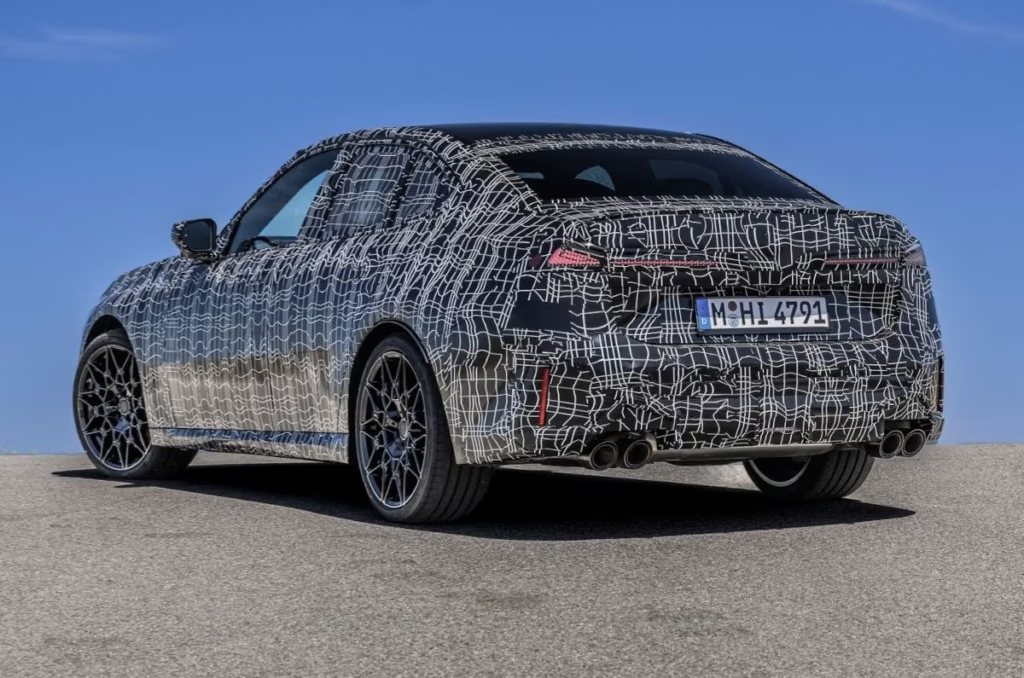
BMW M350 Gets 443hp and 580Nm
On paper, the numbers make the BMW M350 considerably more serious than the M340i it replaces.
BMW quotes 443hp and 580Nm, with the output generated by the combination of its six-cylinder combustion engine and 48V mild-hybrid system. The M350’s 4.1-second provisional 0-100kph time also puts it firmly into performance-car territory rather than merely being a quick executive sedan.
There is an important distinction here, though. BMW describes these as development-phase figures, and the official information does not yet provide final WLTP consumption figures. That means the production car’s certified numbers may differ from what we see today.
Still, the direction is obvious. BMW is not trying to make the next 3 Series simply more efficient. It is trying to make the performance version more capable while keeping the combustion engine very much alive.
The Big Surprise: BMW M350 Gets Drift Mode
And now we get to the part that will make enthusiasts sit up.
The BMW M350 introduces something previously reserved for BMW’s full-fat M models: a dedicated Drift Moment function. BMW says the system can be activated through the Central Display, after which engine drive is sent fully to the rear wheels. With DSC switched off and the M350’s electronically controlled all-wheel-drive hardware working with the system, the car can be deliberately driven into controlled oversteer.
This is a major change in the character of an M Performance 3 Series.
Until now, the M340i occupied a fascinating middle ground. It had the engine, pace and chassis capability to feel genuinely sporty, but BMW kept certain theatrical tricks for the M3. The BMW M350 blurs that boundary further by giving drivers a feature designed specifically around going sideways.
Of course, this is not something designed for public-road heroics. Drift functions belong on appropriate closed courses or controlled environments. But from an enthusiast perspective, the message from BMW is unmistakable: the M350 is not being developed simply as a faster commuter.
Drift Moment Will Arrive Through a Software Update
There is another interesting technological twist to the drift function.
BMW says Drift Moment will become available during 2027, rather than necessarily being active from the first day every M350 reaches customers. More importantly, cars delivered before the feature becomes available can also receive it through a Remote Software Upgrade.
That is a fascinating example of how modern BMWs are becoming software-defined performance machines.
Traditionally, adding a new driving mode meant changing hardware or sending a car back to a workshop. With the M350, BMW can develop and activate a significant driving feature through an over-the-air software update once the necessary systems are ready.
The hardware is already engineered into the car; the software decides when and how the function becomes available.
BMW M350 xDrive Keeps All-Wheel Drive
Despite the new drift capability, the BMW M350 remains an xDrive all-wheel-drive performance sedan.
That is important because BMW is not simply turning the car into a rear-wheel-drive hooligan machine. Most of the time, the M350 is designed to deliver the traction, stability and confidence expected from an all-wheel-drive executive performance car. The Drift Moment function is effectively an additional layer that changes how the system behaves under specific conditions.
This dual personality could become one of the M350’s strongest attributes.
You can have the traction of xDrive when launching the car or driving through poor conditions, then access a much more playful rear-driven character when the conditions and environment are appropriate. It is a very BMW solution to the eternal enthusiast dilemma of speed versus involvement.
The Chassis Has Been Developed for More Than Straight-Line Speed
BMW has also worked extensively on the next-generation 3 Series’ underlying chassis.
The new platform uses a double-joint spring-strut front axle and a five-link rear axle, while BMW says the new 3 Series benefits from increased torsional and vertical stiffness. The M350 receives its own chassis tuning, along with standard adaptive M suspension, an M Sport differential and variable sport steering.
That hardware matters because adding another 70-odd horsepower would mean little if the chassis could not exploit it.
The M350 is therefore being developed around the idea that performance should come from the entire vehicle rather than the engine alone. Suspension control, steering, torque distribution and differential management all become part of the performance equation.
BMW is also offering optional sports tyres in 245/35 R20 at the front and 275/30 R20 at the rear, giving the car a distinctly serious footprint.
BMW M350 vs M340i: What Actually Changes?
The easiest way to understand the new car is to look at what BMW is changing beyond the badge.
The BMW M350 keeps the familiar formula of a straight-six engine, automatic transmission and xDrive, but increases performance while adding a much more sophisticated chassis package. More importantly, it introduces a feature that changes the emotional character of the car rather than merely its acceleration figures.
The M350 therefore represents an evolution from fast executive sedan toward seriously capable performance sedan.
That distinction is important because the M3 still exists above it. BMW does not need the M350 to become an M3 replacement. Instead, it needs the car to become exciting enough that buyers do not feel they are settling for the lesser model simply because they want something usable every day.
What Happens to the BMW M340d?
One question BMW has not answered is whether the next-generation 3 Series will receive a high-performance diesel equivalent to the current M340d.
The company has confirmed the M350 as the six-cylinder performance flagship of the combustion-powered range, while other versions of the new 3 Series will use four-cylinder petrol and diesel engines with 48V mild-hybrid technology. BMW has not confirmed a successor to the M340d.
The M350’s naming is also interesting because BMW has dropped the familiar “i” suffix. That does not, by itself, confirm the end of the M340d formula, but it adds another layer to BMW’s evolving naming strategy as its combustion and electric model ranges increasingly develop in parallel.
For diesel enthusiasts, therefore, the M350 announcement leaves an important question unanswered.
BMW M350 and the New Generation of 3 Series
The M350 is part of a much larger change for the 3 Series.
The next-generation sedan is being developed on BMW’s Neue Klasse-era architecture, with combustion-powered and electric models following their own technical paths. BMW has now completed the latest summer driving-dynamics testing of the combustion-powered 3 Series at Miramas and says the car is entering the final stage of series-production development.
Production of the combustion-powered 3 Series is scheduled to begin in the second half of 2026, while international availability is expected toward the end of the year. India is expected to receive the new generation in 2027, although BMW has not yet announced a specific India launch date for the M350.
That timing will make the Indian market particularly interesting.
The current M340i has already given Indian enthusiasts access to a genuinely fast six-cylinder BMW sedan. If BMW brings the M350 to India, the combination of 443hp, xDrive, adaptive M suspension and its new rear-drive-oriented Drift Moment could make it one of the most interesting combustion-powered luxury sedans in the market.
Will the BMW M350 Be Available in India?
The BMW M350 India launch has not been officially confirmed with a specific date or price yet.
Current reporting points toward an India arrival in 2027, following the international rollout of the next-generation 3 Series. That means Indian buyers should not treat current reports about pricing, exact specifications or launch timing as final.
BMW India already sells the current 3 Series and M340i in the country, so an India-spec M350 would have a natural place in the company’s performance-sedan portfolio. However, the final specification and positioning will depend on BMW India’s product strategy closer to launch.
For now, the important takeaway is that BMW M350 India is an expected future possibility rather than a confirmed launch with finalized pricing.
Read More: Mammootty Car Collection
Why the BMW M350 Matters
The significance of the M350 goes beyond one new performance sedan.
BMW is simultaneously expanding its electric Neue Klasse family while continuing to develop highly sophisticated combustion engines. The M350 demonstrates that the company is not treating the internal-combustion 3 Series as an afterthought during this transition. Instead, it is giving the petrol-powered flagship more power, more chassis technology and a feature designed specifically to appeal to enthusiasts.
That makes the BMW M350 an intriguing snapshot of where performance cars are heading.
The future may be electric, but BMW clearly believes there is still room for a six-cylinder engine to make a serious emotional argument.
And with 443hp, 580Nm, xDrive and Drift Moment, the M350 is making that argument rather loudly.
FAQs
What is the BMW M350?
The BMW M350 is the upcoming range-topping M Performance version of the next-generation combustion-powered BMW 3 Series. It replaces the current M340i and uses a 3.0-litre six-cylinder turbo-petrol engine with 48V mild-hybrid assistance.
How much power does the BMW M350 produce?
BMW quotes a combined 443hp and 580Nm for the development-phase M350 xDrive. These figures are provisional and could change before final production certification.
How fast is the BMW M350?
BMW gives the M350 a provisional 0-100kph time of 4.1 seconds and an electronically limited top speed of 250kph.
Does the BMW M350 have drift mode?
Yes. The M350 introduces BMW’s Drift Moment, which can send the engine’s drive fully to the rear wheels when activated under the appropriate conditions. BMW says the feature will become available during 2027 and can also be activated on already-delivered cars through a Remote Software Upgrade.
Is the BMW M350 all-wheel drive?
Yes. The M350 xDrive comes with BMW’s intelligent xDrive all-wheel-drive system as standard, alongside an eight-speed Steptronic automatic transmission.
When will the BMW M350 launch in India?
The next-generation 3 Series is expected to arrive in India in 2027, but BMW has not yet announced a specific M350 India launch date or final India-specification details.
Will the BMW M350 replace the M340i?
Yes. BMW has confirmed that the M350 will replace the current M340i as the range-topping M Performance version of the combustion-powered 3 Series.
Ride And Tech Verdict
The BMW M350 is exactly the kind of car that makes the transition toward electrification more complicated—and considerably more interesting. BMW could have simply increased efficiency and allowed the combustion-powered 3 Series to fade quietly behind its electric Neue Klasse models. Instead, it has given the M Performance flagship more power, a sharper chassis and a feature that was previously reserved for BMW’s full M cars.
The 443hp six-cylinder, 580Nm, xDrive system and 4.1-second provisional acceleration are impressive, but the real story is the character BMW is trying to build around them. Drift Moment gives the M350 a playful side that the M340i never had, while adaptive M suspension, the M Sport differential and variable sport steering suggest that BMW wants the car to be more than a straight-line missile.
For Indian enthusiasts, the next big question is whether BMW brings this formula here in 2027 and how aggressively it positions the car against the M3 and other performance luxury sedans. If the M350 arrives with its current development specification largely intact, it could become one of the most compelling BMW 3 Series performance cars yet—not because it replaces the M3, but because it makes the gap between an M Performance car and a full M machine considerably harder to ignore.
Ride And Tech — Where Ride Meets Tech.
Drive Smarter. Ride Smarter.
Copyright (c) Ride And Tech. All rights reserved.

2 thoughts on “BMW M350 Replaces M340i With 443hp and Drift Mode: The New 3 Series Gets Serious”