


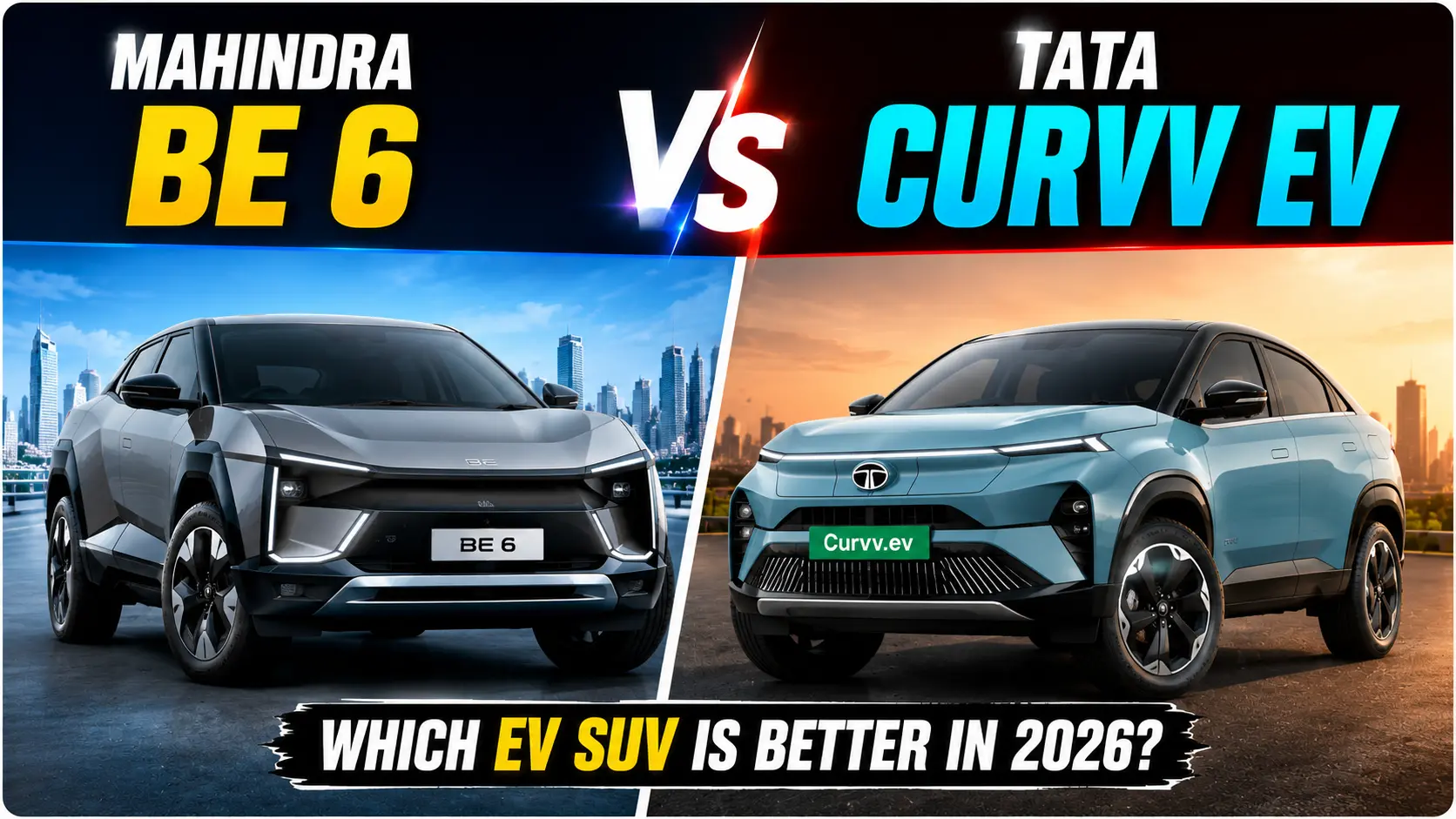
The Mahindra BE 6 vs Tata Curvv EV comparison is becoming increasingly relevant for Indian buyers looking for a stylish and modern electric SUV. Both models bring distinctive designs, advanced technology and the benefits of electric driving, but they follow noticeably different philosophies. The Mahindra BE 6 focuses more strongly on performance, range and futuristic technology, while the Tata Curvv EV combines its electric powertrain with a distinctive SUV-coupe design and a practical family-oriented approach.
The difference becomes clearer when we look at their battery options and overall positioning. The BE 6 is available with 59 kWh and 79 kWh battery packs, with the larger version offering a claimed range of around 682–683 km under MIDC testing. The Curvv EV is offered with 45 kWh and 55 kWh battery options, with the 55 kWh version offering a claimed 502 km range under ARAI testing. These figures give the Mahindra an advantage for buyers who regularly travel longer distances, while the Tata can make more sense for buyers whose driving is primarily urban or mixed.
However, range is only one part of the buying decision. Price, charging speed, performance, cabin technology, boot space, safety and everyday usability can all influence which SUV makes more sense. The BE 6’s stronger performance and larger battery come with a higher price on comparable variants, while the Curvv EV offers a lower entry point and a more conventional family-SUV proposition.
So, which electric SUV should you buy in 2026—the Mahindra BE 6 or Tata Curvv EV? Let’s compare the two SUVs across the areas that matter most to an EV buyer before reaching our final verdict.
Mahindra BE 6: A Performance-Focused Electric SUV
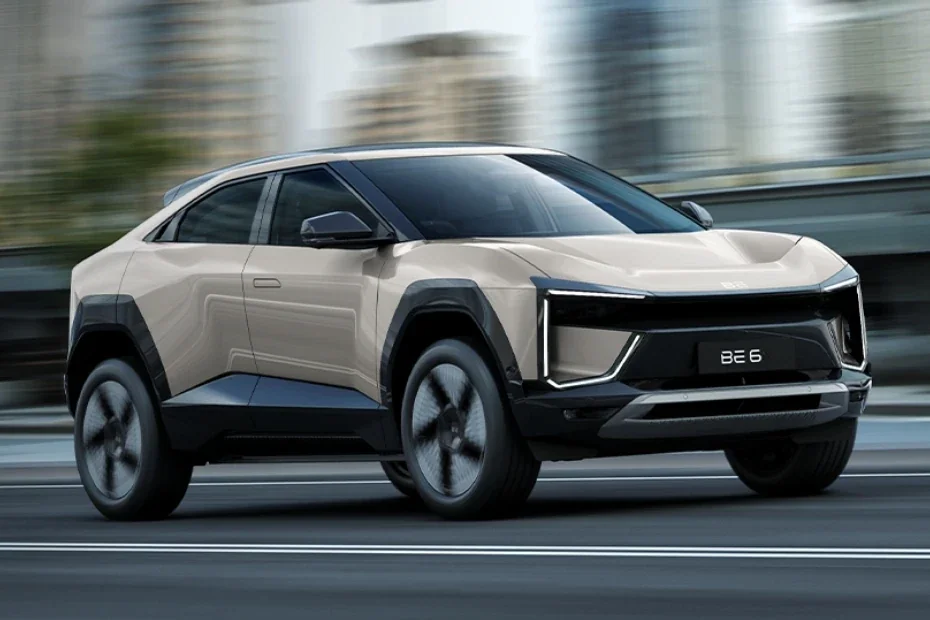
The Mahindra BE 6 takes a more performance-oriented approach to the electric SUV segment. Unlike an EV that is primarily designed around efficiency and everyday commuting, the BE 6 has been developed to offer a more engaging driving experience while still providing the practicality expected from a five-seat SUV. Its sharp exterior design, rear-wheel-drive layout and dedicated electric platform give it a character that is quite different from traditional SUVs.
The BE 6 is built on Mahindra’s INGLO electric architecture and is available with 59 kWh and 79 kWh battery options. The larger battery version uses a powerful electric motor producing up to 210 kW, while Mahindra claims a range of around 682–683 km under MIDC testing. The 79 kWh version can also accelerate from 0–100 km/h in around 6.7 seconds, making it one of the quicker electric SUVs in its segment.
Another major strength of the BE 6 is its charging capability. With the appropriate high-power DC charger, Mahindra says the larger battery can charge from 20% to 80% in around 20 minutes. This combination of a large battery, strong performance and fast charging makes the BE 6 particularly interesting for buyers who want to use their EV for both daily driving and longer highway journeys.
The futuristic approach continues inside the cabin, where Mahindra has placed considerable emphasis on digital technology and connected features. Depending on the variant, the BE 6 offers large digital displays, connected-car technology, advanced driver assistance systems and other premium equipment. More recent versions such as the BE 6 SPORTEQ have pushed the technology theme even further with features including a three-screen cockpit and Google Gemini-powered TEQ_Talk.
Overall, the Mahindra BE 6 is aimed at buyers who want more than just an efficient electric SUV. Its combination of performance, range, charging capability and technology makes it particularly appealing to drivers who enjoy driving and want their EV to have a more futuristic and performance-focused character.
Read More: 2027 Lamborghini Revuelto SV Unveiled
Tata Curvv EV: Stylish Design Meets Everyday Practicality
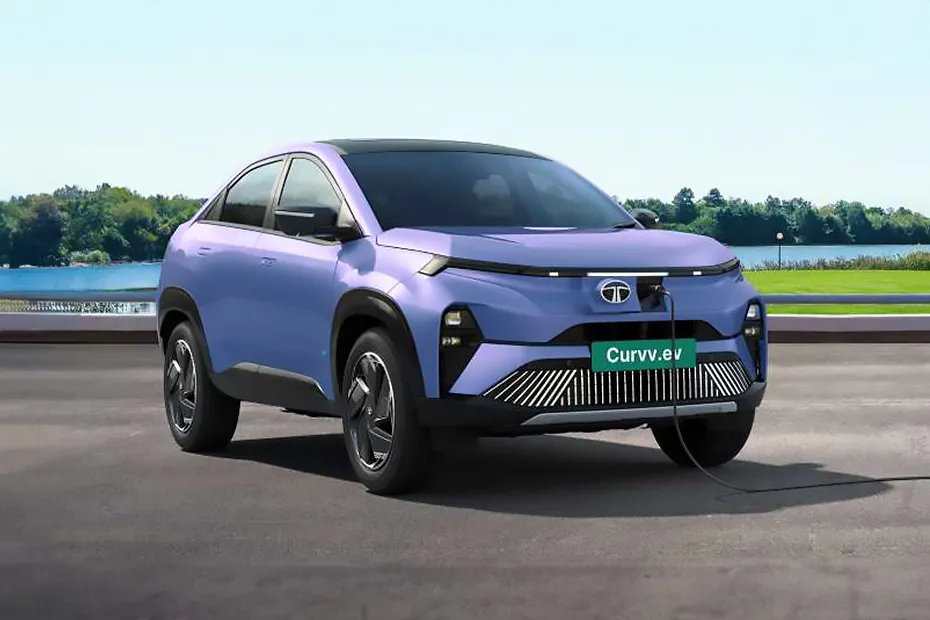
The Tata Curvv EV takes a different approach to the electric SUV segment. Instead of focusing heavily on outright performance, Tata has positioned the Curvv EV around a combination of distinctive styling, everyday practicality and modern technology. Its SUV-coupe design gives it a strong road presence, while the electric powertrain makes it well suited to buyers looking to transition from a conventional petrol or diesel SUV to an EV.
The Curvv EV is available with 45 kWh and 55 kWh battery options, with the larger 55 kWh version offering an ARAI-certified range of 502 km. Tata lists a 123 kW electric motor producing 215 Nm of torque for the 55 kWh version, with a claimed 0–100 km/h acceleration time of around 8.6–8.8 seconds depending on the version. These figures make it capable enough for city traffic, highway cruising and everyday overtaking, even though it isn’t positioned as a performance-focused EV like the higher-powered BE 6.
One of the Curvv EV’s biggest strengths is its design. The sloping roofline gives the SUV a coupe-inspired profile, while the modern lighting elements and clean bodywork help it stand apart from conventional SUVs. This makes the Curvv EV particularly appealing to buyers who want an electric vehicle that looks distinctive and premium without adopting an extremely aggressive design.
Practicality remains an important part of the package as well. Tata lists 500 litres of boot space, giving the Curvv EV useful luggage capacity for family trips and everyday requirements. The cabin combines this practicality with features such as a large infotainment display, digital instrumentation, connected technology and, depending on the variant, equipment including a panoramic sunroof, 360-degree camera and advanced driver-assistance features.
Overall, the Tata Curvv EV is better suited to buyers who want a stylish family-oriented electric SUV with useful range, modern features and a comparatively accessible price. It may not match the BE 6 for outright performance, but its combination of design, practicality and everyday usability makes it a strong alternative.
Mahindra BE 6 vs Tata Curvv EV: Design, Cabin and Practicality Compared
The design philosophies of the Mahindra BE 6 and Tata Curvv EV are quite different, even though both SUVs are aimed at buyers looking for something more modern than a conventional petrol or diesel SUV. The BE 6 has a sharper and more futuristic appearance, with angular surfaces, distinctive lighting and a deliberately aggressive stance. Its design makes the SUV look performance-oriented even when it is standing still. Mahindra has also used several aerodynamic elements to give the BE 6 a more technical appearance, which suits its positioning as an electric vehicle built around a dedicated EV platform.
The Tata Curvv EV takes a more elegant approach with its SUV-coupe profile. The sloping roofline is its most noticeable design feature and gives the vehicle a distinctive silhouette compared with traditional SUVs in the segment. Tata has combined this shape with modern lighting elements, clean body surfaces and a relatively upright front section, creating a design that looks futuristic without becoming as aggressive as the BE 6. For buyers who want an EV that stands out but still has a relatively conventional SUV presence, the Curvv EV’s styling can be particularly appealing.
Inside the cabin, the difference continues. The BE 6 has a more driver-focused and technology-heavy environment, with its large digital displays and futuristic dashboard design contributing to the overall character of the vehicle. The cabin feels like an extension of the exterior, with technology playing a central role rather than simply being added as a collection of features. This makes the BE 6 attractive to buyers who enjoy a modern digital experience and want their vehicle to feel noticeably different from a traditional family SUV.
The Curvv EV’s cabin takes a slightly more familiar approach while still offering plenty of modern technology. The dashboard is designed around a large infotainment display and digital instrumentation, while available features such as a panoramic sunroof, connected technology and advanced camera systems add to the premium experience. The biggest practical advantage comes from its 500-litre boot, which makes the Curvv EV well suited to family use and longer journeys where luggage space becomes important.
The BE 6 isn’t impractical, however. Mahindra lists 455 litres of boot space along with a 45-litre frunk, giving owners additional storage space that can be useful for smaller bags, charging equipment or other items that you don’t want to place in the main luggage compartment. The Curvv EV, meanwhile, offers an 11.6-litre frunk according to Tata’s specifications, so its larger main boot remains its strongest practicality advantage.
For everyday family use, therefore, the Curvv EV has a slight advantage in conventional luggage practicality, while the BE 6 offers a more interesting combination of front and rear storage. The more important difference is the overall character of the two cabins: the BE 6 feels more futuristic and driver-oriented, while the Curvv EV focuses more on combining premium styling with familiar family usability.
Design and Practicality Comparison
| Feature | Mahindra BE 6 | Tata Curvv EV |
|---|---|---|
| Exterior character | Futuristic, sharp and aggressive | Stylish SUV-coupe design |
| Cabin character | Technology-focused and driver-oriented | Premium and family-friendly |
| Main boot space | 455 litres | 500 litres |
| Frunk | 45 litres | 11.6 litres |
| Seating capacity | 5 | 5 |
| Design advantage | Sportier and more futuristic | More elegant and distinctive |
| Practicality advantage | Additional frunk space | Larger conventional boot |
Our take: If your priority is futuristic design, technology and a sportier cabin, the BE 6 has the stronger personality. If you place greater importance on boot space, family usability and a more elegant SUV-coupe design, the Curvv EV makes a strong case.
Mahindra BE 6 vs Tata Curvv EV: Battery, Range and Charging
For an electric SUV buyer, battery capacity and range are among the most important factors to consider because they directly influence how frequently the vehicle needs to be charged. The Mahindra BE 6 vs Tata Curvv EV comparison becomes particularly interesting here because Mahindra offers a substantially larger battery option, while Tata focuses on providing two battery sizes that cover the needs of typical city and mixed-use buyers.

The Mahindra BE 6 is available with 59 kWh and 79 kWh battery packs. The larger 79 kWh version has an officially claimed MIDC range of around 682–683 km, while the smaller battery version offers a lower certified range depending on the variant. This makes the BE 6 one of the more range-focused electric SUVs in its segment on paper. Mahindra has also developed the vehicle around an 800-volt electrical architecture, which allows the larger battery to take advantage of high-power DC fast charging.
The Tata Curvv EV, meanwhile, is offered with 45 kWh and 55 kWh battery options. The 55 kWh version has an ARAI-certified range of 502 km, while the smaller battery is intended to provide a more accessible entry point into the Curvv EV range. For buyers who mainly use their vehicle for commuting, school runs, shopping and regular city travel, a 45 kWh or 55 kWh battery can already provide enough range to avoid frequent charging when the vehicle is charged at home.
However, claimed range should not be treated as the exact distance either SUV will cover in everyday conditions. Actual range can change depending on driving speed, traffic, air-conditioning use, outside temperature, road conditions, passenger load and driving style. Highway driving at sustained high speeds can reduce EV range considerably compared with controlled certification tests. This is why buyers should consider their real daily and weekly driving distance rather than choosing an EV solely because it has the highest claimed range.
For someone who regularly drives between cities, the BE 6’s larger 79 kWh battery can provide an important psychological and practical advantage. Having more usable energy means fewer charging stops on longer journeys and gives the driver greater flexibility when charging infrastructure isn’t available exactly where they would prefer it. The Curvv EV’s 55 kWh battery, on the other hand, can be more than adequate for buyers whose driving is primarily urban and who have reliable access to home charging.
Charging Speed
Charging speed is another area where the Mahindra BE 6 has a significant advantage. Mahindra says the 79 kWh version can charge from 20% to 80% in around 20 minutes when connected to a compatible 175 kW DC fast charger. The 59 kWh version can also achieve a 20–80% charging window of around 20 minutes when paired with the appropriate high-power DC charger.
The Tata Curvv EV supports DC fast charging at up to 70 kW, with Tata quoting approximately 40 minutes for a 10–80% charge. The company also offers AC home charging options, which are more relevant for overnight charging and regular daily use.
In real ownership, the difference matters most during road trips. If you stop at a highway fast-charging station with the BE 6 and the charger is capable of delivering the required power, a relatively short break can add a substantial amount of range. With the Curvv EV, the longer charging window may require a little more planning. At home, however, the difference becomes much less important because an overnight charge gives both vehicles plenty of opportunity to start the next day with a high state of charge.
Battery and Charging Comparison
| Feature | Mahindra BE 6 | Tata Curvv EV |
|---|---|---|
| Battery options | 59 kWh / 79 kWh | 45 kWh / 55 kWh |
| Highest claimed range | Around 682–683 km MIDC | 502 km ARAI |
| DC fast charging | Up to 175 kW* | Up to 70 kW |
| Fast-charge claim | 20–80% in ~20 minutes* | 10–80% in ~40 minutes |
| Best suited for | Long-distance and mixed driving | City and mixed everyday use |
*With the appropriate battery/charger configuration and compatible high-power charging equipment.
Our take: For battery capacity, claimed range and high-speed charging, the Mahindra BE 6 is the clear winner. The Tata Curvv EV still offers enough range for many everyday users, particularly those with convenient home charging, but the BE 6 is better suited to buyers who expect to make frequent long-distance journeys.
And this is an important distinction: you don’t necessarily need the BE 6’s larger battery if most of your driving is within the city. For an urban buyer who can charge at home, the Curvv EV’s smaller battery could actually be a more sensible choice because you’re not paying for range you rarely use.
Mahindra BE 6 vs Tata Curvv EV: Performance and Driving Experience
Performance is another area where the Mahindra BE 6 and Tata Curvv EV take noticeably different approaches. Both electric SUVs deliver instant torque and smooth acceleration, but Mahindra has given the BE 6 a much stronger performance-oriented character. The Curvv EV, in comparison, focuses more on delivering predictable and comfortable performance that works well for everyday driving.
The Mahindra BE 6 gets a rear-wheel-drive layout and is available with different power outputs depending on the battery and variant. The higher-specification 79 kWh version produces up to 210 kW, with Mahindra quoting a 0–100 km/h acceleration time of around 6.7 seconds. That is quick enough to make the BE 6 feel genuinely sporty, particularly when accelerating onto a highway or overtaking slower traffic. The instant torque delivery of the electric motor also means that the response is immediate without requiring the driver to wait for a conventional gearbox to select the appropriate gear.
The BE 6’s performance isn’t limited to straight-line acceleration either. Its dedicated EV platform and rear-wheel-drive configuration give Mahindra more freedom to tune the vehicle around driving dynamics. The SUV gets multiple drive modes and performance-oriented functions, while the suspension and chassis have been developed to handle the additional performance available from the electric powertrain. For an enthusiast, this makes the BE 6 more interesting because it feels like Mahindra has deliberately designed the vehicle to be enjoyable to drive rather than simply efficient.
The Tata Curvv EV is less aggressive in comparison, but that doesn’t make it unsuitable for everyday driving. The 55 kWh version uses a 123 kW electric motor producing 215 Nm, with a claimed 0–100 km/h time of around 8.6–8.8 seconds depending on the version. That is slower than the BE 6, but still adequate for urban traffic, highway cruising and normal overtaking situations.
Where the Curvv EV can make more sense is for buyers who prioritize a relaxed and predictable driving experience. Not every EV buyer is looking for sports-car-like acceleration, and the Curvv’s performance is sufficient for most family requirements. Its emphasis is more on making electric driving easy and comfortable rather than turning every acceleration into a performance event.
The difference becomes especially noticeable when both vehicles are driven beyond normal city speeds. The BE 6’s stronger motor and rear-wheel-drive layout give it more confidence when rapid acceleration is required, while its performance-oriented character makes it more appealing to drivers who enjoy being behind the wheel. The Curvv EV, meanwhile, remains better suited to someone who wants smooth progress, comfortable cruising and enough performance for everyday situations.
Performance Comparison
| Feature | Mahindra BE 6 | Tata Curvv EV |
|---|---|---|
| Highest motor output | Up to 210 kW | 123 kW |
| Drive layout | Rear-wheel drive | Front-wheel drive |
| Highest battery option | 79 kWh | 55 kWh |
| 0–100 km/h | Around 6.7 seconds* | Around 8.6–8.8 seconds* |
| Driving character | Sporty and performance-focused | Smooth and comfort-oriented |
| Best suited for | Enthusiastic drivers | Everyday family driving |
*Manufacturer-quoted figures vary by version/variant.
Our take: If performance and driving enjoyment are high on your priority list, the Mahindra BE 6 is the clear choice. Its stronger motor, rear-wheel-drive architecture and quicker acceleration give it a significantly more exciting character. The Tata Curvv EV is still perfectly capable for everyday driving, but its strengths lie more in comfort, practicality and ease of use than outright performance.
Mahindra BE 6 vs Tata Curvv EV: Features, Technology and Connected Experience
Technology has become one of the biggest selling points in modern electric vehicles, and both the Mahindra BE 6 and Tata Curvv EV offer considerably more equipment than buyers would have expected from SUVs in this price range a few years ago. However, the two manufacturers have approached technology differently. Mahindra has made the BE 6 feel more software-driven and futuristic, while Tata has focused on combining a long list of features with a cabin that remains familiar and easy to use for everyday driving.
The Mahindra BE 6 gets a technology-focused cabin with large digital displays, connected-car functions, wireless smartphone connectivity, 5G capability, built-in navigation and a range of entertainment and convenience features depending on the variant. Its electronic architecture also supports over-the-air updates, allowing certain vehicle functions and software features to be improved without requiring the owner to visit a service centre for every update. This software-focused approach is one of the reasons the BE 6 feels different from a conventional SUV that has simply replaced its combustion engine with an electric motor.
Mahindra has also introduced several more advanced features in the BE 6 lineup as it has expanded the model range. The recently introduced BE 6 SPORTEQ, for example, adds a three-screen cockpit, Google Gemini-powered TEQ_Talk, TEQ Suites, a Digital Car Key and performance-focused functions such as Drift Mode and Acceleration Boost. These features show how Mahindra is positioning the BE 6 as a technology platform rather than just another electric SUV. However, it is important to remember that equipment can vary considerably between variants, so buyers should check the exact feature list of the version they are considering rather than assuming every BE 6 gets the same technology package.
The Tata Curvv EV also has a strong feature list. Depending on the variant, Tata offers a large touchscreen infotainment system, digital driver’s display, wireless Android Auto and Apple CarPlay, connected-car technology, voice-assisted functions, a panoramic sunroof, automatic climate control and premium audio equipment. Higher variants can also be equipped with features such as a 360-degree camera and blind-spot monitoring, adding useful assistance during parking and busy urban driving.
What makes the Curvv EV interesting is that Tata has tried to balance technology with straightforward usability. The cabin doesn’t feel as experimental as the BE 6, which could appeal to buyers who want plenty of modern features without making the vehicle feel overly dependent on digital interfaces. For a family that uses the vehicle every day, simple controls and familiar smartphone connectivity can sometimes be more useful than having the largest possible list of technology features.
Technology Comparison
| Feature | Mahindra BE 6 | Tata Curvv EV |
|---|---|---|
| Digital displays | Large digital display setup | Digital instrument cluster + touchscreen |
| Connected technology | Yes | Yes |
| Wireless smartphone connectivity | Available | Available |
| OTA updates | Supported | Connected/software features vary |
| 360-degree camera | Available on selected variants | Available on selected variants |
| Advanced driver assistance | Available | Available |
| Panoramic sunroof | Available | Available |
| Voice/AI technology | Advanced features on selected versions | Voice-assisted features |
| Technology character | Futuristic and software-focused | Feature-rich and user-friendly |
For buyers who want the most futuristic and technology-driven experience, the BE 6 has the edge, particularly in its higher variants and newer editions. The Curvv EV, however, remains a very strong option for buyers who want a well-equipped cabin with useful technology without making technology the entire focus of the ownership experience.
Our take: Mahindra BE 6 wins on technology innovation, while the Tata Curvv EV offers a more familiar and practical technology experience. The final decision should be based on the exact variant because several of the premium features discussed above are not available across the entire range.
Mahindra BE 6 vs Tata Curvv EV: Safety and Everyday Usability
Safety is an important part of any SUV comparison, but it becomes even more relevant when you’re choosing an electric vehicle for regular family use. Both the Mahindra BE 6 and Tata Curvv EV come with a strong set of active and passive safety technologies, although the exact equipment depends on the variant. Instead of looking only at the number of features, buyers should consider how well the vehicle fits their regular driving conditions, parking environment and family requirements.
The Mahindra BE 6 is built on the INGLO dedicated EV platform and comes with a comprehensive safety package that includes multiple airbags, electronic stability control and other electronic safety systems. Higher variants also offer advanced driver assistance features designed to provide additional support in situations such as highway driving and traffic. Mahindra has also focused on protecting the battery and high-voltage electrical components, which is an important consideration in any modern EV. The combination of the dedicated platform and electronic safety systems gives the BE 6 a strong safety-oriented foundation.
The Tata Curvv EV also comes with a substantial safety package. Tata offers six airbags, electronic stability control, all-wheel disc brakes, tyre-pressure monitoring and other standard safety systems, while selected variants add features such as a 360-degree camera and blind-spot monitoring. These features can be particularly useful in everyday Indian driving conditions, where narrow parking spaces, dense traffic and unpredictable road movements are common.
For everyday usability, however, safety equipment is only part of the equation. The BE 6’s larger battery can be an advantage for drivers who regularly travel long distances, while its faster charging capability can reduce the time spent at highway charging stations. The Curvv EV’s more conventional family-SUV character and larger 500-litre boot can make it easier for buyers who frequently carry luggage or use the vehicle primarily for urban and family travel.
Charging access should also be considered before choosing either vehicle. If you have a dedicated home charger, both SUVs can be convenient to live with because most daily charging can be completed overnight. If home charging isn’t available, the decision becomes more dependent on the public charging network around your home, office and regular routes. In such a situation, the availability and reliability of charging stations can have a greater impact on ownership convenience than the difference between their claimed ranges.
Another important consideration is driving environment. A buyer who spends most of their time in a city may value a 360-degree camera, blind-spot monitoring, parking assistance and a manageable footprint more than maximum highway range. Someone who regularly drives on expressways may place greater importance on ADAS functionality, battery range and fast charging. This is why there isn’t a universal answer to which SUV is more practical—the right choice depends heavily on how and where you drive.
Safety and Usability Comparison
| Feature | Mahindra BE 6 | Tata Curvv EV |
|---|---|---|
| Airbags | Multiple airbags | 6 airbags |
| Electronic stability control | Yes | Yes |
| TPMS | Available | Available |
| 360-degree camera | Selected variants | Selected variants |
| ADAS | Available on selected variants | Available on selected variants |
| Blind-spot monitoring | Available on selected variants | Available on selected variants |
| Everyday character | Tech-focused and performance-oriented | Family-focused and practical |
| Boot space | 455 litres + 45-litre frunk | 500 litres + frunk |
Our take: Both SUVs offer a strong safety and convenience package, so the decision here is less about choosing a clear winner and more about selecting the right variant. The BE 6 is better suited to buyers who combine city use with frequent highway driving, while the Curvv EV makes a strong case as a practical family EV, particularly for buyers who value luggage space and easy everyday usability.
Mahindra BE 6 vs Tata Curvv EV: Price, Variants and Value for Money
Price is one of the most important factors in the Mahindra BE 6 vs Tata Curvv EV comparison because both SUVs cover a fairly wide range of variants, and the difference between their entry-level and higher-specification versions can be significant. For buyers, the important question isn’t simply which SUV has the lower starting price. It is about how much equipment, battery capacity, range and performance you receive for the money you spend.
The Tata Curvv EV currently starts at ₹16.99 lakh ex-showroom for the Series X range, with the current official price range extending to ₹19.49 lakh for the top #DARK version. Tata’s official page lists the Empowered X 55 at ₹19.19 lakh, while the #DARK version is priced at ₹19.49 lakh. These prices make the Curvv EV particularly interesting for buyers who want a premium-looking electric SUV without moving too far beyond the ₹20 lakh mark.
The Mahindra BE 6 was originally introduced with prices starting at ₹18.90 lakh for the 59 kWh Pack One, with the 79 kWh Pack Three announced at ₹26.90 lakh. Mahindra’s published pricing also noted that home-charger and installation costs were additional. Since the BE 6 range has subsequently expanded with special editions and newer versions, buyers should check the current variant and dealer price rather than assuming that the original launch pricing applies to every version.
This difference gives the Curvv EV an advantage for buyers working with a tighter budget. The entry-level Curvv EV gets you into a stylish electric SUV at a lower price, while the BE 6 asks for more money, particularly if you want its larger 79 kWh battery and higher-performance configuration. However, the BE 6’s additional cost is not simply paying for cosmetic upgrades. The larger battery, stronger motor, rear-wheel-drive architecture, faster charging capability and more performance-focused hardware explain why its higher variants sit at a different price point.
Variant selection is therefore particularly important. A buyer who mostly drives within the city may not need the 79 kWh BE 6, and spending significantly more for maximum range may not provide much practical benefit if the vehicle is charged every night at home. On the other hand, someone who regularly travels long distances may find the larger BE 6 battery worth the additional investment because it offers greater range and faster DC charging capability.
The Curvv EV follows a slightly different value proposition. Its 55 kWh versions offer a useful balance between range, equipment and price, while higher variants add features such as a larger infotainment display, premium audio, ventilated seats, powered seat adjustment, Level 2 ADAS and advanced parking and camera systems. Tata’s current official specifications show that equipment varies significantly between variants, so buyers should compare the exact version rather than judging the Curvv EV solely by its entry price.
Price and Value Comparison
| Factor | Mahindra BE 6 | Tata Curvv EV |
|---|---|---|
| Starting price | From ₹18.90 lakh at original published pricing* | From ₹16.99 lakh |
| Higher battery | 79 kWh | 55 kWh |
| Maximum claimed range | Around 682–683 km MIDC | 502 km ARAI |
| Performance focus | Strong | Moderate |
| Fast charging capability | Up to 175 kW configuration | Up to 70 kW |
| Value advantage | Range, performance and technology | Lower entry price and equipment |
| Best suited for | Buyers willing to spend more for capability | Buyers seeking balanced EV value |
*Mahindra’s published BE 6 pricing has changed across variants and editions; buyers should confirm the current applicable price at the time of purchase.
Our take: The Tata Curvv EV offers better value for buyers who want to keep the initial purchase price under control, while the Mahindra BE 6 becomes more compelling as you prioritize range, performance and advanced EV technology. The Curvv EV is therefore the more budget-conscious choice, whereas the BE 6 can justify its higher price for buyers who will actually use its additional capabilities.
And this is where we should avoid calling one SUV the outright “value-for-money winner.” Value depends on what you actually need from an EV. Paying more for the BE 6 makes sense if you regularly use its larger battery and performance; otherwise, the Curvv EV may give you everything you need for less money.
Read More: Kia Syros EV vs Maruti Suzuki Brezza Facelift
Which Electric SUV Should You Buy in 2026?

The answer to the Mahindra BE 6 vs Tata Curvv EV question depends less on which SUV has the longer specification sheet and more on how you plan to use the vehicle. Both SUVs can work well as daily electric vehicles, but their strengths are different enough that your driving pattern, budget and charging requirements should influence the final decision.
If performance, range and charging speed are your biggest priorities, the Mahindra BE 6 is the more convincing option. Its larger 79 kWh battery, higher power output and rear-wheel-drive layout give it a clear advantage for buyers who enjoy driving and regularly travel longer distances. The higher claimed range also provides more flexibility for highway journeys, while its faster DC charging capability can reduce the time spent waiting at compatible charging stations. For an enthusiast who wants an EV that feels exciting rather than simply efficient, the BE 6 is the stronger choice.
The BE 6 also makes more sense if you are comfortable spending more for technology and don’t mind choosing a higher variant to access the features you specifically want. Its futuristic cabin, software-focused architecture and performance-oriented character make it feel more like a new-generation electric vehicle rather than a conventional SUV converted to electric power. However, buyers should carefully compare variants because the most impressive features and larger battery are not available at the lowest price point.
The Tata Curvv EV, on the other hand, makes a stronger case for buyers who want a stylish and practical family EV without stretching their budget as much. Its lower starting price, 500-litre boot, comfortable cabin and 55 kWh battery option make it a sensible choice for everyday urban and mixed driving. If most of your journeys are within the city and you have access to home charging, the Curvv EV’s 502 km claimed range can be more than sufficient for normal use.
The Curvv EV is also the better choice for someone who prefers a more elegant SUV-coupe design over the aggressive, futuristic appearance of the BE 6. Its cabin combines modern technology with a relatively familiar layout, which can make the transition to an electric vehicle easier for buyers moving from a conventional petrol or diesel SUV.
Our Recommendation by Buyer Type
| Buyer Type | Better Choice | Why |
|---|---|---|
| Long-distance EV user | Mahindra BE 6 | Larger battery and faster charging |
| Performance enthusiast | Mahindra BE 6 | Stronger motor and quicker acceleration |
| Technology-focused buyer | Mahindra BE 6 | More futuristic software and digital experience |
| City-focused buyer | Tata Curvv EV | Sufficient range with lower entry price |
| Family-focused buyer | Tata Curvv EV | Larger conventional boot and practical cabin |
| Budget-conscious buyer | Tata Curvv EV | Lower starting price |
| Buyer wanting distinctive styling | Tata Curvv EV | SUV-coupe design |
| Buyer wanting a sporty EV | Mahindra BE 6 | Rear-wheel drive and stronger performance |
Ultimately, there is no reason to choose the BE 6 simply because it has more power or range, just as there is no reason to choose the Curvv EV solely because it costs less. The right decision comes down to whether you will actually use the additional capability offered by the Mahindra.
If you frequently travel on highways, enjoy driving and want the freedom of a larger battery, the BE 6 is worth the additional investment. If your driving is predominantly urban, you want a stylish family SUV and prefer to keep the purchase price under control, the Curvv EV is likely to make more sense.
Frequently Asked Questions
Is the Mahindra BE 6 better than the Tata Curvv EV?
The Mahindra BE 6 has an advantage in performance, battery capacity, claimed range and fast-charging capability, while the Tata Curvv EV offers a lower starting price, distinctive SUV-coupe styling and strong everyday practicality. The better choice ultimately depends on your budget, driving pattern and charging requirements.
Which has better range, Mahindra BE 6 or Tata Curvv EV?
The Mahindra BE 6 offers the higher claimed range. Its 79 kWh version has an officially claimed MIDC range of around 682–683 km, while the Tata Curvv EV’s 55 kWh version is rated at 502 km under ARAI testing. Actual range for both vehicles can vary depending on speed, traffic, weather, air-conditioning use and driving style.
Which is faster, Mahindra BE 6 or Tata Curvv EV?
The Mahindra BE 6 is quicker, particularly in its 79 kWh configuration. Mahindra quotes around 6.7 seconds for 0–100 km/h, while the Tata Curvv EV 55 kWh takes approximately 8.6–8.8 seconds depending on the version. The difference is noticeable when you want stronger acceleration during highway overtaking or simply prefer a more performance-oriented driving experience.
Which has a bigger battery?
The Mahindra BE 6 has the larger battery option. It is available with 59 kWh and 79 kWh battery packs, while the Tata Curvv EV is offered with 45 kWh and 55 kWh options. The larger BE 6 battery is particularly useful for buyers who regularly travel longer distances and want fewer charging stops.
Which electric SUV charges faster?
The Mahindra BE 6 has the stronger fast-charging specification. With the appropriate high-power DC charger, Mahindra quotes around 20 minutes for a 20–80% charge on the relevant BE 6 configurations. Tata quotes approximately 40 minutes for a 10–80% charge for the Curvv EV using its specified DC charging setup.
However, charging speed also depends on the actual charger available. A high-power charging specification is useful only when compatible charging infrastructure is accessible on your regular routes.
Which has more boot space, BE 6 or Curvv EV?
The Tata Curvv EV has the larger conventional boot, with 500 litres of capacity. The Mahindra BE 6 offers 455 litres of boot space but adds a 45-litre frunk, giving owners additional storage at the front of the vehicle.
For families carrying larger suitcases or regular luggage, the Curvv EV’s larger main boot may be more convenient, while the BE 6’s additional front storage can be useful for smaller items and charging equipment.
Which is better for long-distance driving?
The Mahindra BE 6 is better suited to frequent long-distance driving because of its 79 kWh battery, higher claimed range and faster DC charging capability. These advantages can reduce the number and duration of charging stops during highway journeys.
That said, charging infrastructure remains an important factor. Before choosing either EV for regular intercity travel, buyers should check whether reliable fast chargers are available along their most frequently used routes.
Which is more affordable, BE 6 or Curvv EV?
The Tata Curvv EV has the lower starting price based on the manufacturers’ published pricing. Tata currently lists the Curvv EV from around ₹16.99 lakh ex-showroom, while Mahindra’s published BE 6 pricing originally started at ₹18.90 lakh for the 59 kWh Pack One. Current prices vary by variant and special edition, so buyers should confirm the latest price before making a purchase.
Which is better for city driving?
Both SUVs can work well as city EVs, but the Tata Curvv EV can make more sense for a buyer focused primarily on urban use. Its available 45 kWh and 55 kWh batteries provide sufficient range for many daily commutes, while its lower entry price and family-friendly cabin make it a practical choice.
The BE 6 becomes more attractive if city driving is combined with frequent highway travel or if the buyer values stronger acceleration and advanced technology.
Which is better for families?
The Tata Curvv EV has a slight advantage for buyers who prioritize conventional family practicality because of its 500-litre boot and comfortable cabin. The BE 6 remains a strong family option, particularly for buyers who want additional technology, stronger performance and the flexibility of a larger battery.
The final choice should also take rear-seat comfort, charging access and the exact variant into account.
Which electric SUV is more fun to drive?
The Mahindra BE 6 is the more performance-oriented choice. Its rear-wheel-drive layout, stronger electric motor and quicker acceleration give it a sportier character than the Curvv EV.
The Curvv EV focuses more on smooth and predictable everyday driving, making it better suited to buyers who prioritize comfort over outright performance.
Is Mahindra BE 6 worth the extra money over Tata Curvv EV?
It can be, but it depends on what you need. The additional cost of the BE 6 becomes easier to justify if you want the 79 kWh battery, stronger performance, longer claimed range, faster charging and more technology-focused experience.
If you mainly drive in the city and can charge at home, the Curvv EV may provide everything you need at a lower purchase price. In that situation, spending more on the BE 6 may not provide enough practical benefit to justify the additional cost.
Which should you buy: Mahindra BE 6 or Tata Curvv EV?
Choose the Mahindra BE 6 if your priorities are performance, range, fast charging and advanced technology.
Choose the Tata Curvv EV if you want a stylish electric SUV with strong family practicality, a lower entry price and sufficient range for everyday driving.
The best choice ultimately depends on your budget, driving pattern and access to charging infrastructure.
Ride And Tech Verdict
The Mahindra BE 6 vs Tata Curvv EV comparison shows that both SUVs are strong options, but they are designed around different priorities.
The Mahindra BE 6 is our choice for buyers who want performance, longer range and faster charging. Its 79 kWh battery option, stronger electric motor, rear-wheel-drive setup and technology-focused cabin give it a clear advantage for enthusiasts and buyers who regularly travel longer distances. It also feels more like a purpose-built next-generation EV, particularly for someone who wants technology and driving experience to be a major part of the ownership experience.
The Tata Curvv EV is our choice for buyers who want stylish design, everyday practicality and a more accessible entry point into the segment. Its SUV-coupe styling gives it a distinctive identity, while the 500-litre boot, comfortable cabin and 55 kWh battery option make it well suited to family and urban use. For buyers who have convenient home charging and don’t regularly undertake very long journeys, the Curvv EV can offer a more sensible balance between price and capability.
So, if performance, range and technology are your priorities, go for the Mahindra BE 6. If design, practicality and value matter more, the Tata Curvv EV deserves your attention.
At the end of the day, there isn’t one perfect electric SUV for every buyer. The better choice is the one that fits your budget, daily driving pattern, charging access and long-term requirements.
Ride And Tech — Where Ride Meets Tech.
Drive Smarter. Ride Smarter.
Copyright (c) Ride And Tech. All rights reserved.
