

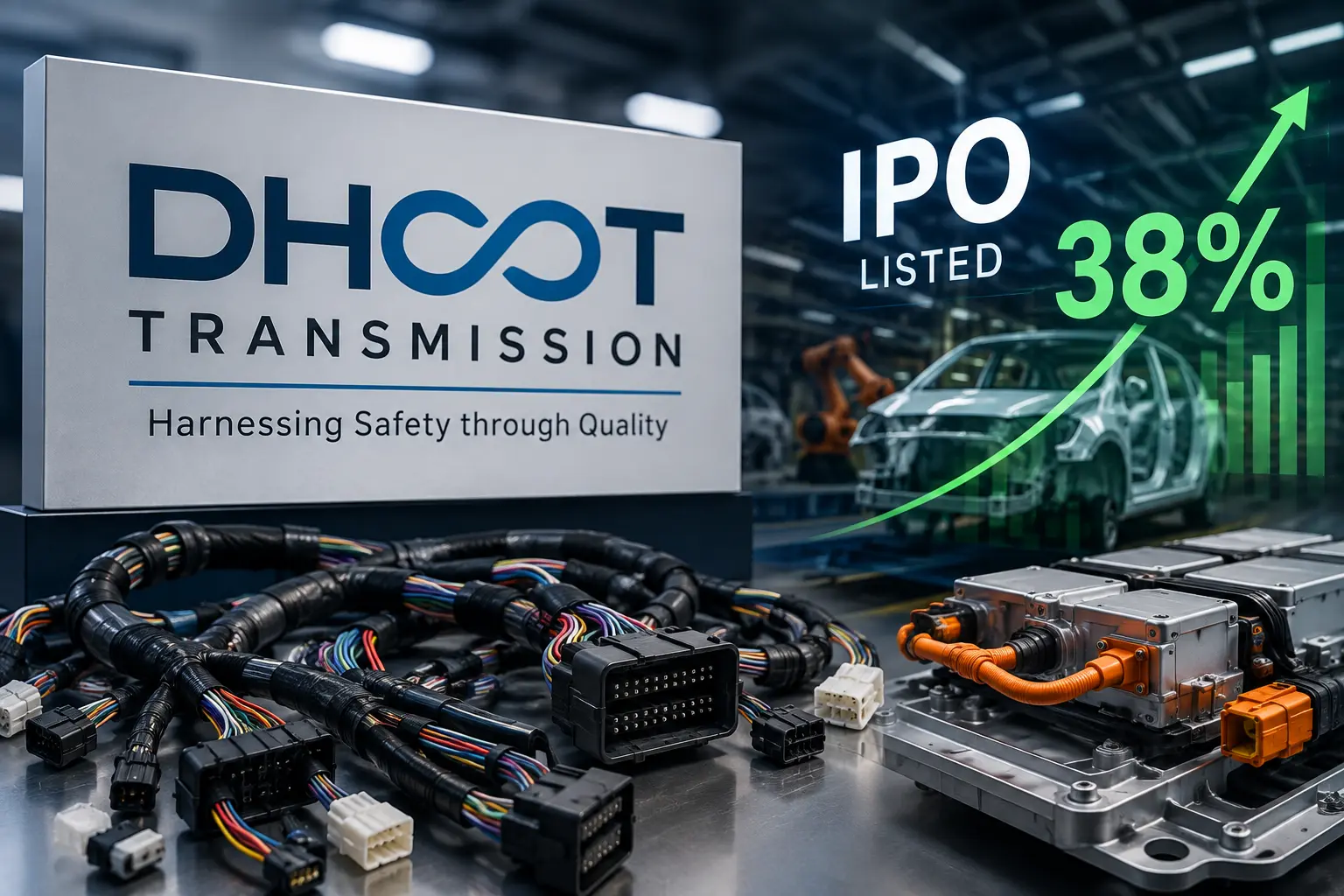
Dhoot Transmission IPO made a strong stock-market debut on August 17, 2026, with the company’s shares listing at a premium of nearly 38% over the issue price. The automotive component manufacturer, known for producing wiring harnesses and a range of electrical and electronic systems for vehicles, has attracted significant attention not only because of its strong listing but also because of its growing exposure to vehicle electrification.
Dhoot Transmission shares listed at ₹1,200 on the NSE against an issue price of ₹871, representing a premium of about 37.8%. The stock subsequently rose as much as 38.3% during the session, giving the company a market value of around $2.47 billion at one point. The strong debut followed heavy demand for the IPO, while the company plans to use the proceeds for areas including debt repayment, investment in a subsidiary, a new manufacturing plant and potential acquisitions.
For the automotive industry, however, the more interesting story is what sits behind the IPO. Dhoot Transmission operates in a part of the vehicle supply chain that consumers rarely see but which is becoming increasingly important as cars, motorcycles and commercial vehicles become more electronic, connected and electrified.
Read More: 2026 Skoda Slavia Facelift Launch
Dhoot Transmission IPO Listing: What Happened?
The Dhoot Transmission IPO received substantial demand before its market debut, with the issue reportedly subscribed 74.21 times. That demand set the stage for a strong listing on the NSE and BSE, with the shares opening substantially above the ₹871 issue price.
The company’s strong first-day performance is significant in the context of India’s renewed primary-market activity, but the initial share-price movement should not be treated as an indication of future returns. For Ride And Tech, the more relevant question is why an automotive component manufacturer has generated such strong market interest and what its business tells us about the changing Indian automotive ecosystem.
Dhoot Transmission is positioned around electrical and electronic components that are becoming increasingly important in modern vehicles. Its business therefore gives us a useful look at the supply-chain side of India’s automotive transformation.
What Does Dhoot Transmission Make?
Dhoot Transmission is an automotive component manufacturer with a product portfolio that includes wiring harnesses, electronic sensors and controllers, automotive switches, cables, connectors and terminals. The company also has capabilities related to battery packs and high-voltage interconnection systems, making its business relevant to both conventional and electric vehicles.
Wiring harnesses remain the company’s core business. According to its IPO documentation, wiring harnesses accounted for 77.15% of revenue from operations for the nine months ended December 31, 2025. The company’s business is particularly exposed to two-wheelers and three-wheelers, which together form an important part of its Indian automotive customer base.
Its disclosed customer base includes major automotive manufacturers such as Bajaj Auto, TVS Motor Company, Honda Motorcycle and Scooter India and Royal Enfield. Bajaj Auto was the company’s largest customer, contributing 33.21% of revenue from operations during the nine months ended December 31, 2025.
This customer base is important because it places Dhoot Transmission directly inside the manufacturing ecosystem of some of India’s largest two-wheeler and three-wheeler companies.
Why Wiring Harnesses Matter in Modern Vehicles
A wiring harness is essentially the electrical network that connects different components and systems within a vehicle. It carries electrical power and signals between components, allowing systems ranging from lighting and sensors to control units and displays to communicate and operate correctly.
The importance of wiring harnesses has increased as vehicles have become more technologically advanced. Modern vehicles contain considerably more electronic equipment than older models, including multiple control units, cameras, sensors, infotainment systems, driver-assistance technologies and connected features.
The shift toward electric vehicles takes this development even further. EVs require high-voltage electrical connections for the battery and motor systems while also retaining low-voltage electrical architecture for conventional vehicle electronics. This creates opportunities for component manufacturers that can develop the necessary wiring, connectors, controllers and other electrical systems.
Dhoot Transmission’s stated capabilities around high-voltage interconnection systems, battery packs, sensors and electronic controllers therefore become particularly relevant as India’s EV market expands.
Dhoot Transmission and the EV Opportunity
The electric-vehicle transition is often discussed in terms of batteries, charging stations, driving range and vehicle prices. However, the transformation is much broader because almost every part of the automotive supply chain is being affected by electrification.
Traditional vehicle architectures depend heavily on mechanical systems such as internal-combustion engines, transmissions and exhaust systems. EVs reduce the importance of some of those components while increasing the requirement for batteries, power electronics, high-voltage connections, sensors, controllers and sophisticated electrical systems.
That creates an opportunity for established auto component manufacturers in India to expand into higher-value products. Companies that can combine existing OEM relationships with new electrical and electronic capabilities may be able to participate in both the conventional vehicle market and the emerging EV ecosystem.
Reuters reported that Dhoot Transmission sees India’s transition toward electric vehicles as an important growth driver. The company’s expansion plans therefore need to be viewed against the broader transformation taking place across the Indian automotive industry.
Where Will the Dhoot Transmission IPO Money Go?
The IPO is also important because the capital raised is intended to support the company’s expansion rather than simply provide an exit opportunity for existing investors.
According to Reuters, Dhoot Transmission plans to use the approximately $146.5 million raised through the IPO for purposes including debt repayment, investment in a subsidiary, construction of a new manufacturing plant and potential acquisitions.
The company’s IPO documentation also outlines manufacturing expansion plans, including facilities in important automotive manufacturing locations such as Jhajjar in Haryana and Shoolagiri in Tamil Nadu. Dhoot Transmission had 22 operational manufacturing facilities, three engineering and design support centres and seven warehouses as of December 31, 2025, with operations in India and international locations.
For an automotive supplier, manufacturing capacity is particularly important because vehicle manufacturers expect suppliers to maintain consistent quality, production volumes and delivery schedules. Expanding closer to major OEM production hubs can also help suppliers reduce logistics costs and improve responsiveness.
What the Dhoot Transmission IPO Means for India’s Auto Component Industry
The biggest takeaway from the Dhoot Transmission IPO debut is not simply the nearly 38% first-day gain. The more important development is the attention being placed on an automotive supplier operating in electrical systems, wiring harnesses and EV-related technologies.
India’s automotive industry is moving toward vehicles with higher electronic content, greater connectivity and increasing electrification. This transition requires a much broader supplier ecosystem, including companies producing batteries, power electronics, wiring systems, sensors, controllers and other advanced components.
Dhoot Transmission represents one part of that ecosystem. Its established relationships with major vehicle manufacturers give it an existing customer base, while its expansion into electrification-related technologies provides a potential route toward higher-value products.
At the same time, the company faces challenges. Its IPO documents highlight significant dependence on major customers and the two-wheeler sector, while wiring harnesses remain a substantial part of its revenue. That means continued customer relationships, technology development and successful capacity expansion will remain important to its long-term performance.
Why the EV Supply Chain Matters
The growth of electric vehicles is creating opportunities throughout the automotive supply chain, not only for companies producing complete vehicles.
An EV requires high-voltage wiring, connectors, battery-related electrical systems, sensors, controllers and other components that are either less important or different from those used in conventional vehicles. As EV adoption increases, suppliers with the ability to manufacture these components at scale could become increasingly important to automakers.
This is also relevant to India’s ambition to become a larger global automotive manufacturing hub. Producing more vehicles domestically is only one part of that ambition. A strong local component ecosystem is equally important because it can improve localisation, reduce supply-chain dependence and create opportunities for Indian manufacturers to participate in global vehicle programs.
The Dhoot Transmission story therefore reflects a broader trend: the future of India’s automotive industry will be shaped not only by car and motorcycle manufacturers, but also by the component companies building the electrical and technological foundation underneath them.
Read More: Pebble Beach Concours 2026
What Happens Next for Dhoot Transmission?
The strong IPO debut gives Dhoot Transmission a high-profile start as a publicly listed company, but its longer-term success will depend on how effectively it executes its expansion strategy.
The company will need to balance investment in new manufacturing capacity with continued support for its existing OEM customers. It will also need to expand its technological capabilities as vehicle manufacturers demand more advanced electrical and electronic systems.
Its ability to increase EV-related business while maintaining its established wiring-harness operations will be particularly important. The company also needs to manage the concentration risks associated with its largest customers, which are clearly highlighted in its IPO documentation.
For the broader India auto component industry, however, the direction is encouraging. Increasing vehicle electronics and electrification are creating new opportunities for suppliers that can move beyond traditional components and develop technologies required by the next generation of vehicles.
Frequently Asked Questions
What is Dhoot Transmission?
Dhoot Transmission is an Indian automotive component manufacturer that produces products including wiring harnesses, electronic sensors and controllers, automotive switches, cables, connectors and terminals. The company also has capabilities related to battery packs and high-voltage interconnection systems.
When did Dhoot Transmission shares list?
Dhoot Transmission shares were listed on the NSE and BSE on August 17, 2026. The stock opened at ₹1,200 on the NSE against an IPO issue price of ₹871.
At what price did Dhoot Transmission IPO list?
The IPO issue price was ₹871 per share, while the shares listed at ₹1,200 on the NSE, representing a premium of approximately 37.8%.
What does Dhoot Transmission manufacture?
Dhoot Transmission manufactures wiring harnesses, sensors and electronic controllers, automotive switches, cables, connectors and terminals, along with products and systems related to vehicle electrification. Wiring harnesses remain its largest product category.
Why is Dhoot Transmission important to the EV industry?
Electric vehicles require sophisticated electrical systems, including high-voltage connections, wiring harnesses, sensors and electronic controllers. Dhoot Transmission’s capabilities in these areas give it exposure to the expanding EV component ecosystem.
Which automakers are customers of Dhoot Transmission?
The company’s disclosed customer base includes Bajaj Auto, TVS Motor Company, Honda Motorcycle and Scooter India and Royal Enfield, among other customers. Bajaj Auto was its largest disclosed customer by revenue contribution for the nine months ended December 31, 2025.
What does the Dhoot Transmission IPO mean for India’s automotive industry?
The IPO highlights the growing importance of automotive component manufacturers as vehicles become more electronic and electrified. Dhoot Transmission’s business demonstrates how India’s EV transition is creating opportunities across the wider supply chain, including wiring, electrical systems, sensors and controllers.
Ride And Tech Verdict
Dhoot Transmission’s strong IPO debut is more significant for the automotive industry than the headline 38% listing gain alone. The company operates in an increasingly important part of the vehicle supply chain, where wiring harnesses, sensors, controllers and high-voltage electrical systems are becoming critical as vehicles become more connected and electrified.
The company’s EV-related capabilities and relationships with major vehicle manufacturers give it an interesting position as India’s automotive industry continues moving toward electrification. However, the IPO’s strong first-day performance should not be confused with a guarantee of long-term business or stock-market performance. The company’s ability to expand manufacturing capacity, develop higher-value products and maintain strong OEM relationships will ultimately determine its longer-term importance.
Ride And Tech’s verdict: Dhoot Transmission is a good example of how India’s automotive transformation is creating opportunities beyond car and motorcycle manufacturers. As EVs and electronic vehicle systems become more widespread, component suppliers capable of combining manufacturing scale with electrical and electronic expertise could become increasingly important to India’s automotive ecosystem.
Ride And Tech — Where Ride Meets Tech.
Drive Smarter. Ride Smarter.
Copyright (c) Ride And Tech. All rights reserved.

2 thoughts on “Dhoot Transmission IPO Debut: What Its 38% Surge Means for India’s Auto Component Industry”