


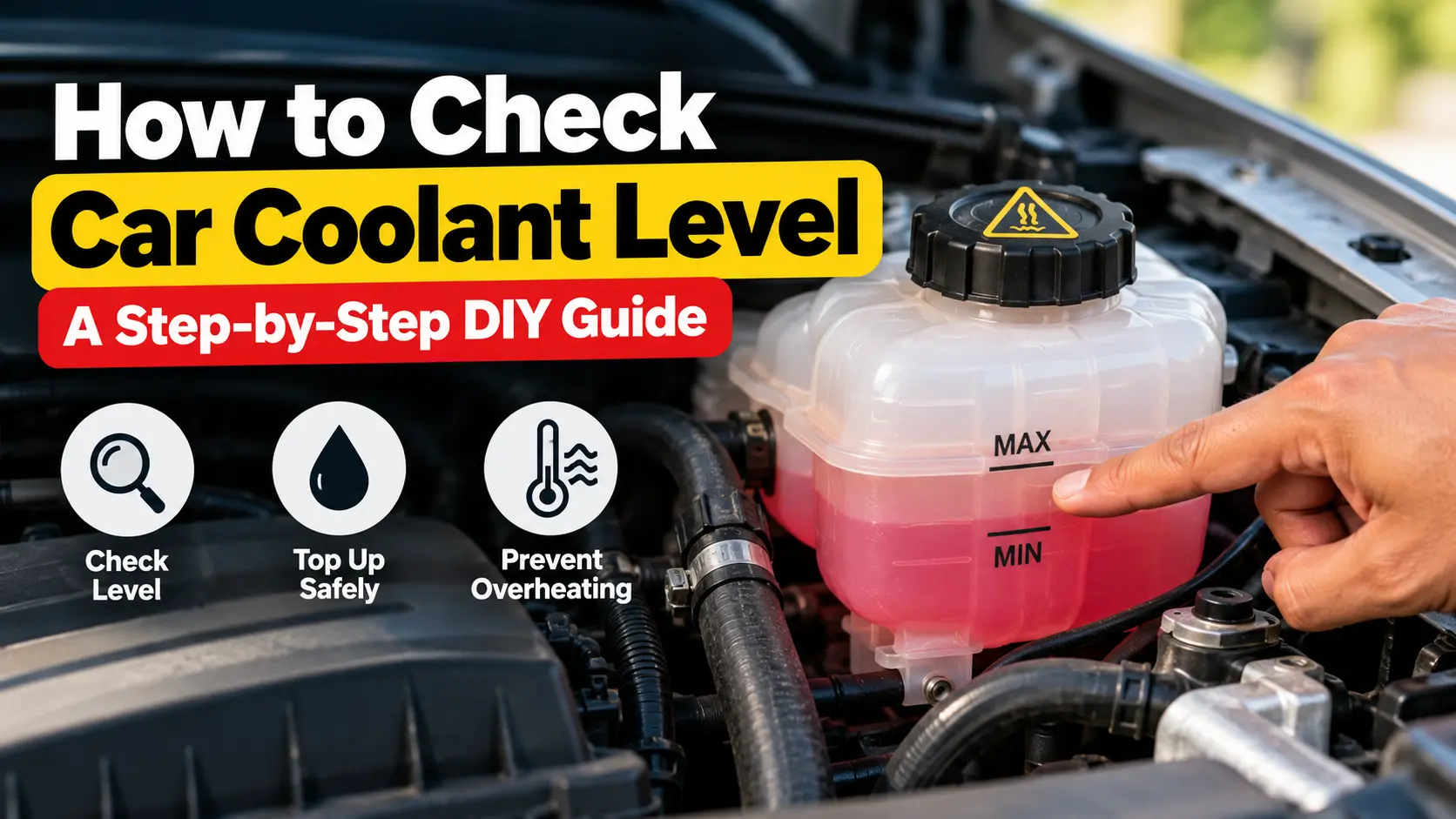
Your car’s engine generates an enormous amount of heat while running, and the cooling system has to manage that heat every time you drive. Whether you are dealing with everyday city traffic, a long highway journey or hot summer conditions in India, keeping an eye on coolant levels is a simple maintenance habit that can help you spot problems before they become expensive repairs.
Learning how to check car coolant level does not require advanced mechanical knowledge or a workshop visit. In most modern cars, you can inspect the coolant reservoir under the bonnet, check the level against the markings and identify whether the system needs attention. The important part is knowing what to look for, when to perform the check and which mistakes to avoid.
What Is Engine Coolant and Why Does It Matter?
Engine coolant is a specially formulated liquid that circulates through the engine and cooling system to help control operating temperature. It absorbs heat from the engine and carries it towards the radiator, where that heat can be released. Depending on the formulation, coolant also helps protect internal components against corrosion, deposits and freezing.
A car’s cooling system is designed to operate with the correct coolant type and concentration. If the level drops too low, the system may struggle to manage engine temperature, potentially leading to overheating and serious engine damage. Low coolant can also indicate a leak or another underlying problem, which is why topping it up without investigating repeated losses is not a complete solution.
Read More: How to Check Tyre Pressure at Home
When Should You Check Your Car’s Coolant Level?
It is sensible to inspect the coolant reservoir periodically, particularly before a long journey or when checking other basic fluids. You should also check it if you notice an unexplained rise in engine temperature, a coolant warning light, a sweet smell around the car or a coloured liquid beneath the engine bay. Follow the inspection interval and procedure recommended in your owner’s manual.
For a reliable reading, park on level ground and allow the engine to become completely cool. Coolant expands as it heats up, and the cooling system can remain pressurised after the engine is switched off. Never open a radiator cap or pressurised coolant reservoir cap while the engine is hot. Escaping steam or hot coolant can cause severe burns.
How to Check Car Coolant Level in 7 Steps
Checking coolant is straightforward when you follow the correct procedure. You do not need to dismantle anything or remove hoses; the first inspection usually involves the coolant reservoir and its level markings.
Step 1: Park on Level Ground and Switch Off the Engine
Park your car on a flat, stable surface, engage the parking brake and switch off the engine. If you have just driven the vehicle, wait until the engine and cooling system have cooled completely before proceeding.
A level surface helps you get a more reliable reading from the reservoir. Do not rush this step just because the bonnet feels cool; some cooling-system components can remain hot long after the engine has stopped.
Step 2: Open the Bonnet and Locate the Coolant Reservoir
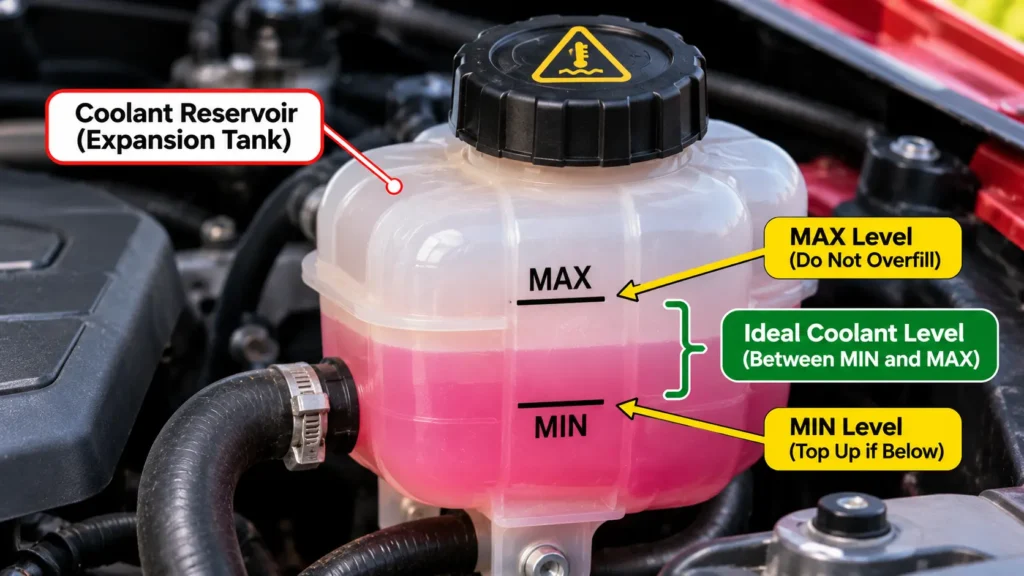
Release the bonnet using the lever inside the car, then open and secure it according to your owner’s manual. Look for a translucent plastic tank, usually with a coolant warning symbol or markings such as MIN and MAX. The tank may contain green, pink, orange, blue or another coloured coolant, depending on the formulation.
Do not confuse the coolant reservoir with the windscreen washer-fluid tank, which often has a windscreen-and-spray symbol. If you cannot confidently identify the correct container, consult the owner’s manual rather than opening a cap at random.
Step 3: Inspect the Coolant Level Against the MIN and MAX Marks
Once the engine is completely cool, look at the side of the reservoir and identify the minimum and maximum level markings. The coolant should normally sit between these marks when cold, although the exact checking procedure can vary by vehicle.
If the level is between MIN and MAX, it is generally within the marked range. If it is below MIN, the system may need topping up with the specified coolant. If the reservoir is empty, do not assume that adding liquid alone will solve the problem; arrange an inspection, especially if the engine has overheated or coolant has disappeared suddenly.
Step 4: Check the Coolant’s Appearance
While checking the level, take a look at the coolant visible through the reservoir. Its colour varies by product, so colour alone cannot tell you whether it is the correct coolant or whether it remains in good condition.
Be alert for an oily film, unusual sludge, heavy discolouration or visible debris. These signs may indicate contamination or a cooling-system problem and deserve professional attention. Do not open the reservoir simply to inspect the liquid more closely unless your vehicle’s manual specifically requires it and the engine is completely cool.
Step 5: Look for Signs of a Coolant Leak
A low reading becomes more concerning when you find other signs of coolant loss. Check the ground beneath the parked car for fresh liquid, and visually inspect accessible hoses and the area around the reservoir for wet patches, dried residue or damaged connections. Never reach near moving belts or fans, and remember that an electric cooling fan can start unexpectedly on some vehicles.
Coolant colour is not a reliable way to identify every leak because different products have different dyes, and other automotive fluids can also leave marks. If you notice a recurring drop in level, a persistent sweet smell or unexplained wetness, arrange a proper inspection rather than repeatedly topping up the reservoir.
Step 6: Top Up With the Correct Coolant if Required
If the level is below MIN and the owner’s manual permits a top-up, use coolant that meets the manufacturer’s specification for your exact car and engine. Some products are premixed and ready to use, while others require mixing with the specified type and quantity of water. Never assume that two coolants are compatible simply because their colours match.
With the engine completely cool, follow the manual’s instructions for the correct filling point and amount. Add the coolant carefully, bringing the level into the recommended range without exceeding MAX. Avoid spills, keep the fluid away from children and pets, and close the cap securely when finished. Manufacturer guidance also warns against using unsuitable water or coolant mixtures, which can compromise cooling-system protection.
Step 7: Recheck the Level and Monitor the Car
After topping up, confirm that the reservoir level remains within the recommended range and that the cap is properly secured. Wipe away any spilled fluid and make a note of the level if you want to monitor it over the following days.
A normal reading after a top-up does not prove that the cooling system is healthy. If the coolant level falls again, a temperature warning appears, steam comes from the engine bay or the engine starts overheating, stop driving as soon as it is safe to do so and seek professional help. Do not open the cooling system while it is hot.
Which Coolant Should You Use in Your Car?
The correct coolant depends on the manufacturer’s specification, the engine and the vehicle’s cooling-system materials. Different formulations use different additive technologies, so a coolant that works in one car may not be suitable for another. Check the owner’s manual or an authorised service centre’s recommendation before purchasing a product.
| Coolant option | What you should know |
|---|---|
| Manufacturer-specified coolant | The safest choice when it meets the exact required specification. |
| Premixed coolant | Ready to use when the product matches the manufacturer’s requirements. |
| Concentrated coolant | Must be diluted using the specified water type and mixing ratio. |
| Plain water | Not a suitable routine replacement for the required coolant mixture. In an emergency, follow your owner’s manual and seek assistance. |
Avoid choosing coolant based only on colour, and do not mix different formulations unless the manufacturer confirms compatibility. Using the wrong product or an incorrect concentration can reduce corrosion protection and affect the cooling system’s performance.
Read More: Road Rage in India
5 Common Mistakes to Avoid When Checking Coolant
1. Opening the cap while the engine is hot
Pressurised coolant and steam can escape and cause serious burns. Wait until the engine and cooling system are completely cool.
2. Ignoring the MIN and MAX markings
Guessing the level can lead to overfilling or overlooking a low reservoir. Read the markings under the conditions specified by the manufacturer.
3. Mixing coolant based on colour
Similar colours do not guarantee compatible chemical formulations. Match the product to the manufacturer’s specification.
4. Repeatedly topping up without investigating
A falling level can indicate a leak or another fault. Repeated coolant loss needs diagnosis rather than endless refilling.
5. Continuing to drive an overheating car
A low coolant reading or temperature warning should never be ignored. Stop safely and seek assistance instead of risking engine damage.
Warning Signs That Your Car May Have a Coolant Problem
Knowing how to check car coolant level is only part of routine maintenance. You should also recognise symptoms that suggest the cooling system needs attention.
- Engine temperature rises above normal: Stop somewhere safe and follow the vehicle’s overheating procedure.
- Coolant warning light appears: Check the dashboard message and owner’s manual; do not assume the warning is only about the reservoir level.
- Coolant keeps disappearing: Repeated losses can point to a leak or another cooling-system fault.
- Steam comes from under the bonnet: Pull over safely, switch off the engine and keep away from the hot cooling system.
- Unusual residue or oily contamination: Arrange a professional inspection to identify the cause.
If the engine overheats, do not continue driving simply because you have coolant available to add. Wait for professional guidance and never open a hot pressurised cooling system.
Frequently Asked Questions
1. How often should you check car coolant level?
Inspect it at the interval recommended in your owner’s manual and before long journeys when appropriate. Check it sooner if you notice a temperature warning, a suspected leak or an unexplained drop in the reservoir level.
2. Should the coolant level be checked when the engine is hot or cold?
For a typical coolant reservoir, check the level with the engine completely cool, following the vehicle manufacturer’s instructions. Coolant expands as it heats up, so readings can differ with temperature.
3. Can I add water instead of coolant?
Water alone is not a suitable long-term replacement for the specified coolant mixture. In an emergency, consult your owner’s manual for the correct procedure, then arrange to restore the recommended coolant mixture as soon as possible.
4. What happens if the coolant level is below MIN?
A level below MIN means you should investigate and top up as directed by the manufacturer. If the reservoir is empty, the engine has overheated or the level keeps falling, seek professional assistance instead of treating it as a routine top-up.
5. Can I drive if my car has a low coolant warning?
Do not ignore a low-coolant or overheating warning. Stop as soon as it is safe, switch off the engine if overheating is suspected and arrange assistance if the warning persists or the coolant level is very low.
6. Does coolant need to be replaced regularly?
Yes. Coolant has a manufacturer-specified service interval, which varies by vehicle and coolant type. Follow your maintenance schedule rather than assuming that coolant lasts forever or replacing it based on colour alone.
Ride And Tech Verdict
Learning how to check car coolant level is one of the simplest ways to become more confident with basic car maintenance. A quick inspection of the reservoir, a careful look at the MIN and MAX markings and attention to signs of leakage can help you spot developing problems before they leave you stranded.
The key is to avoid treating coolant as just another fluid to top up whenever the level drops. Use the correct specification, check it when the engine is completely cool and take repeated coolant loss or overheating seriously. A few minutes of sensible inspection can help protect your engine, but persistent problems deserve a proper diagnosis rather than another bottle of coolant.
Ride And Tech — Where Ride Meets Tech.
Drive Smarter. Ride Smarter.
Copyright (c) Ride And Tech. All rights reserved.

1 thought on “How to Check Car Coolant Level: A Step-by-Step DIY Guide”