


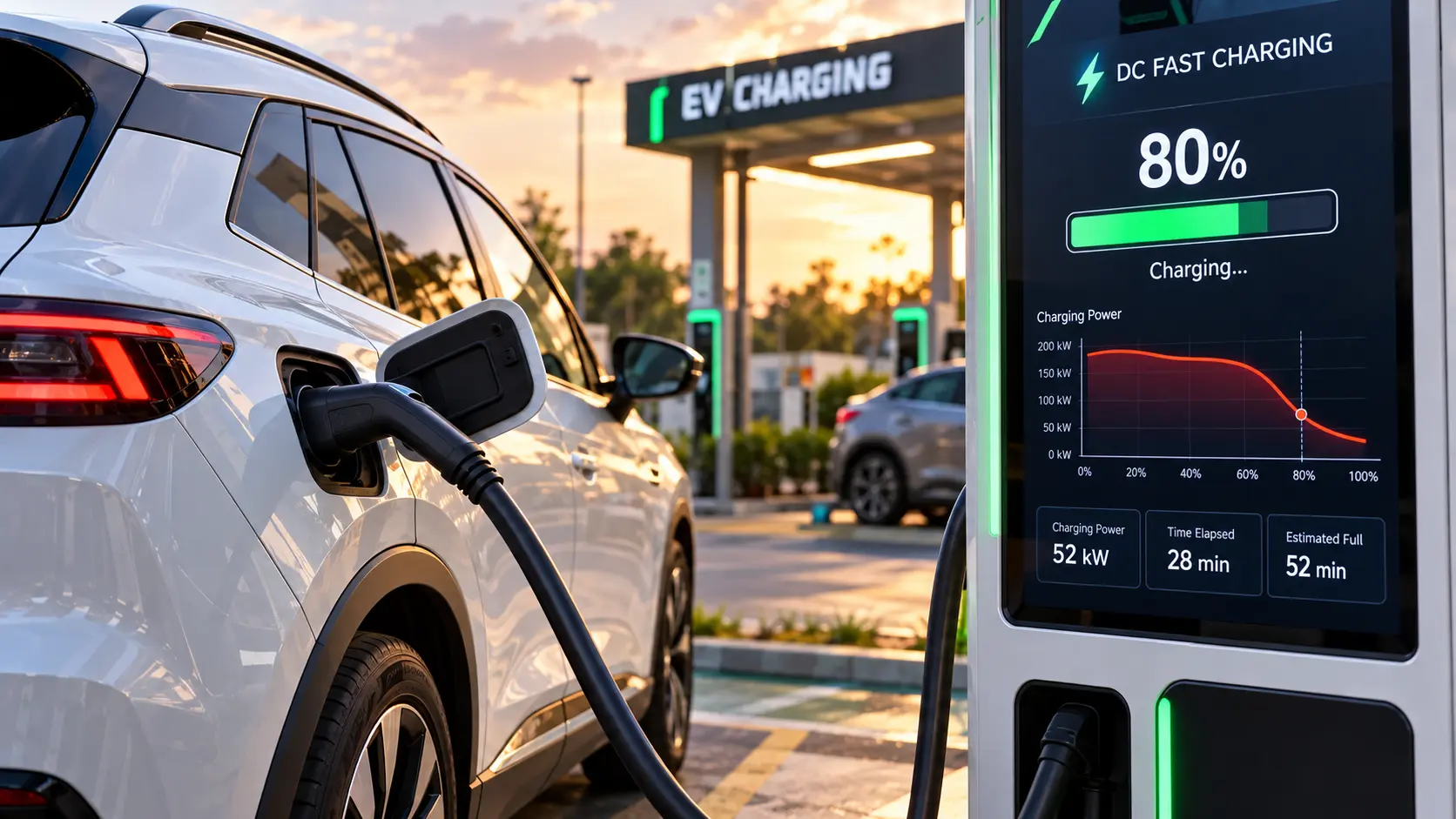
You plug your electric car into a powerful DC fast charger, watch the battery percentage climb quickly, and expect the same pace to continue until the battery reaches 100%. Instead, the charging speed begins to drop, and the final few percentage points seem to take much longer than expected. If you’ve experienced this, your car is most likely behaving exactly as designed.
The reason EV charging slows after 80% is closely connected to battery chemistry, temperature management and the way modern electric vehicles control charging power. As the battery approaches a higher state of charge, the vehicle gradually reduces the amount of power it accepts to keep the cells within their operating limits. The exact point at which this happens varies by vehicle, battery design and charging conditions.
For Indian EV owners, understanding this behavior can make a real difference during highway journeys. It helps explain why a car advertised with a 150kW or 180kW charging capability may not sustain that speed throughout a session, why charging from 80% to 100% can take disproportionately long, and when it makes sense to unplug and continue driving.
What Is an EV Charging Curve?
An EV charging curve describes how the power accepted by a vehicle’s battery changes as its state of charge increases. Instead of charging at a constant speed from empty to full, most electric cars follow a changing pattern in which charging power rises, reaches a peak or plateau, and then gradually falls as the battery fills.
State of charge, commonly abbreviated as SoC, is the battery’s current charge level expressed as a percentage. A reading of 20% means the battery is approximately one-fifth charged according to the vehicle’s battery-management calculations, while 80% indicates a substantially fuller battery.
When the battery has plenty of room to accept energy, the vehicle can often draw higher charging power. As the cells approach their upper voltage limits, the battery-management system reduces the charging current, producing the familiar slowdown that drivers notice during the final part of a fast-charging session.
Read More: AC vs DC Charging
7 Essential Facts About Why EV Charging Slows After 80%
1. Battery Chemistry Limits Charging Speed Near Full Capacity
Lithium-ion batteries cannot accept unlimited current at every stage of charging. As the cells fill, their voltage rises, and the battery must be charged more carefully to remain within the limits specified by its manufacturer.
This is why EV charging slows after 80% in many vehicles, particularly during DC fast charging. The battery-management system progressively reduces charging power as needed instead of continuing to push the same high current into a battery that is approaching its upper charge limit.
This behaviour is a normal part of battery operation rather than evidence that the charger has suddenly become defective. Some cars begin reducing power well before 80%, while others maintain relatively strong charging power beyond that point. The actual curve depends on the battery chemistry, pack design, temperature and vehicle software.
2. The Battery Management System Controls Charging Power
The battery-management system, or BMS, monitors important battery parameters and helps control how much charging power the pack can safely accept. Depending on the vehicle, this includes monitoring cell voltage, temperature and other operating conditions that influence charging limits.
When the battery is at a lower state of charge and within its preferred temperature range, the BMS may allow relatively high charging power. As the battery fills or operating conditions become less favourable, it can reduce the permitted power to protect the cells and maintain safe operation.
This means the charger’s advertised power rating is only part of the story. A 180kW charger cannot force every connected vehicle to accept 180kW continuously, because the car’s battery, charging hardware and control software determine the power the vehicle can actually use.
3. The Final 20% Can Take Much Longer Than Expected
The difference between charging the battery from 10% to 80% and charging it from 80% to 100% is not simply a matter of adding more minutes to the same charging speed. The charging rate can fall significantly as the battery approaches full capacity, making the last part of the session disproportionately slow.
Consider a purely illustrative example involving a 70kWh battery pack. Increasing the state of charge from 10% to 80% adds approximately 49kWh, whereas moving from 80% to 100% adds around 14kWh. Although the second stage requires much less energy, it can still take a substantial amount of time because the battery accepts power more slowly near full charge.
The important lesson is that charging time does not increase in direct proportion to the battery percentage. When planning a journey, the time needed to reach 80% may be a much more useful planning figure than the time needed to reach 100%.
4. Battery Temperature Can Make Charging Even Slower
Temperature is another important factor in EV charging performance. A battery that is too cold may not accept high charging power immediately, while a battery that becomes too hot during a fast-charging session may also need its charging rate reduced. The vehicle’s thermal-management system works to keep the battery within its permitted operating range.
This is particularly relevant during Indian summers, when a car may arrive at a charging station after a long highway drive in hot weather. The vehicle may need to manage battery temperature before or during charging, and the resulting charging speed may differ from the manufacturer’s best-case figure.
Some EVs offer battery preconditioning, which prepares the battery for charging before arrival at a compatible fast charger. If your vehicle supports this feature, using the built-in navigation or charging preparation function as instructed by the manufacturer may help improve charging performance when conditions require it.
5. The Charger’s Power Rating Is Not the Power Your Car Always Receives
A charging station advertised as 150kW, 180kW or 350kW does not guarantee that your car will receive that amount of power throughout the session. The vehicle must support the relevant charging capability, and the battery must be able to accept the power under the current conditions.
Charging power may also be limited by the station’s available output, the vehicle’s charging hardware, battery temperature, state of charge or power-sharing arrangements at the charging site.
For example, an EV capable of accepting a high peak charging rate may reach that rate only during a limited part of a session. As the battery percentage rises, its charging curve can bring the power down even when the charger itself is capable of delivering more.
This is why comparing EVs solely by their maximum advertised charging power can be misleading. The charging curve and the time required to complete a practical charging window are often more useful indicators of highway usability.
6. Charging from 80% to 100% Is Not Always the Best Highway Strategy
When travelling long distances, waiting for the battery to reach 100% at every stop may increase the total journey time. If the charging speed has already dropped significantly, unplugging at a lower percentage and continuing to a suitable next charger can sometimes be faster overall.
The best stopping point depends on the car’s range, the distance to the next reliable charger, road conditions and the availability of charging stations along the route. Drivers should not leave a charger at 80% simply because it is a popular recommendation if doing so would leave insufficient range or an inadequate safety margin for the next leg.
For Indian highway travel, it is sensible to consider the next charging location, traffic, air-conditioning use, elevation changes and any detours. A slightly longer charging stop may be worthwhile if the next station is far away or its availability is uncertain.
7. Charging to 100% Can Still Be Useful
The slowdown does not mean that charging to 100% is always wrong. A full charge can be useful before a long journey, particularly when the next charging point is distant or when you need the maximum available range. The important distinction is between charging to full when it serves a purpose and routinely waiting for 100% during every fast-charging stop.
Battery-care recommendations also vary by vehicle and battery chemistry. Some manufacturers recommend a lower daily charge limit for particular battery types, while others permit or recommend periodic full charging for specific battery-management or range-estimation purposes. Follow the instructions for your exact model rather than applying one percentage limit to every EV.
For everyday use, setting a suitable charging target can help balance convenience and battery care. Before a long trip, you can raise that target when additional range is genuinely needed, provided you follow the manufacturer’s guidance.
Is It Normal for EV Charging to Slow After 80%?
Yes, a reduction in charging power at a high state of charge is normal for many electric vehicles, especially during DC fast charging. The battery-management system may lower the accepted power to keep cell voltage and temperature within permitted limits as the battery approaches full capacity.
However, the number 80% should not be treated as a universal trigger. A vehicle may start reducing charging power earlier, and the size of the reduction depends on the model, battery temperature, charger and other conditions. The vehicle’s displayed charging power and manufacturer guidance are more useful than assuming every EV should maintain peak power until exactly 80%.
If charging becomes unusually slow at low battery levels, repeatedly fails to reach expected performance under suitable conditions, or produces an error message, it is worth investigating further. Check the charger, cable connection, vehicle settings and battery temperature, and contact the service provider or vehicle manufacturer if the problem persists.
Read More: ADAS Calibration Explained
How to Make EV Charging Stops Faster
The most effective approach is to plan around the vehicle’s charging curve instead of assuming that the advertised peak power will remain available throughout the session. A few practical steps can help reduce unnecessary waiting, especially during long journeys.
- Arrive with a suitable battery percentage: If route planning and charger availability permit, arriving at a fast charger with a lower state of charge can allow the vehicle to spend more of the session in a faster part of its charging curve.
- Use battery preconditioning when supported: Follow your vehicle’s instructions to prepare the battery before arriving at a compatible fast charger, particularly when temperature conditions could limit charging.
- Choose a compatible charger: Check the connector, vehicle charging limit and station power before starting the session. A higher-rated station is not automatically faster for every vehicle.
- Plan the next charging stop: Use the vehicle’s navigation or a reliable charging map to estimate whether you need to charge beyond 80% before leaving.
- Avoid waiting for 100% without a reason: If the next stop is accessible and the remaining range is sufficient, continuing the journey may save time compared with waiting through the slow final part of the session.
- Follow your battery-care instructions: Use the manufacturer’s recommended daily charging limit and full-charge guidance rather than applying a universal rule to every battery.
These steps cannot guarantee a particular charging time, because temperature, battery condition, charger availability and vehicle design all matter. They can, however, help you make more informed charging decisions and reduce time spent waiting when the journey allows it.
FAQs About EV Charging Slows After 80%
Why does EV charging slow after 80%?
Charging power often decreases as the battery approaches a high state of charge. The battery-management system reduces the accepted current as needed to keep the cells within their voltage and temperature limits, so charging the final portion takes longer.
Does every electric car slow down at exactly 80%?
No. Eighty per cent is a useful general reference point, not a fixed threshold for every EV. The charging curve varies by vehicle, battery design, temperature, state of charge and charger conditions, and some cars begin reducing power well before 80%.
Is charging from 80% to 100% bad for the battery?
Not necessarily. Charging to 100% can be appropriate when you need the range or when the manufacturer recommends it for your vehicle. The best routine depends on the battery chemistry and manufacturer guidance, so use the recommended daily charging limit and full-charge instructions for your specific EV.
Why is my EV charging slowly even at 30%?
A low state of charge does not guarantee peak charging power. A cold or hot battery, a charger with limited output, a vehicle-specific charging limit, power sharing or another system condition may reduce the rate. If charging remains unusually slow across suitable conditions, consult your vehicle manufacturer or charging provider.
Should I unplug my EV at 80% on a highway trip?
Often, charging to around 80% can be a time-efficient strategy if the next charger is accessible and you have enough range to reach it safely. But if the next station is far away, unreliable or requires a larger reserve, charging beyond 80% may be the more sensible choice.
Does AC charging also slow down after 80%?
AC charging often follows a different pattern because the onboard charger and the vehicle’s charging controls determine the rate, and the power level is typically much lower than DC fast charging. The amount of slowdown depends on the vehicle and its charging strategy, so the dramatic taper commonly seen during DC fast charging may be less noticeable during home charging.
Ride And Tech Verdict
Understanding why EV charging slows after 80% helps drivers separate normal battery behaviour from a possible charging problem. The slowdown is usually part of the vehicle’s strategy for managing the battery safely as it approaches a higher state of charge, although the exact charging curve differs from one EV to another.
For everyday charging, follow the manufacturer’s battery-care recommendations and set a suitable target for your usage. On highway journeys, focus on the time required to reach the next useful charging level rather than automatically waiting for 100% at every stop.
Ultimately, a good EV charging strategy is not about keeping the charging display at its highest number for as long as possible. It is about understanding your car’s charging curve, preparing the battery when appropriate and choosing the right stopping point for the journey ahead.
Ride And Tech — Where Ride Meets Tech.
Drive Smarter. Ride Smarter.
Copyright (c) Ride And Tech. All rights reserved.

1 thought on “Why EV Charging Slows After 80%: 7 Essential Facts Explained”