


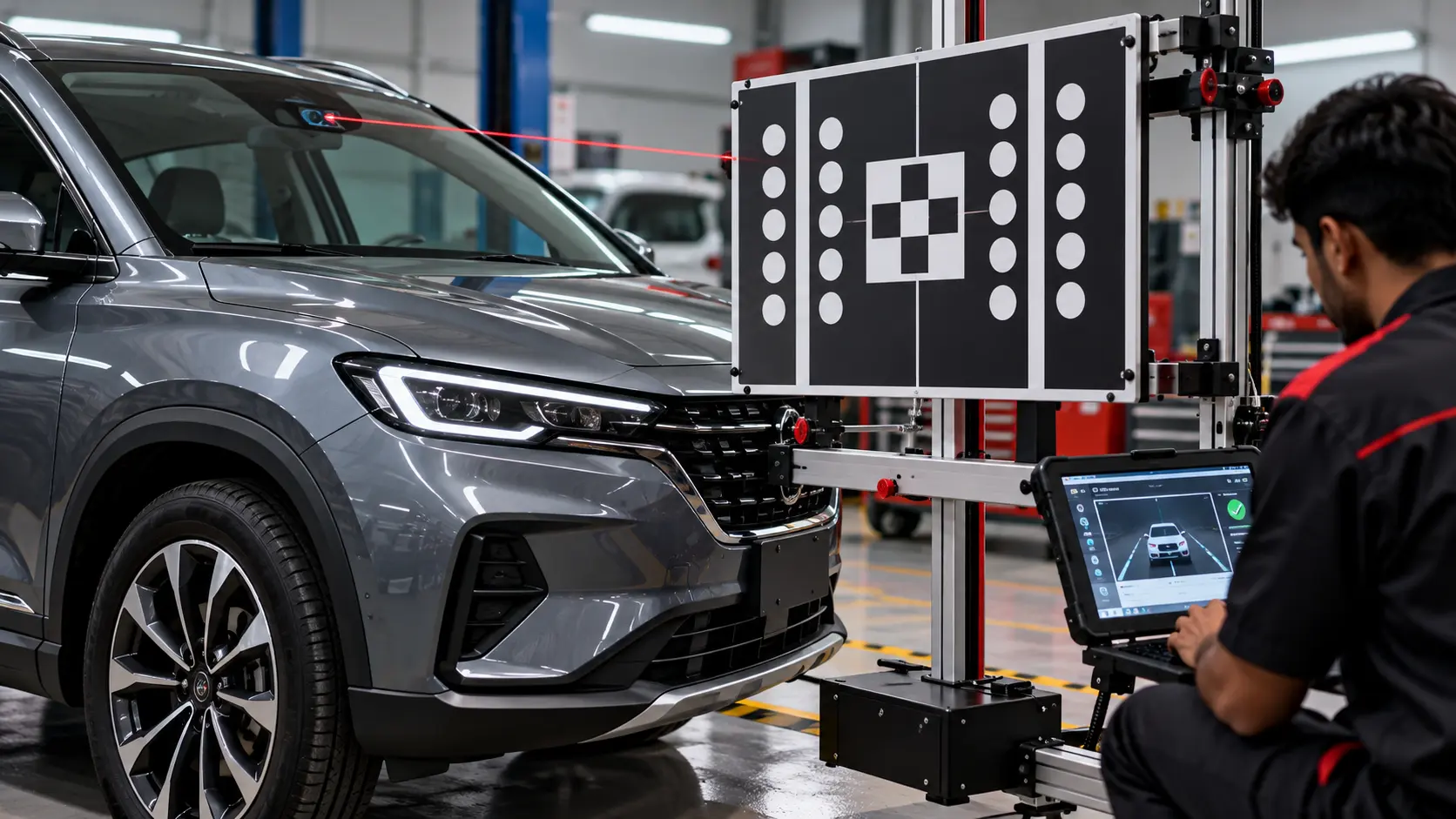
Modern cars can warn drivers about potential collisions, help maintain lane position and apply emergency braking when certain conditions are met. But these advanced safety features depend on more than software alone. Their cameras, radar sensors and other components must be positioned and configured according to the vehicle manufacturer’s specifications to interpret the road accurately.
This is where ADAS calibration becomes important. After certain repairs or changes to a vehicle, its Advanced Driver Assistance Systems (ADAS) may require calibration to ensure that the sensors and cameras are correctly aligned and that the systems can operate as intended.
For Indian car owners, this is an increasingly relevant part of vehicle maintenance as more cars arrive with features such as lane departure warning, adaptive cruise control, forward collision warning and automatic emergency braking. Understanding when calibration may be needed can help you ask the right questions at the workshop and avoid assuming that a warning-free dashboard automatically means every safety system is functioning correctly.
What Is ADAS Calibration?
ADAS calibration is the process of setting up or adjusting a vehicle’s driver-assistance cameras, radar sensors and related systems according to the manufacturer’s specified reference points, angles and procedures. Depending on the vehicle, technicians may use special targets, diagnostic equipment, alignment measurements or a controlled road drive to complete the process.
These sensors help the vehicle interpret its surroundings. A forward-facing camera may identify lane markings and road users, while radar can help measure the distance and relative speed of vehicles ahead. Some cars combine information from multiple sensors, so the calibration requirements can be more complex than simply adjusting one camera.
The purpose of ADAS calibration is to help the relevant systems interpret their environment as designed. It does not make a car autonomous, guarantee that every hazard will be detected or replace the driver’s responsibility to observe the road and remain in control.
Read More: ADAS Explained: 10 Features Every Car Buyer Should Know in 2026
Why Does ADAS Calibration Matter?
Driver-assistance systems rely on measurements and observations from sensors installed at specific locations. If a camera or radar unit is displaced, replaced or disturbed during certain repairs, its view or reference position may no longer match the manufacturer’s requirements.
Even a small alignment error can matter because these systems make decisions using information about lane position, distance, direction and the movement of other road users. The actual effect of an error depends on the vehicle, sensor and system involved; it should not be assumed that every misalignment produces the same symptom.
Proper ADAS calibration helps restore the required sensor alignment or configuration after work that calls for it. It is therefore part of the repair process on applicable vehicles, rather than an optional feature enhancement or a substitute for fixing a damaged component.
7 Essential Things Car Owners Must Know About ADAS Calibration
1. Windshield Replacement Can Require Camera Calibration
Many modern cars have a forward-facing ADAS camera mounted behind the windshield, often near the rear-view mirror. This camera may support lane departure warning, lane-keeping assistance, traffic sign recognition and other driver-assistance functions.
When the windshield is replaced, the camera may need to be removed and reinstalled, or its position relative to the glass may change. In such cases, the manufacturer’s repair procedure may require ADAS calibration before the affected features can be considered correctly set up. Bosch’s calibration guidance specifically identifies windshield replacement as a common reason for camera calibration.
However, not every glass repair automatically requires the same procedure. The requirement depends on the vehicle, the camera mounting arrangement and the manufacturer’s instructions. Before approving a windshield replacement, ask the workshop whether your car requires calibration and whether it is included in the quotation.
2. Collision and Bumper Repairs May Affect Sensors
Radar sensors and other ADAS components may be mounted behind a front grille, inside a bumper or at other locations around the vehicle. A collision can damage a sensor, alter its mounting position or affect nearby components even when the external damage appears relatively minor.
After an accident, the workshop should inspect the affected ADAS components and consult the manufacturer’s repair procedure. Depending on the damage and the work performed, the vehicle may need diagnostic checks, sensor replacement, calibration or a combination of these steps. Bosch identifies collision repairs and sensor-related work among situations that can call for calibration.
Do not assume that a repaired bumper means every safety system behind it is functioning correctly. If your car has automatic emergency braking, adaptive cruise control or blind-spot monitoring, ask whether the relevant sensors were inspected and whether any required calibration was completed.
3. Wheel Alignment or Suspension Work Can Affect Calibration Requirements
ADAS systems interpret the road in relation to the vehicle’s position and movement. Work that changes suspension geometry, steering alignment or ride height can affect the reference conditions used by certain driver-assistance systems.
That does not mean every wheel alignment automatically requires ADAS calibration. The correct procedure depends on the vehicle manufacturer’s instructions, the system fitted and the specific repair performed. Bosch’s technical guidance lists wheel alignment and suspension-related work among possible calibration triggers, while vehicle-specific procedures determine what is actually required.
If your car has lane-keeping assistance or other camera- or radar-based features, tell the workshop before suspension or alignment work begins. The technician can check the applicable service information and determine whether additional inspection or calibration is necessary.
4. Static and Dynamic Calibration Are Different
There are two widely used approaches to ADAS calibration: static calibration and dynamic calibration. Some vehicles require one method, while others require both, depending on the sensors and manufacturer procedure.
Static calibration
The vehicle remains stationary in a suitable workshop while technicians position calibration targets or reflectors at specified distances and heights. Diagnostic equipment guides the process, and the workshop environment may need to meet requirements for floor level, lighting and target placement.
Dynamic calibration
The technician follows a prescribed driving procedure while diagnostic equipment guides the system through its calibration or learning process. Conditions such as road markings, speed and weather can matter, depending on the vehicle-specific instructions.
A workshop should not choose a method simply because it is faster or more convenient. The manufacturer’s procedure determines whether static calibration, dynamic calibration or a combination is appropriate for the vehicle.
5. Calibration Requires Suitable Equipment and Trained Technicians
ADAS calibration is not simply a matter of clearing a dashboard warning or adjusting a camera by eye. The process can require a compatible diagnostic tool, manufacturer-specific targets, accurately positioned equipment and the correct vehicle service information.
For example, Bosch’s calibration systems use dedicated fixtures and targets to help technicians position equipment for particular camera and radar procedures. The required setup varies by vehicle and system.
A workshop should also follow the relevant prerequisites, which may include checking tyre pressures, vehicle alignment, sensor mounting and diagnostic fault codes. If the vehicle does not meet the conditions specified by the manufacturer, calibration may fail or may not produce a valid result.
When choosing a repair centre, ask whether it has the equipment and technical information needed for your specific make and model. A general diagnostic scan alone should not be treated as proof that a required calibration has been completed successfully.
6. Warning Lights and Unusual Behaviour Should Not Be Ignored
Some vehicles display an ADAS warning when a camera or sensor is obstructed, a system fault is detected or calibration is incomplete. Others may disable particular assistance features or display a message explaining that a system is temporarily unavailable.
Warning messages can have several causes, including dirty camera areas, poor visibility, sensor damage, electrical faults or a calibration issue. A warning by itself does not establish which component is responsible, so diagnosis should precede assumptions about what needs replacing.
If a warning appears after windshield replacement, bumper repair or other relevant work, return to the workshop and request an inspection. If the vehicle reports that a safety feature is unavailable, do not rely on that feature until the problem has been resolved. Continue driving only when it is safe and consistent with the vehicle’s instructions; arrange assistance if the condition makes the vehicle unsafe to operate.
7. Always Ask for Proof That the Required Procedure Was Completed
Once the workshop has finished the repair, ask for confirmation of the calibration procedure and its result. This is particularly important when the work involved a windshield-mounted camera, radar sensor, collision repair or another component covered by the manufacturer’s calibration instructions.
A useful service record should identify the vehicle, the work performed, the calibration method used where applicable, and whether the procedure completed successfully. If diagnostic scans or a calibration report are available, keep a copy with your service records.
Do not settle for a vague statement that the system was checked if the manufacturer required an actual calibration. Conversely, calibration is not automatically necessary after every repair, so the workshop should be able to explain the applicable requirement rather than recommending it without a technical basis.
Read More: How to Check Tyre Pressure at Home: 7 Essential Steps
When Is ADAS Calibration Required?
There is no universal rule that every ADAS-equipped car must be recalibrated after every repair. The requirement depends on the make, model, year, installed systems and the exact work performed.
The following table summarises common situations in which calibration may need to be assessed. It is a guide for owners, not a substitute for the manufacturer’s repair instructions.
| Repair or situation | What the workshop should check |
|---|---|
| Windshield replacement | Whether the forward-facing camera or another system requires calibration |
| Camera or radar replacement | Required setup, programming and calibration procedures |
| Collision or bumper repair | Sensor damage, mounting position and manufacturer requirements |
| Suspension or ride-height changes | Whether the altered geometry affects relevant systems |
| Wheel alignment | Whether the vehicle-specific procedure calls for ADAS checks or calibration |
| ADAS warning after repair | Diagnostic faults, sensor condition and any incomplete calibration |
The key is to connect calibration to the repair actually performed. A careful inspection and the correct service information are more reliable than applying one blanket rule to every car.
How Much Does ADAS Calibration Cost in India?
The cost of ADAS calibration varies with the vehicle, the system involved, the calibration method and the workshop’s equipment. A camera-only procedure may involve different work from a job requiring radar calibration, multiple sensors, diagnostic repairs or both static and dynamic procedures.
The final quotation may also depend on whether calibration is being performed as part of a windshield replacement or collision repair, or as a separate service. If a sensor or bracket is damaged, the cost of replacing that component will be additional to any calibration charge.
Before approving the work, ask the workshop to explain what is included in the price. Confirm whether the quotation covers diagnostic checks, calibration, any required road procedure and a report showing the result. Since there is no single price that applies to every vehicle in India, obtain a quote based on your exact model and repair requirements.
Can You Drive If ADAS Calibration Is Pending?
The answer depends on the repair, the affected system, the vehicle manufacturer’s instructions and whether the car has any other damage or faults.
If a required calibration has not been completed, the affected driver-assistance features may not operate as intended. A warning-free dashboard should not be treated as proof that a system is correctly calibrated, and drivers should never assume that emergency braking or lane assistance will compensate for an unresolved problem.
Ask the workshop whether the vehicle is safe to return to the road and whether the manufacturer permits it to be driven before the procedure is completed. If the vehicle has structural damage, steering or braking problems, or a warning that makes driving unsafe, do not continue driving simply to reach a calibration centre. Arrange appropriate professional assistance instead.
How to Choose an ADAS Calibration Workshop
As more cars feature cameras, radar and driver-assistance technology, it is worth checking a workshop’s capabilities before booking a repair. The presence of an expensive calibration frame alone is not enough; the equipment, software and procedure must support the vehicle being serviced.
Before authorising the job, ask these questions:
- Does the workshop support the make, model and ADAS system fitted to my car?
- Has it checked the manufacturer’s requirements for the repair?
- Does the vehicle require static calibration, dynamic calibration or both?
- Will the workshop inspect relevant sensor mounts and diagnostic faults?
- Will I receive confirmation of the completed procedure and its result?
- If calibration fails, will the workshop explain the cause and next steps?
A qualified workshop should be able to answer these questions clearly and explain why the procedure is required for your vehicle. That is more valuable than choosing a service solely because it advertises the lowest price.
FAQs About ADAS Calibration
What does ADAS calibration mean?
ADAS calibration is the process of setting up a vehicle’s driver-assistance cameras, radar sensors or related systems according to the manufacturer’s specifications. It may be required after certain repairs, component replacements or changes that affect sensor positioning.
Is ADAS calibration necessary after windshield replacement?
It may be. Many cars have a camera mounted behind the windshield, and the manufacturer’s procedure may require calibration after the glass is replaced or the camera is disturbed. The exact requirement depends on the vehicle and the work performed.
What is the difference between static and dynamic calibration?
Static calibration is performed with the vehicle stationary using appropriately positioned targets or reflectors. Dynamic calibration uses a prescribed driving procedure to complete the required learning or calibration process. Some vehicles require one method, while others need both.
Does wheel alignment always require ADAS calibration?
No. Wheel alignment can affect calibration requirements on certain vehicles, but the requirement depends on the manufacturer’s instructions and the work performed. The workshop should check the vehicle-specific procedure rather than assuming calibration is always necessary.
Can ADAS calibration be done at home?
Professional calibration may require dedicated targets, precise measurements, suitable workshop conditions and compatible diagnostic equipment. Owners should not attempt to align safety-critical sensors by eye or use improvised targets. Follow the manufacturer’s requirements and use a suitably equipped technician.
How long does ADAS calibration take?
There is no universal time. Duration depends on the vehicle, the sensors involved, the calibration method, workshop conditions and whether additional repairs or diagnostic work are needed. Ask the service centre for an estimate based on your car and the procedure it requires.
Does ADAS calibration guarantee that safety systems will work perfectly?
No. Calibration helps establish the required sensor alignment or configuration, but it cannot eliminate every limitation or guarantee that a system will detect every hazard. Drivers must continue to pay attention, follow road rules and remain responsible for controlling the vehicle.
Ride And Tech Verdict
ADAS calibration is an important part of maintaining modern driver-assistance systems when a repair or component change affects their setup. Replacing a windshield, repairing a collision-damaged area or working on suspension components can trigger additional requirements, but the correct procedure must always be confirmed for the specific vehicle.
For Indian car owners, the most useful habit is to ask about ADAS before approving relevant repairs. Confirm whether calibration is required, ensure the workshop follows the manufacturer’s procedure, and keep the completion report with your service records whenever one is provided.
Above all, remember that driver-assistance technology is there to support the person behind the wheel, not replace them. Properly completed repairs and calibration can help the systems operate as designed, but safe driving still depends on attention, judgement and responsible control of the vehicle.
Ride And Tech — Where Ride Meets Tech.
Drive Smarter. Ride Smarter.
Copyright (c) Ride And Tech. All rights reserved.

1 thought on “ADAS Calibration Explained: 7 Essential Things Car Owners Must Know”