



The Mercedes-Benz GLC Electric is coming to India at a particularly important moment for the luxury EV market. Mercedes-Benz has confirmed that bookings for its new electric SUV will open in the first week of October 2026, with the India launch scheduled for the end of the year. More importantly, the GLC Electric will be locally assembled in India, making its arrival far more significant than another imported luxury EV quietly joining the market.
The India-bound Mercedes-Benz GLC Electric will initially be offered in the GLC 400 4MATIC specification, pairing two electric motors with all-wheel drive, a 94kWh battery and a claimed WLTP range of up to 715km. With 360kW of peak output, 800Nm of torque and a 0–100km/h time of 4.3 seconds, it has the numbers to appeal to buyers who expect an electric SUV to be as entertaining as it is efficient.
But the specification sheet is only part of the story. The Mercedes GLC Electric is arriving in India unusually quickly after its European introduction, while local assembly could allow Mercedes-Benz to position it more aggressively than a fully imported luxury EV. That combination of timing, technology, performance and localisation could make the GLC Electric one of the more important premium electric SUVs to arrive in India in 2026.
Mercedes-Benz GLC Electric India Launch: What Has Mercedes Confirmed?
Mercedes-Benz has confirmed that bookings for the GLC Electric will begin in the first week of October 2026, while the SUV is scheduled to go on sale in India by the end of 2026. The company has not yet announced an exact launch date, so there is no reason to attach a specific day to the launch at this stage.
What makes the announcement more interesting is the speed of the programme. Mercedes-Benz says the India-bound GLC Electric will arrive as a locally assembled model roughly six months after European sales began, making it the fastest global Mercedes-Benz model to reach India in an assembled form according to the company. That is a meaningful change from the longer localisation timelines traditionally associated with global luxury vehicles.
The Indian market will initially get the Mercedes GLC 400 4MATIC Electric, rather than a wide range of variants. It combines a dual-motor powertrain with all-wheel drive and will be offered in the standard-wheelbase configuration, with a 2,972mm wheelbase. Mercedes does sell a longer-wheelbase GLC Electric in China, but India will not receive that version at launch.
Read More: BMW 7 Series and i7 Launched in India
Mercedes GLC 400 4MATIC: Performance That Means Business
The Mercedes GLC 400 4MATIC is not being positioned as a slow, efficiency-first luxury SUV. Its two electric motors produce a combined 360kW, equivalent to roughly 489bhp, while maximum torque stands at 800Nm. Mercedes quotes a 0–100km/h acceleration time of just 4.3 seconds and a top speed of 210km/h.
Those figures are particularly impressive when you remember what the GLC Electric actually is: a substantial luxury SUV weighing more than 2.5 tonnes in this specification. Electric motors deliver their torque almost instantly, allowing the GLC 400 4MATIC to combine the quietness expected from a premium EV with acceleration that belongs in performance-car territory. The result should feel considerably more energetic than the traditional image of a large family-oriented SUV suggests.
The all-wheel-drive system also gives the Mercedes GLC Electric a useful advantage in terms of traction. Rather than relying solely on rear-wheel drive for efficiency, the dual-motor configuration allows Mercedes to deliver strong acceleration while maintaining four-wheel traction when conditions demand it. For Indian buyers who want a luxury SUV that can handle both city driving and long-distance highway use, that broader capability matters.
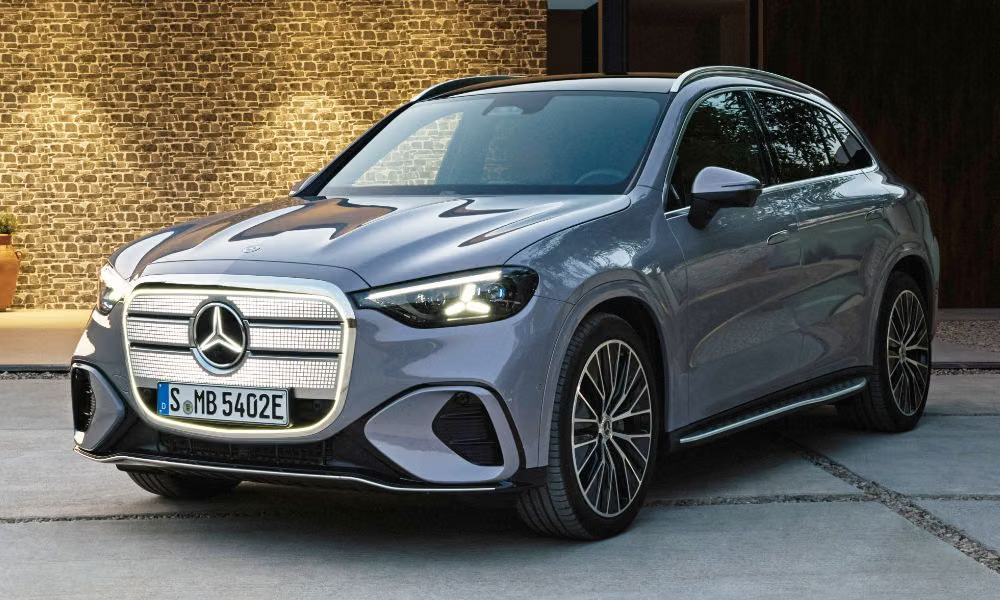
94kWh Battery and Up to 715km WLTP Range
At the heart of the GLC Electric is a 94kWh usable lithium-ion battery using NMC cell chemistry. Mercedes-Benz says the cells use silicon oxide mixed with graphite in the anodes, while the proportion of cobalt has been reduced compared with the previous battery generation. The battery architecture has also been developed with servicing and repair considerations in mind, rather than treating the pack simply as a sealed performance component.
The headline figure is an up to 715km WLTP range, which immediately puts the Mercedes GLC Electric among the more interesting long-range luxury EVs heading for India. However, 715km should not be interpreted as a guaranteed real-world driving range. Mercedes’ technical data gives a WLTP range band of 568–715km depending on configuration and conditions, while actual Indian driving range will vary with speed, traffic, temperature, road conditions, tyre choice, load and use of the climate-control system.
That distinction is important because range figures can easily become the center of an EV launch story without explaining what they actually mean. The more useful takeaway is that the Mercedes GLC Electric has a large battery and an efficient electric architecture designed to make long-distance travel substantially easier. For buyers considering an electric luxury SUV for regular highway use, that matters more than simply chasing the biggest number on a specification sheet.
800V Architecture and 330kW Charging
The charging technology may ultimately be just as important as the battery itself. The Mercedes GLC Electric uses an 800-volt electrical architecture, allowing the GLC 400 4MATIC to accept DC fast charging at up to 330kW. Mercedes says a 10–80 percent charge can take approximately 22 minutes under the specified conditions.
The company also says the SUV can add as much as 305km of WLTP range in 10 minutes under suitable charging conditions. AC charging is available at up to 11kW as standard, with 22kW AC charging available depending on specification and market. These figures will obviously depend on the charger and the infrastructure available, but the underlying hardware gives the GLC Electric the ability to take advantage of high-powered charging stations as India’s premium charging network develops.
This is one area where the Mercedes GLC Electric could have a genuine advantage over luxury EVs that rely on less powerful charging systems. A large battery is useful for long journeys, but fast replenishment is what makes that battery genuinely convenient. If Mercedes can pair the GLC Electric with a strong ownership and charging support ecosystem in India, the combination could significantly reduce the practical compromises associated with switching from an ICE luxury SUV to an EV.
A 39.1-Inch MBUX Hyperscreen Dominates the Cabin
Inside, the biggest visual talking point is the 39.1-inch MBUX Hyperscreen stretching across the dashboard. The single seamless display combines the driver’s instrument cluster, central infotainment screen and passenger display into one large digital interface, giving the GLC Electric a distinctly high-tech character. Mercedes describes it as the largest display it has fitted to a production vehicle.
The technology goes beyond screen size. The latest MBUX system brings artificial intelligence functionality from Microsoft and Google, along with Mercedes-Benz’s Multi-Agent Approach for its virtual assistant. Google Cloud’s Automotive AI Agent is also integrated for navigation-related functions, allowing the system to handle more complex requests rather than functioning purely as a conventional voice-control system.
Interestingly, Mercedes has not completely abandoned physical controls in the pursuit of a digital cabin. The GLC Electric retains physical buttons and controls for several functions, providing a useful contrast to some modern EV interiors that attempt to place almost everything behind a touchscreen. That balance could prove important for an SUV whose owners may value technology without wanting every basic function to require interaction with a display.
AIRMATIC, Rear-Wheel Steering and More Than Just Straight-Line Speed
The Mercedes-Benz GLC Electric also brings chassis technology normally associated with larger and more expensive Mercedes models. AIRMATIC air suspension with intelligent suspension control is part of the technical package, while rear-wheel steering can reduce the turning circle from 12.1 metres to 11.2 metres when equipped.
Rear-wheel steering is particularly relevant for India because the GLC Electric is not a small SUV. Being able to turn the rear wheels in the opposite direction at lower speeds can make tight parking areas, narrow urban streets and multi-storey car parks easier to negotiate, while the system can also contribute to stability at higher speeds. It is the sort of feature that sounds less exciting than 489bhp but can become far more noticeable during everyday ownership.
The SUV also uses Mercedes-Benz’s One-Box braking system, combining regenerative and friction braking into a single braking system for a more consistent pedal response. Regenerative braking can deliver up to approximately 300kW, while different recuperation modes allow the driver to alter how aggressively the vehicle recovers energy during deceleration.
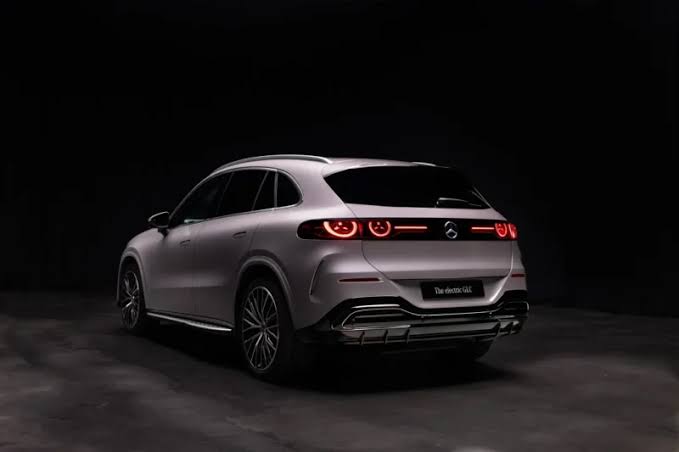
Why Local Assembly Could Change the GLC Electric’s Story
Local assembly is arguably the most important India-specific aspect of the Mercedes GLC Electric. Mercedes-Benz is not simply importing the SUV as a completely built unit and testing whether customers will accept its price; the company is bringing the model into local production relatively quickly after its global introduction. That gives Mercedes greater flexibility when positioning the SUV against other premium electric models.
The company has indicated that the GLC Electric could eventually account for as much as 50 percent of the GLC lineup’s sales, which reveals how seriously Mercedes-Benz views the electric version. Mercedes-Benz India currently sees EV demand as meaningful but constrained partly by vehicle availability, making the GLC Electric an important addition to a portfolio where the company expects the SUV format to play a major role.
Local assembly does not automatically guarantee a low price, of course. The final figure will depend on localisation levels, equipment, taxes, battery costs and Mercedes-Benz India’s positioning strategy, but assembling the GLC Electric in India gives the company a very different starting point from a fully imported luxury EV. That could be the key to turning the GLC EV from an interesting technology product into a meaningful volume contributor.
Mercedes GLC Electric Price: What Can We Expect?
Mercedes-Benz has not officially announced the Mercedes GLC Electric price in India. Current industry expectations put the SUV somewhere around the ₹80 lakh to ₹90 lakh ex-showroom mark, while a Financial Express report citing Mercedes-Benz India’s positioning puts the expected price at around ₹80–85 lakh. These figures should be treated as estimates until Mercedes-Benz formally announces the price.
If Mercedes manages to keep the GLC Electric within that territory, the positioning becomes particularly interesting. Buyers would be looking at a locally assembled luxury electric SUV with nearly 500bhp, 800Nm, all-wheel drive, a 94kWh battery, 800V charging hardware and a claimed WLTP range of up to 715km. That does not make the SUV inexpensive, but it could make the technology package look compelling within the premium EV market.
The price will also determine how aggressively Mercedes can challenge upcoming rivals. A few lakh rupees either way could change the GLC Electric from a strong-value luxury EV into another premium product competing mainly on badge and technology. For that reason, the official price may be almost as important as the specification sheet when the SUV finally launches.
Mercedes GLC Electric vs BMW iX3: The Rivalry to Watch
The most interesting upcoming competitor is likely to be the BMW iX3, which is expected to reach India in 2027. BMW’s next-generation electric SUV will bring the Neue Klasse technology package and is expected to be offered in a long-wheelbase configuration for India, creating a very direct comparison with the Mercedes GLC Electric.
That gives Mercedes a useful timing advantage. If the GLC Electric launches by the end of 2026 and BMW follows with the iX3 in 2027, Mercedes could establish itself in the segment before its closest German rival arrives. The comparison will eventually come down to more than range, though, because both brands are pushing software, charging technology, cabin space and electric efficiency as major parts of their next-generation product strategies.
The Audi Q6 e-tron will also be relevant to the broader luxury electric SUV conversation, while larger models such as the Volvo EX90 occupy a higher part of the market. But the GLC Electric has the advantage of an established nameplate, local assembly and a familiar SUV footprint, which could make it more accessible to existing luxury-car customers considering their first EV.
Why the GLC Electric Matters to Mercedes-Benz India
The most interesting part of this launch is not that Mercedes-Benz has developed another electric SUV. Every major luxury manufacturer is doing that now. What matters is that Mercedes appears to be using one of its strongest existing SUV nameplates to make the transition towards electric mobility more mainstream within its own customer base.
The GLC already has recognition among Indian luxury SUV buyers, and the electric version does not ask customers to completely change their idea of what a Mercedes SUV should be. It retains the premium positioning, familiar GLC identity and SUV practicality, while replacing the combustion powertrain with a considerably more sophisticated electric architecture. That makes the transition less radical from a customer’s perspective.
There is also a broader strategic signal here. Mercedes-Benz India has chosen to bring the GLC Electric ahead of an electric C-Class because the company believes the SUV format is better aligned with Indian demand. If the strategy works, the GLC could become one of the models that helps move luxury EVs from a niche purchase into a genuine alternative to petrol and diesel luxury SUVs.
Read More: BMW i5 LWB Launched in India at ₹79.6 Lakh
What We Still Don’t Know
There are still several pieces of the Mercedes-Benz GLC Electric India story that should be left open until the launch. The official ex-showroom price has not been announced, nor has Mercedes-Benz published every detail of the India-specific equipment list. Some features and technology available globally may vary by market or trim, so global specifications should not automatically be treated as confirmed Indian equipment.
The exact launch date is also still pending. Mercedes has only confirmed that the GLC Electric will launch by the end of 2026, with bookings beginning in the first week of October. That is enough to establish the timeline without guessing a date that Mercedes itself has not announced.
The real-world range in India is another question that can only be answered after proper testing. The 715km figure is a WLTP maximum claim, and Indian conditions can be considerably different from the controlled testing environment used to establish that figure. Until independent road tests are available, it is better to treat 715km as a useful benchmark rather than a promise of how far every owner will travel on a full charge.
Frequently Asked Questions
When will Mercedes-Benz GLC Electric bookings open in India?
Mercedes-Benz has confirmed that bookings for the GLC Electric will open in the first week of October 2026. The SUV itself is scheduled to launch in India by the end of 2026.
When will the Mercedes GLC Electric launch in India?
The Mercedes GLC Electric is scheduled to launch in India by the end of 2026. Mercedes-Benz has not yet announced a specific launch date.
What is the Mercedes GLC Electric range?
The GLC 400 4MATIC has a claimed up to 715km WLTP range. Mercedes’ technical data gives a broader WLTP range band of 568–715km depending on configuration and conditions, so actual range will vary.
What battery does the Mercedes GLC Electric use?
The India-bound GLC 400 4MATIC uses a 94kWh usable NMC battery. The battery uses silicon-oxide and graphite anode technology and forms part of Mercedes-Benz’s new 800V electric architecture.
How powerful is the Mercedes GLC 400 4MATIC Electric?
The dual-motor GLC 400 4MATIC produces 360kW, or approximately 489bhp, and 800Nm of torque. Mercedes quotes a 0–100km/h time of 4.3 seconds.
How quickly can the Mercedes GLC Electric charge?
The GLC 400 4MATIC supports DC charging at up to 330kW. Mercedes quotes approximately 22 minutes for a 10–80 percent charge under suitable conditions.
Will the Mercedes GLC Electric be locally assembled in India?
Yes. Mercedes-Benz has confirmed that the GLC Electric will be locally assembled in India, with the company highlighting the unusually short timeline between the model’s European sales launch and Indian local production.
What will the Mercedes GLC Electric price be in India?
Mercedes-Benz has not announced the official price yet. Current industry estimates place it around ₹80–90 lakh ex-showroom, while some reporting expects a positioning closer to ₹80–85 lakh. The final price will only be confirmed at launch.
Which cars will compete with the Mercedes GLC Electric?
The upcoming BMW iX3 is expected to be one of its most direct rivals in India, particularly once BMW introduces its next-generation electric SUV in 2027. The Audi Q6 e-tron and other premium electric SUVs will also form part of the broader competitive landscape.
Ride And Tech Verdict
The Mercedes-Benz GLC Electric arrives in India with more than an impressive specification sheet. Its 94kWh battery, up to 715km WLTP range, 800V architecture, 330kW charging capability and 489bhp dual-motor powertrain give it the technical credentials to compete seriously with the next generation of luxury electric SUVs. The 39.1-inch MBUX Hyperscreen, AI-enabled software, AIRMATIC suspension and rear-wheel steering add the kind of technology and sophistication expected from a modern Mercedes-Benz.
But the bigger story could be what happens underneath the badge. By bringing the GLC Electric to India within months of its European introduction and assembling it locally, Mercedes-Benz is signalling that it does not want electric SUVs to remain a small, imported corner of its Indian business. If the final price lands around the expected ₹80–90 lakh mark and the India-spec equipment remains competitive, the GLC Electric could become one of the most convincing luxury EV alternatives to conventional petrol and diesel SUVs in the country.
For Mercedes-Benz, that could make the GLC Electric much more than another EV. It could become the model that proves a familiar luxury SUV nameplate can carry buyers from combustion power to electric power without asking them to compromise on performance, technology or premium appeal.
Ride And Tech — Where Ride Meets Tech.
Drive Smarter. Ride Smarter.
Copyright (c) Ride And Tech. All rights reserved.
