


If there is one question that still makes plenty of prospective EV buyers hesitate, it is not how quickly an electric car accelerates or how much it costs to charge. It is the battery. After all, the battery is the heart of an EV, and replacing a large traction pack sounds like the sort of bill nobody wants to discover halfway through ownership.
The good news is that the reality is considerably less dramatic than some of the internet’s battery horror stories suggest. Modern EV battery life is generally much better understood than it was when the first wave of mass-market electric cars arrived, and real-world data is beginning to show how these batteries actually age outside the laboratory. Geotab’s latest analysis of more than 22,700 EVs across 21 makes and models found average battery degradation of around 2.3% per year.
But that number needs some context. Battery degradation is a gradual loss of usable capacity, not a countdown to sudden failure. How quickly it happens can depend on charging behaviour, temperature, battery chemistry, vehicle use and the way the manufacturer manages the pack.
So, how long do EV batteries last in the real world? And does an EV battery really need replacing after eight or ten years?
The answer is more interesting than a simple number—and understanding the difference between battery ageing, degradation and outright failure is the key to figuring out how long your EV could realistically keep going.
Read More: Why Do Electric Cars Accelerate Faster Than Petrol Cars
How Long Do EV Batteries Actually Last?
There isn’t a single magic number for EV battery lifespan, because two identical electric cars can age quite differently depending on how they are charged, driven and kept cool. Still, the evidence we have today is reassuring. The U.S. Department of Energy says current EV batteries may last around 12 to 15 years in moderate climates, with climate, charging patterns, battery chemistry and thermal management all influencing the result. Many manufacturers also offer battery warranties around eight years or 100,000 miles, although the exact coverage varies by vehicle and market.
Real-world data paints an equally interesting picture. Geotab’s analysis of more than 22,700 EVs found an average degradation rate of 2.3% per year, and its modelling suggests the average battery would retain around 81.6% of its original capacity after eight years. That doesn’t mean every EV will follow the same curve—some models perform considerably better, while others degrade faster—but it gives us a useful indication of what modern batteries are capable of.
And here’s the bit that often gets lost in the battery-life debate: degradation isn’t the same thing as failure. An eight-year-old EV battery that has lost some of its original capacity can still have plenty of useful life left. You might notice reduced maximum range compared with when the car was new, but that is very different from the battery suddenly becoming unusable.
In fact, outright battery failure appears to be relatively uncommon in newer EVs. Data cited by the U.S. Department of Energy found that battery replacements caused by failure were well below 1% for model-year 2016–2023 vehicles outside recalls.
So if you’re wondering how long do EV batteries last, the sensible answer isn’t simply “eight years” or “15 years”. A modern battery pack can potentially remain useful for well beyond the period covered by its warranty, with its remaining capacity and condition being much more important than its age alone.
What Is EV Battery Degradation?
An EV battery doesn’t suddenly go from healthy to dead. Like any rechargeable lithium-ion battery, it gradually loses some of its ability to store energy as it ages. That process is known as EV battery degradation, and it is one of the most important things to understand when talking about long-term EV battery life.
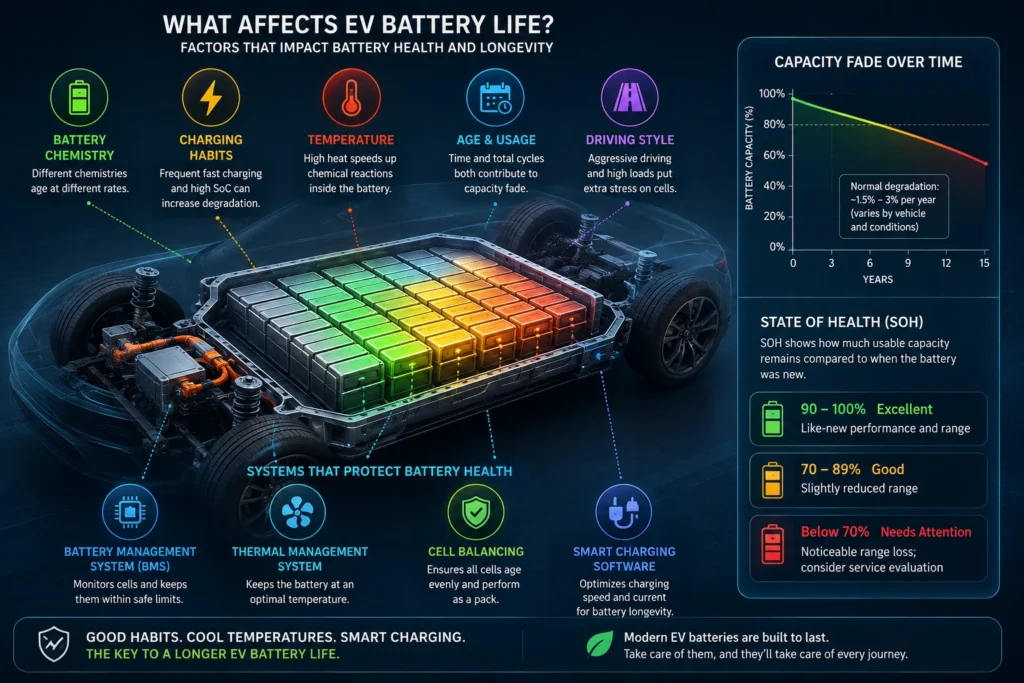
The easiest way to think about it is through state of health (SoH). A new battery effectively starts at 100% SoH, while a battery showing 90% SoH has lost roughly 10% of its original usable capacity. So, if an EV originally had a 60kWh usable battery, 90% health would mean roughly 54kWh of usable energy remains. The result is usually less driving range between charges rather than some dramatic change in the way the car drives.
And degradation isn’t necessarily a straight line. Some batteries experience a more noticeable drop during their early years before the rate settles down, while others can maintain relatively stable performance for a long period. Geotab’s latest real-world analysis found an average degradation rate of 2.3% per year across more than 22,700 EVs, but the rate varied considerably between models and operating conditions.
That variation is important because quoting one universal EV battery degradation rate can be misleading. Battery chemistry, thermal management, charging behaviour and the way a particular vehicle is used all play a part. A well-managed battery in a temperate climate may age very differently from one that spends much of its life exposed to extreme heat and frequent high-power charging.
There is also a useful distinction between losing capacity and losing the ability to drive the car. An EV with 80% of its original battery capacity hasn’t suddenly reached the end of its life; it simply won’t travel as far on a full charge as it did when new. In many cases, that remaining capacity can still be perfectly usable for years.
So when you’re assessing EV battery health, don’t think of the battery as having an on/off switch. Think of it more like the tread on a tyre: it gradually changes with use, and what matters is how much useful performance remains—not simply how old the component is.
What Causes EV Battery Degradation?
An EV battery ages for two broad reasons: time and use. Engineers generally describe these as calendar ageing and cycling ageing. The first happens simply because the battery exists and its chemistry changes over time; the second is linked to the repeated process of charging and discharging the cells. Temperature, state of charge and charging power can influence both processes, which is why two cars with similar mileage can end up with noticeably different EV battery health.
Heat is one of the bigger enemies. High temperatures can accelerate chemical reactions inside lithium-ion cells and increase the rate at which the battery loses usable capacity. That doesn’t mean parking an EV outside on a hot afternoon is going to ruin its battery, particularly when the car has an effective thermal-management system, but sustained exposure to high temperatures can contribute to faster ageing. Geotab’s real-world analysis found EVs operating in hotter climates degraded around 0.4 percentage points faster per year than those in milder conditions.
Charging behaviour matters too, although the reality is more nuanced than the usual internet advice of “never fast-charge your EV”. Geotab found that vehicles relying heavily on DC fast charging above 100kW experienced degradation rates of up to 3.0% per year, compared with around 1.5% for vehicles primarily using AC or lower-power charging. That’s a meaningful difference, but it doesn’t make rapid charging something EV owners need to fear; it suggests that frequent high-power charging can accelerate ageing compared with gentler charging patterns.
The same research also challenges another common battery myth. Keeping an EV at extremely high or extremely low states of charge for prolonged periods appears to be more significant than simply using a wide charging range occasionally. In other words, you don’t need to obsess over every percentage point on the battery gauge, but regularly leaving the car sitting near completely full or nearly empty isn’t ideal for long-term battery health.
Battery chemistry and thermal management add another layer to the story. Different lithium-ion chemistries behave differently under heat, charging and repeated cycling, while modern battery-management systems continuously monitor temperature and other parameters to keep the pack operating within safer limits. That’s one reason today’s EV battery life is considerably more complicated—and generally more reassuring—than simply counting the number of times a car has been charged.
Does Fast Charging Damage an EV Battery?
Fast charging has become one of the biggest talking points around EV battery life, and it is also one of the easiest areas to oversimplify. You will often hear that using a DC fast charger will “destroy” an EV battery, but that isn’t what the real-world evidence shows. Fast charging is a perfectly legitimate part of EV ownership; the question is how frequently you rely on it and under what conditions.
The latest Geotab analysis of more than 22,700 EVs found that vehicles making heavy use of DC fast charging above 100kW experienced degradation of up to around 3.0% per year, compared with roughly 1.5% annually for vehicles primarily using AC or lower-power charging. That’s a meaningful difference, but it doesn’t mean an occasional rapid charge is going to noticeably shorten the life of your battery.
In fact, the same research found that even vehicles frequently using high-power DC charging remained above the commonly used 70% capacity threshold over a typical eight-year warranty period when extrapolating from the observed rates. The important word here is frequently. If you normally charge at home using AC and use a fast charger when you’re travelling, the situation is very different from relying on 100kW-plus charging as your everyday routine.
There is good technical reasoning behind this. Higher charging power creates more heat and puts greater electrochemical stress on the cells, particularly when the battery is cold or already at a high state of charge. Research into charging strategies has found that high charging rates can accelerate ageing, while temperature and state of charge also influence how quickly degradation occurs.
That doesn’t mean you should drive past a perfectly good fast charger because you’re worried about your EV battery health. If you’re on a road trip and need to add 200km of range quickly, that’s exactly what the system was designed to do. The sensible approach is to use high-power charging when it provides a genuine benefit, while relying on slower AC charging when the car is parked for several hours or overnight.
Modern EVs also have sophisticated battery-management and thermal-management systems designed to control charging conditions. The car, rather than the driver, is constantly deciding how much power the battery can safely accept at a particular moment.
So, does fast charging damage an EV battery? It can contribute to faster degradation when used heavily and repeatedly, but occasional fast charging is not something owners need to fear. The better rule is simple: use the fastest charger when you need it, not simply because it is available.
Does Hot Weather Reduce EV Battery Life?
Heat is one of the biggest environmental factors to consider when talking about EV battery temperature and long-term battery health. Lithium-ion cells work best within a controlled temperature range, and prolonged exposure to high temperatures can accelerate the chemical reactions that contribute to capacity loss. That doesn’t mean an EV parked outside on a hot summer afternoon is quietly destroying its battery, but repeated exposure to elevated temperatures can add to long-term ageing.
This matters particularly in hot regions, where the battery-management system has to work harder to keep the pack within its preferred operating range. Modern EVs are generally much better equipped for this than early electric vehicles, with manufacturers using air, liquid or refrigerant-based thermal-management systems to control battery temperature. A recent review of EV thermal-management technologies found that liquid-cooling systems can substantially reduce peak battery temperatures compared with conventional air cooling.
The latest research also shows why simply saying “hot weather kills EV batteries” is far too simplistic. A 2026 study modelling different battery chemistries across different climates found that calendar ageing—the degradation that happens while a battery is simply sitting over time—accounted for between 62% and 83% of total capacity loss in its scenarios. The researchers also found that improving thermal management during parking could significantly extend predicted battery life, particularly in warmer climates.
So what does this mean for an EV owner in a hot country such as India? Mostly, it means the car’s thermal-management system matters enormously. You don’t need to treat sunlight as the enemy or spend your life hunting for the shadiest parking space, but avoiding prolonged extreme heat where practical and following the manufacturer’s charging and parking recommendations is sensible.
And there is another reason not to panic about climate. EV battery life is increasingly an engineering problem rather than something left entirely to the weather. Manufacturers can actively control battery temperature during driving and charging, and increasingly sophisticated thermal systems are designed specifically to keep cells away from conditions that accelerate degradation.
The takeaway is simple: heat can accelerate battery ageing, but a well-designed thermal-management system can make a huge difference. The battery pack isn’t simply at the mercy of the climate outside the car.
LFP vs NMC: Does Battery Chemistry Affect Lifespan?
Not all EV batteries age in exactly the same way, and one of the biggest reasons is the chemistry inside the cells. Two of the most common lithium-ion chemistries in modern electric cars are LFP (lithium iron phosphate) and NMC (nickel manganese cobalt). Neither is simply “better” across the board; they are designed around different compromises between energy density, cost, performance and longevity.
LFP has built a reputation for durability, and there is good reason for that. Research comparing battery chemistries generally finds LFP cells capable of significantly higher cycle life under comparable conditions, while their chemistry also offers strong thermal stability. NITI Aayog’s analysis of EV batteries in India, for example, describes LFP as having 2,000-plus cycles in first-life applications, compared with a lower cycle-life benchmark for NMC.
NMC, meanwhile, offers a different advantage: higher energy density. That allows manufacturers to package more usable energy into a given amount of space and weight, which is particularly useful for longer-range and performance-oriented EVs. The trade-off is that nickel-rich chemistries can be more sensitive to certain operating conditions and generally don’t offer the same cycle-life advantage as LFP.
But this is where battery discussions often go off the rails. A higher cycle-life rating doesn’t automatically tell you how many years a battery will last in an actual car. EV battery lifespan depends on far more than chemistry alone, including temperature, charging behaviour, depth of discharge, battery-management software and how the manufacturer operates the cells within their safe limits. Recent laboratory research has also found that different LFP and NMC cells can respond quite differently to temperature and charging conditions.
For buyers, the practical takeaway is simple: don’t choose an EV purely because it has LFP or NMC cells. Look at the complete package—battery warranty, thermal management, charging limits, expected usage and the manufacturer’s battery-health provisions. Battery chemistry matters, but the way the entire battery system is engineered matters just as much.
How Can You Make an EV Battery Last Longer?
The good news is that extending EV battery life doesn’t require treating your car like a fragile piece of laboratory equipment. Modern EVs have sophisticated battery-management systems that constantly monitor temperature, voltage and charging conditions, so much of the hard work happens without the driver even noticing. What you can do is avoid repeatedly putting the battery through conditions that are known to increase stress.
For everyday driving, following the charging limit recommended by the manufacturer is a sensible starting point. Many EVs allow owners to set a lower maximum charge for routine use, while reserving 100% for situations where the extra range is actually needed. VinFast, for example, recommends keeping daily charging around 20–80% for its vehicles, while Kia recommends limiting routine charging to 80% and minimising DC fast charging for optimal battery performance.
The same principle applies at the bottom end of the battery gauge. Regularly running an EV extremely low isn’t a great habit, particularly if the car is then left sitting for an extended period. Mahindra’s current EV manuals specifically warn against frequently allowing the battery to fall below 5% state of charge and recommend maintaining a reasonable charge level before leaving the vehicle unused for a long period.
Then there’s fast charging. There’s no reason to avoid a DC charger when you’re travelling and need to get back on the road quickly—that is exactly what it is there for. But if the car spends most of its life parked at home overnight, AC charging is generally the more sensible everyday option. Kia and Mahindra both make similar recommendations in their current EV guidance.
Temperature deserves attention too. Parking in a covered or shaded location when practical can reduce unnecessary heat exposure, particularly in very hot climates. More importantly, don’t override the vehicle’s thermal-management or charging protections simply to gain a few extra minutes of charging speed. The car’s battery-management system is there for a reason.
Perhaps the most important advice is not to become obsessed with the battery percentage. EV battery health is a long-term game. One fast charge, one trip to 100% or one particularly hot afternoon isn’t going to destroy a modern battery. The objective is to develop sensible habits over thousands of charging cycles, rather than worrying about every individual charging session.
How Do You Check the Health of a Used EV Battery?
This is where EV battery health becomes much more than a technical statistic. For someone buying a used electric car, the battery is arguably the most important component to investigate because you cannot judge its condition simply by listening to the motor or taking the car for a ten-minute test drive. A clean exterior and low odometer reading can tell you plenty about the car, but neither tells you how much capacity the battery has actually lost.
The number to look for is State of Health (SoH). It represents the battery’s current usable capacity compared with its original capacity. SoH should not be confused with State of Charge—the percentage you see on the dashboard when the car is plugged in. A battery can show 100% charge while having, for example, 85% of the capacity it had when new.
A proper EV battery health check can therefore be far more useful than simply charging the car to 100% and looking at the estimated range. A diagnostic report can provide the battery’s SoH and, depending on the vehicle and diagnostic system, additional information such as cell balance and charging history. Some manufacturers also provide battery-health information through their own diagnostic systems or connected services.
The important thing is to look at the number in context rather than treating a particular percentage as an automatic pass or fail. An older EV with 85% SoH and a healthy, transferable battery warranty could still be a very sensible purchase, while a newer car with unexplained degradation, poor service history or no reliable battery-health information deserves much closer scrutiny. Battery condition should also be considered alongside the vehicle’s original range, because losing 15% from a long-range EV is a very different proposition from losing 15% from a small-city EV.
For anyone shopping for a used electric car, the lesson is straightforward: don’t buy the odometer; buy the battery condition. Ask for a recent battery-health report, check the remaining battery warranty and confirm whether that warranty transfers to the next owner. If the seller cannot provide meaningful information about the pack, that uncertainty should be reflected in the price—or be enough reason to keep looking.
What Happens When an EV Battery Gets Old?
An EV battery reaching the end of its useful automotive life does not necessarily mean it has become useless. In fact, this is where the phrase “battery life” can become misleading. A pack may no longer deliver the range or performance an owner expects from a car while still holding enough capacity to be valuable somewhere else.
For an EV manufacturer, the point at which a battery is no longer suitable for its original vehicle application can depend on its remaining EV battery capacity, State of Health, safety condition and the demands of the vehicle. Some industry and government analyses use roughly 70–80% of original capacity as a practical threshold for considering a battery at the end of its first automotive life, but this isn’t a universal failure point. A battery with 75% capacity hasn’t suddenly stopped working; it simply may no longer make economic or practical sense in its original role.
That distinction opens the door to second-life EV batteries. A pack that has retired from a car can potentially be assessed, refurbished and reused in less demanding applications such as stationary energy storage. Individual modules can also be tested and repurposed where their condition makes that practical. Recent research continues to examine these second-life applications, although safety, standardisation, economics and reliable battery-health assessment remain important challenges.
And then there is recycling. Batteries that are too degraded, damaged or otherwise unsuitable for another application can be dismantled and processed to recover valuable materials. The objective is increasingly to extract as much useful life and material value from the battery as possible before it reaches genuine end-of-life.
This is an important point for anyone worried about EV battery replacement. An ageing battery doesn’t automatically mean that the entire pack needs to be thrown away and replaced. Depending on the fault and vehicle design, diagnostics may identify a problem at the cell or module level, while a healthy but degraded pack may still have years of useful service ahead of it.
So the end of an EV’s first battery life is better thought of as a change of job, rather than an instant retirement. The battery may leave the car, but its useful life doesn’t necessarily end there.
Are EV Batteries Really Expensive to Replace?
This is probably the question that makes the idea of long-term EV battery life feel slightly less reassuring. The battery is the most expensive single component in an electric car, so the thought of receiving a huge replacement bill after the warranty expires is enough to make any buyer hesitate. And yes, a complete out-of-warranty pack can be expensive—but that is not the same as saying every ageing EV eventually needs a new battery.
The first thing to understand is that EV battery replacement can mean several very different things. A battery pack is made up of cells and modules, monitored by a battery-management system, so a fault in one part doesn’t automatically mean the entire pack has to be discarded. Depending on the vehicle and the manufacturer’s repair strategy, a faulty module or other component may be repaired or replaced instead of fitting an entirely new pack. Current Indian EV repair guidance reflects this distinction, with module-level repairs generally costing far less than a complete pack replacement.
A full replacement is still a serious expense when it is genuinely required. Current Indian market estimates vary substantially by vehicle and battery size, with some smaller packs costing several lakh rupees and larger 50–60kWh packs potentially reaching much higher figures. These are best treated as indicative out-of-warranty figures, rather than a standard price for every EV, because labour, battery chemistry, parts availability and manufacturer repair policies can all change the final bill.
This is also where the EV battery warranty becomes enormously important. Many manufacturers cover their high-voltage batteries for around eight years or 160,000km, while some newer programmes go beyond that. However, the exact terms matter: some warranties specify a minimum battery capacity, while others distinguish between manufacturing defects and normal degradation. A buyer should therefore read the actual warranty conditions rather than relying on a headline “eight-year battery warranty.”
And there is another reason not to panic about the eventual replacement bill: most owners are unlikely to reach that point during normal ownership. Modern batteries are generally designed to remain useful for many years, and outright battery failure is relatively uncommon in newer EVs. If capacity gradually falls over time, the car can continue operating with reduced range rather than suddenly demanding a replacement pack.
So yes, an EV battery can be expensive to replace. But treating that worst-case bill as an inevitable ownership cost misses the bigger picture. Battery degradation, a repairable fault and complete battery failure are three different things—and only the last one potentially calls for replacing the entire pack.
What Happens When an EV Battery Gets Old?
An EV battery reaching the end of its useful automotive life does not necessarily mean it has suddenly become useless. In fact, that is one of the biggest misconceptions surrounding EV battery lifespan. A battery can lose enough capacity to make a car less practical while still containing plenty of useful energy and valuable materials.
There is no universal percentage at which every battery is officially “dead”. A pack may become unsuitable for its original vehicle application when its capacity, power delivery or reliability falls below what the manufacturer considers acceptable, but that doesn’t mean it has stopped working. Research into second-life batteries commonly looks at packs around the 70–80% capacity-retention range as candidates for applications that are less demanding than powering a car.
That creates an interesting second chapter. An EV battery that has reached the end of its first automotive life can potentially be refurbished and used for stationary energy storage, where weight and maximum power are less critical. A 2026 review of second-life EV batteries highlights applications ranging from energy storage to other less demanding uses, while also pointing out that safety assessment, refurbishment and reliable health testing remain important challenges.
There is also a fascinating engineering problem happening inside the pack itself. A recent Nature Energy study found that individual cells don’t necessarily age at exactly the same rate. As the weakest cells degrade faster, they can eventually limit the performance of the entire pack, meaning a battery pack may be retired before every individual cell has reached the end of its own useful life.
And when a battery really has reached the end of its useful life, recycling becomes the final step rather than simply throwing the pack away. Valuable materials can potentially be recovered and returned to the battery supply chain, reducing the need for completely new raw materials.
So the end of EV battery life is better viewed as a gradual transition than a cliff edge. First the car may lose some range, then the pack may eventually become less suitable for automotive use, and only later does it become a candidate for refurbishment, second-life storage or recycling. The battery’s story doesn’t necessarily end when its driving range does.
Read More: Ford’s New WEC Hypercar Takes Shape
Are EV Batteries Really Expensive to Replace?
This is probably the question that makes EV battery life feel a little less reassuring. The battery is the most expensive component in an electric car, so the idea of receiving a huge replacement bill after the warranty expires is enough to make any buyer hesitate. And yes, replacing an entire out-of-warranty pack can be expensive. But that is very different from saying every ageing EV will eventually need a brand-new battery.
The first thing to understand is that EV battery replacement can mean several different things. A traction battery is made up of cells and modules, along with the battery-management system, cooling hardware and other components. If a fault develops in part of the pack, the entire battery does not necessarily have to be thrown away. Depending on the vehicle’s design and the manufacturer’s repair policy, a faulty module or other component may be repaired or replaced instead. Current Indian EV repair guidance increasingly distinguishes between module-level repairs and complete pack replacement.
A full replacement is still a serious expense when it genuinely becomes necessary. Current Indian estimates vary substantially with battery size and vehicle, with indicative out-of-warranty figures ranging from several lakh rupees for smaller packs to well above ₹10 lakh for some larger EVs. These numbers should be treated as estimates rather than universal prices because battery chemistry, pack size, labour, manufacturer policy and parts availability can all change the final bill.
This is where the EV battery warranty becomes particularly important. Many manufacturers provide around eight years or 1,60,000km of battery coverage, while some newer programmes go further. But the headline warranty period isn’t the whole story. Owners need to check exactly what the warranty covers, whether it includes a minimum State of Health threshold, what counts as normal degradation and whether the coverage transfers to a subsequent owner.
There is also a useful distinction between a battery that has degraded and one that has failed. A pack that has lost 15 or 20% of its original capacity may still have many years of useful service ahead of it. A genuine component failure, on the other hand, could require repair or replacement even if the battery isn’t particularly old. Those are two very different ownership scenarios.
So yes, an EV battery can be expensive to replace. But treating the worst-case full-pack price as an inevitable future expense misses the bigger picture. Battery degradation, a repairable battery fault and complete pack failure are not the same thing—and only the last one necessarily points towards replacing the entire pack.
FAQ: EV Battery Life
How many years does an EV battery last?
A modern EV battery can potentially remain useful for 12–15 years or longer, although there is no universal lifespan. Battery chemistry, climate, charging habits, thermal management and how the vehicle is used all influence ageing. The important point is that the end of a battery warranty does not automatically mean the end of the battery’s useful life.
How much EV battery degradation is normal?
There is no single figure that applies to every vehicle, but real-world data gives us a useful benchmark. Geotab’s analysis of more than 22,700 EVs found average degradation of around 2.3% per year. Some vehicles perform better than that, while others degrade faster depending on their operating conditions and battery technology.
Does fast charging reduce EV battery life?
Frequent high-power DC charging can contribute to faster degradation, particularly when the battery regularly experiences high temperatures and high charging rates. That doesn’t mean you should avoid fast chargers altogether. They are an important part of EV ownership, particularly on long journeys; the sensible approach is to use them when their speed is useful rather than making them your only charging method.
Does hot weather damage an EV battery?
High temperatures can accelerate battery ageing, but modern EVs use thermal-management systems to keep the cells within an appropriate operating range. Extreme heat is therefore a factor in EV battery degradation, not an automatic death sentence for the battery. In hotter climates, the quality of the vehicle’s thermal management becomes particularly important.
Is 80% battery health still good?
An EV with 80% State of Health still has around 80% of its original usable capacity, so it has not suddenly become unusable. It will generally offer less range than when new, but whether that remaining capacity is acceptable depends on the vehicle’s original range, the owner’s requirements and the battery warranty. A percentage should therefore be viewed in context rather than treated as a universal pass-or-fail number.
How can I check an EV battery’s health?
For a used EV, the most useful starting point is a State of Health (SoH) report generated from the vehicle’s battery-management system. Depending on the manufacturer, this may be available through an authorised service centre, diagnostic equipment or the vehicle’s connected services. A dashboard range estimate alone isn’t a reliable substitute for a proper battery-health assessment.
Does an EV battery warranty cover normal degradation?
It depends on the manufacturer’s terms. Many EV warranties specify a minimum capacity or State of Health threshold in addition to a time and mileage limit. Normal gradual degradation may therefore not qualify for a replacement, while a battery that falls below the specified threshold or develops a covered defect may. Always check the warranty conditions for the specific vehicle rather than assuming every battery warranty works the same way.
How much does EV battery replacement cost?
There is no universal price. A complete EV battery replacement can cost several lakh rupees and varies significantly according to the vehicle, battery size, chemistry, manufacturer and whether the repair requires the complete pack or only a module or component. This is one reason battery health and remaining warranty are particularly important when buying a used EV.
Ride And Tech Verdict
The reality of EV battery life is considerably less frightening than the worst-case stories suggest. Modern battery packs are not disposable components designed to give up after a few years; they are complex systems engineered to manage heat, charging and thousands of operating cycles, and real-world data increasingly shows that many can remain useful for well over a decade.
That doesn’t mean degradation should be ignored. Battery capacity will gradually decline, and the rate can be influenced by temperature, charging behaviour, battery chemistry and how the vehicle is used. Recent research is also showing that degradation isn’t always uniform across a pack: individual cells can age differently, with the weakest cells eventually limiting the usable performance of the whole battery.
For buyers, particularly those considering a used EV, EV battery health should therefore matter more than simply looking at the vehicle’s age or mileage. A proper health assessment, remaining warranty and charging history can tell you far more about the condition of the battery than a headline claim about how many years an EV battery is supposed to last.
And perhaps that’s the biggest takeaway. EV battery degradation is inevitable; premature battery failure isn’t. Sensible charging habits, effective thermal management and increasingly sophisticated battery-management systems are making these packs more durable, while research and better diagnostics are making it easier to understand how they age.
So, how long do EV batteries last? There isn’t one number that applies to every electric car, but the evidence suggests that a well-managed modern battery can remain a useful part of the vehicle for many years—and potentially for most of the car’s useful life.
The battery isn’t the ticking time bomb some headlines make it out to be. It’s one of the most heavily engineered components in the entire car, and its story doesn’t end when the range eventually starts to fall.
Ride And Tech — Where Ride Meets Tech.
Drive Smarter. Ride Smarter.
Copyright (c) Ride And Tech. All rights reserved.

1 thought on “How Long Do EV Batteries Last? The Truth About EV Battery Life and Degradation”