


India’s electric vehicle industry is entering a phase where battery safety, engineering validation and manufacturing quality are becoming increasingly important. As automakers expand their electric portfolios and Indian suppliers develop new propulsion technologies, the availability of advanced testing infrastructure can directly influence how efficiently new vehicles reach the market.
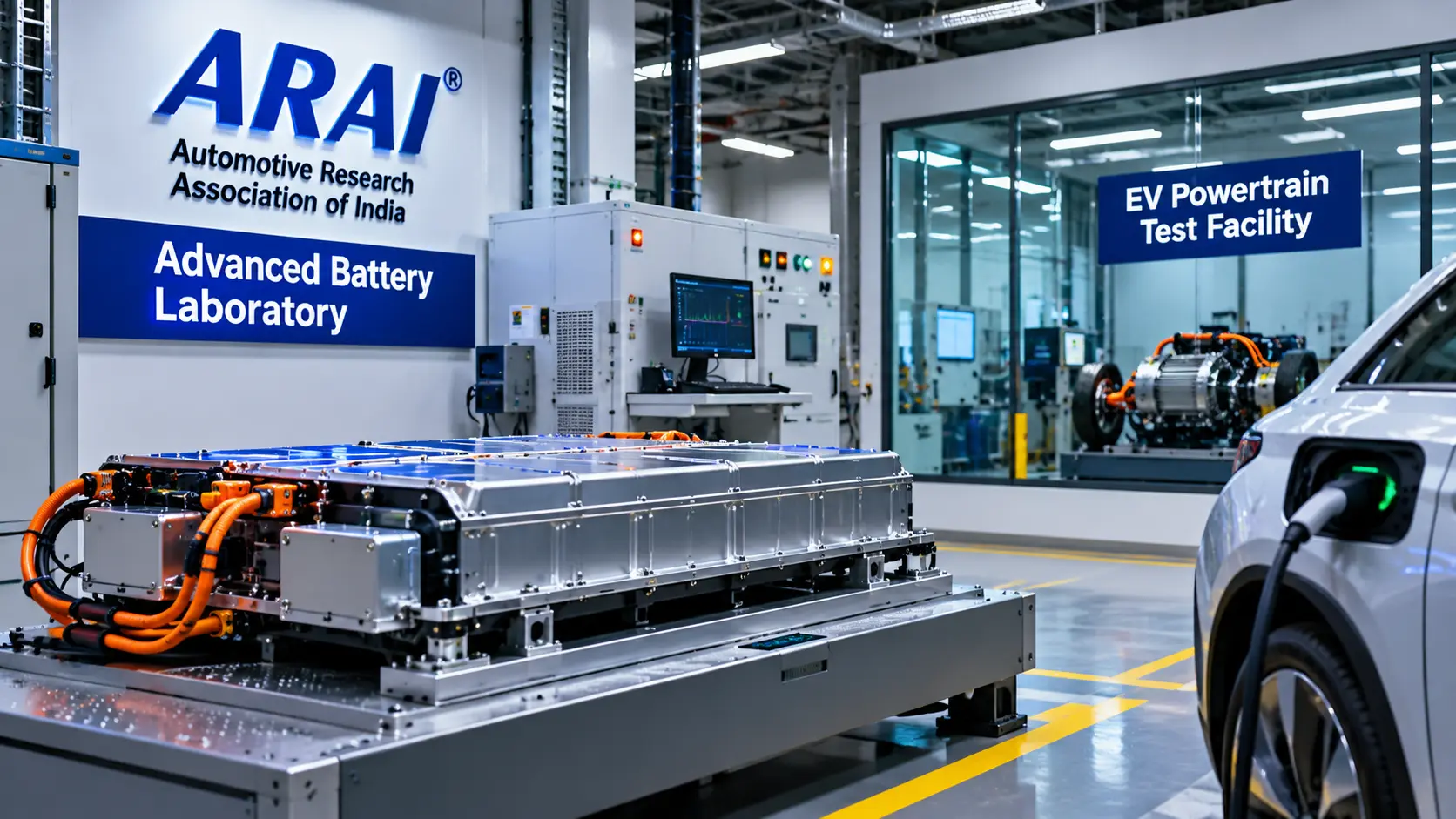
The Automotive Research Association of India (ARAI) has taken an important step in this direction with the inauguration of its Advanced Battery Laboratory in Pune. Developed with an investment of approximately ₹55 crore, the facility is designed to strengthen India’s capabilities in battery testing, safety assessment, performance evaluation and certification for electric and hybrid vehicles.
The ARAI Battery Lab was inaugurated virtually by Union Minister for Heavy Industries and Steel H.D. Kumaraswamy during ARAI’s Diamond Jubilee celebrations on October 31, 2026. Alongside the laboratory, ARAI also introduced an advanced electric powertrain testing facility, expanding its infrastructure for next-generation automotive development.
Read More: AI-Powered In-Car Voice Assistants
ARAI Battery Lab: What Has India Actually Introduced?
The Advanced Battery Laboratory has been developed under the Ministry of Heavy Industries’ Enhancement of Competitiveness in the Indian Capital Goods Sector – Phase II scheme, with financial support from the ministry and ARAI.
According to the official announcement, the facility is intended to support battery testing, validation, safety assessment and performance evaluation for electric and hybrid vehicle applications. It will also support design validation, certification and export-compliance testing against applicable Indian and international standards.
This is significant because batteries are among the most technically demanding components of modern electric vehicles. Their performance affects driving range, charging capability, vehicle weight and efficiency, while their safety characteristics influence the overall reliability of an electric vehicle.
The ARAI Battery Lab adds dedicated testing infrastructure to India’s automotive research ecosystem at a time when manufacturers are increasingly developing battery packs, electric platforms and associated components locally.
However, the announcement does not disclose the laboratory’s annual testing capacity, individual test charges or the number of manufacturers expected to use it. Those details will be important in understanding how much additional testing capacity the facility can provide to the industry.
Why Battery Testing Matters for Electric Vehicles
An electric vehicle battery is considerably more complex than a conventional fuel tank. It contains multiple cells connected into modules and packs, alongside electrical connections, cooling systems, sensors and battery management electronics.
These components must operate together under different temperatures, charging conditions, driving loads and environmental circumstances. Testing helps engineers understand how the battery behaves when subjected to these conditions before it is integrated into a production vehicle.
Battery evaluation can involve examining electrical performance, temperature behaviour, durability and safety under defined testing procedures. Depending on the applicable standard and test programme, engineers may also assess how a battery responds to mechanical stress, electrical abnormalities and thermal conditions.
The ARAI Battery Lab is intended to strengthen India’s ability to undertake such evaluation domestically. Greater testing capability can help manufacturers validate their battery designs and identify potential engineering issues before vehicles enter production.
For consumers, battery safety is particularly important because the traction battery represents one of the most expensive and technically critical components in an electric vehicle. Strong testing and validation practices contribute to a more dependable electric mobility ecosystem, although laboratory infrastructure alone cannot guarantee the quality of every battery or vehicle.
How the New Laboratory Could Support EV Manufacturers
One of the biggest advantages of expanding domestic testing infrastructure is the potential to make vehicle development more efficient. Manufacturers developing electric vehicles must validate several components and systems before a model can complete its approval and launch process.
A battery pack may require testing at different development stages, from initial engineering validation to compliance-related assessments. If suitable facilities are available within India, manufacturers can potentially coordinate these activities more efficiently without relying exclusively on overseas testing resources.
The ARAI Battery Lab could therefore become an important resource for Indian automakers, battery manufacturers and component suppliers working on new electric and hybrid vehicle technologies.
It may also support companies developing battery systems for export-oriented vehicles. International markets often require manufacturers to demonstrate compliance with applicable safety and technical requirements, making access to capable testing infrastructure an important part of the development process.
The actual benefits, however, will depend on the laboratory’s operational capacity, testing schedules, accreditation scope and accessibility to different industry participants.
Advanced EV Powertrain Testing Facility Also Inaugurated
The battery laboratory was not the only major development announced during ARAI’s Diamond Jubilee programme. The institute also inaugurated its Advanced Two-Dynamometer E-Axle and EV Powertrain Test Facility.
This facility is designed to support the development, validation and optimisation of electric powertrains and e-axles. An e-axle generally integrates key electric propulsion components, including an electric motor and transmission, into a compact drive assembly.
Testing these systems under controlled conditions allows engineers to evaluate how the electric drivetrain performs across different operating loads and speeds. It can help assess efficiency, performance, thermal behaviour and engineering characteristics during the development process.
The availability of dedicated powertrain testing infrastructure is particularly relevant as automakers move towards integrated electric drive systems and develop more locally engineered EV platforms.
Together, the battery laboratory and powertrain testing facility expand ARAI’s capabilities beyond individual component assessment and strengthen the broader engineering environment required for electric vehicle development.
ARAI and Škoda Auto Volkswagen India Move Towards a Crash Test Facility
Another important announcement during the celebrations involved ARAI and Škoda Auto Volkswagen India Private Limited (SAVWIPL).
The two organisations exchanged a memorandum of understanding concerning the transfer of a land parcel for the development of an Advanced Crash Test Facility. The proposed facility is expected to strengthen India’s vehicle safety assessment and testing infrastructure for conventional vehicles as well as battery electric vehicles.
According to the Ministry of Heavy Industries, the expanded crash-testing capabilities could support homologation, advanced safety assessments, Bharat NCAP implementation and export approval programmes.
More domestic crash-testing infrastructure could also reduce manufacturers’ dependence on overseas facilities for certain validation activities. This becomes increasingly relevant as vehicle safety requirements evolve and automakers prepare new platforms for Indian and international markets.
The crash test facility remains a development initiative, rather than an already operational testing centre. Its location, investment and commissioning timeline have not been publicly detailed in the announcement.
ARAI’s Expansion Reflects India’s Changing Automotive Priorities
The latest developments reflect how India’s automotive research priorities are expanding alongside the industry’s transition towards electrification and more advanced vehicle technologies.
Battery testing, electric powertrain validation and crash safety are becoming increasingly interconnected areas of automotive engineering. Manufacturers require suitable infrastructure to develop products that meet regulatory requirements while maintaining performance, reliability and competitiveness.
The ARAI Battery Lab is therefore part of a wider effort to strengthen domestic engineering capabilities rather than an isolated investment in battery research.
ARAI also announced a nationwide road safety outreach campaign during its Diamond Jubilee programme. The initiative is intended to promote safer mobility through awareness programmes, education, driver training and digital engagement.
The institute also launched SIAT 2028, its international Symposium on International Automotive Technology, and announced plans to expand its testing capabilities further, including advanced fire safety testing infrastructure.
These initiatives underline ARAI’s broader role in research, certification, testing and technology development across India’s automotive sector.
What This Means for India’s EV Industry
India’s electric vehicle market needs more than new models and expanding charging networks. It also requires dependable engineering infrastructure that can support manufacturers throughout the vehicle development and approval process.
The addition of dedicated battery and powertrain testing facilities could strengthen this foundation by making advanced evaluation capabilities available within the country. This may help manufacturers develop products more efficiently, support local component engineering and improve readiness for export markets.
The ARAI Battery Lab could also contribute to India’s long-term ambitions to become a stronger automotive technology and manufacturing hub. Its significance will ultimately depend on how effectively manufacturers, suppliers and research organisations use the new capabilities.
The investment does not automatically mean lower EV prices, longer driving ranges or improved battery warranties for customers. Those outcomes depend on several factors, including battery chemistry, vehicle engineering, manufacturing quality, economies of scale and commercial decisions made by automakers.
Instead, the development should be viewed as an investment in the technical infrastructure that supports future electric vehicle products.
Frequently Asked Questions
What is ARAI’s Advanced Battery Laboratory?
ARAI’s Advanced Battery Laboratory is a new testing facility in Pune designed to support battery testing, validation, safety assessment and performance evaluation for electric and hybrid vehicles. It also supports certification and export-compliance testing.
How much did the ARAI Battery Lab cost?
The laboratory was developed with an investment of approximately ₹55 crore, supported by the Ministry of Heavy Industries and ARAI under the Enhancement of Competitiveness in the Indian Capital Goods Sector – Phase II scheme.
Who inaugurated ARAI’s new battery testing facility?
Union Minister for Heavy Industries and Steel H.D. Kumaraswamy virtually inaugurated the Advanced Battery Laboratory during ARAI’s Diamond Jubilee celebrations on October 31, 2026.
What is ARAI’s Advanced Two-Dynamometer EV Powertrain Test Facility?
It is a specialised testing facility designed to support the development, validation and optimisation of electric powertrains and e-axles under controlled operating conditions.
Will the new ARAI Battery Lab make electric vehicles cheaper?
Not directly. The facility could support more efficient engineering and validation, but vehicle prices depend on battery costs, manufacturing scale, technology choices and other commercial factors.
Will the new laboratory improve EV battery safety?
The facility is intended to strengthen battery safety assessment and validation capabilities. Better testing infrastructure can support manufacturers in identifying and addressing engineering risks, although overall battery safety also depends on design, manufacturing quality and vehicle-level systems.
What is ARAI’s proposed Advanced Crash Test Facility?
ARAI and Škoda Auto Volkswagen India have exchanged an MoU concerning the transfer of land for a proposed Advanced Crash Test Facility. It is intended to support vehicle crash testing, homologation and safety assessments.
Ride And Tech Verdict
India’s electric vehicle ambitions will ultimately depend on the engineering capabilities supporting the vehicles themselves. Battery development, electric powertrain validation and safety testing are essential parts of that foundation, even though consumers rarely see them directly.
The ₹55 crore Advanced Battery Laboratory represents a meaningful investment in India’s domestic automotive testing infrastructure. Combined with ARAI’s new e-axle and EV powertrain testing facility, it strengthens the technical resources available to manufacturers developing electric and hybrid vehicles.
The real value of the ARAI Battery Lab will become clearer as its testing capabilities are utilised by manufacturers and suppliers. Transparent information about testing capacity, industry access and operational scope will help establish how much the facility contributes to India’s EV development ecosystem.
For now, the development is a positive step towards strengthening India’s automotive engineering capabilities and supporting the next phase of electric mobility.
Sources
- Press Information Bureau (Ministry of Heavy Industries) – ARAI inaugurates Advanced Battery Laboratory and EV Powertrain Test Facility. Official announcement covering the ₹55 crore investment, laboratory capabilities, powertrain facility and other Diamond Jubilee initiatives.
- Hindustan Times – ARAI unveils ₹55-cr battery lab, advanced EV testing facility. Additional reporting on the inauguration and India’s automotive testing infrastructure.
- Economic Times Sustainability – ARAI unveils ₹55 crore battery lab and EV powertrain facility. Industry context covering battery testing, powertrain development and the wider EV ecosystem.
- Škoda Auto Volkswagen India – ARAI and SAVWIPL partner to strengthen crash-testing infrastructure. Official announcement concerning the proposed Advanced Crash Test Facility in Chakan.
Ride And Tech — Where Ride Meets Tech.
Drive Smarter. Ride Smarter.
Copyright (c) Ride And Tech. All rights reserved.
