

Imagine driving through traffic when a vehicle around a blind corner suddenly brakes. You cannot see it, your camera cannot see it and your radar may not detect it. But what if your car could receive a warning directly from that vehicle before the danger entered your line of sight?
That is the basic idea behind India V2V technology. Vehicle-to-Vehicle communication allows nearby vehicles to exchange information such as position, speed, direction and acceleration, giving connected vehicles another source of information beyond their own cameras, radar and other sensors.
India is now developing a regulatory framework around this technology. The Ministry of Road Transport and Highways (MoRTH) issued a draft notification in August 2026 proposing phased implementation of V2V systems based on the AIS-230 standard, with mandatory fitment proposed for new L, M and N category vehicles from October 1, 2028 if the rules are finalised in their current form.
But India V2V technology is about much more than simply making cars “talk”. It involves wireless communication, positioning, cybersecurity, vehicle hardware and safety applications that could eventually become an important part of connected mobility in India.
What Is V2V Technology?
V2V stands for Vehicle-to-Vehicle communication. It is a technology that allows vehicles equipped with suitable communication hardware to exchange information with other nearby vehicles.
Instead of relying entirely on a vehicle’s own sensors, V2V allows one vehicle to communicate information about its current movement to another vehicle. This can include data such as its position, speed, direction and acceleration.
The important difference is that communication does not depend entirely on what the receiving vehicle can physically see. A vehicle approaching from behind a large truck, for example, could potentially receive information about another connected vehicle or an emerging hazard before its own camera or driver has a clear view.
This makes V2V communication a complementary safety technology rather than a replacement for cameras, radar, driver assistance systems or human attention.
Read More: Supercar vs Hypercar: What’s the Difference?
How Does V2V Communication Work?
A vehicle equipped with a V2V system uses an On-Board Unit (OBU) to communicate with nearby vehicles. The OBU handles wireless communication and exchanges relevant vehicle information with other compatible systems.
Under India’s proposed AIS-230 framework, the factory-installed systems would use Cellular Vehicle-to-Everything (C-V2X) technology in the 5.875 GHz to 5.925 GHz frequency range. The Government of India says the standard covers requirements including radio performance, positioning, electrical systems, electromagnetic compatibility and cybersecurity.
The process can be simplified into three stages. A vehicle generates information about its movement, the communication system broadcasts relevant information to nearby vehicles, and receiving vehicles process that information to determine whether a safety warning may be required.
The technology therefore adds another layer of awareness around the vehicle. It does not mean that every connected car automatically takes control of another vehicle or makes autonomous driving decisions.
V2V vs ADAS: What Is the Difference?
V2V technology and ADAS can work together, but they obtain information in different ways.
Most conventional ADAS functions depend heavily on sensors mounted on the vehicle. Cameras can identify objects and road markings, radar can detect vehicles and their movement, while other sensors can contribute information about the vehicle’s surroundings.
V2V communication, by contrast, can provide information directly from another connected vehicle. This can be particularly useful when an object or vehicle is outside the receiving car’s direct line of sight. The Government of India specifically notes that V2V can provide information beyond direct line of sight and complement ADAS.
Consider a vehicle braking suddenly around a blind bend. A following car may not yet have visual confirmation of the braking vehicle, but a connected system could receive an alert from the vehicle ahead and provide an earlier warning.
That does not make V2V a replacement for ADAS. Instead, V2V safety technology can provide another information source that works alongside existing vehicle sensors.
What Safety Features Can V2V Provide?
India’s proposed AIS-230 framework includes several road-safety applications that could be introduced in phases.
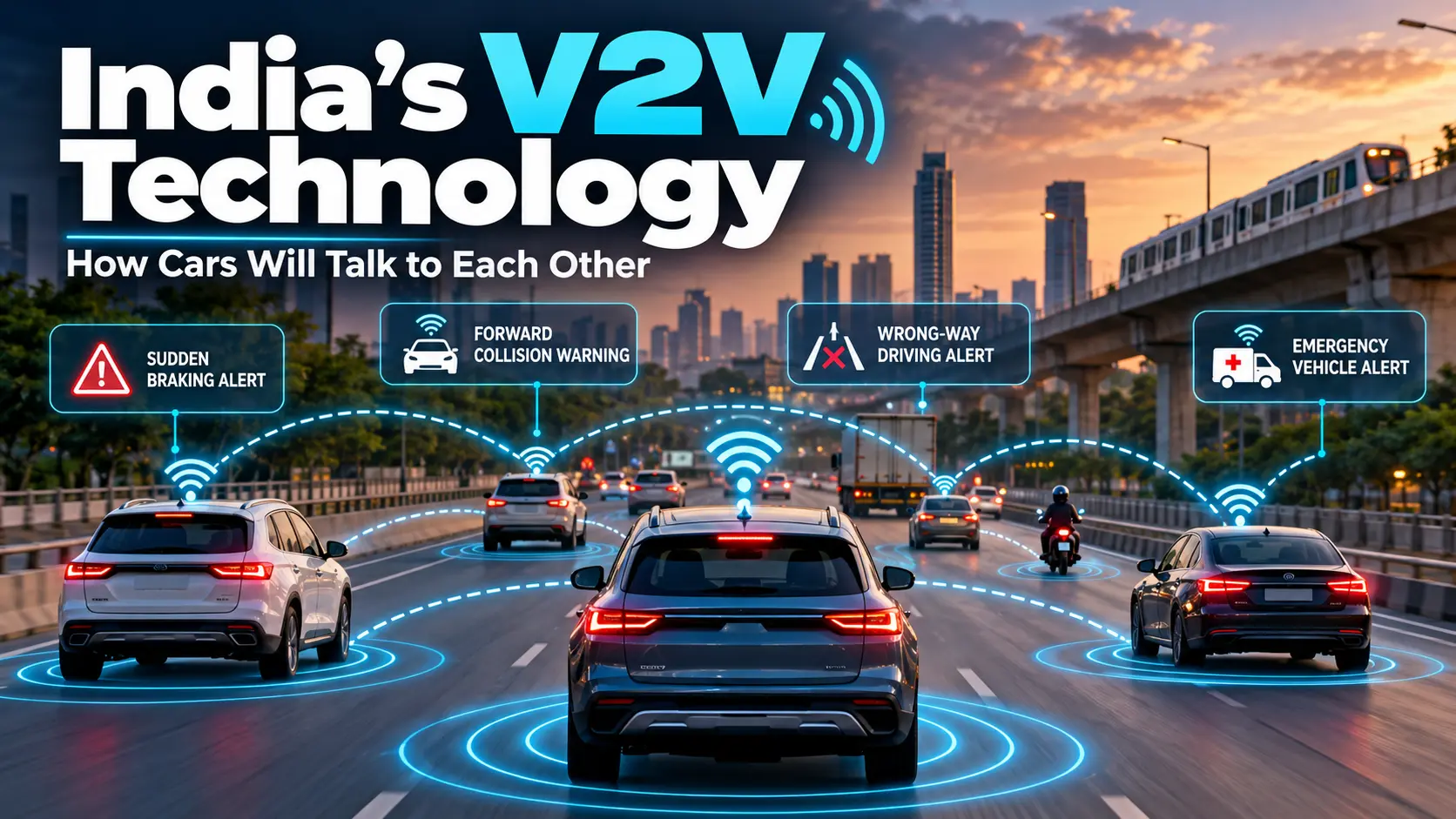
Emergency Brake Alert
A sudden braking event can create a dangerous situation when following vehicles do not have enough time to react.
A connected vehicle could communicate information about hard braking to nearby vehicles. Those vehicles could then provide an advance warning to the driver or their safety system.
This could be particularly useful in dense traffic, where one sudden braking event can quickly create a chain reaction.
Forward Collision Warning
V2V can also support forward-collision warnings by allowing vehicles to exchange information about their movement.
Instead of relying only on the receiving vehicle’s radar or camera to determine what is happening, information transmitted by another connected vehicle can provide additional context.
The proposed AIS-230 framework specifically identifies forward-collision warning as one of its safety applications.
Wrong-Way Driving Alerts
A vehicle travelling in the wrong direction can create an extremely dangerous situation because approaching drivers may have very little time to respond.
Connected vehicles could potentially exchange movement information and identify a wrong-way scenario, allowing an alert to be issued to nearby vehicles.
Wrong-way driving is one of the use cases included in the proposed Indian framework.
Emergency Vehicle Alerts
Emergency vehicles need to move quickly through traffic, but drivers may not always be able to see or hear an approaching ambulance, fire engine or other emergency vehicle in time.
The proposed V2V framework also includes emergency vehicle alerts, allowing compatible vehicles to receive information that can improve awareness of an approaching emergency vehicle.
What Is V2X Technology?
V2V is only one part of the larger V2X technology ecosystem.
V2X means Vehicle-to-Everything, which is a broader concept covering communication between vehicles and several other elements of the transport environment.
This can include:
- V2V — Vehicle-to-Vehicle
- V2I — Vehicle-to-Infrastructure
- V2P — Vehicle-to-Pedestrian
- V2N — Vehicle-to-Network
The wider V2X concept could eventually allow vehicles to communicate with traffic infrastructure, road systems, pedestrians and network services.
The Telecom Regulatory Authority of India (TRAI) also examined the broader regulatory framework for V2X communication in a consultation paper released in April 2026.
India’s current proposed vehicle requirement, however, is specifically focused on V2V communication rather than requiring the entire V2X ecosystem to be deployed simultaneously.
What Is AIS-230?
AIS-230 is the proposed Indian Automotive Industry Standard that defines technical requirements for V2V communication systems.
According to the Ministry of Road Transport and Highways, AIS-230 covers minimum technical, functional, performance, environmental and security requirements for V2V systems installed in vehicles operating on Indian roads.
The standard covers areas including radio performance, receiver sensitivity, GNSS positioning, electrical requirements, electromagnetic compatibility, cybersecurity and communication security.
This is important because a connected-vehicle system cannot simply be treated like an ordinary wireless gadget. If vehicles are going to exchange safety-critical information, communication reliability and security become essential parts of the system.
What Is India’s Proposed V2V Mandate?
India’s V2V framework is currently based on a draft notification, so it is important not to describe the proposed 2028 requirement as an existing law.
MoRTH’s draft proposes two important dates. Vehicles in L, M and N categories manufactured from October 1, 2027 that are fitted with V2V systems would have to comply with AIS-230. From October 1, 2028, the draft proposes that newly manufactured L, M and N category vehicles be fitted with V2V systems conforming to AIS-230.
The categories cover a broad range of motor vehicles, meaning the proposal is not limited to premium cars. The framework is intended to create a common technical foundation for connected vehicle safety systems across the covered vehicle categories.
However, the final implementation depends on the government completing the regulatory process and issuing the final notification.
Why Does India Need V2V Communication?
India has an enormous and highly diverse road environment. Cars, motorcycles, scooters, buses, trucks, three-wheelers and other road users share roads with widely varying traffic conditions.
Traditional vehicle safety systems can provide substantial assistance, but they are still limited by what their sensors can detect and what the driver can see.
India V2V technology could provide another layer of situational awareness by allowing connected vehicles to exchange information directly.
For example, a driver approaching a blind intersection may not see another vehicle approaching from the side. If both vehicles are equipped with compatible systems, their exchanged information could potentially allow a warning to be generated before the drivers have direct visual confirmation.
This is one of the fundamental reasons connected-vehicle technology is being considered as part of India’s future road-safety ecosystem. The Government of India says V2V can provide information beyond direct line of sight and support proactive accident prevention.
Will V2V Work Without Mobile Internet?
One of the interesting aspects of C-V2X is that direct vehicle communication does not necessarily depend on a conventional internet connection.
C-V2X supports direct communication between vehicles through its sidelink functionality, meaning nearby vehicles can exchange safety information directly rather than having every message travel through a cloud server.
This distinction is important because safety-critical communication cannot always depend on cellular network availability.
A vehicle therefore does not need to wait for a remote server to tell another vehicle that it has suddenly braked. The connected vehicles can exchange relevant information directly within the supported communication system.
What Happens When a Vehicle Does Not Have V2V?
This is one of the biggest practical challenges of V2V cars in India.
V2V communication works most effectively when a meaningful proportion of vehicles on the road are equipped with compatible systems. A connected vehicle cannot exchange V2V information with a vehicle that has no compatible communication hardware.
That means the benefits will not necessarily appear everywhere immediately after any future mandate takes effect.
India’s proposed phased approach gives manufacturers time to prepare, but the broader safety benefits will also depend on how quickly the equipped vehicle population grows over time.
This is one reason V2V should be viewed as a long-term connected-mobility ecosystem rather than a feature that suddenly changes road safety on a single implementation date.
Does V2V Replace Cameras, Radar or LiDAR?
No. V2V is better understood as a complementary technology.
Cameras, radar and other vehicle sensors provide information about the physical environment around the vehicle. V2V provides information communicated by other connected vehicles.
Combining these sources can potentially give an intelligent vehicle a broader understanding of what is happening around it.
For example, radar may detect a vehicle directly ahead while V2V information can provide additional information about that vehicle’s movement. Similarly, a camera may have limited visibility around a large truck, while communication from another connected vehicle can potentially provide information beyond that obstruction.
The strongest connected safety systems will therefore likely use multiple information sources rather than depending on one technology alone.
What About Cybersecurity?
Cybersecurity is particularly important when discussing V2V technology India because safety-critical messages must be protected from manipulation.
If vehicles are going to use wireless information to generate warnings, the system needs mechanisms to ensure that the information being received is trustworthy.
India’s proposed AIS-230 framework explicitly includes cybersecurity and communication-security requirements alongside radio, positioning and performance requirements.
This is an important part of the technology’s development. A connected vehicle should not blindly trust every wireless message it receives, particularly when that information could influence safety warnings or future automated driving functions.
What Are the Biggest Challenges for V2V in India?
The technology itself is only one part of the challenge.
India will need reliable hardware, common standards, cybersecurity systems, accurate positioning and interoperability between vehicles from different manufacturers.
The country’s highly mixed traffic environment also creates an important practical limitation. New connected cars may share information with other connected cars, but older vehicles without compatible systems will remain part of the road environment for many years.
Two-wheelers are another important consideration because India’s motorcycle and scooter population is enormous. A connected-vehicle ecosystem that works only for premium passenger cars would provide a much smaller coverage area than one designed across different vehicle categories.
Cost, hardware packaging, power consumption, testing and interoperability will therefore be important considerations as connected vehicle technology India develops.
How V2V Could Change the Future of Driving
The long-term potential of V2V goes beyond warning drivers about sudden braking.
As connected vehicle adoption grows, V2V can become part of a larger intelligent transportation system in which vehicles continuously exchange information about their surroundings.
Combined with V2I and other V2X technologies, vehicles could eventually receive information about traffic signals, road hazards, work zones, emergency vehicles and other road conditions.
This could also support future automated-driving systems by giving vehicles additional information that their onboard sensors alone cannot always obtain.
However, these possibilities should be treated as the future direction of connected mobility, not as features that India’s current V2V proposal automatically guarantees.
Read More: How Connected Cars Are Changing the Future of U.S. Roads
V2V vs V2X: What’s the Difference?
The simplest distinction is that V2V is vehicle-to-vehicle communication, while V2X is the broader ecosystem of vehicle-to-everything communication.
| Technology | Communication | Example |
|---|---|---|
| V2V | Vehicle to vehicle | Sudden braking alert |
| V2I | Vehicle to infrastructure | Traffic-signal information |
| V2P | Vehicle to pedestrian | Pedestrian safety alert |
| V2N | Vehicle to network | Cloud-based traffic information |
| V2X | Vehicle to everything | Combination of connected mobility systems |
India’s current proposed AIS-230 framework is specifically focused on V2V communication, while TRAI has separately examined the broader V2X regulatory environment.
Frequently Asked Questions
What does V2V stand for?
V2V stands for Vehicle-to-Vehicle communication. It allows compatible vehicles to exchange information such as position, speed, direction and acceleration through wireless communication.
What is V2V technology in India?
India V2V technology refers to the development of vehicle-to-vehicle communication systems for vehicles operating on Indian roads. MoRTH has proposed a framework based on AIS-230 and C-V2X technology.
Will V2V become mandatory in India?
MoRTH has proposed mandatory V2V fitment for new L, M and N category vehicles from October 1, 2028, but this remains a draft proposal until the final notification is issued.
What is AIS-230?
AIS-230 is the proposed Automotive Industry Standard covering the technical, functional, performance, environmental and security requirements for V2V communication systems in vehicles operating in India.
Does V2V require 5G?
V2V does not simply mean communication through a conventional 5G internet connection. India’s proposed framework specifies C-V2X communication operating in the 5.875–5.925 GHz band for factory-installed V2V systems.
Can V2V prevent accidents?
V2V is designed to provide earlier information about potential hazards and support safety applications such as emergency brake alerts and forward-collision warnings. It can complement existing safety systems, but it cannot guarantee that accidents will be prevented.
Is V2V the same as ADAS?
No. ADAS primarily uses sensors such as cameras and radar to understand the vehicle’s surroundings, while V2V allows compatible vehicles to exchange information directly. The two technologies can work together.
Ride And Tech Verdict
India V2V technology represents an important step toward a more connected automotive ecosystem, but its significance goes beyond adding another electronic feature to new cars.
The proposed AIS-230 framework establishes a technical foundation for vehicles to exchange safety-related information, while C-V2X provides the communication technology through which compatible vehicles can share that information. The potential applications include emergency braking alerts, forward-collision warnings, wrong-way alerts and emergency vehicle notifications.
The most important point for Indian drivers is that V2V will not replace ADAS, cameras, radar or responsible driving. Instead, it could add another layer of awareness that allows a vehicle to receive information about situations that may not yet be visible to its own sensors.
India’s proposed October 2028 requirement is still subject to the regulatory process, but the direction is clear: the country’s automotive ecosystem is moving toward greater vehicle connectivity. If manufacturers, regulators and technology suppliers can build a reliable, secure and interoperable system, V2V communication could become an important foundation for India’s future connected and intelligent transportation network.
Ride And Tech — Where Ride Meets Tech.
Drive Smarter. Ride Smarter.
Copyright (c) Ride And Tech. All rights reserved.

1 thought on “India’s V2V Technology: How Cars Will Talk to Each Other”