


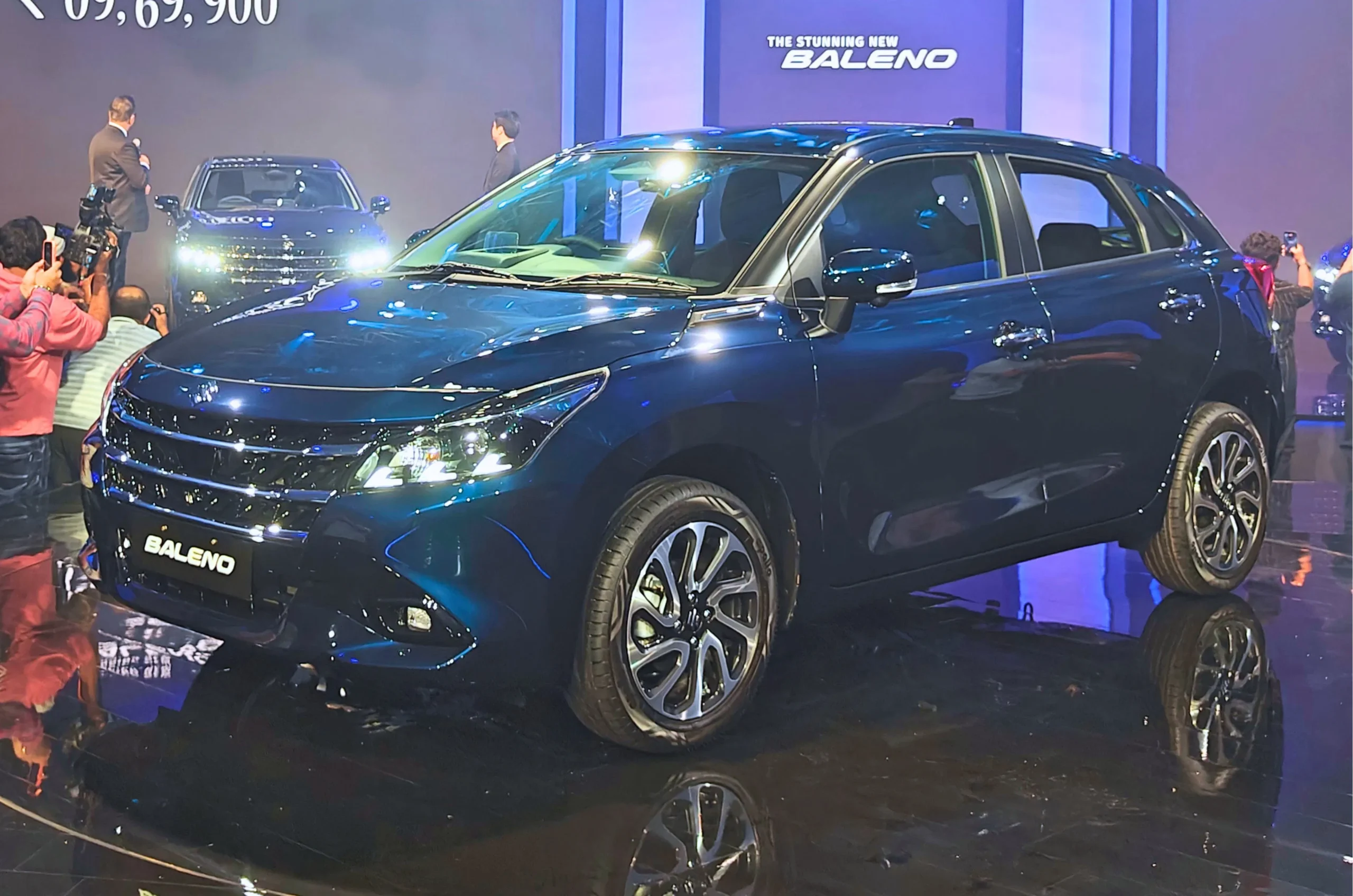
Maruti Suzuki has given the Baleno a much more meaningful facelift than the usual nip-and-tuck exercise. The updated premium hatchback arrives in India with a new three-cylinder petrol engine, Level 2 ADAS, ventilated front seats and a handful of cabin upgrades, while retaining the practical dimensions and familiar character that have made the Baleno a strong seller for the brand. Prices start at ₹6.10 lakh, ex-showroom, with bookings now open.
For a car that sits in one of India’s most competitive hatchback segments, the interesting part isn’t the revised grille or bumper. It is the amount of technology Maruti Suzuki has managed to squeeze into a familiar package. The Maruti Baleno facelift now looks less like a routine refresh and more like an attempt to move the premium hatchback closer to the technology levels buyers increasingly expect from larger cars.
Maruti Baleno Facelift: What’s New?
The Maruti Baleno facelift keeps the basic shape of the existing car, but the front end receives the most obvious visual changes. There is a redesigned grille, a reprofiled bumper and additional chrome detailing, while a shark-fin antenna and revised exterior elements help distinguish the updated model from the outgoing car. The overall dimensions remain broadly unchanged, with a 3,990mm length, 1,745mm width and 2,520mm wheelbase.
Maruti has also added a new Enigmatic Teal exterior colour, taking the total colour choice to seven. The approach is deliberately restrained: this isn’t a Baleno trying to reinvent itself visually, but rather one that wants to look fresher without throwing away the proportions that already work.
That restraint continues inside. The basic dashboard architecture remains familiar, but the Maruti Baleno facelift gains a cooled wireless charging pad, Clarion-branded audio system and ventilated front seats. The 9-inch SmartPlay Pro+ touchscreen, wireless Android Auto and Apple CarPlay, head-up display and Suzuki Connect continue to feature on higher variants.
Read More: Lexus NX Facelift Revealed
The Big Story Is Level 2 ADAS
If there is one upgrade that changes the conversation around the Maruti Baleno facelift, it is the arrival of Level 2 ADAS.
The system brings functions including adaptive cruise control, lane-keep assistance, autonomous emergency braking and automatic high-beam assistance. That puts the Baleno in a rather different technological bracket from the typical premium hatchback, particularly when combined with six airbags, electronic stability control, hill-hold assist and tyre-pressure monitoring.
There is an important distinction, though. ADAS isn’t simply something every version of the car gets as standard. The detailed variant breakdown shows the advanced system on the Alpha (O) trim, alongside adaptive cruise control and other equipment. So buyers will need to move up the range if they specifically want the full driver-assistance package.
That makes the Maruti Baleno ADAS package particularly interesting from a value perspective. The technology is no longer something buyers have to associate exclusively with larger SUVs or significantly more expensive cars.
New 1.2-Litre Z-Series Engine
Under the bonnet, the Maruti Baleno facelift gets a new 1.2-litre, three-cylinder naturally aspirated Z-Series petrol engine. It is the same basic engine family already used in the latest Swift and Dzire, replacing the previous Baleno petrol powertrain.
The new Maruti Baleno 1.2 litre engine produces around 83PS and 112Nm, with power sent through either a five-speed manual gearbox or Maruti’s AGS automated manual transmission. The company claims 23.80kmpl for the manual and 24.77kmpl for the AGS version.
Those numbers tell you what Maruti is chasing here. This isn’t a performance upgrade designed to make the Baleno suddenly behave like a hot hatch. Instead, the new Z12E engine is aimed at efficiency and everyday drivability, which makes considerably more sense for a family-focused premium hatchback.
The Maruti Baleno facelift also continues with a factory-fitted S-CNG version using the new Z-Series engine. Maruti claims 33.61km/kg for the CNG model, while reports confirm that the updated Baleno introduces a CNG-AMT combination, a first for a Maruti model.
Maruti Baleno Facelift Price and Variants
The Maruti Baleno facelift price starts at ₹6.10 lakh ex-showroom for the Sigma petrol manual. Maruti has initially announced the starting price, while the complete variant-wise pricing is being revealed separately.
The range continues with familiar Sigma, Delta, Zeta and Alpha grades, along with an Alpha (O) variant. The Delta and Zeta versions bring progressively more equipment, while the Alpha versions add features such as the head-up display, 360-degree camera, ventilated front seats and premium audio equipment. The Alpha (O) goes further with the ADAS package and adaptive cruise control.
That gives the new Maruti Baleno a broader spread of equipment than before, although buyers looking specifically for the headline technology will have to look higher up the range.
A More Premium Cabin Without Losing the Practicality
Maruti hasn’t attempted to turn the Baleno into something it isn’t. The cabin remains familiar, spacious and designed around everyday usability rather than dramatic styling.
The addition of ventilated front seats is particularly notable. Maruti positions this as a first for the segment, and it is exactly the kind of feature that can make a difference during India’s hot summers. The cooled wireless charger is another small but sensible touch, especially for drivers who regularly rely on their phones for navigation.
The existing 9-inch touchscreen, wireless smartphone connectivity, automatic climate control, cruise control and Suzuki Connect technology continue to give the car a reasonably comprehensive equipment list. The result is a Maruti Baleno facelift that feels more substantial inside without requiring a completely new cabin design.
Where the Baleno Sits Against Its Rivals
The Maruti Baleno continues to operate in the premium hatchback territory alongside the Hyundai i20, Tata Altroz and Toyota Glanza. That means its biggest challenge isn’t simply attracting buyers with new equipment; it has to make the entire package feel compelling against rivals that have their own strengths in design, safety, features and driving character.
The new engine and efficiency figures strengthen the Baleno’s everyday proposition, while Level 2 ADAS gives it a technology talking point that few cars in this class can match. The CNG option also keeps Maruti’s traditional fuel-efficiency advantage firmly in the conversation.
In other words, the Maruti Baleno facelift hasn’t suddenly become a radically different car. It has become a considerably better-equipped version of the same formula.
Maruti Baleno Facelift: Key Specifications
| Specification | 2026 Maruti Baleno |
|---|---|
| Engine | 1.2-litre, 3-cylinder naturally aspirated petrol |
| Petrol power | 82.93PS |
| Petrol torque | 112.4Nm |
| Gearboxes | 5-speed MT / AGS |
| Petrol efficiency | Up to 24.77kmpl |
| CNG efficiency | 33.61km/kg |
| Length | 3,990mm |
| Width | 1,745mm |
| Wheelbase | 2,520mm |
| Starting price | ₹6.10 lakh, ex-showroom |
| Key safety tech | Level 2 ADAS, 6 airbags, ESC, TPMS |
The figures and equipment listed above are based on the launch information currently available; some variant-specific pricing and equipment details remain subject to Maruti Suzuki’s full price-list disclosure.
Read More: Simple Wave Electric Scooter Launched in India at ₹1.10 Lakh
Maruti Baleno Facelift FAQ
What is the starting price of the Maruti Baleno facelift?
The Maruti Baleno facelift price starts at ₹6.10 lakh ex-showroom for the Sigma petrol manual variant.
Does the new Baleno get Level 2 ADAS?
Yes. The Maruti Baleno facelift introduces Level 2 ADAS, including functions such as adaptive cruise control, lane-keep assistance, autonomous emergency braking and automatic high-beam assistance. The full ADAS package is offered on the higher Alpha (O) variant.
What engine does the 2026 Baleno use?
The new Baleno uses a 1.2-litre, three-cylinder naturally aspirated Z-Series petrol engine producing around 83PS and 112Nm.
Does the Baleno facelift get CNG?
Yes. The Maruti Baleno CNG continues with a factory-fitted S-CNG setup using the new Z-Series engine. The launch coverage also confirms a CNG-AMT option for the updated model.
What are the main new features?
Major additions include Level 2 ADAS, ventilated front seats, a cooled wireless charger, Clarion audio system and updated exterior styling.
Ride And Tech Verdict
The Maruti Baleno facelift is a clever update because Maruti Suzuki hasn’t tried to fix what wasn’t broken. Instead, it has attacked the areas where the car was beginning to feel less convincing: technology, safety equipment and powertrain freshness.
The new Z-Series engine should keep efficiency-focused buyers interested, while the added comfort equipment makes the cabin feel more upmarket. But the real headline is Level 2 ADAS. Bringing that sort of driver-assistance technology into a mainstream premium hatchback changes what buyers can reasonably expect from the segment.
At ₹6.10 lakh to start, the new Baleno isn’t suddenly a performance car or a technological showcase on wheels. It doesn’t need to be. Its appeal is much simpler: take a proven, practical hatchback and make it significantly smarter without losing the everyday usability that made it popular in the first place.
Ride And Tech — Where Ride Meets Tech.
Drive Smarter. Ride Smarter.
Copyright (c) Ride And Tech. All rights reserved.

2 thoughts on “Maruti Baleno Facelift Launched at ₹6.10 Lakh: Level 2 ADAS and New Engine”