
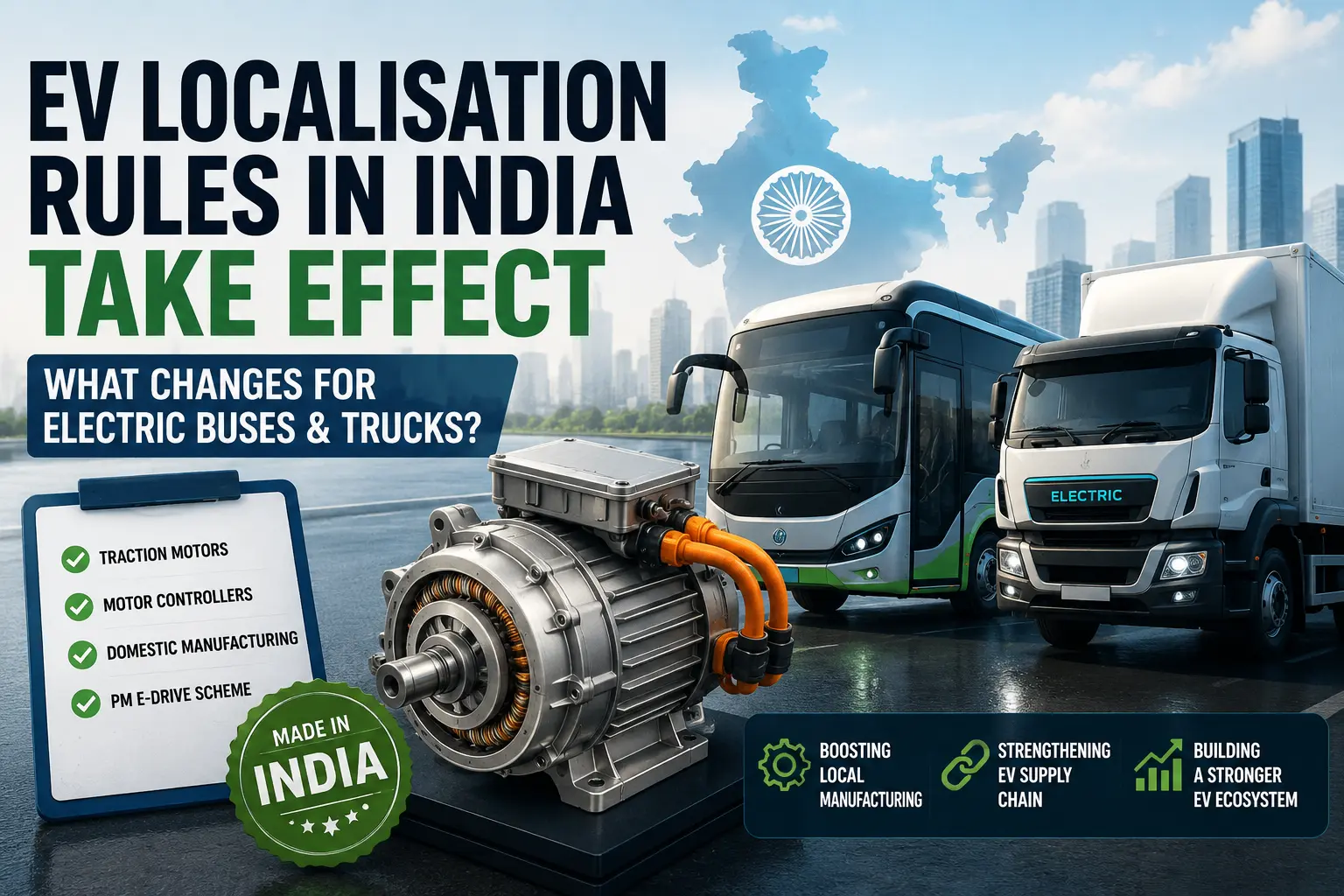
EV localization rules in India take effect from September 1, 2026, marking another important step in India’s push to build more of its electric-vehicle supply chain locally. The new requirements apply to eligible electric buses and electric trucks under the PM E-DRIVE scheme, with greater emphasis on domestic manufacturing of key traction-motor and controller components. The timing is significant, however, as manufacturers continue to face uncertainty around global supplies of rare-earth magnets.
The change is less about stopping electric commercial vehicles from being built in India and more about determining which vehicles can meet the localization conditions linked to government incentives. Manufacturers seeking benefits under the scheme now face tighter requirements around how important parts of the electric powertrain are manufactured and assembled in India.
What Changes From September 1?
The new EV localization rules in India require specified manufacturing operations for traction motors to be carried out domestically. These include processes such as rotor and stator assembly, shaft and bearing fitment, motor enclosure, connectors and cables, with the exact requirements depending on the applicable vehicle category and stage of the phased manufacturing programme.
The timing follows a temporary relaxation that allowed manufacturers to continue importing traction motors containing rare-earth magnets until August 31, 2026. That relaxation has now ended, bringing the September 1 localization deadline into focus.
Read More: Mercedes-Benz Vision V Concept Revealed
Why Rare-Earth Magnets Have Become a Problem
The complication is sitting much further upstream than the vehicle assembly line. Modern traction motors can rely on powerful permanent magnets containing rare-earth materials, and China remains a major part of the global supply chain for these materials and magnets. Export controls and licensing requirements have made procurement less predictable, with manufacturers facing longer lead times and uncertainty over supplies.
That has put electric commercial-vehicle manufacturers in an uncomfortable position. They are being asked to increase domestic manufacturing of traction motors at precisely the time when securing some of the critical materials needed for those motors has become more difficult. For companies already trying to scale electric bus and electric truck localization in India, that is a difficult combination.
SIAM Wants More Time
The industry has already asked the government for another extension. The Society of Indian Automobile Manufacturers (SIAM) requested that the localization deadline be moved from September 1, 2026 to April 1, 2027, arguing that rare-earth magnet supply disruptions are still affecting manufacturers and their suppliers.
As of the latest reports, however, there is no confirmed approval of that requested extension. That distinction matters: manufacturers are seeking more time, but the request itself does not change the September 1 implementation date.
Which Electric Vehicles Are Affected?
The immediate focus of the EV localization rules in India is on electric commercial vehicles covered by the relevant PM E-DRIVE framework, particularly electric buses and electric trucks. The policy covers categories including M2 and M3 electric buses and N2 and N3 electric trucks.
For private electric-car and electric-two-wheeler buyers, therefore, this is not a new rule suddenly changing how their vehicle is manufactured. The significance is much more industrial: India is trying to push more of the high-value electric powertrain work into the domestic supply chain.
Why Traction Motors Matter
A traction motor is effectively the muscle of an EV. It takes electrical energy from the battery and turns it into the mechanical force that ultimately drives the wheels. Localising its manufacturing therefore means more than simply assembling another component in India; it moves a strategically important part of the electric powertrain closer to the domestic supply chain.
That is the larger reason behind the EV localization rules in India. The government wants incentives such as PM E-DRIVE to support not just the sale of electric vehicles, but also the development of the manufacturing ecosystem behind them. The latest rules push that idea further by requiring specified traction-motor manufacturing activities to happen domestically.
Read More: Kia Sorento India
What Happens Next?
For manufacturers, the immediate challenge is balancing compliance with the reality of the global component market. If rare-earth magnet supplies remain difficult to secure, companies may face higher costs, longer procurement cycles or pressure to accelerate alternative sourcing and domestic supply chains. Industry bodies argue that additional time would allow manufacturers and component suppliers to make that transition more orderly.
For India, the bigger picture is more ambitious. The government is trying to make electric mobility less dependent on imported powertrain systems while creating a stronger domestic EV component industry. Whether that transition happens smoothly will depend partly on how quickly local suppliers can scale and how the global rare-earth supply situation develops.
Frequently Asked Questions
What are the new EV localization rules in India?
The rules require specified manufacturing and assembly operations for key EV components, including traction motors, to be carried out domestically for eligible vehicles seeking benefits under the PM E-DRIVE framework.
Which EVs are affected by the September 2026 localization rules?
The immediate impact is on eligible electric buses and electric trucks, rather than all electric vehicles sold in India.
Why are rare-earth magnets important for EVs?
Rare-earth permanent magnets are used in several traction-motor designs because of their strong magnetic performance. Supply uncertainty has become a major concern for manufacturers following tighter export controls and licensing requirements.
Has the EV localization deadline been extended to April 2027?
Not at the time of the latest reports. SIAM has requested an extension until April 1, 2027, but the request has not been confirmed as approved.
Ride And Tech Verdict
The latest EV localization rules in India are about more than where an electric motor gets assembled. They are part of a much larger attempt to build an EV manufacturing ecosystem that relies less heavily on imported powertrain components. For electric buses and trucks, September 1 marks another step in that direction, even if the industry is still asking for more time to make the transition.
The difficult part is that localization is arriving alongside a global rare-earth supply problem. If India can build domestic capability without creating major disruptions for electric commercial-vehicle makers, the policy could strengthen the country’s EV supply chain over the long term. For now, though, the September 1 deadline is here, the requested extension remains unresolved, and manufacturers have to navigate both challenges at once.
Ride And Tech — Where Ride Meets Tech.
Drive Smarter. Ride Smarter.
Copyright (c) Ride And Tech. All rights reserved.

1 thought on “EV Localization Rules in India Take Effect: What Changes for Electric Buses and Trucks”