


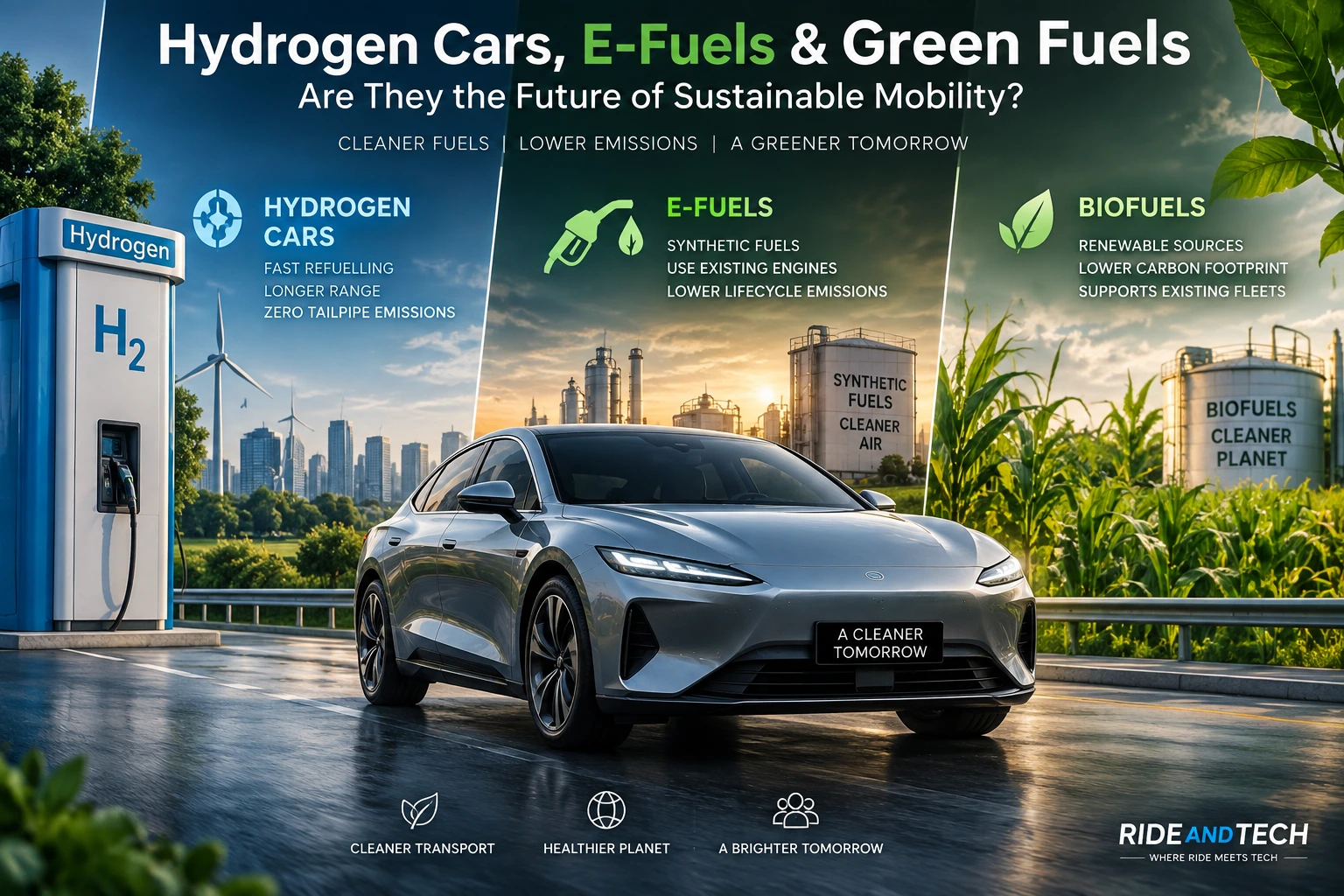
The future of the automobile is unlikely to be powered by a single technology.
Battery-electric vehicles are rapidly becoming the most visible part of the transition away from petrol and diesel, but they are not the only technologies being developed to reduce transport emissions. Hydrogen cars, e-fuels, biofuels and other low-emission fuels are all being explored as part of a much broader transformation of the energy system.
That distinction matters because different forms of transport have different energy requirements.
A city car that can charge overnight is very different from a long-haul truck that needs to operate for hours, while aviation and shipping face even greater challenges when it comes to storing enough energy onboard. The IEA’s current outlook reflects this reality: renewable electricity is expected to account for the largest share of growth in renewable transport energy through 2030, while biofuels, renewable hydrogen and hydrogen-based fuels continue to play important roles in areas where direct electrification is more difficult.
So where do hydrogen cars, e-fuels and green fuels actually fit into the automotive future?
What Are Green Fuels?
“Green fuel” is often used as a broad term for fuels produced with lower greenhouse-gas emissions than conventional fossil fuels. But not every alternative fuel has the same environmental footprint.
The way a fuel is produced matters just as much as what comes out of the vehicle.
Hydrogen made using renewable electricity can have a very different carbon footprint from hydrogen produced using unabated fossil fuels. Similarly, biofuels can provide significant emissions reductions when produced from sustainable waste and residue feedstocks, but their climate benefits depend on the entire supply chain.
The IEA therefore increasingly looks at lifecycle emissions, which account for emissions across fuel production, processing, transport and use rather than focusing only on the vehicle’s tailpipe.
That is an important distinction when discussing the future of sustainable mobility.
Read More: 400V vs 800V EV Architecture
Hydrogen Cars: How Fuel-Cell EVs Actually Work
Hydrogen cars, more accurately called fuel-cell electric vehicles (FCEVs), are electric vehicles that generate their electricity onboard rather than storing all of it in a large battery.
A fuel-cell vehicle stores compressed hydrogen in high-pressure tanks. The hydrogen is supplied to a fuel-cell stack, where it reacts electrochemically with oxygen from the air. The resulting electrical energy powers an electric motor, while water and heat are produced as by-products.
In other words, the vehicle is still fundamentally an electric car.
The major difference is where the electricity comes from.
A battery EV stores electricity in its battery before the journey. A fuel-cell EV stores hydrogen and uses the fuel cell to generate electricity while driving.
This gives hydrogen cars a potentially useful combination of electric propulsion and rapid refuelling.
Why Hydrogen Cars Are Attractive
One of hydrogen’s biggest advantages is the ability to refuel relatively quickly compared with charging a large battery.
That characteristic becomes particularly interesting for vehicles that spend much of their time on the road.
A fuel-cell vehicle can also carry its energy in a relatively compact fuel system compared with the very large batteries that may be required for some heavy-duty applications.
But hydrogen has an important limitation: the entire hydrogen supply chain has to exist before the vehicle can become genuinely convenient.
That means production facilities, transport and storage infrastructure, refuelling stations and reliable access to suitable hydrogen.
Without those elements, even an excellent hydrogen vehicle has limited practical usefulness.
The Biggest Problem With Hydrogen Cars Is Infrastructure
This is where hydrogen passenger cars face a major challenge.
Battery charging infrastructure has expanded rapidly because electricity is already available almost everywhere a vehicle can be parked. Hydrogen requires an entirely separate fuelling infrastructure.
The IEA’s road-transport pathway expects electrification to play the dominant role in road transport decarbonisation, while hydrogen remains a smaller but potentially important part of the mix. In its 2023 net-zero pathway, hydrogen accounts for a much larger share of road energy by 2050 than today, but electricity remains overwhelmingly dominant.
That suggests hydrogen may have a stronger long-term role in heavy-duty and difficult-to-electrify transport than in ordinary passenger cars.
For consumers, this distinction is important.
Hydrogen cars aren’t necessarily a dead-end technology, but their success depends heavily on whether countries build enough affordable and reliable hydrogen infrastructure.
Hydrogen Is Not Automatically a Green Fuel
The phrase “hydrogen car” can create the impression that hydrogen itself is automatically clean.
It isn’t.
Hydrogen is an energy carrier, not a primary energy source. Its environmental impact depends on how it is produced.
Hydrogen produced using renewable electricity can have a much lower carbon footprint than hydrogen produced from fossil fuels without effective emissions controls.
That means the cleanest version of the hydrogen-car concept requires more than a fuel-cell vehicle. It requires a low-emission hydrogen supply chain.
This is why discussions around hydrogen increasingly focus on renewable or low-emissions hydrogen, rather than treating all hydrogen as environmentally equivalent.
E-Fuels: Can Petrol Engines Survive the Energy Transition?
E-fuels take a completely different approach.
Instead of replacing the internal-combustion engine, synthetic fuels attempt to produce a liquid fuel that can be used in combustion engines while reducing their lifecycle carbon footprint.
E-fuels are generally produced using hydrogen and a carbon source. Renewable electricity can be used to produce hydrogen through electrolysis, while captured carbon dioxide can then be combined with hydrogen to produce synthetic hydrocarbons.
The resulting fuels can be formulated for applications such as synthetic petrol, diesel or aviation fuels.
The attraction is obvious for the automotive industry:
the fuel changes, while much of the existing engine and fuelling infrastructure can potentially remain relevant.
But that does not make e-fuels a simple replacement for conventional petrol.
How E-Fuels Work
The basic concept starts with hydrogen.
An electrolyser uses electricity to split water into hydrogen and oxygen. If that electricity comes from low-emission renewable sources, the resulting hydrogen can have a much lower carbon intensity.
That hydrogen can then be combined with carbon dioxide to create synthetic hydrocarbons.
The resulting fuel can be refined into different products depending on the intended application.
The carbon dioxide used in the process can potentially come from sources such as industrial processes or direct-air capture. The overall climate benefit depends heavily on where the electricity and carbon come from and how efficiently the entire production chain operates.
This is why the term e-fuel does not automatically mean zero-emission fuel.
Are E-Fuels Carbon Neutral?
Not automatically.
This is one of the biggest misconceptions surrounding synthetic fuels.
If an e-fuel is produced using large amounts of fossil-generated electricity, its lifecycle emissions can be considerably higher than they would be if renewable electricity were used.
Likewise, capturing carbon dioxide does not by itself make the entire process carbon neutral.
The climate benefit depends on the complete lifecycle of the fuel.
The IEA describes e-fuels as fuels derived from electrolytic hydrogen and highlights their potential particularly in sectors such as aviation and shipping, where direct electrification is more difficult. It also notes the need for large amounts of low-cost renewable electricity and continued cost reductions in electrolysis.
That is a much more realistic way to view e-fuels than simply calling them “green petrol.”
Why E-Fuels Could Still Matter to the Car Industry
Despite their efficiency and cost challenges, e-fuels have an interesting advantage: they can work with liquid-fuel systems and combustion-engine technology.
That could make them useful for parts of the existing vehicle fleet and for applications where replacing the entire powertrain is difficult.
There is also a major role for e-fuels outside ordinary passenger cars.
Aviation and shipping are particularly important because batteries can become extremely heavy when very large amounts of onboard energy are required.
The IEA’s research therefore sees e-fuels as one part of a wider decarbonisation toolbox, with their strongest potential in sectors where direct electrification faces greater technical challenges.
For passenger cars, however, the equation is less favourable.
Why Battery EVs Have an Efficiency Advantage
The biggest challenge for e-fuels in passenger cars is energy efficiency.
With a battery EV, electricity can be sent through the charging system into the battery and then to the electric motor.
With an e-fuel vehicle, electricity may first be used to produce hydrogen, then synthetic fuel, followed by transport and combustion in an engine.
Every conversion step involves energy losses.
That doesn’t make e-fuels useless. It simply means that using renewable electricity directly in an electric vehicle can generally make more efficient use of that electricity than converting it into a synthetic liquid fuel and then burning it in an engine.
This is one reason battery-electric vehicles are expected to dominate the road-transport electrification pathway in the long term. The IEA’s road-transport analysis projects electricity to account for three-quarters of road energy consumption by 2050 in its net-zero pathway.
Biofuels: The Existing Alternative Fuel
Biofuels are less futuristic than hydrogen and e-fuels because they are already widely used around the world.
They can be produced from biological feedstocks such as crops, agricultural residues, waste oils and other organic materials.
Common examples include:
- Ethanol
- Biodiesel
- Renewable diesel
- Sustainable aviation fuel
- Biogas and biomethane
Their biggest advantage is that many biofuels can be blended into existing fuel systems, reducing the need for immediate replacement of every vehicle and fuelling asset.
The IEA expects biofuels to remain an important part of transport decarbonisation, particularly in emerging economies and in transport sectors where electrification is difficult.
But Biofuels Are Not Automatically Sustainable
Biofuels also demonstrate why the phrase “green fuel” needs context.
A fuel produced from sustainable waste or residue can have a very different lifecycle footprint from one that relies heavily on energy-intensive crops or causes land-use changes.
The IEA’s research on sustainable biofuels highlights significant variation in lifecycle greenhouse-gas emissions and identifies land-use change as one of the major sources of disagreement when assessing the climate impact of different biofuel pathways.
This means the future of biofuels is likely to depend increasingly on better feedstocks and better carbon accounting.
Waste, residues and other advanced feedstocks can become more important as countries seek to reduce the environmental pressure associated with conventional crop-based fuels.
Where Do Biofuels Make the Most Sense?
Biofuels have a particularly interesting role in countries with large existing vehicle fleets.
Millions of petrol and diesel vehicles will remain on roads for years even as new EV sales increase.
Replacing every existing vehicle immediately is neither practical nor economically realistic.
Blending lower-carbon fuels into existing transport systems can therefore reduce fossil-fuel consumption while electrification gradually expands.
The IEA expects road biofuel demand to continue growing through 2030, with significant growth in countries including Brazil, Indonesia and India.
That makes biofuels less of a futuristic replacement for EVs and more of a transition technology and complementary decarbonization tool.
Read More: Augmented Reality in Cars
Hydrogen vs E-Fuels vs Biofuels
These technologies are often grouped together, but they solve different problems.
| Technology | How it powers transport | Biggest potential advantage | Major challenge |
|---|---|---|---|
| Battery EV | Electricity stored in battery | High efficiency and mature infrastructure | Charging time and battery/resource requirements |
| Hydrogen FCEV | Hydrogen converted to electricity in fuel cell | Fast refuelling and potentially useful for high-utilisation vehicles | Hydrogen production and refuelling infrastructure |
| E-fuels | Synthetic liquid fuel burned in engine | Can work with combustion-engine systems | High energy requirements and production cost |
| Biofuels | Renewable fuel from biological feedstocks | Can work with existing fuel systems | Feedstock sustainability and lifecycle emissions |
This comparison shows why the future is unlikely to be a simple contest in which one technology eliminates every other option.
Which Green Fuel Is Best for Passenger Cars?
For most passenger cars, battery-electric technology currently has the strongest overall case for direct electrification.
It uses electricity directly, has a highly efficient electric drivetrain and avoids the additional energy-conversion stages associated with producing hydrogen or synthetic liquid fuels.
That does not mean hydrogen, e-fuels or biofuels have no role.
Hydrogen could become more relevant where fast refuelling and high utilisation matter. E-fuels could have applications in specialist vehicles, legacy fleets and sectors where liquid fuels remain difficult to replace. Biofuels can help reduce fossil-fuel consumption in existing vehicles and remain particularly relevant to heavy transport, aviation and other applications.
The IEA’s current outlook reinforces this complementary approach: renewable electricity provides the largest share of growth in renewable transport energy, while liquid biofuels, renewable hydrogen and hydrogen-based fuels fill other parts of the transition.
Why Heavy-Duty Transport Could Change the Equation
Passenger cars are only one part of transportation.
Heavy trucks, buses, ships and aircraft have very different energy requirements.
A large truck travelling long distances needs to carry enormous amounts of energy. Increasing battery size can add substantial mass, while charging very large batteries can also require significant infrastructure and time.
That is where hydrogen and renewable fuels become more interesting.
The IEA identifies sustainable fuels as particularly important for sectors that continue to rely on fuel-based solutions, including aviation, shipping and parts of road transport.
This doesn’t guarantee that hydrogen will dominate heavy transport. Battery-electric trucks are also developing rapidly.
But it does mean the future energy mix for transportation will likely be more diverse than simply petrol versus EV.
What Does This Mean for India?
India is particularly interesting because its transport transition is happening across several technologies at once.
Battery-electric vehicles are expanding rapidly, while ethanol blending, biofuels, CNG, hybrids and other alternatives continue to play roles in reducing petroleum dependence.
The IEA expects India to be one of the major contributors to global biofuel demand growth through 2030.
For India, the most practical strategy is unlikely to involve betting everything on one alternative fuel.
Battery EVs can handle a growing share of passenger mobility, particularly urban and commuter use. Biofuels can reduce fossil-fuel consumption in the existing fleet. Hydrogen could become relevant for heavy-duty applications if production and refuelling infrastructure scale successfully. Synthetic fuels may eventually find specialist applications where liquid-fuel compatibility provides a significant advantage.
That creates a multi-technology transition rather than a single replacement cycle.
The Biggest Challenge: Producing Enough Clean Energy
There is a common mistake in discussions about sustainable transport: focusing on the vehicle while ignoring the energy source.
An electric vehicle is only as low-carbon as the electricity system supplying it, although EVs can still offer significant lifecycle emissions advantages depending on the electricity mix.
The same principle applies to hydrogen and e-fuels.
Hydrogen produced using renewable electricity is fundamentally different from hydrogen produced using fossil energy without adequate emissions controls.
E-fuels made using abundant low-carbon electricity have a different climate profile from synthetic fuels produced using carbon-intensive electricity.
Biofuels made from sustainable waste and residues are different from fuels with problematic land-use impacts.
In every case, the fuel pathway matters.
Will Hydrogen Cars, E-Fuels and Biofuels Replace EVs?
Probably not.
The more likely future is that these technologies complement battery-electric vehicles rather than replace them.
Battery EVs have a strong advantage in passenger cars because of their efficiency and increasingly mature charging ecosystem.
Hydrogen can address some use cases where rapid refuelling and high utilisation are important.
Biofuels can reduce emissions from existing vehicles and support sectors where liquid fuels remain difficult to replace.
E-fuels can preserve the usefulness of liquid-fuel systems in selected applications, particularly where direct electrification is challenging or where existing powertrains remain difficult to replace.
The IEA’s current research increasingly frames sustainable fuels as complementary to electrification and energy efficiency rather than as a universal replacement for them.
The Future of Sustainable Automotive Energy
The next generation of mobility will not be defined by a single fuel.
Instead, the industry is moving toward an ecosystem in which battery electricity, hydrogen, biofuels and synthetic fuels each have different jobs to perform.
For everyday passenger cars, battery-electric vehicles are likely to remain the leading path toward lower-emission road transport. For heavy-duty vehicles and other difficult applications, the balance could be much more complicated.
The IEA’s latest renewable-transport outlook expects renewable energy use in transport to increase significantly through 2030, with renewable electricity accounting for the largest share of that growth, followed by biofuels and smaller but growing contributions from renewable hydrogen and hydrogen-based fuels.
That tells us something important about the future.
The automotive industry’s energy transition is not simply a race to find the next petrol.
It is a search for the most efficient, affordable and sustainable energy pathway for each type of vehicle and journey.
FAQs
Are hydrogen cars better than electric cars?
Not universally. Battery-electric vehicles generally have an efficiency advantage for passenger-car use, while hydrogen fuel-cell vehicles can offer fast refuelling and may become more attractive for high-utilisation or difficult-to-electrify applications.
Are hydrogen cars zero-emission vehicles?
At the vehicle tailpipe, fuel-cell vehicles produce water and heat rather than conventional exhaust emissions. However, the overall climate impact depends on how the hydrogen is produced and the emissions associated with its supply chain.
What are e-fuels?
E-fuels are synthetic fuels produced using hydrogen and a carbon source, often involving captured carbon dioxide. When produced using low-emission electricity and appropriate carbon sources, they can potentially reduce lifecycle emissions compared with conventional fossil fuels.
Are e-fuels completely carbon neutral?
No. Their climate impact depends on the electricity used, the source of carbon dioxide, production efficiency, transportation and other lifecycle factors.
Are biofuels actually sustainable?
They can be, but sustainability depends heavily on feedstock and production methods. Waste and residue-based biofuels can offer significant emissions benefits, while land-use change and unsustainable feedstocks can reduce or undermine those benefits.
Will hydrogen replace battery EVs?
That is unlikely for the passenger-car market as a whole. Battery-electric vehicles currently have a strong efficiency and infrastructure advantage, while hydrogen is more likely to find specific applications where rapid refuelling, range and high utilisation provide a stronger case.
Which green fuel is best for cars?
For most new passenger cars, direct electrification through battery EVs currently has the strongest overall efficiency case. Hydrogen, biofuels and e-fuels can still play complementary roles depending on vehicle type, infrastructure and energy availability.
Ride And Tech Verdict
The future of sustainable mobility is not going to be decided by one magic fuel.
Battery-electric vehicles are currently the strongest pathway for directly electrifying most passenger-car travel, thanks to their efficient electric drivetrains and rapidly expanding charging ecosystem. But that doesn’t make hydrogen, biofuels or e-fuels irrelevant.
Hydrogen could become valuable where vehicles need rapid refuelling and high utilisation. Biofuels can help decarbonise parts of the existing vehicle fleet and remain important in sectors where electrification is difficult. E-fuels offer another route for applications where liquid fuels continue to provide advantages, although their high energy requirements make them much harder to justify for ordinary passenger cars.
The real challenge is therefore not simply finding a replacement for petrol and diesel. It is producing enough low-emission energy to power transportation while keeping costs, infrastructure requirements and lifecycle emissions under control.
For Ride And Tech, the most realistic view is simple: EVs will lead much of passenger-car electrification, while hydrogen, biofuels and e-fuels will compete for the jobs that batteries cannot easily do.
The future of automotive energy won’t be one fuel replacing another.
It will be about using the right energy technology for the right vehicle, the right journey and the right part of the world.
Ride And Tech — Where Ride Meets Tech.
Drive Smarter. Ride Smarter.
Copyright (c) Ride And Tech. All rights reserved.

1 thought on “Hydrogen Cars, E-Fuels & Green Fuels: Are They the Future of Sustainable Mobility?”