


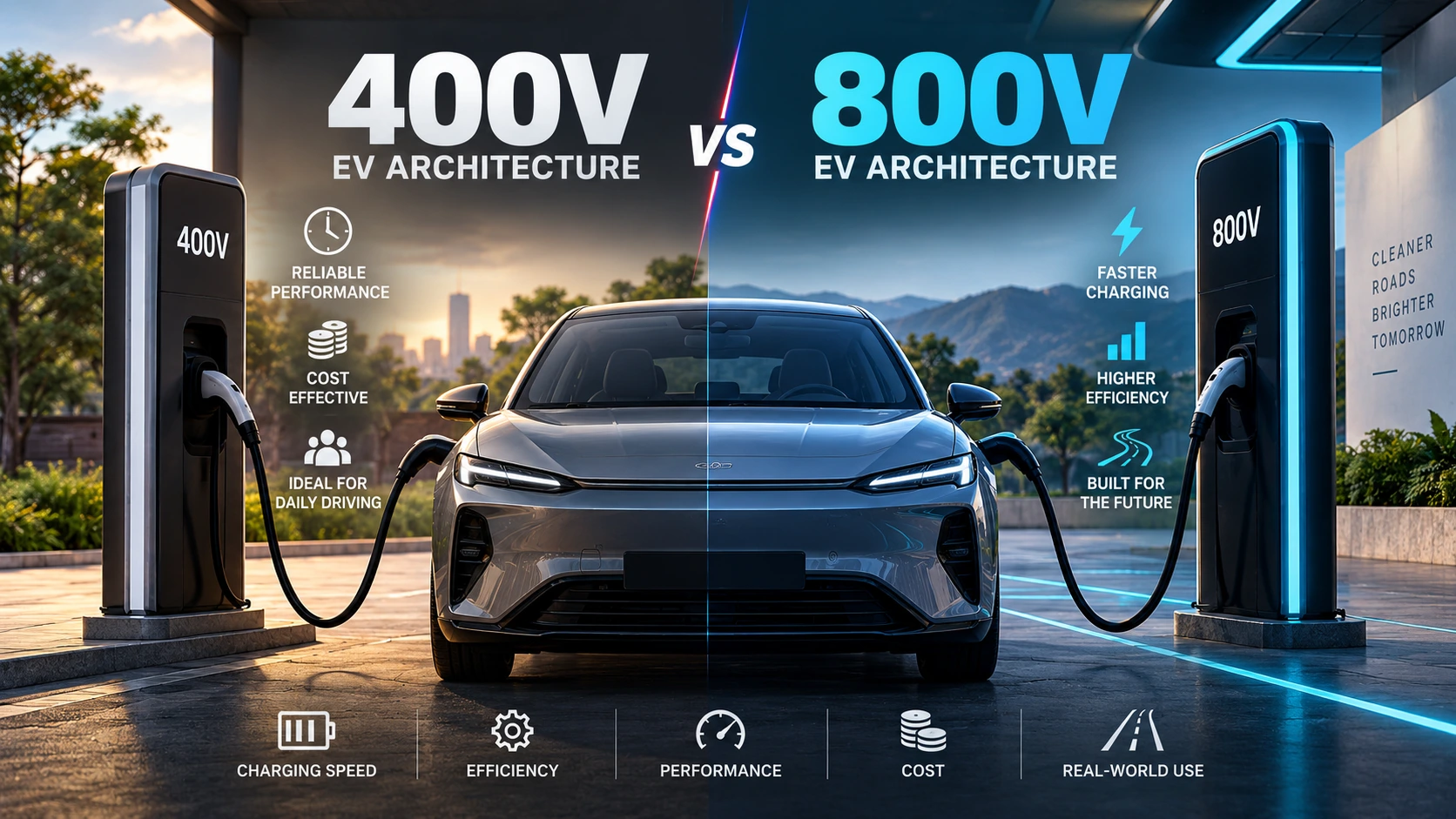
Electric vehicles have moved far beyond the question of how many kilometres they can travel on a charge. As EV batteries become larger and electric motors become more powerful, another part of the equation is becoming increasingly important: how efficiently the vehicle can move large amounts of electrical power through its high-voltage system.
That is where the debate around 400V vs 800V EV architecture comes in.
For years, 400V-class electrical systems have been the mainstream solution for battery-electric vehicles. They offer a mature balance between cost, performance and engineering complexity. But newer EV platforms are increasingly adopting 800V architectures, particularly where ultra-fast charging and high power delivery are priorities.
The attraction of 800V is not simply that the number is twice as large. At a given power level, a higher voltage allows the system to operate at lower current. That can reduce electrical losses and heat and makes very high charging power easier to engineer.
But does that mean every EV should move to 800V?
Not necessarily.
The real difference between 400V and 800V becomes clear when we look at charging power, current, efficiency, thermal management, cost and the type of driving an EV is designed to handle.
What Is an EV High-Voltage Architecture?
An EV’s high-voltage architecture is the electrical system responsible for moving energy between the battery, electric motors, inverter, charging hardware and other high-voltage components.
The battery pack supplies electrical energy to the power electronics, which then control how that energy reaches the electric motor. During charging, the process is reversed as electrical energy is transferred into the battery.
When an automaker describes an EV as a 400V or 800V vehicle, it is referring to the approximate voltage class around which its high-voltage system is designed.
The actual voltage is not permanently fixed at exactly 400V or 800V. Battery state of charge, operating conditions and system design can cause the voltage to vary.
The important point is that 400V and 800V describe different electrical architectures rather than different battery capacities.
A 100kWh battery, for example, can theoretically be engineered around a different voltage architecture. What changes is how the battery’s stored energy is delivered through the vehicle’s electrical system.
Read More: 800V EV Architecture vs 400V
400V EV Architecture: The Established Standard
The 400V EV architecture has become one of the industry’s most established solutions.
It provides enough electrical power for everyday passenger EVs while keeping the cost and complexity of the high-voltage system under control. Battery packs, inverters, cables, connectors and charging systems have all been developed around this voltage class for years.
For a driver who mostly charges at home, commutes relatively short distances and doesn’t frequently rely on ultra-fast public DC charging, a well-engineered 400V EV can be more than adequate.
The limitation becomes more obvious when manufacturers want to push very high power through the system.
Electrical power can be expressed as:
Power = Voltage × Current
This means that if the desired power remains the same, increasing voltage allows the system to use less current.
That relationship is at the heart of the 400V-versus-800V debate.
800V EV Architecture: Why Higher Voltage Matters
An 800V EV architecture roughly doubles the nominal voltage of a 400V-class system.
That doesn’t automatically make the vehicle twice as powerful or twice as fast to charge. Instead, the higher voltage provides a way to deliver a given amount of power with substantially less current.
Consider a simplified example:
- 200kW at 400V = approximately 500A
- 200kW at 800V = approximately 250A
Real-world EV systems are more complicated than this simple calculation, but the principle remains important.
Lower current can reduce the electrical losses and heat generated in high-current components. That becomes increasingly useful when an EV is designed to accept very high DC charging power or deliver substantial electrical power to its motors.
Porsche’s electric Macan is a good production example. Its 800V architecture supports DC charging at up to 270kW, with a claimed 10–80% charging time of approximately 21 minutes under suitable conditions.
400V vs 800V EV Architecture: Key Differences
| Feature | 400V Architecture | 800V Architecture |
|---|---|---|
| Voltage class | Around 400V | Around 800V |
| Current required for same power | Higher | Lower |
| High-power charging potential | Strong | Very high |
| Electrical losses at the same power | Higher | Lower potential |
| Thermal load at high current | Higher | Lower potential |
| System cost | Generally lower | Generally higher |
| Engineering complexity | Mature | More demanding |
| Ultra-fast charging | Capable | Better suited |
| Home charging advantage | Already sufficient | Usually limited |
| Typical application | Mainstream EVs | Premium, performance and fast-charging EVs |
The crucial word here is potential.
An 800V EV isn’t automatically superior to every 400V EV. The battery, charging curve, charger, thermal-management system and power electronics still determine what the vehicle can actually achieve.
Why Can 800V EVs Charge Faster?
This is probably the biggest reason consumers hear about 800V architecture.
Charging power is measured in kilowatts. To deliver high charging power, an EV needs sufficient voltage and current.
Increasing voltage allows the vehicle to achieve high power without requiring the same extreme current that a lower-voltage architecture would need.
That becomes particularly valuable when charging stations are capable of delivering hundreds of kilowatts.
Porsche’s Macan demonstrates the difference particularly well. On suitable 800V infrastructure, it can accept up to 270kW and charge from 10–80% in approximately 21 minutes. At suitable 400V charging stations, Porsche specifies up to 135kW and approximately 33 minutes for the same 10–80% window.
This is a much better way to understand the difference than simply saying “800V charges twice as fast.”
It doesn’t.
The charging station, battery temperature, state of charge and vehicle charging curve all matter. Porsche specifically notes that these factors can influence charging performance.
The Physics Behind 800V: Less Current, Less Loss
The technical advantage of higher voltage becomes even more interesting when we look at electrical losses.
Resistance in a conductor creates heat as current passes through it. Resistive power loss is commonly expressed as:
P = I²R
The important part is the I².
If current is reduced, resistive losses can fall significantly.
That means an 800V architecture can make it easier to move large amounts of electrical power while keeping current under control. This can reduce heat in high-power cables, busbars and other components when compared with a lower-voltage system carrying the same power.
That doesn’t mean the entire vehicle suddenly becomes dramatically more efficient simply because it has an 800V badge.
Overall EV efficiency still depends on many factors, including:
- Battery chemistry
- Motor efficiency
- Inverter efficiency
- Aerodynamics
- Vehicle weight
- Tyres
- Thermal management
- Software
- Regenerative braking
The advantage of 800V is more specifically about efficiently handling high electrical power.
Does 800V Give an EV More Range?
Not directly.
This is an important distinction.
An 800V architecture does not automatically give an EV a longer driving range, nor does it mean an automaker can simply install a smaller battery and achieve the same range.
Range primarily depends on how much usable energy the battery stores and how efficiently the vehicle uses that energy.
However, higher-voltage architecture can contribute to overall powertrain efficiency by reducing electrical losses under certain operating conditions. It can also help engineers package a high-power electrical system more effectively.
So the correct way to look at it is:
800V architecture can support efficiency and high-power operation, but battery capacity and vehicle efficiency remain the primary determinants of range.
Read More: Emerging Battery Technologies: Exciting Solid-State & Lithium Alternatives
Smaller Cables and Lower Electrical Stress
One potential advantage of higher voltage is that the same power can be transmitted with lower current.
That can reduce the current-carrying requirements of high-voltage conductors.
In simple terms, if an engineer wants to deliver a particular amount of power, an 800V system doesn’t need the same current capacity as a 400V system.
That can create opportunities to reduce the size or weight of certain conductors and components, although the final design depends on the automaker’s requirements.
The result isn’t necessarily a dramatically lighter EV. Modern EVs contain many systems, and battery mass remains dominant.
The more important benefit is that high electrical power becomes easier to manage without continuously increasing current.
800V Isn’t Just About Charging
The benefits of a high-voltage architecture extend beyond the charging station.
An EV’s electric motors can demand significant electrical power during hard acceleration and sustained high-performance driving.
A higher-voltage system can provide that power with lower current compared with an equivalent lower-voltage system.
This makes 800V architecture particularly attractive for performance-oriented EVs.
Porsche’s electric Macan combines its 800V PPE architecture with high-output electric motors and up to 270kW DC charging capability.
Hyundai Motor Group’s E-GMP platform provides another example. The platform was designed around 800V high-speed charging while also supporting 400V charging, giving its dedicated EVs greater charging flexibility.
Can an 800V EV Use a 400V Charger?
Yes — and this is one of the most important developments in modern EV charging architecture.
An 800V vehicle doesn’t necessarily become useless when it encounters a 400V charging station.
Automakers can use different electrical strategies to make the vehicle compatible with lower-voltage infrastructure.
Porsche’s electric Macan provides a particularly clear example. At a 400V charging station, a high-voltage switch can effectively divide its 800V battery into two 400V sections. This allows the battery to charge without requiring an additional high-voltage booster, with charging power of up to 135kW under Porsche’s specified conditions.
Hyundai’s E-GMP takes a different approach, using its integrated charging system to support both 400V and 800V charging. Hyundai says the system can boost 400V input to the voltage required by the high-voltage battery using the vehicle’s motor and inverter.
This flexibility is critical because 800V EV adoption depends partly on the charging infrastructure available around the vehicle.
The Biggest Disadvantage of 800V EV Architecture
If 800V is so useful, why isn’t every EV using it?
The answer comes down largely to cost and complexity.
Higher-voltage systems require components that are designed and rated appropriately for the electrical environment. Power electronics, insulation, connectors, contactors and other high-voltage components must meet the relevant requirements.
Manufacturers also need sophisticated battery-management and thermal-management systems to make full use of the architecture.
Advanced semiconductor technologies can further improve power-electronics performance, but they also add engineering and manufacturing complexity.
For an affordable EV where the customer mainly charges at home, those additional costs may not provide enough benefit.
For a premium EV designed around rapid charging and high performance, the calculation is very different.
400V vs 800V: Which Is Better for Daily Driving?
For everyday driving, the difference may be smaller than the specifications suggest.
Imagine two EV owners.
The first drives 40–50km a day and plugs the car into a home wallbox every night. The vehicle spends hours charging while parked.
The second regularly drives hundreds of kilometres on highways and relies on public DC fast chargers to continue the journey.
The second driver has much more to gain from an 800V architecture.
The first driver may find that a good 400V EV provides everything they actually need.
That is why charging behaviour matters more than the voltage number alone.
400V vs 800V for Long-Distance EV Travel
Long-distance driving is where 800V architecture becomes particularly compelling.
A highway journey may require several charging stops, and reducing each stop can make a noticeable difference over an entire trip.
But the architecture is only part of the equation.
A high-voltage EV needs access to a high-power charging station to realize its full potential. If the charger is limited to a much lower output, the vehicle cannot simply force more electricity through the connection.
This is why charging-network development and EV architecture need to progress together.
An 800V car paired with inadequate charging infrastructure cannot deliver the full experience its electrical system was designed to provide.
What 800V Means for Indian EV Buyers
For Indian EV buyers, the 400V-versus-800V question is becoming increasingly relevant as electric vehicles move into higher price segments and long-distance use becomes more common.
But the smartest approach is not to buy a vehicle simply because its specification sheet says 800V.
Instead, look at the complete charging package:
- Maximum DC charging power
- 10–80% charging time
- Charging curve
- Battery preconditioning
- Compatibility with 400V chargers
- Availability of high-power chargers on your routes
- Real-world range
- Battery size
- Thermal-management capability
A theoretically capable 800V EV may provide little practical advantage if the charging infrastructure you use cannot supply the required power.
Conversely, a well-engineered 400V EV can still be an excellent choice if it has a strong charging curve and meets your daily requirements.
Is 800V the Future of EVs?
The direction of the industry suggests that 800V architecture will become increasingly important, particularly in premium, performance and long-distance EVs.
Porsche has already built production EVs around 800V systems, while Hyundai Motor Group incorporated 800V capability into its dedicated E-GMP platform. More manufacturers are following the same general direction as demand for faster charging and higher electrical power increases.
But that does not mean 400V architecture will suddenly disappear.
For affordable and mainstream EVs, 400V remains a sensible solution. It is mature, established and capable of providing excellent performance when paired with an appropriately engineered battery and charging system.
The future is therefore more likely to be a coexistence of architectures, with 800V increasingly used where its advantages justify the additional engineering cost.
FAQs
What is the difference between 400V and 800V EV architecture?
The main difference is the voltage class around which the vehicle’s high-voltage electrical system is designed. For the same electrical power, an 800V system can operate at roughly half the current of a 400V system, which can help reduce resistive losses and heat.
Does 800V mean an EV charges twice as fast?
No. Charging speed depends on the vehicle, charging station, battery temperature, state of charge, charging curve and other factors. An 800V architecture makes high charging power easier to achieve, but it does not automatically double charging speed. Porsche’s Macan, for example, has different charging performance depending on whether it is connected to 800V or 400V infrastructure.
Is 800V more efficient than 400V?
An 800V system can reduce current for a given power level, which can reduce resistive electrical losses. However, overall vehicle efficiency depends on the entire powertrain and vehicle design, not voltage architecture alone.
Can an 800V EV charge at a 400V station?
Yes. Modern 800V EVs can be designed to support lower-voltage charging. Porsche’s electric Macan, for example, can use its high-voltage switch to divide the 800V battery into two 400V sections for charging at suitable 400V stations.
Is 800V better for long-distance EVs?
It can be. Drivers who frequently depend on high-power DC charging can benefit from the shorter charging stops that an appropriately engineered 800V EV can provide.
Are 400V EVs outdated?
No. 400V remains a mature and capable architecture and can make considerable sense for mainstream EVs, particularly when most charging happens at home.
Which EVs use 800V architecture?
Examples include the Porsche Taycan, Porsche Macan Electric and Hyundai Motor Group’s E-GMP-based EVs. Porsche’s Macan uses an 800V PPE architecture and supports up to 270kW DC charging under suitable conditions.
Ride And Tech Verdict
The 400V vs 800V EV architecture debate is not really about one technology replacing another overnight. It is about how automakers intend to handle the increasing electrical demands of modern electric vehicles.
400V remains a proven and cost-effective solution, and for many drivers it provides more than enough capability. But as EVs demand higher charging power, faster highway charging and greater electrical performance, the advantages of moving to higher voltage become increasingly difficult to ignore.
An 800V architecture allows manufacturers to deliver high electrical power with lower current, potentially reducing resistive losses and heat while making ultra-fast charging easier to engineer. Real-world examples such as the Porsche Macan demonstrate how an 800V system can combine very high DC charging capability with compatibility with 400V infrastructure.
The important lesson for EV buyers is simple: don’t judge an electric car by its voltage number alone. Look at the charging curve, real-world charging time, battery thermal management, charger compatibility and the infrastructure available where you drive.
For mainstream EVs, 400V still has plenty of life ahead.
For premium and performance EVs — and especially vehicles designed around frequent long-distance fast charging — 800V is increasingly looking like the architecture of the future.
Ride And Tech — Where Ride Meets Tech.
Drive Smarter. Ride Smarter.
Copyright (c) Ride And Tech. All rights reserved.

2 thoughts on “400V vs 800V EV Architecture: Key Differences, Charging Speed & Benefits”