



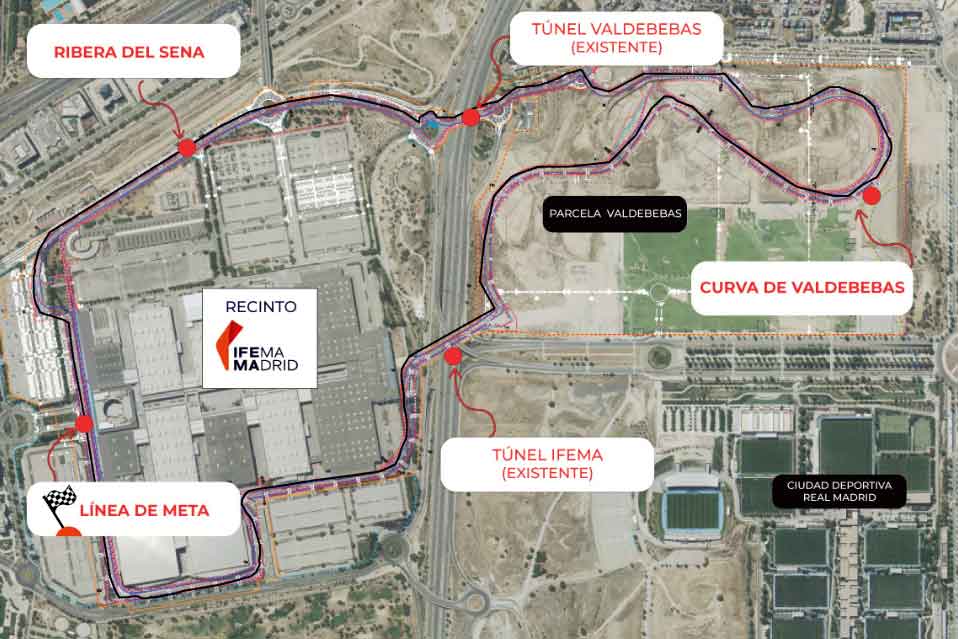
Formula 1 is heading into unfamiliar territory this weekend. The F1 Madrid 2026 chapter begins at the brand-new Madring circuit, a 5.416-kilometre venue built around Madrid’s IFEMA exhibition centre and Valdebebas, as the Spanish Grand Prix moves to the capital for the first time since F1 last raced near Madrid at Jarama in 1981.
For the drivers, this is not simply another race on the calendar. The Madring has never hosted a Formula 1 Grand Prix, meaning teams arrive with no previous race weekend data from the circuit and drivers have largely been relying on simulator preparation. That lack of knowledge makes the 2026 Spanish Grand Prix one of the more intriguing races of the season, particularly with championship leader Kimi Antonelli arriving in Madrid after a huge victory at Monza.
The circuit itself is the biggest reason for the uncertainty. It mixes public-road sections with purpose-built track, includes 22 corners and features one of the most unusual pieces of track design on the modern F1 calendar: a long, heavily banked Turn 12 known as La Monumental. Add a completely new asphalt surface, potentially unpredictable grip levels and a championship battle that is beginning to take shape, and F1 Madrid 2026 has all the ingredients for a genuine wild card.
F1 Madrid 2026 Marks a New Era for the Spanish Grand Prix
The arrival of the Madrid F1 circuit represents a significant change for the Spanish Grand Prix. Barcelona’s Circuit de Barcelona-Catalunya has been associated with the event for decades, but the 2026 calendar introduces a completely new setting in the Spanish capital.
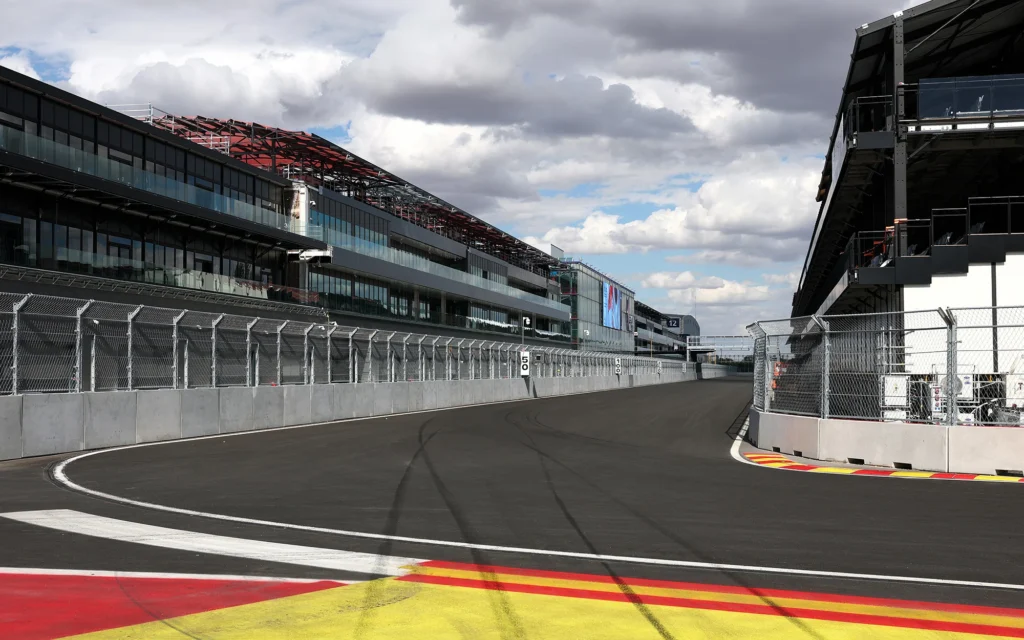
Madring is positioned close to Madrid’s IFEMA exhibition centre and combines sections built on public roads with permanent-track characteristics. Formula 1 describes it as a hybrid between a street circuit and a conventional racing venue, giving it a character that should be very different from the traditional Barcelona layout.
That distinction matters because modern Formula 1 teams normally arrive at established circuits with years of data covering tyre behaviour, setup direction, braking references and aerodynamic performance. None of that historical database exists at Madring. Every team will effectively begin the weekend by trying to understand the same fundamental questions.
How much grip will the new asphalt provide? How quickly will the racing line develop? Which corners will punish the tyres most severely? And perhaps most importantly, how much confidence can a driver build when there is no previous Grand Prix experience to fall back on?
Those questions make the opening practice sessions particularly important.
Read More: Ford’s New WEC Hypercar Takes Shape
The Madring Circuit Is Unlike Anything Else on the Calendar
The Madring circuit stretches for 5.416 kilometres and contains 22 corners, with the 2026 Spanish Grand Prix scheduled over 57 laps for a total race distance of 308.524 kilometres. Formula 1’s official circuit information describes a layout that combines public roads and private land around IFEMA Madrid and Valdebebas.
The first sector is expected to be relatively fast, while the middle section becomes more technical with medium- and low-speed corners. The final part of the lap contains several 90-degree turns, giving the track a very different rhythm from traditional flowing circuits such as Silverstone or Suzuka.
That mixture is one of Madring’s biggest strengths as a racing venue. Drivers will not be able to settle into one rhythm for an entire lap. They will have to move between high-speed commitment, heavy braking and technical precision while managing a surface that has never experienced a Formula 1 race before.
The result could be a circuit where confidence becomes just as important as outright car performance.
La Monumental Could Become the Star of F1 Madrid 2026
Every new Formula 1 circuit needs a signature corner, and Madring has one that is almost impossible to ignore.
Turn 12, La Monumental, is a sweeping 550-metre semi-circular section with banking of up to 24 percent. Formula 1 describes it as the longest banked corner on the current calendar, while Pirelli expects it to generate the highest vertical tyre load of the season.
The interesting part is not simply the banking. La Monumental arrives as part of a high-speed section and feeds into a slower corner, meaning the way drivers approach the banked section could influence what happens immediately afterward.
Carlos Sainz has previously suggested that cars could enter the corner at roughly 180–200 km/h and continue accelerating through it. Formula 1 has also highlighted the potential for slipstream effects and different lines through the banking, particularly because drivers may be able to position their cars at different heights through the turn.
That could make La Monumental more than a spectacular television shot.
If the corner genuinely allows drivers to remain committed while choosing different lines, it could influence overtaking opportunities into the following braking zone. At the same time, the outside wall and the speed of the section mean that even a small loss of confidence could become expensive.
For an F1 driver, that is exactly the sort of corner that separates a fast lap from a great one.
New Asphalt Could Make the First Weekend Extremely Difficult
One of the biggest unknowns at the Madring F1 circuit is not the layout. It is the surface.
The circuit has freshly laid asphalt with relatively low grip, and the surface has been treated with high-pressure water jets to remove dust and oily residues associated with new asphalt. That preparation is intended to make the surface more consistent, but it does not eliminate the fundamental challenge of racing on a brand-new track.
Pirelli has selected the C2, C3 and C4 compounds for the weekend, with the smooth surface expected to make tyre management a significant consideration. The tyre supplier also classifies Madrid among the more demanding circuits in terms of energy, with La Monumental producing particularly high vertical loads.
This creates an interesting technical contradiction.
A smooth surface can be relatively gentle in terms of abrasion, but lower grip can make it difficult for drivers to generate and maintain tyre temperature. If the track evolves rapidly as rubber is laid down, the balance between Friday practice and Sunday race conditions could also change substantially.
That means teams will have to be careful about drawing conclusions too early.
A setup that appears strong during the opening session may not necessarily remain the ideal configuration once the circuit gains rubber and grip.
Why No Team Has a Clear Madring Advantage Yet
Normally, Formula 1 teams can look back at previous races at a circuit to identify patterns. Mercedes might know exactly how its car behaved there twelve months earlier, Ferrari can compare setup choices from previous seasons, and engineers can use historical tyre data to narrow the operating window.
That advantage disappears at a completely new circuit.
Every team has simulations, driver-in-loop work and the information provided by the circuit and tyre supplier, but the real track remains the final test. This is particularly important because modern F1 cars are extremely sensitive to ride height, tyre temperature, aerodynamic balance and track characteristics.
Ferrari does have one small piece of additional experience. Charles Leclerc and Lewis Hamilton drove the circuit during a filming day in July, giving Ferrari some physical exposure to the layout before the Grand Prix. However, that experience is limited and does not replicate the demands of a full race weekend with qualifying, tyre allocation, fuel loads and competitive traffic.
In other words, Ferrari may know what the track feels like, but it does not possess a complete competitive database.
That distinction could become important.
Kimi Antonelli Arrives in Madrid as the Man to Beat
The timing of F1 Madrid 2026 could hardly be more interesting for Kimi Antonelli.
The Mercedes driver arrives in Spain as the championship leader after winning the Italian Grand Prix at Monza. He currently holds a 66-point advantage over Mercedes teammate George Russell, while Mercedes also leads Ferrari by 122 points in the constructors’ championship. Antonelli has already taken seven victories this season, including five consecutive wins according to Reuters’ latest pre-race statistics.
That makes Madrid a fascinating test of whether Mercedes can carry its recent momentum onto a completely different type of circuit.
Monza rewards low drag and straight-line efficiency. Madring is a much more complicated proposition, combining fast sections with slower technical corners, heavy braking zones and the unique demands of La Monumental.
A dominant Mercedes weekend therefore cannot simply be assumed from what happened in Italy.
That is precisely what makes this race interesting for the championship.
Can McLaren and Ferrari Disrupt Mercedes?
If there is one thing Mercedes will not want in Madrid, it is a new circuit allowing its closest rivals to reset the competitive order.
McLaren remains one of the obvious threats, with Lando Norris and Oscar Piastri both capable of challenging at the front. Ferrari also has the advantage of its limited filming-day running at Madring, even if that experience should not be exaggerated.
The circuit’s characteristics could make the competitive picture particularly difficult to predict. Formula 1’s official preview describes Madring as a very different challenge from Monza, while Reuters notes similarities to circuits such as Budapest and Zandvoort in terms of the potential demands on the cars.
That does not mean Mercedes, McLaren or Ferrari will automatically be strongest.
It means the usual assumptions are less reliable than they would be at a familiar venue.
And when the field is separated by small margins, even a slightly better understanding of tyre preparation or corner entry can translate into a meaningful advantage.
Carlos Sainz and Fernando Alonso Add a Home-Race Dimension
The Madrid Grand Prix also gives Spanish fans two major names to follow.
Carlos Sainz is a Madrid native and has already spoken positively about the new circuit, comparing its characteristics to places such as Baku and Jeddah. He is expected to be one of the focal points of the home crowd, particularly as Williams prepares to tackle a circuit where track knowledge is essentially being built from scratch by the entire field.
Fernando Alonso brings an entirely different kind of home-race significance. The two-time world champion remains one of Spain’s most recognisable motorsport figures, although expectations for his Aston Martin should remain realistic rather than being inflated simply because the race is taking place in Spain.
That is another reason the 2026 Spanish Grand Prix should be treated as a genuine sporting event rather than merely a promotional showcase.
For Sainz and Alonso, the home support will be enormous, but neither driver gets a shortcut around the physical and technical demands of the circuit.
The F1 Madrid Circuit Could Punish Mistakes
One of the most intriguing characteristics of Madring is how quickly a small error could become a major problem.
The circuit contains walls and relatively tight sections typical of a street circuit, while other portions feel more like a permanent racing facility. Drivers therefore need to balance aggression with precision.
That is especially relevant during qualifying.
At a new circuit, drivers will be searching for the final few tenths while simultaneously learning the exact braking points, kerb behaviour and track limits. A driver who pushes beyond the available grip may gain nothing and simply lose a lap through a mistake.
The same applies to setup.
Teams may be tempted to chase maximum performance during the early sessions, but with limited knowledge of the track’s evolution, finding a stable baseline could be more valuable than immediately searching for the ultimate qualifying setup.
This is where experienced drivers can become particularly valuable.
Read More: JSW Volkswagen Joint Venture
Tyres Could Decide More Than Expected
The tyre situation is another reason the Madring circuit could produce a difficult race for teams.
Pirelli’s C2, C3 and C4 selection gives the field a familiar three-compound spread, but the characteristics of the new asphalt remain a major variable. The smooth surface means grip generation and temperature management could become more important than outright degradation.
La Monumental adds another layer because of the vertical load generated by its banking and length. Pirelli says the corner will create the highest vertical load of the season, which puts unusual demands on the tyres even though the asphalt itself is new and relatively smooth.
That could create strategic differences between teams.
Some may prioritise qualifying performance and track position, while others may look for a setup that protects the tyres over a longer stint. If the track evolves significantly between Friday and Sunday, the best strategy could also change as the weekend progresses.
For fans, that uncertainty is exactly what a new circuit should bring.
What Makes F1 Madrid 2026 Different From a Normal New Race?
A new race is not automatically an unpredictable race. Some circuits quickly reveal their strengths and weaknesses once teams complete a few practice sessions.
Madring has a better chance of maintaining uncertainty because it combines several very different track characteristics in one lap.
There are fast sections, medium-speed corners, low-speed turns, steep gradients, heavy braking zones and the heavily banked La Monumental. The track also combines public-road sections with permanent facilities, creating a mixture of street-circuit and conventional-track behaviour.
That diversity makes the circuit harder to categorise.
It is not simply a Monaco-style street circuit. It is not simply a high-speed permanent venue. And it is not a conventional modern Grand Prix track built around long, sweeping corners.
Madring is trying to be something in between.
Whether that produces genuinely good racing will only become clear once Formula 1 gets through its first competitive weekend.
Madrid Is Getting a Major F1 Showcase
Beyond the racing itself, the arrival of Formula 1 represents a significant moment for Madrid.
The city has not hosted a World Championship Grand Prix since 1981, when Formula 1 raced at Jarama. Madring now brings the sport much closer to the centre of the capital, with the circuit positioned around IFEMA and close to Barajas airport.
Formula 1 has also highlighted the scale of the venue, with a large spectator capacity and substantial fan facilities around the track. La Monumental is expected to become one of the most recognisable visual features of the event, combining the racing spectacle with a large stadium-style atmosphere.
For Formula 1, this is another example of the sport’s continuing move toward major metropolitan destinations.
For Madrid, it is an opportunity to establish itself as a major motorsport destination.
For fans, however, the real test will happen once the lights go out.
The Biggest Question: Will the New Madring Deliver Good Racing?
A spectacular circuit does not automatically produce spectacular racing.
That is perhaps the biggest question hanging over F1 Madrid 2026.
The layout has several features that look promising on paper, particularly the fast sections leading into slower corners and the possibility of slipstream effects around La Monumental. But actual overtaking depends on much more than the shape of the circuit.
The cars must be able to follow one another closely, tyre performance must remain manageable and the braking zones need to create realistic opportunities for drivers to attack.
There is also the possibility that the new surface changes significantly during the weekend.
If grip improves rapidly and the racing line develops, the Sunday race could look very different from Friday practice. If overtaking proves difficult, however, qualifying position may become disproportionately important.
That is why the first few sessions will tell us almost as much about the circuit’s future as the race itself.
What Indian F1 Fans Should Watch This Weekend
For Indian viewers, the easiest way to enjoy the Spanish Grand Prix 2026 is to watch the weekend as a learning exercise rather than simply following the championship standings.
Keep an eye on how quickly the drivers become comfortable with Madring. Watch how much the lap times improve as rubber goes down. Pay attention to tyre temperatures and whether teams struggle more with generating grip or controlling degradation.
Most importantly, watch La Monumental.
If drivers can attack the 550-metre banked section confidently and use different lines without losing significant time, it could become one of the most interesting corners introduced to F1 in years. If the corner proves too easy at full throttle, its spectacle may outweigh its racing value.
The opening weekend will begin answering that question.
F1 Madrid 2026 Could Become a Defining New Venue
Formula 1 has increasingly moved toward spectacular new venues, but not every new circuit manages to create a genuine identity. Madring has at least been designed with that objective in mind.
Its 22-corner layout, hybrid street-and-permanent character and extraordinary La Monumental section give it a visual and technical identity before a single Grand Prix has been completed. The challenge now is proving that those features translate into good racing.
The timing could hardly be better.
Kimi Antonelli arrives with momentum and a substantial championship lead. Mercedes is leading the constructors’ standings, while McLaren and Ferrari have every reason to believe a completely new venue could provide an opportunity to reset the order. Sainz and Alonso will have the home crowd behind them, while every driver faces the same fundamental problem: nobody truly knows what Madring will feel like when an F1 car is being pushed to its limit in anger.
That is why F1 Madrid 2026 deserves attention.
This is not just the Spanish Grand Prix moving to another city. It is Formula 1 opening a completely new chapter in Madrid, with a circuit that could either become one of the sport’s most distinctive modern venues or reveal just how difficult it is to turn an ambitious design into great racing.
Either way, we are about to find out.
Frequently Asked Questions
When is the 2026 Spanish Grand Prix?
The 2026 Spanish Grand Prix takes place at the new Madring circuit in Madrid from September 11 to September 13, 2026, with Formula 1 practice, qualifying and the race scheduled across the weekend.
What is the Madring circuit?
The Madring circuit is Formula 1’s newest venue and is located around Madrid’s IFEMA exhibition centre and Valdebebas. It combines public-road sections with purpose-built track and features 22 corners over a lap of 5.416 kilometres.
How long is the Madrid F1 circuit?
The official F1 circuit length is 5.416 kilometres, with the Spanish Grand Prix scheduled for 57 laps and a total race distance of 308.524 kilometres.
What is La Monumental at the Madring?
La Monumental is Turn 12 of the Madring and is a roughly 550-metre-long, semi-circular banked corner with banking of up to 24 percent. It is expected to create some of the highest vertical tyre loads of the season.
Has Formula 1 raced in Madrid before?
Formula 1 last raced near Madrid at the Jarama circuit in 1981. The 2026 Spanish Grand Prix marks the return of Formula 1 racing to the Madrid area after 45 years.
Who is the championship leader heading into F1 Madrid 2026?
Mercedes’ Kimi Antonelli leads the 2026 Formula 1 drivers’ championship heading into the Madrid race. Reuters’ latest pre-race statistics put him 66 points ahead of teammate George Russell, following Antonelli’s victory at Monza.
Which tyres will Pirelli bring to the Spanish Grand Prix?
Pirelli has selected the C2 hard, C3 medium and C4 soft compounds for the debut Spanish Grand Prix at Madring. The smooth new surface and demanding La Monumental corner are expected to make tyre management an important part of the weekend.
Ride And Tech Verdict
F1 Madrid 2026 arrives with exactly the ingredient a new Grand Prix needs: uncertainty. Nobody has a genuine race-weekend reference for Madring, the surface is new, the track mixes very different types of corners and La Monumental introduces a banking configuration that Formula 1 has rarely seen at this scale.
That does not guarantee a classic race. The real measure of Madring will be whether drivers can follow each other closely, whether the tyres remain predictable and whether the circuit creates genuine opportunities to attack rather than simply spectacular television images. Those answers will only come once the cars complete their first competitive laps.
But as a motorsport story, Madrid has already cleared the first hurdle. F1 Madrid 2026 is not simply another stop on the calendar; it is the debut of a completely new racing environment at a crucial point in the championship. With Antonelli carrying momentum, Mercedes under pressure from Ferrari and McLaren, and Sainz and Alonso facing their home crowd, there is plenty at stake before the first lights go out.
For a sport built around extracting every last tenth from a known machine and known circuit, Madring offers something Formula 1 rarely gets anymore: a genuine blank sheet of asphalt.
Ride And Tech — Where Ride Meets Tech.
Drive Smarter. Ride Smarter.
Copyright (c) Ride And Tech. All rights reserved.
