

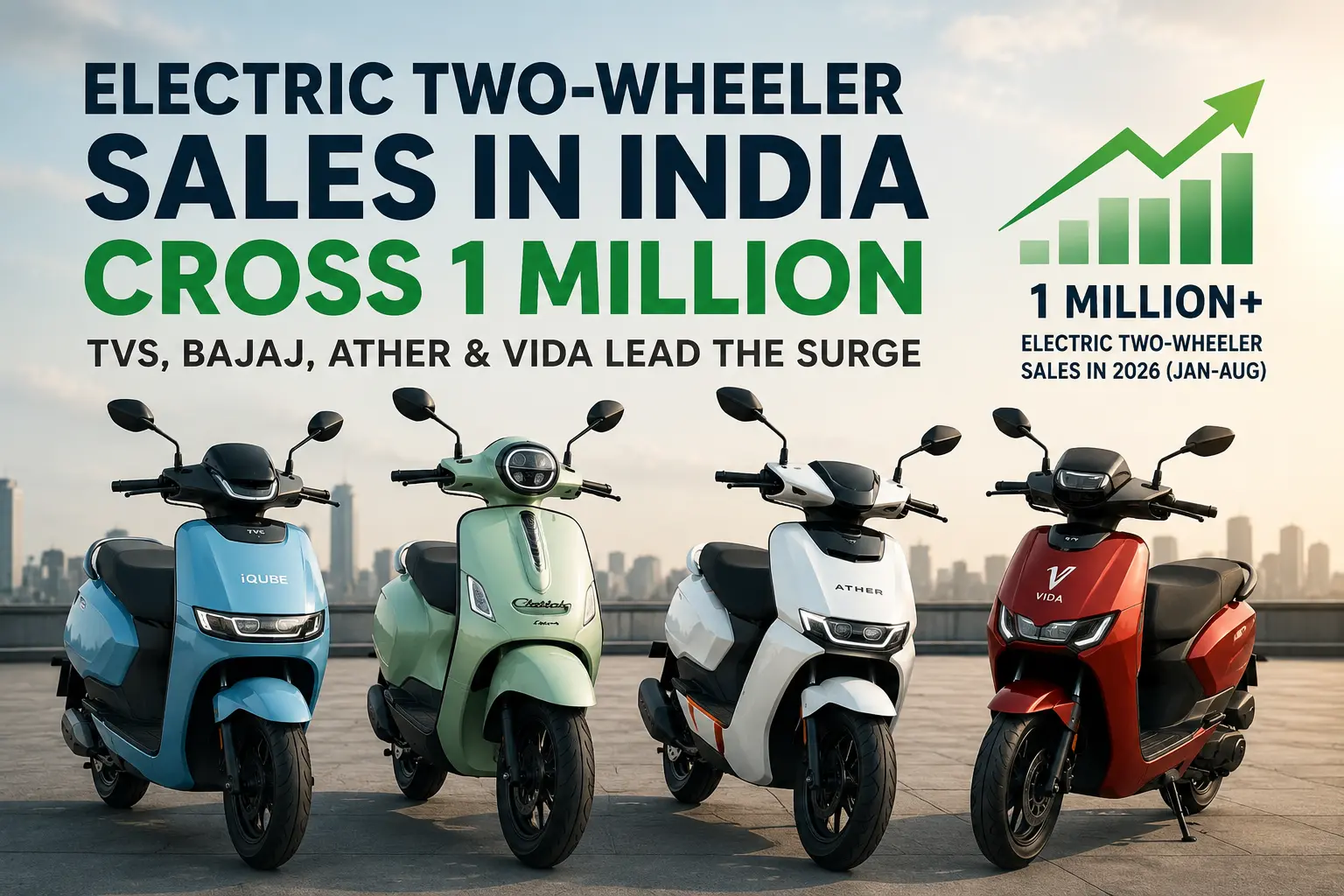
India’s electric two-wheeler market has hit another major milestone in 2026, and it has happened much earlier than expected. Electric two-wheeler sales in India reached around 1.36 million units between January and August 2026, with TVS Motor, Bajaj Auto, Ather Energy and Hero MotoCorp’s Vida accounting for 1,038,973 units between them.
That means four manufacturers now control roughly 76% of India’s electric two-wheeler market, while the overall segment is on course to cross the two-million-unit mark for the first time in a calendar year. The growth is particularly notable because the same four manufacturers had combined sales of 922,824 units across the entire 2025 calendar year.
Electric Two-Wheeler Sales in India Have Already Surpassed 1 Million
The scale of the 2026 growth is difficult to ignore. Between January and August, India recorded approximately 1.36 million electric two-wheeler retail sales, compared with 565,635 units for the same period in 2025.
That represents a substantial year-on-year increase for the segment. More importantly, TVS, Bajaj, Ather and Vida alone delivered more than 10.38 lakh electric two-wheelers during those eight months, putting their combined growth at around 84% year on year.
The four manufacturers have therefore already surpassed their combined full-year 2025 volume by 116,139 units, despite four months still remaining in 2026. This makes the current surge more than just a strong festive-season story; the market has been building momentum throughout the year.
August itself was slightly weaker than July. India’s electric two-wheeler retail sales stood at about 182,936 units, down around 11% from July’s record 205,629 units but still 67% higher than August 2025.
Read More: EV Localization Rules in India Take Effect
TVS Is Still the Electric Two-Wheeler Market Leader
TVS Motor remains the biggest name in India’s electric two-wheeler market. The company recorded 356,579 electric two-wheeler sales between January and August 2026, giving it around a 26% share of the overall 1.36-million-unit market. Its volume was up 77% compared with the same period last year.
TVS has achieved this largely through the iQube and Orbiter, giving the company a relatively focused EV portfolio while its traditional scooter range continues to provide scale in the internal-combustion market.
The iQube has become one of the most established electric scooters in India, while the Orbiter gives TVS another option lower down the price ladder. That combination appears to be working: TVS has already exceeded its entire 2025 electric two-wheeler sales figure of 315,082 units.
August also showed the strength of its EV business. TVS recorded 48,873 electric two-wheeler retail sales, up 91% year on year. Its July figure of 55,823 units remains the highest monthly number recorded by an EV manufacturer in India so far.
Bajaj Chetak Is Closing the Gap
Bajaj Auto is not far behind. The Chetak maker sold 305,226 electric scooters between January and August, up 69% year on year. That gives Bajaj approximately 22% of India’s electric two-wheeler market and places it firmly in second position.
The interesting part is how much ground Bajaj has covered with essentially one mainstream electric scooter family. The Chetak has continued expanding across variants and price points, helping Bajaj turn its electric scooter into a major volume product.
Bajaj crossed the 300,000-unit mark on August 31. It also recorded 41,019 electric scooter sales in August, a massive 235% increase over August 2025, although that comparison is affected by production-related constraints that limited last year’s volume.
For Bajaj, the next challenge is no longer proving that the Chetak can sell. It is maintaining that momentum as competition becomes increasingly aggressive.
Ather Is Growing Into a Major Volume Player
Ather Energy has also made a significant jump in 2026. The Bengaluru-based EV manufacturer recorded 229,099 electric scooter sales between January and August, an 83% year-on-year increase. That gives Ather around a 17% share of the overall electric two-wheeler market, up from 15% during the corresponding period last year.
The Rizta has played an important role in that growth by taking Ather into the family-scooter space, while the 450S, 450X and 450 Apex continue to target different parts of the performance and premium scooter market.
Ather has also expanded its reach with the new Konzarc, its most affordable model, giving the company another tool to compete for customers who may previously have considered mainstream electric scooters primarily on price.
August sales stood at 28,708 units, up 49% year on year. Although that was lower than July’s 30,636 units, the broader trajectory remains strong.
Vida Is the Fastest-Growing of the Top Four
Hero MotoCorp’s Vida has arguably delivered the most dramatic percentage growth among the four leading manufacturers. Vida sold 148,069 electric two-wheelers from January to August, representing a remarkable 151% year-on-year increase. Its market share has climbed to around 11%, compared with 7% in the same period last year.
The VX2 range has been central to this improvement. Vida has been using different battery and ownership approaches, including its Battery-as-a-Service (BaaS) option, to reduce the upfront cost of its electric scooters.
August sales reached 18,978 units, up 38% year on year, while July remains Vida’s strongest month so far at 22,989 units.
The numbers suggest that Hero’s EV strategy is beginning to find considerably more traction than it did during the earlier stages of India’s electric scooter transition.
Four Brands Now Control 76% of the Market
This is perhaps the most important part of the story. TVS, Bajaj, Ather and Vida have together captured approximately 76% of electric two-wheeler sales in India during January-August 2026. The same four manufacturers held around 66% during the corresponding period last year.
That means the market is becoming more concentrated around established manufacturers with strong products, dealer networks and manufacturing capacity.
The remaining roughly 24% is being shared by nearly 190 other manufacturers listed on the Vahan portal. Ola Electric, for example, recorded 94,307 units during the first eight months and ranked fifth, considerably behind the four market leaders.
For smaller EV companies, this could become an increasingly difficult environment. Customers are not only looking at range and price anymore. Brand confidence, service reach, financing, charging or battery solutions and long-term ownership support are becoming increasingly important when choosing an electric scooter.
Why Are Electric Two-Wheeler Sales Growing So Quickly?
There isn’t one reason behind the rise in electric two-wheeler sales in India. Instead, several factors are now working together. The biggest change is the wider choice of electric scooters. Buyers can now choose from commuter-focused models, family scooters, premium performance products and lower-cost options rather than being restricted to a small number of early EV products.
The latest numbers suggest that electric two-wheeler sales in India are no longer being driven only by early EV adopters, with mainstream buyers increasingly considering electric scooters for everyday commuting.
Pricing strategies are also evolving. Battery subscription or BaaS models can reduce the upfront purchase price, while manufacturers are offering more variants to cover different budgets.
Running costs remain another major attraction. For riders covering significant daily distances, the lower energy cost of an electric scooter compared with a petrol scooter can make the ownership equation increasingly compelling.
There is also a broader shift in consumer confidence. Electric scooters are no longer an unusual sight in major Indian cities, and the growing presence of TVS, Bajaj, Hero and Ather gives buyers more confidence that EV ownership is becoming mainstream.
The Two-Million Mark Is Now Within Reach
For electric two-wheeler sales in India, the next big milestone could arrive before the end of the year. India’s electric two-wheeler market had reached around 1.36 million units by the end of August, leaving roughly 839,000 units to reach two million. With the festive season still ahead, the industry is increasingly expected to cross the two-million mark during calendar 2026.
July already demonstrated that the market can exceed 200,000 electric two-wheelers in a single month. August fell back from that record but still remained comfortably above the corresponding month of 2025.
The festive period will therefore be crucial. Manufacturers are likely to push new variants, discounts, financing offers and wider availability as buyers enter the biggest purchasing period of the year.
If demand holds, electric two-wheeler sales in India could finish 2026 at a level that would have looked ambitious only a few years ago.
What This Means for India’s EV Market
The biggest takeaway is that electric two-wheelers are increasingly becoming the volume engine of India’s EV transition. Electric passenger cars receive much of the attention because of their technology and higher prices, but two-wheelers have a much larger addressable consumer base. For many Indian commuters, an electric scooter is a simpler switch because daily travel distances are predictable and charging requirements are relatively manageable.
The latest sales numbers also show that India’s EV market is moving beyond a start-up-only phase. Traditional manufacturers such as TVS, Bajaj and Hero now have a major role in the segment, while Ather continues to demonstrate that a specialist EV company can scale rapidly with the right products.
The battle ahead will therefore be less about whether electric scooters can sell and more about which manufacturers can maintain growth, improve profitability and build long-term customer loyalty.
Read More: Lexus NX Facelift Revealed
Electric Two-Wheeler Sales in India: What Happens Next?
The current numbers point towards another major year for India’s EV industry, but the market is not without challenges. Competition is intensifying, manufacturers need to maintain product quality and service networks, and smaller companies will have to find ways to compete against brands with considerably greater scale.
For TVS and Bajaj, the immediate task is defending their positions. Ather will want to close the gap with the two market leaders, while Vida’s rapid growth gives Hero an increasingly important role in the segment.
Meanwhile, the performance of the wider market will determine whether the two-million-unit milestone becomes a one-off achievement or the beginning of a much larger phase of EV adoption.
FAQ
How many electric two-wheelers were sold in India in 2026?
Around 1.36 million electric two-wheelers were sold in India between January and August 2026, according to Vahan-linked retail data reported by Autocar Professional.
Which company leads electric two-wheeler sales in India?
TVS Motor is currently India’s electric two-wheeler market leader. It recorded 356,579 electric two-wheeler retail sales between January and August 2026, ahead of Bajaj Auto.
Which are India’s top electric two-wheeler companies?
TVS Motor, Bajaj Auto, Ather Energy and Hero MotoCorp’s Vida are currently the four leading manufacturers by January-August 2026 retail sales. Together, they account for around 76% of the market.
Will India sell 2 million electric two-wheelers in 2026?
The market is on track to cross two million units for the first time in a calendar year. Around 1.36 million units had already been sold by the end of August, leaving approximately 839,000 units to reach the milestone.
Why are electric scooter sales growing in India?
The growth is being supported by a wider range of products, more competitive pricing, lower running costs, financing and battery-ownership options, improving consumer awareness and stronger manufacturer and dealer networks.
Ride And Tech Verdict
Electric two-wheeler sales in India have moved beyond the early-adopter phase. Crossing 1.36 million units in just eight months is a strong indication that electric scooters are becoming a mainstream part of India’s two-wheeler market.
The most interesting change, however, is who is driving that growth. TVS, Bajaj, Ather and Vida now dominate the segment, with each building a distinct position instead of relying on a single definition of what an electric scooter should be.
With the festive season still to come, 2026 could be the year India’s electric two-wheeler market finally breaks the two-million-unit barrier.
Ride And Tech — Where Ride Meets Tech.
Drive Smarter. Ride Smarter.
Copyright (c) Ride And Tech. All rights reserved.

1 thought on “Electric Two-Wheeler Sales in India Cross 1 Million: TVS, Bajaj, Ather and Vida Lead the Surge”