


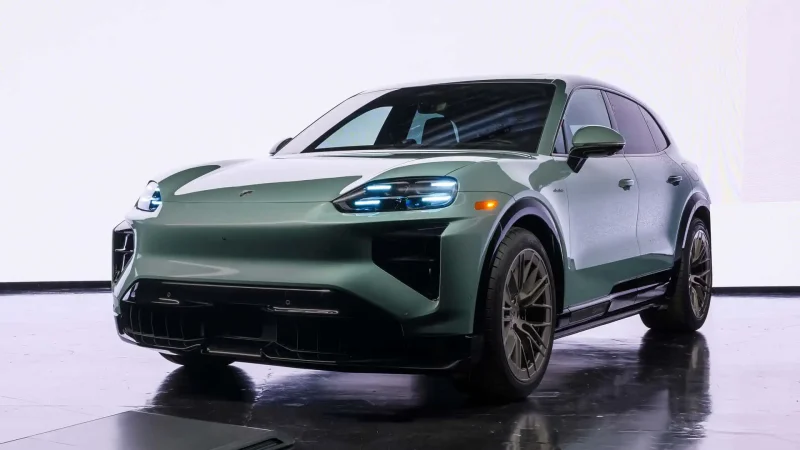
Porsche is preparing to bring its electric Cayenne properly into the Indian spotlight, with the Porsche Cayenne Electric India launch scheduled for September 30. The electric SUV has already been priced and is listed on Porsche India’s website, but the upcoming debut will give Indian customers a closer look at what is arguably the most technically ambitious version of the Cayenne yet.
And this isn’t just another luxury SUV getting an electric powertrain. The Cayenne Electric combines Porsche’s familiar performance brief with an 800V electrical architecture, a 113kWh battery and charging capability of up to 390kW. At the other end of the range, the Cayenne Turbo Electric produces a frankly absurd 1,156 PS with Launch Control.
For India, Porsche currently lists two versions: the Cayenne Electric from ₹1.7727 crore and the Cayenne Turbo Electric from ₹2.2751 crore, both including VAT and before options. The numbers are substantial, but so is the hardware underneath them.
The interesting question is whether Porsche can make an electric Cayenne feel like a proper Cayenne rather than simply a very fast luxury EV. On paper, it has the ingredients. Now the Indian debut gives us a closer look at how Porsche has put them together.
Read More: MG Hector Hawk Launch in India
Porsche Cayenne Electric Price and Performance
The Porsche Cayenne Electric price in India starts at ₹1.77 crore, while the range-topping Cayenne Turbo Electric is listed at ₹2.28 crore, both including VAT and before options. The standard Cayenne Electric produces up to 442 PS and 835 Nm, enough to take the SUV from 0–100 km/h in 4.8 seconds with Launch Control.
Then there’s the Turbo. With 1,156 PS and 1,500 Nm, it gets to 100 km/h in just 2.5 seconds and can reach 260 km/h. Those are supercar numbers wearing an SUV badge, and they give the electric Cayenne a rather different answer to the question of what a luxury electric SUV should be.
The standard Cayenne Electric is capped at 230 km/h, but outright speed isn’t really the point here. Porsche is trying to retain the Cayenne’s blend of performance and everyday usability while replacing the combustion engine with electric power. On paper, it has certainly brought enough firepower to make that argument interesting.
113kWh Battery and Up to 643km Range
The Porsche Cayenne Electric range is just as important as its performance numbers. The SUV uses a 113kWh high-voltage battery and Porsche quotes a WLTP range of 576–643km for the standard Cayenne Electric, depending on configuration. The Turbo Electric is rated for up to 623km.
That is a useful figure for a large luxury SUV, particularly when you consider what Porsche is asking the car to do. This isn’t a lightweight efficiency special; it is a heavy, all-wheel-drive performance SUV with the sort of acceleration that can make the range number disappear rather quickly if you keep exploiting it.
The 800V architecture also helps here, allowing Porsche to manage the battery’s thermal performance while delivering very high charging speeds. In other words, the Cayenne Electric isn’t relying on a giant battery alone to solve the long-distance problem. Range and charging speed are being treated as two sides of the same equation, which is probably the more important story for an SUV expected to cover serious distances.
390kW Charging Is the Real Technology Story
For all the attention the Porsche Cayenne Electric gets for its acceleration, the charging system may be the more important achievement. Its 800V architecture allows DC charging at up to 390kW, with Porsche quoting a 10–80 percent charge in around 16 minutes under the right conditions. The company also says up to 325km of WLTP range can be added in 10 minutes.
Of course, 390kW isn’t something you will get from every fast charger. The figure requires a suitably powerful 800V charging station, along with specific battery temperature and state-of-charge conditions. That’s an important caveat, particularly in India where charging infrastructure is still nowhere near as dense as it is in some mature EV markets.
Still, this is where the Cayenne Electric starts to feel like a Porsche rather than simply another large luxury EV. If you’re spending more than ₹1.7 crore on an electric SUV, you shouldn’t have to plan your life around charging stops. Porsche appears to understand that, and the Cayenne’s charging hardware is arguably just as important as its enormous power figures.
And that raises the question an enthusiast will actually care about: can a 2.5-tonne electric SUV really deliver the sort of driving involvement we expect from a Porsche, or is all that performance ultimately just straight-line theatre? That is where the Cayenne’s chassis and technology become particularly interesting.
Luxury, Technology and Everyday Usability
Porsche hasn’t treated the Cayenne Electric as a technology showcase that happens to have four seats. The cabin remains focused on the familiar mix of driver orientation, premium materials and digital technology expected from a Cayenne, while the electric version adds features such as Porsche’s digital cockpit, passenger display and available augmented-reality head-up display.
There is also plenty of attention paid to everyday usability. The Cayenne Electric retains the SUV practicality buyers expect, while Porsche has worked on features such as digital key functionality, connected services and advanced lighting systems. It means the car isn’t asking its owner to trade everyday convenience for electric performance.
But here’s the interesting bit: do buyers spending more than ₹1.7 crore really want their Cayenne to be sensible? Probably not entirely. They want it to swallow luggage and deal with the daily commute, but they also want something that feels special every time they press the accelerator. That’s where the Cayenne Electric’s combination of luxury, technology and outrageous performance starts to make sense.
Why the Porsche Cayenne Electric Matters in India
The Porsche Cayenne Electric India launch is significant because the Cayenne isn’t just another model in Porsche’s catalogue. It is one of the company’s most recognisable SUVs, and making it fully electric is a much bigger statement than simply adding another EV to the range. Porsche is effectively asking its SUV buyers to believe that going electric doesn’t mean giving up performance or the character expected from a Porsche.
That argument is particularly relevant in India, where the luxury EV market is growing but buyers still have plenty of reasons to hesitate. Charging infrastructure, long-distance travel and the sheer size and weight of large electric SUVs remain practical concerns. Porsche’s answer is to attack those concerns with a combination of substantial range and extremely fast charging rather than trying to make the Cayenne smaller or less ambitious.
And then there is the Turbo Electric. 1,156 PS in a Cayenne sounds slightly ridiculous — which is probably exactly the point. Porsche isn’t merely trying to make an efficient electric SUV; it wants the Cayenne Electric to demonstrate that electric power can make a performance SUV faster without stripping away its everyday usability. Whether that translates into the sort of driving experience enthusiasts expect from a Porsche will ultimately be decided behind the wheel, but the hardware certainly gives it a fighting chance.
Read More: Ather Konarc Launched at ₹99,999
Porsche Cayenne Electric: Key Takeaways
The Porsche Cayenne Electric arrives in India with a fairly simple proposition: enormous performance, serious range and charging technology that attempts to make a large luxury EV less compromised for long-distance use. With the standard version starting at ₹1.77 crore and the Turbo Electric reaching ₹2.28 crore, this is very much a premium proposition, but Porsche is also bringing some serious hardware to justify the numbers.
The standard Cayenne Electric offers up to 643km of WLTP range, while the Turbo Electric combines up to 623km of range with 1,156 PS and a 2.5-second 0–100 km/h time. Add 390kW charging and the picture becomes considerably more interesting than simply another electric SUV with a big battery.
The real question now is whether Indian buyers will see enough value in that combination to make the switch from Porsche’s petrol-powered SUVs. The Cayenne Electric certainly has the numbers to start the argument; the road will decide whether it wins it.
Frequently Asked Questions
When will the Porsche Cayenne Electric launch in India?
The Porsche Cayenne Electric India debut is scheduled for September 30, 2026. Porsche has already listed the electric Cayenne and Cayenne Turbo Electric on its Indian website.
What is the Porsche Cayenne Electric price in India?
The standard Cayenne Electric is priced from around ₹1.77 crore, while the Cayenne Turbo Electric is listed at around ₹2.28 crore, including VAT and before options.
How much range does the Porsche Cayenne Electric offer?
The standard Cayenne Electric has a claimed WLTP range of up to 643km, while the Turbo Electric can cover up to around 623km under the WLTP test cycle.
How powerful is the Porsche Cayenne Turbo Electric?
The Cayenne Turbo Electric produces up to 1,156 PS and 1,500 Nm, allowing it to accelerate from 0–100 km/h in just 2.5 seconds with Launch Control.
Can the Cayenne Electric really charge at 390kW?
Yes. Porsche quotes up to 390kW DC charging, with a claimed 10–80 percent charging time of around 16 minutes under suitable conditions. Actual charging speed will depend on the charger, battery temperature and other conditions.
Is the Porsche Cayenne Electric worth considering over a petrol Cayenne?
That’s ultimately going to depend on the buyer. The electric Cayenne offers extraordinary performance and potentially much quicker charging than many large EVs, but buyers who regularly travel long distances in areas with limited charging infrastructure may still find a petrol Cayenne easier to live with. For enthusiasts, the bigger question is whether Porsche has managed to preserve the Cayenne’s driving character while making the switch to electric power.
Ride And Tech Verdict
The Porsche Cayenne Electric is a fascinating step for Porsche because it doesn’t appear to be chasing the usual EV argument of simply being cleaner or cheaper to run. Instead, Porsche has gone in the opposite direction: huge power, serious range and extremely rapid charging, while keeping the Cayenne’s role as a luxury performance SUV intact.
The numbers are almost comical on the Turbo Electric — 1,156 PS, 1,500 Nm and 0–100 km/h in 2.5 seconds. But the more important achievement may be the combination of that performance with a claimed range of up to 643km in the standard Cayenne Electric and 390kW charging capability.
For Indian buyers, though, the usual EV questions remain. Charging infrastructure, real-world range and the enormous price tag will matter far more than another spectacular acceleration figure. At more than ₹1.7 crore before options, this is never going to be a rational purchase in the conventional sense.
But that’s missing the point. The Cayenne Electric isn’t trying to be rational transportation. It’s trying to prove that an electric SUV can still be desirable, ridiculously fast and genuinely usable. Whether Porsche has pulled that off completely will only become clear once we drive it, but on paper, the Cayenne Electric has certainly given enthusiasts something worth talking about.
Ride And Tech — Where Ride Meets Tech.
Drive Smarter. Ride Smarter.
Copyright (c) Ride And Tech. All rights reserved.

2 thoughts on “Porsche Cayenne Electric India Launch Set for September 30”